Evelyn Waugh an early explorer of the backrooms: “Perhaps, I thought, while her words still hung in the air between us like a wisp of tobacco smoke--a thought to fade and vanish like smoke without a trace--perhaps all our loves are merely hints and symbols; a hill of many invisible crests; doors that open as in a dream to reveal only a further stretch of carpet and another door; perhaps you and I are types and this sadness which sometimes falls between us springs from disappointment in our search, each straining through and beyond the other, snatching a glimpse now and then of the shadow which turns the corner always a pace or two ahead of us.” (Brideshead Revisited)
What does it mean for us to “go forth to him, outside the camp, bearing his reproach” (Heb 13)? One thing it certainly means is that we rush to bring our little ones along, crossing the same baptismal waters together with us in order to be with our king at any cost.
“But Ittai answered the king and said, ‘As Yahweh lives, and as my lord the king lives, surely in whatever place my lord the king shall be, whether in death or life, even there also your servant will be.’ So David said to Ittai, ‘Go, and cross over.’ Then Ittai the Gittite and all his men and all the little ones who were with him crossed over. And all the country wept with a loud voice, and all the people crossed over. The king himself also crossed over the Brook Kidron, and all the people crossed over toward the way of the wilderness.” (2 Sam. 15)
Jesus’s death in AD 30 is significant; this makes the period until AD 70 into a wilderness wandering. This was a time for incorporation of Gentiles into the church, and, crucially, a time for a generation of Israelites, but not their children, to perish. https://t.co/XM2ZJ6vmkY
Taken together, Jordan shows that the crucifixion could have been no later than AD 30, while this adjustment to Köstenberger’s argument shows that it could have been no earlier than AD 30. 6/6
“As @SolomonsaysN used to say, the world was going to be completely destroyed one Friday afternoon. Every single human being on it. And Jesus’ death rescued every single human being. But especially those who believe.” - Bill DeJong
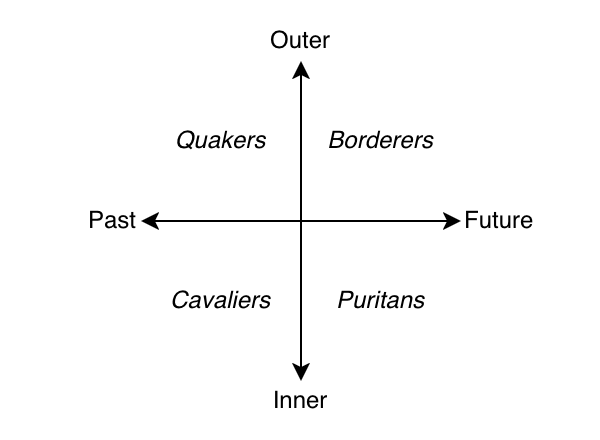
In political terms, these pieces were coupled in Merry England and it is a mistake to decouple them here. In ecclesial terms, there is a lot both to love and hate about the Puritans, for example. The Puritans needed the Cavaliers and the Cavaliers needed the Puritans. And we can even thank the Quakers for bringing us Mercersburg.
This gave me a laugh, but it’s insightful. I’ve been thinking about it a lot, especially since reading Albion’s Seed. It seems to me that it is important to allow yourself to be strung out on the cross of reality, no matter how painful it is. 1/3
Some intersections are contradictory, while others are complementary. In terms of ERH’s scheme, the inner/outer and past/future axes are all complementary. It is proper for individuals and subgroups to be oriented in specific directions (think of differentiation in marriage), but the long-term health of the organization as a whole depends on covering all the axes.
If you read Albion’s Seed asking the question “which is best,” then you have failed the test of gratitude. Here is an attempt to diagram this in terms of Albion’s Seed. Like anything connected to ERH, it is somewhat arbitrary; I stand more by the principle than the detail. 3/3
This is true both politically and ecclesially. If you are blessed to live at the intersection of Anglican and Presbyterian (and Lutheran too—CREC), then give thanks. If you are blessed to live at the intersection of Borderer and Cavalier (North Carolina), then give thanks. 2/3