Agentic Finance (AiFi) spans trading, payments, permissions, and more.
Excited to share the latest paper from Coinbase Institute, co-authored alongside @CKHctp, @MurrLincoln, and @smshr98, which explores the infrastructure that enables M2M payments.
Great chat with Mariel Laxamana at @PaymentsConsNet on the future of money movement: why stablecoins complement banks, why cross-border is the first real win, and the rise of agentic payments.
Looking forward to talking with central bankers at #CBPC2026 later this month.
This is 81 months of community bank deposits and USDC. See the co-movement on the left? See the lack of negative correlation on the right? (In fact a slight positive correlation.) This is not a picture of deposit flight to stablecoins. Both have grown over the last 7 years.
The @WSJopinion editorial page, having published a poorly reasoned editorial on the CLARITY Act, is doubling down. It calls the arguments from those of us in crypto “slippery,” while repeating the banking lobby’s claim that community banks “stand to lose most.”
But repetition isn’t evidence. Community bank deposits have grown throughout the USDC era, including while @coinbase has paid rewards. Charles River Associates looked specifically at USDC growth and found no evidence of community-bank deposit flight. And roughly 70% of dollar stablecoins are held outside the United States.
The Journal’s discussion of a supposed GENIUS “loophole” is even more revealing. It claims Congress tried - and failed - to close a loophole by allowing activity-based rewards under CLARITY.
That badly misunderstands what Congress was trying to do.
There was no accidental loophole to close. GENIUS created a regulated market for payment stablecoins precisely to encourage their adoption as a faster, cheaper and more competitive way to move money - to modernize America’s “slow and outdated payment rails,” as @SenatorHagerty put it.
CLARITY therefore draws a deliberate line: no passive, deposit-like yield simply for holding a stablecoin, while preserving incentives tied to actually using one. That isn’t a loophole. It’s an intentional policy choice to encourage adoption and competition.
The Journal also warns that stablecoins carry “bank risk.” This gets the issue almost exactly backwards. Stablecoins under the GENIUS Act are backed 1:1 by cash and highly liquid reserves that cannot be lent out through fractional-reserve banking. A stablecoin doesn’t take a dollar, lend most of it to someone else, and promise the original holder it remains available on demand. Banks do.
But the larger issue is the one the Journal avoids.
Blockchain technology is beginning to do for value what the internet did for information: allow it to move globally, instantly and cheaply over open networks. And just as nobody could predict everything built on TCP/IP, we cannot predict what programmable money and smart contracts will make possible.
What we do know is that open networks threaten the economics of intermediaries controlling the old rails, particularly the largest banks and payment providers that earn enormous revenues from payments, settlement and treasury services.
And here is the irony of invoking community banks to defend that status quo: community banks may be among the biggest beneficiaries of changing it.
Blockchain infrastructure can give smaller banks access to 24/7 settlement, cross-border payments and sophisticated treasury services without recreating the infrastructure of a megabank. Stablecoins could help level the technological playing field between community banks and their largest competitors.
So community banks are being used to defend a system whose economics have long favored the biggest banks.
That isn’t protecting competition. It’s protecting incumbency.
Which makes the Journal’s position so strange. Its traditional instinct would be to tell incumbents threatened by new technology to compete - not ask Congress to preserve their economic rents through regulation.
Yet here we are: the Wall Street Journal editorial page defending incumbent financial intermediaries from technological competition, with progressive senators holding up its editorial in support.
Politics does make strange bedfellows.
When technology makes an incumbent business model less necessary, we can use regulation to preserve the old economics - or allow competition and let consumers decide.
The @WSJopinion’s decision to side in favor of regulatory moats and against consumer choice are confounding and disappointing.
Three flavors of the U.S. dollar — all up and to the right.
(FRED, 2006 → 2026): Bank deposits: ≈$6.4T → $19.1T; Money market funds: ≈$2.3T → $8.2T; Stablecoins: $0 → ≈$317B (didn't even exist 10 yrs ago)
So what's happened since GENIUS was in the mix? In the last 12 months alone: Bank deposits: +≈$760B; MMFs: +≈$800B; Stablecoins: +50% YoY to ≈$317B
No displacement here — just room for all three to grow. The dollar is expanding across rails, not shifting from one to another.
Thanks, @stephengandel, for a very thoughtful take in @Reuters on why the US banks' stablecoin arguments don’t hold up.
One point worth underscoring: the $6.6T number from the bank industry’s TBAC study is actually the entire amount of ALL deposits in U.S. transactional bank accounts - it is not a serious deposit flight estimate. In fact, the same TBAC study projects the TOTAL amount of stablecoins in circulation as only reaching $2T by 2030.
Also, bank deposits are historically sticky and not yield-seeking, even within the legacy system. That’s why banks are able to pay virtually no interest to consumers. And most stablecoins are currently held overseas, where significant demand for GENIUS Act stablecoins is likely to come.
Bottom line: stablecoins are a powerful way to increase overall demand for the USD, modernize payments and give consumers choice, rather than a threat to banks.
There’s a significant (and growing) problem with global wealth creation. For decades, income growth from capital has dramatically outpaced that from labor, but capital ownership remains a privilege of the few. Roughly two-thirds of adults on earth are excluded from capital markets due to access barriers and frictions. Our new paper shows how tokenization could help billions of unbrokered savers turn a smartphone into a gateway to diversified, global ownership.
There’s a fundamental problem with global wealth creation:
- Capital markets overwhelming benefit the rich
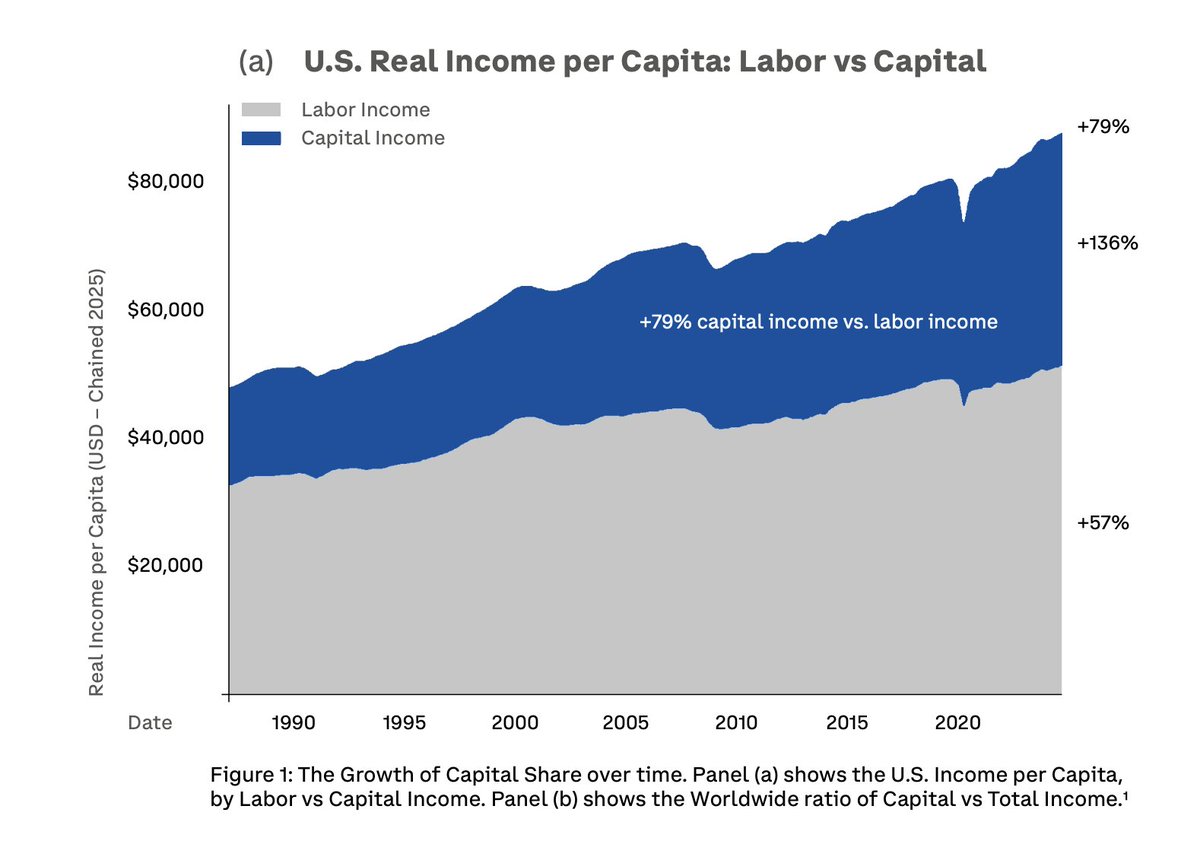
- Working income growth is massively outpaced by capital income
- Most people are unable to or priced out from participating in the best financial markets
Everyone should have the same opportunities. It shouldn’t be determined by where you're from or how much money you have.
The solution: tokenization, to unlock truly global markets for everyone.
There's a quiet crisis eroding the social contract: Over 40 years, capital income grew 136% while labor income lagged at just 57%. Meanwhile, ~4 billion adults worldwide have zero access to stocks, bonds, or real wealth-building tools. The divide isn't just rich vs poor—it's the brokered vs the unbrokered. The good news is that tokenization can bridge that divide.
@coinbase's new @CoinbaseCBI paper shows how. 1/
A young Iranian man who just crossed the border from Iran into Turkey records a message for the world
He says that people outside of Iran have no idea just how many protesters have been murdered by the Islamic regime
He says that they’re shooting at people’s chests all the time
Coinbase submitted a comment letter in support of @USComptroller Jonathan Gould and @FDICgov Chair Travis Hill's proposal to eliminate “reputational risk” once and for all from their agencies’ supervisory toolkit. During the Biden Administration, OCC and FDIC examiners used "reputational risk" as a supervisory hammer to pressure banks to drop crypto customers. This was at the core of Operation Chokepoint 2.0. Big thanks to Gould and Hill for taking action to ensure this sort of abuse doesn't happen again.
Today we submitted @coinbase's response to the @CFTC's request for information on the President's Working Group Report on Digital Assets.
Our letter contained the following key recommendations:
1) Allow customers to reap the benefits of vertical integration, while implementing tried-and-true measures to mitigate conflicts of interest
2) Establish a workable path for DeFi derivatives
3) Allow stablecoins as collateral to reduce risk and further enable 24/7 trading
The CFTC's principles-based framework is well-suited to embrace these innovations responsibly. Thank you Acting Chair @CarolineDPham for your leadership.
Let's make the U.S. the crypto derivatives capital of the world.🇺🇸
David Frum’s - @davidfrum - piece in @TheAtlantic raises alarms about stablecoins and the GENIUS Act, but he breezes by key facts about their safety, utility, and especially the robust safeguards that the legislation mandates. Stablecoins aren’t a fuse for crisis—they’re a breakthrough for faster, cheaper payments that strengthen U.S. dollar dominance. 🧵 1/9
The banking associations are arguing that merchant rewards tied to stablecoin payments are “indirect interest” should be banned. Two problems with this argument: (1) Congress was clear that the GENIUS Act only prohibits interest/yield paid by the issuer, and nothing else; and (2) if the ban is expanded to third party benefits then the implications of this are unprecedented, far-reaching and unpredictacle. The @CoinbaseCBI has a great new paper that explains why.
Critics are out again–this time claiming stablecoins threaten financial stability. A few key points they are overlooking:
- Full-reserve backing makes stablecoins safer than banking
- Secondary market deviations are not depegs
- Flexible capital requirements can deal with asset quality variations
- Broader adoption actually reinforces stability
The GENIUS Act gets this right by adding the clarity and guardrails to bring stablecoin payments mainstream. The latest @CoinbaseCBI Insights paper breaks it all down. 1/2
The "stablecoins will destroy bank lending" narrative ignores reality. U.S. banks are sitting on trillions in reserves—they have plenty of liquidity. Meanwhile, most stablecoin demand comes from outside the U.S., expanding dollar dominance globally, not competing with your local bank. 1/3
Stablecoins take center stage in @GroupofThirty's recent report, but comparing them to the chaotic, pre-Civil War “free banking” economy misses the mark. The G30 represents much of the world's financial establishment - yet it's striking how much they get wrong. Read our blog to see what they're missing, and why stablecoins are the future of payments. 1/4