@RedbellyNetwork The other day, when I tried to bridge 201 USDT on Reddex, I got an error and my funds disappeared. I noticed that Router Protocol announced it would shut down Router Nitro and its app by September 30, 2026, and Router Nitro’s site is no longer accessible for me.
@VincentGramoli@RedbellyNetwork@VincentGramoli
The other day, when I tried to bridge 201 USDT on Reddex, I got an error and my funds disappeared. I noticed that Router Protocol announced it would shut down Router Nitro and its app by September 30, 2026, and Router Nitro’s site is no longer accessible for me.
@reddex_io The other day, when I tried to bridge 201 USDT on Reddex, I got an error and my funds disappeared. I noticed that Router Protocol announced it would shut down Router Nitro and its app by September 30, 2026, and Router Nitro’s site is no longer accessible for me.
@tbass_aus The other day, when I tried to bridge 201 USDT on Reddex, I got an error and my funds disappeared. I noticed that Router Protocol announced it would shut down Router Nitro and its app by September 30, 2026, and Router Nitro’s site is no longer accessible for me.
@VincentGramoli The other day, when I tried to bridge 201 USDT on Reddex, I got an error and my funds disappeared.
I noticed that Router Protocol announced it would shut down Router Nitro and its app by September 30, 2026, and Router Nitro’s site is no longer accessible for me.
While Anthropic has had some disagreements with the Pentagon (the Department of Defense), it has demonstrated a cooperative stance on matters related to national security.
Not enough attention is being paid to the fact that the NSA will have unimpeded access to every corporate and government system on earth for the next 12-24 months as a function of its exclusive access to unconstrained Mythos+ models.
The gap between open source and closed is about to widen substantially as national security will be cited as an excuse for anti-distillation and whitelisting.
Past M2 growth fueled crypto rallies via additional liquidity from Japan's carry trades. Even as global M2 rises now, that extra engine has slowed—meaning effective liquidity likely isn't reaching crypto sufficiently.
Total Global Liquidity is rising
Global M2 is rising
US Total Liquidity is rising
US M2 is rising
China Total Liquidity is rising
ISM is rising
Try not to over think it.
Today, Israel carried out airstrikes against the "China-Iran Railway"—marking the first direct attack on the core interests of China's Belt and Road Initiative.
This railway, which opened on June 3, 2025, was constructed with 40 billion RMB funding by China. It was designed to allow Iranian oil to bypass the Strait of Hormuz and the Strait of Malacca, traveling directly to China—thereby saving 20 days in transit time—and serves as a strategic corridor intended to "break through 13 years of U.S. sanctions."
JUST IN: Iran’s new supreme leader apparently approved the ceasefire from a hospital bed in Qom where US-Israeli intelligence says he is unconscious and unable to participate in any decision-making. Few hours later, IRGC cluster warheads were still detonating over Israeli and gulf cities. Not many in the Western press have connected these two facts, and the connection rewrites everything the market just priced.
The system that accepted the ceasefire and the system that violated it are not the same system. That is the point of Mosaic Defence.
Twenty years ago, the IRGC restructured itself into 31 independent provincial commands, each with its own missile arsenal, drone fleet, Basij militia integration, and pre-delegated launch authority. The doctrine was designed for exactly this scenario: supreme leader incapacitated, central communications degraded, conventional military infrastructure destroyed. Every provincial commander can execute offensive operations without a phone call to Tehran. The architecture was tested in war games, refined after watching Saddam’s centralised command collapse in 48 hours in 2003, and activated the moment Ali Khamenei was killed on February 28th.
The senior IRGC military council that approved the ceasefire through the Supreme National Security Council, citing Mojtaba’s name for domestic legitimacy, does not control the launch decisions of every provincial unit. It cannot. That is by design. The field commanders who fired at Israel and the UAE after the announcement were not violating orders. They were following standing pre-delegated authority that exists precisely so that operations continue when the centre cannot communicate, or chooses not to. The ceasefire was a political act by the council in Tehran. The missile launches were a military act by autonomous field units in the provinces. Both happened simultaneously because the architecture permits it.
This is what the market failed to price when WTI crashed nine percent.
The nine percent drop assumed a unified Iranian state that accepted a ceasefire and would enforce it across all domains. What exists instead is a fragmented command structure where political leadership in Tehran can sign agreements that provincial military commanders are neither required nor expected to follow in real time. The Mosaic Defence that kept the regime alive through 39 days of the most intense bombing campaign since 2003 is the same architecture that makes ceasefire enforcement structurally unreliable.
Israel understood this immediately. The IDF did not pause. It continued eliminating Hezbollah fighters in southern Lebanon, struck a weapons crossing south of the Litani River, and cited Iranian violations as justification for ongoing raids on Iranian targets. Netanyahu’s calculus is transparent: if the adversary’s own military architecture cannot enforce a ceasefire, then the ceasefire does not constrain the defender.
The molecule thesis absorbs this development without modification. If the ceasefire holds, the crackers are still rubble and reconstruction takes years. If the ceasefire fragments because autonomous IRGC units continue launching, the war resumes and the deficit deepens. Both branches produce the same terminal condition for petrochemical supply. The human-chain game theory from yesterday and the Mosaic Defence autonomy from tonight converge on the same conclusion: the crisis duration is structurally guaranteed by the adversary’s own defensive architecture, regardless of what any council signs in Tehran or any diplomat negotiates in Islamabad.
The supreme leader is unconscious. The missiles are not.
https://t.co/0fIdGsM5qH
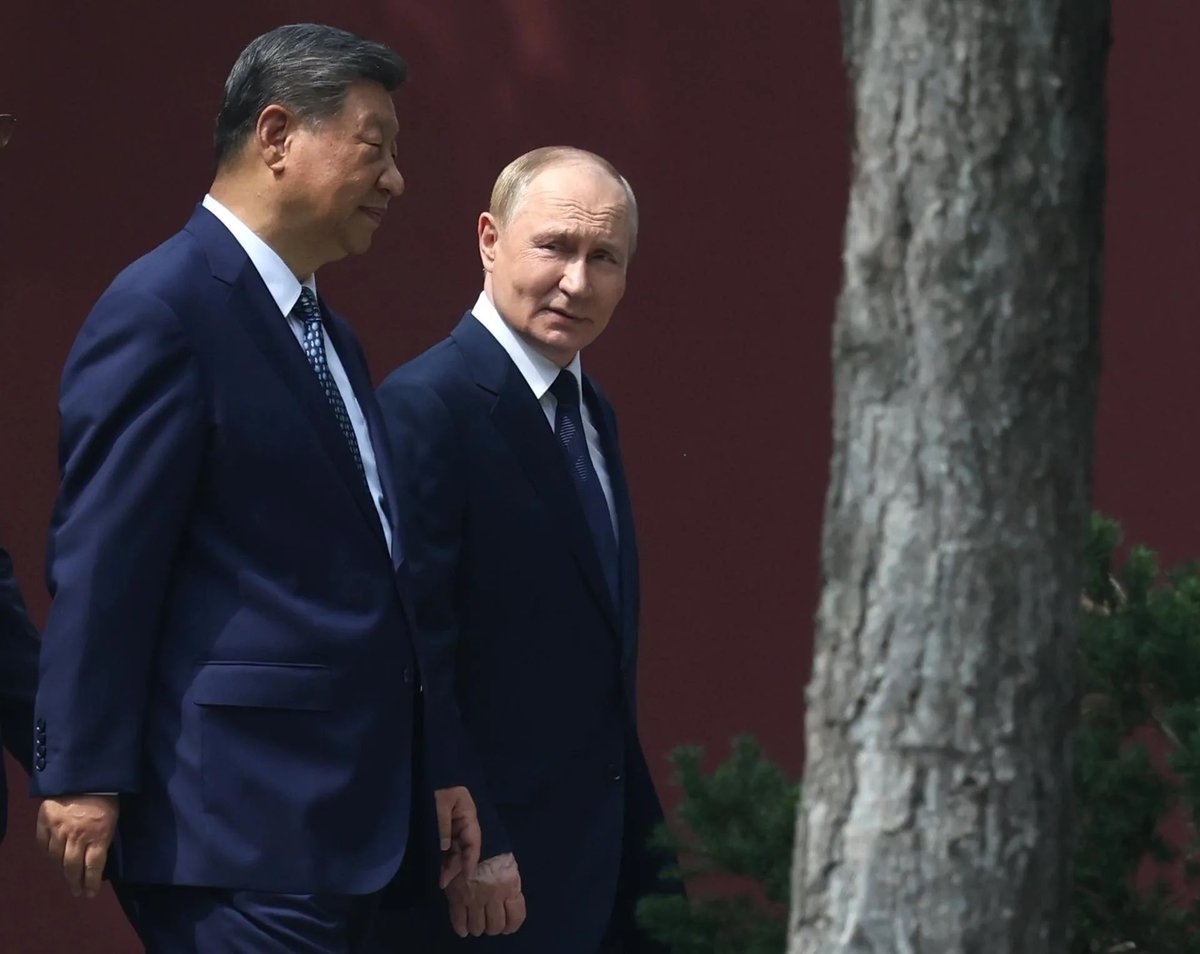
What we learnt tonight is the IRGC can tolerate multiple layers of its ranks getting obliterated but can’t tolerate losing support from China who is its primary supplier for everything that makes the economy run.
That in-turn implies that the real pressure point for the IRGC is its economic infrastructure and destroying it would be an existential threat for the regime.
The logical conclusion is that the IRGC’s internal calculus for its ability to survive an escalation by Trump where he embargo’s trade between Iran-China is far more pessimistic than the prevailing narrative implies.
In other words regime change is closer to a coin flip if Trump escalates.
If we oversimplify it as being “just for the elderly,” it becomes harder to see the real cost drivers (structural issues on the healthcare provider side and incentives for over-treatment).
JUST IN: While the world watched the bombs fall on Isfahan and the bridges burn in Karaj and the generals get fired in Washington, three supertankers quietly slipped out of the Persian Gulf without paying a single dollar to the IRGC.
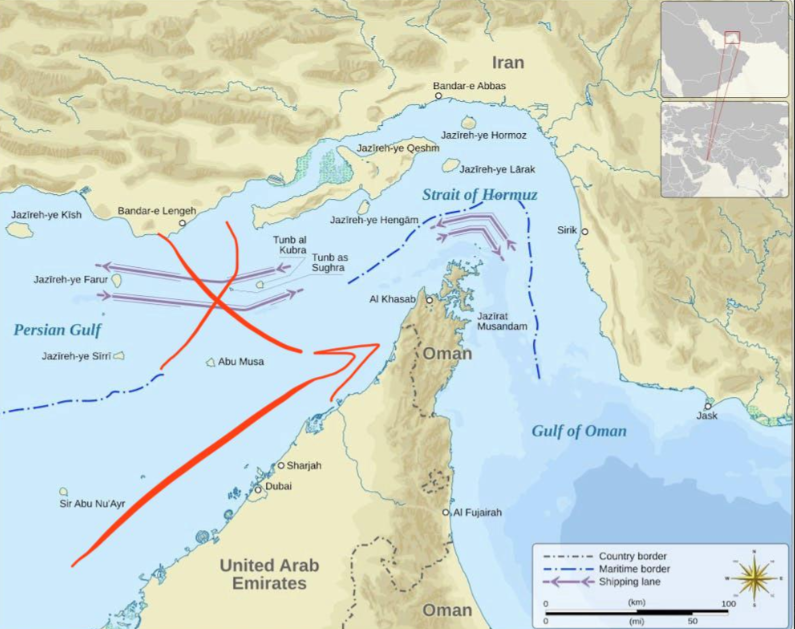
On April 2, satellite imagery and AIS tracking confirmed that the DHALKUT, carrying two million barrels of Saudi crude, the HABRUT, carrying two million barrels of UAE crude, and the SOHAR LNG, carrying Emirati liquefied natural gas, exited the Gulf by hugging the northern coastline of Oman’s Musandam governorate, sailing through Omani territorial waters and completely bypassing Iran’s Larak-Qeshm checkpoint. No toll paid. No clearance code requested. No yuan transaction. No permission sought from the military that spent five weeks building the most sophisticated chokepoint regime in modern maritime history. Four million barrels of crude and a cargo of LNG simply left.
In the entire month of March, 84 tankers exited the Strait of Hormuz. Eighty-four. The pre-war baseline was 75 to 85 per day. The monthly total collapsed to what used to move in a single day. And then on April 2, three insured, sanctions-compliant supertankers demonstrated that the geography Iran claims to control has a door that Iran did not lock.
The Musandam Peninsula is Omani territory jutting into the Strait like a hook. Ships hugging its northern coast can transit through Omani waters without entering the Iranian-controlled lanes where the IRGC operates its checkpoint. The route is narrower and slower. But it is Omani. And Oman, which has maintained relations with Tehran through every crisis since 1979 and mediated every significant backchannel for four decades, appears to have facilitated the passage. Iran either tolerated it or could not prevent it. Either answer erodes the tollbooth.
The implications are structural. If three vessels passed on April 2 and were not attacked, the insurance market notices. If the insurance market notices, the war-risk premiums that have kept vessels anchored begin to recalculate. If premiums fall on the Musandam route, more captains will choose it. If more captains choose it, the IRGC’s chokepoint leverage, the leverage that shut down Sadara’s $20 billion Jubail complex and stranded 3,000 ships and triggered the fertiliser crisis and kept the helium boiling, begins to leak. Not through diplomacy. Not through military force. Through a coastline.
But three vessels is not a reopening. It is a proof of concept. The Fujairah pipeline that provides the UAE’s primary bypass was hit by Iranian drones in mid-March. Storage tanks burned. Pumping stations along the 380-kilometre corridor were struck. Loadings resumed at nearly 1.9 million barrels per day by late March, but the vulnerability was demonstrated. Saudi Arabia has maxed out the East-West Petroline to Yanbu at 7 million barrels per day. Combined bypass capacity covers less than 30 percent of the 20 million barrels per day that normally transit Hormuz.
Three tankers through Musandam. A pipeline running at surge. A Saudi artery at maximum. Together they form the skeleton of a workaround. Not a solution. A workaround. And a workaround built on Omani neutrality, damaged terminals, and a pipeline that has already been hit by the country it was designed to bypass.
The toll booth is leaking. The molecule found a crack. Whether the crack widens or closes depends on what happens in the next six days.
https://t.co/dAOBBMsgDS
Source: @TankerTrackers
The deployment of these low-cost Ukrainian interceptor drones is a game-changer that fundamentally undermines Iran’s “cheap and numerous” attack doctrine.
BREAKING: Three things happened within hours on March 28 that nobody has connected.
First. Iran’s IRGC claimed it destroyed a Ukrainian anti-drone system depot in the UAE. Ukraine’s foreign ministry immediately denied it: “This is a lie. We officially refute this information. The Iranian regime frequently carries out such disinformation campaigns.” Whether the strike occurred or not, the claim itself is the signal. Iran is publicly declaring that Ukrainian drone defence expertise in the Gulf is now a military target.
Second. Israel confirmed the killing of Ali Shoeib, a veteran Al-Manar television correspondent in southern Lebanon. The IDF stated he was an operative in the intelligence unit of Hezbollah’s elite Radwan Force who “served as a terrorist under the guise of a journalist” while “consistently working to expose the locations of IDF troops.” He was broadcasting live from southern Lebanon three hours before the strike killed him per Times of Israel and Ynet.
Third. Zelensky landed in Qatar and the UAE on the same day, signing defence cooperation agreements offering the same FPV interceptor technology that Iran’s IRGC just publicly threatened to destroy.
Connect the three events and the architecture becomes visible.
Iran’s proxy war is being dismantled simultaneously on two fronts by two countries that are not formally allied with each other. Israel is eliminating the intelligence layer in Lebanon. Ukraine is building the counter-drone layer across the Gulf. Both are targeting the same Iranian network from different angles. The Radwan Force that Shoeib served coordinates with Iranian Shahed drones in Lebanon. The same Shahed variant is attacking Ras Laffan in Qatar and military infrastructure in the UAE. The same Shahed is being countered by the Ukrainian FPV teams whose depot Iran claims to have destroyed in Dubai.
One weapon. One network. Two countries dismantling it from opposite ends without a formal alliance between them.
The Radwan Force that Shoeib embedded with is not a standalone militia. It is an IRGC-trained special operations brigade of 2,500 to 5,000 fighters with reconnaissance, intelligence, anti-tank, engineering, and assault subunits per Carnegie and Atlantic Council analyses. IDF strikes have killed over 200 Radwan operatives and multiple commanders in recent weeks per Times of Israel. The intelligence subunit Shoeib served used journalist credentials to map Israeli positions for the same targeting network that feeds Shahed launch coordinates.
Shoeib was broadcasting live three hours before the strike. His camera was the weapon. The coordinates embedded in his footage were the payload. Al-Manar was the delivery system. Iran’s proxy architecture does not distinguish between media and military because it was never designed to. The journalist, the drone, the toll booth, the legislation. In this war, the instrument of destruction is always disguised as something else.
And now Iran has announced, whether truthfully or as propaganda, that it considers Ukrainian counter-drone depots in the UAE to be legitimate military targets. This means Zelensky’s Gulf tour is not just a diplomatic exercise. It is an operational deployment into a theatre where Iran has publicly identified his teams as combatants. The $2,100 Sting interceptor is no longer an advisory export. It is a weapon Iran has acknowledged as a threat worth striking.
The invisible front runs from Jezzine to Dubai. From a journalist’s camera to a drone depot. From Radwan intelligence to FPV interceptors. Two countries. One network. Zero alliance. Maximum convergence.
Full analysis - https://t.co/32ixeQpN7N
But if Russia is liquidating physical gold so readily for rubles, wouldn't crypto be even more convenient? No storage, instant settlement, 24/7 liquidity. XRP looks like a solid choice for that.
BREAKING: Russia just sold physical gold from its central bank reserves for the first time in 25 years. And then Putin signed a decree banning the export of refined gold bars over 100 grams.
Selling gold while banning gold exports. That sounds contradictory until you understand the mechanism.
The Central Bank of Russia sold 300,000 troy ounces in January and 200,000 in February 2026 per CBR and MinFin data reported by bne IntelliNews. Total: 500,000 ounces, roughly 15 tonnes, worth approximately 3.5 trillion rubles. Reserves dropped to 74.3 million ounces, a four-year low.
Russia is not selling gold because it is desperate. Russia is selling gold because yuan is more useful than gold when you need rubles for a war budget, and converting yuan to rubles has become nearly impossible through the banking system.
Here is the part the market has not connected.
Russia receives enormous yuan inflows. Roughly 80 to 90 percent of Russia-China bilateral trade now settles in yuan or rubles per Carnegie and Trade Data Monitor. Russian banks hold over $60 billion in yuan assets. The yuan has replaced the dollar as Russia’s primary foreign currency. But yuan cannot pay Russian soldiers or fund domestic military procurement. That requires rubles.
On March 18, the Central Bank of Russia exhausted its RMB 5 billion yuan swap facility. Demand for this facility was zero a year ago. Overnight yuan borrowing rates on the Moscow Exchange spiked above 20 percent per the Moscow Times and Sovcombank data. Chinese banks have been tightening compliance on Russian transactions due to fear of US secondary sanctions, with processing delays reaching 18 days in some cases.
Russia is drowning in yuan it cannot spend domestically.
Gold solves this. The CBR sells physical gold bars on the domestic market. Buyers pay in rubles. The rubles go directly into the federal budget. No yuan conversion needed. No printing press inflation. No dependence on Chinese banking compliance. Gold at roughly $4,400 per ounce means Russia is monetizing its reserves at record prices, extracting maximum ruble value per ounce sold.
The May 1 export ban completes the logic. Deputy Finance Minister Moiseev stated the rationale explicitly: gold bars had become a tool for capital flight and shadow economy transactions, functioning as an illicit foreign exchange substitute. The ban on bars over 100 grams keeps the physical metal inside Russia while allowing the CBR to continue domestic sales for budget liquidity. Banks are exempt.
Now connect this to the broader architecture.
China tolerates Russia’s gold sales because they stabilize a partner whose fiscal collapse would disrupt China’s primary overland energy supply. Russia stabilized by gold sales remains a reliable supplier of discounted oil and gas settled in yuan. The trade loop stays intact. The ruble bridge stays funded. The de-dollarization testbed keeps running.
This is not “Russia dumping gold in panic.” This is a sovereign state operating a dual-currency regime where yuan handles trade and gold handles fiscal liquidity, because the banking infrastructure connecting the two currencies has been deliberately degraded by the same sanctions architecture that was supposed to isolate Russia from global markets.
The sanctions created the yuan dependency. The yuan dependency created the ruble liquidity gap. The liquidity gap created the gold sales. The gold sales fund the war. The war sustains the Hormuz crisis. The Hormuz crisis accelerates yuan settlement at the strait.
The snake is eating its own tail again.
Full analysis - https://t.co/32ixeQpfif
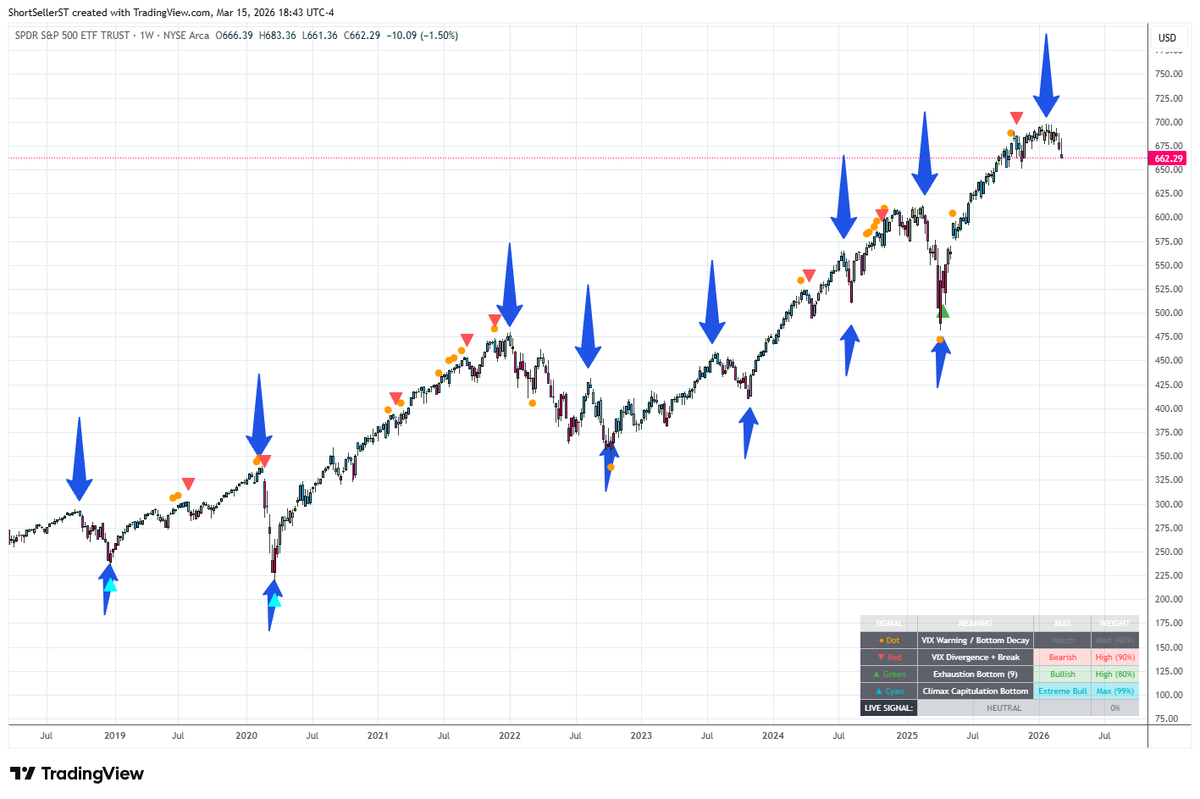
$SPY help me out with a new indicator I am working on (the key is in the bottom right corner as to what the signals mean) is this a good/great result - or should I be more aggressive? (The blue arrows are hard coded to teach if what I want to show as a signal)
$BTC has 32 days left to reach the macro tops trend line during the first half of this halving cycle @ ~$400k.
… just like during the past 3 cycles. ❎❎❎