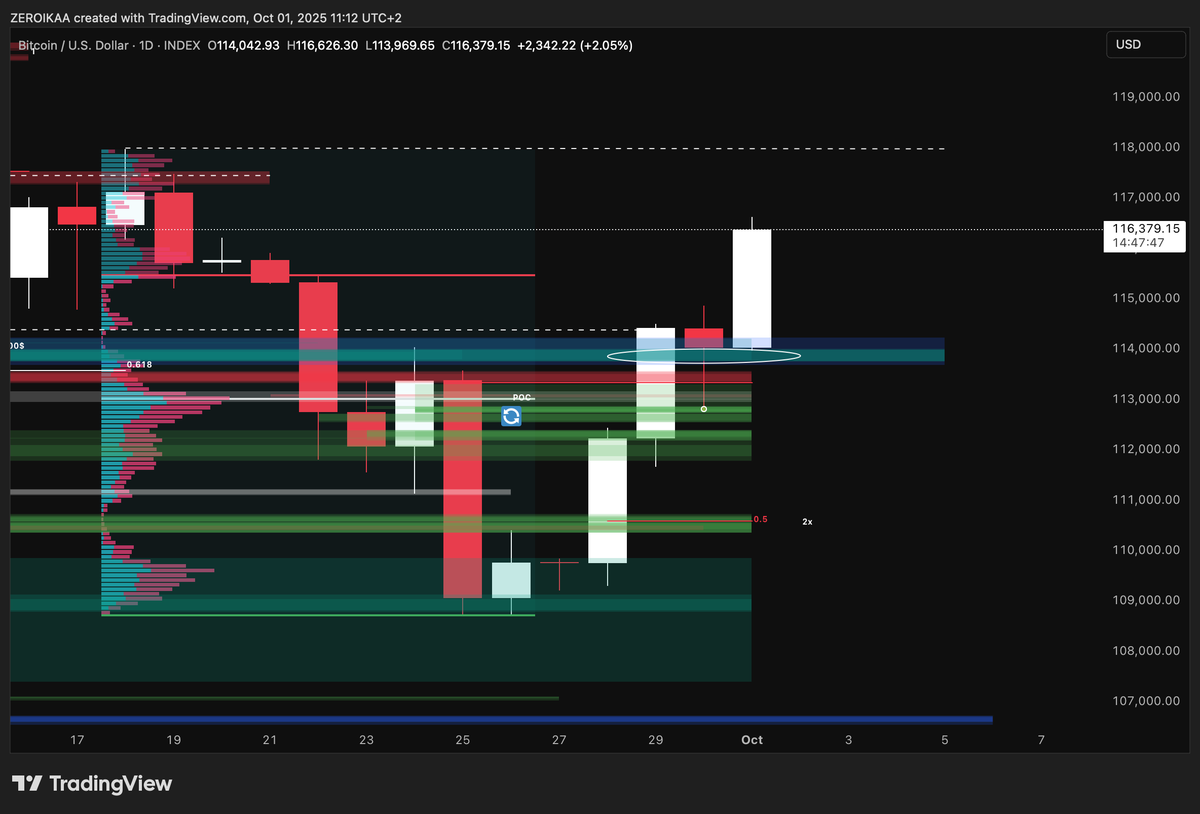
One of the most complicated things in the market is the ability to contextualize different pieces of information distilling them for developing a thesis, in this case a bullish one.
As highlighted in this post a few days ago, I was tracking a clean bearish Wolfe wave on the USDT D which would have caused a proportional bullish movement on BTC.
One necessary condition to have the confirmation of a Wolfe, together with the sub-waves, is the deviation above the trendline which clearly shows a liquidity grab. (and this often coincides with an institutional area, supply in this case).
In this example you saw how these things aren't just "patterns" but reflections of smart money actions.
Another confluence for not being bearish was the 1W closure on BTC that was able to sustain the 112.000$ key area, suggesting clean manipulation during the past daily sessions.
From there, based on my HTF bullish "bias", I monitored the recent supply formed at 112.600$, melted and utilized as a breaker to shot higher in confluence with the POC, and that's where I entered a long. (also watched at the order flow signaling stacked imbalances at the level)
Now it's crystal clear that we have some key areas on the USDT D, especially the 4.42% one, so I would be patient there monitoring a closure below it in order to potentially reach the EPA targeted at the beginning of this post.
However, at the moment, things look promising.
👁️Many people have asked me: 👁️
“Mate, what’s your strategy? How do you actually trade the market and which tips can you give me?"
Today, I want to share my approach with you and not just the mechanics, but the mindset, the discipline, and the long-term vision that are often overlooked. (I believe this can help you if you're struggling)
The truth is, trading isn’t just about techniques or spotting levels.
It’s about psychology, discipline, and clarity.
Life already pressures us with work, deadlines, family, and constant notifications.
Why should we turn trading into another source of anxiety?
Many people chase excitement in the market, seeking adrenaline, fear, or euphoria.
I seek the opposite, therefore calm, coherence, and simplicity as profit doesn’t come from tension, but it comes from staying still while the market moves around you.
My goal is to build a clear, repeatable, and sustainable approach that doesn’t add stress to an already busy life.
You already know I rely mainly on SMC so I won’t get into explaining them.
Now everyone can spot levels with some practice, but the real edge comes from contextualizing them, understanding why certain order blocks work while others don’t, and being able to interpret accumulation, distribution, and other complex market dynamics.
It's crystal clear that execution is where many traders make mistakes.
Often, it��s not analysis that fails, but timing.
Prices often approach key levels, absorb liquidity, and only afterward move in the intended direction forcing early entries to get stopped out.
Waiting for confirmations? Absolutely, it increases the probability of success, even if it occasionally skews the risk/reward ratio.
However, there are two main ways to execute trades: high leverage and low leverage.
After years of experience, I’ve chosen the second path, but why?
Because it allows me to give the market time to form reliable structures, manage my risk effectively, and trade calmly and clearly without unnecessary stress.
-----------------------------
Psychological connotation 🧠
-----------------------------
Yes, I know what you're thinking: "I scroll social media and I see plenty of people flexing 100xs longs/shorts and this forces me to think I'm not enough"
I get it.
Every time you open Instagram or TikTok, there’s someone showing off their massive wins, their luxurious lifestyle, their fast gains and it’s easy to fall into the trap of comparison, to start thinking that slow, steady growth isn’t exciting enough, that your discipline isn’t “doing enough.”
Social media is a highlight reel, not reality.
You’re only seeing the wins, the celebrations, the moments that make for clicks and likes.
Rarely do you see the drawdowns, the stress, the emotional battles, or the countless trades that didn’t work out.
Comparing yourself to curated 📷snapshots is a psychological trap.
It can push traders toward reckless decisions, over-leveraging, or chasing trades for the thrill, just to feel like they “measure up.”
The truth is, calm, disciplined, consistent trading doesn’t make for flashy Instagram stories, but it builds real, sustainable wealth.
You don’t need to impress anyone online.
The real victory isn’t in showing off a 100x trade, it’s sticking to your method, following your plan, and letting compounding work quietly and steadily over time.
The people who scream the loudest on social media are not necessarily the ones winning in the long run, they’re the ones who make the market look exciting while masking the real risk behind it.
My mantra is simple: plan, execute, and profit (hopefully)
Behind these 3 words lies a precise methodology.
Planning means analyzing HTF for key levels, identifying liquidity zones, contextualizing them, and defining invalidation points where a trade idea no longer makes sense.
My execution often happens on the same timeframe of the level I'm trading (waiting for closures within the level), but I also look into MTF where I confirm operational signals such as accumulation, BBs, or FVGs completion.
Risk management is essential.
My stop loss is always at the invalidation level, never arbitrary.
Position size is based on the risk per trade, and I never average down or improvise.
❗️Trade management is equally important ❗️
I move my stop to breakeven when a trade moves in my favor, take partial profits at key levels, and let the remainder run to maximize potential moves.
For instance, if price rebounds from an order block and breaks a supply, I start to trail below that supply that has now became a breaker, letting the rest ride toward the next liquidity area.
Compounding and leverage are where long-term growth truly shines, in my opinion.
Many people think success comes from big wins using high leverage and while this can be a great integration (open low lev/when in profit trail/remove the margin/increase the leverage) what I prefer is a slow, consistent progress.
----------------------------------
👁️Example
---------------------------------
Imagine two traders, both starting with 10K.
Trader A decides to risk 1% of their account on each trade, aiming for a 2:1 reward-to-risk ratio.
That means for every $100 risked, they aim to make $200.
After 50 trades with a 50% win rate, their account grows steadily to around €12,800.
After 100 trades, it reaches approximately $16,400.
His growth is gradual, almost unnoticeable day to day, but remarkably consistent.
Even a string of losses doesn’t shake his account significantly as he can keep trading calmly, stick to his plan, and let compounding work in their favor over months and years.
Now consider Trader B.
Trader B decides to take bigger risks, 5% of their account per trade, with the same 2:1 reward-to-risk ratio.
That seems exciting because the potential gains are enormous.
One winning trade could make $1,000, 10 times more than Trader A’s typical win.
After 50 trades with the same 50% win rate, the account has the potential to reach $34,000.
After 100 trades, it could surpass $100,000.
Sounds incredible, right? But the problem here is that high leverage comes with high stress.
Just imagine if Trader B hits 10 consecutive losses, which is not unlikely.
That would wipe out 40% of their account in a very short period.
Emotionally, he's riding a rollercoaster made of fear, frustration, and desperation creep in, and his decision-making suffers.
One bad reaction could undo weeks or months of progress.
The key takeaway is that compounding only works if you remain disciplined over years.
Leverage can amplify gains, but it also amplifies psychological pressure.
So, I keep it simple where the majority of my trades are made with bigger size and lower leverage as I can clearly manage them understanding if the price is invalidating my setups or not, looking for a powerful compounding over months/years.
Trading is complex enough already and I don't want to make it harder.
I aim to reduce stress, maintain clarity, and trade with discipline. I don’t chase tomorrow’s big win. I focus on building today so I can reap rewards in the years ahead with this extra business.
I believe that true victory isn’t a single profitable trade but it’s sticking to your method consistently, even when the market tests you.
This is how I trade.
@sjdedic 2/2 it before for sending ETH to Binance. PEAQ was on Ethereum when launched on Coinlist and later migrated to native peaq network and I think here is where Coinlist lost it's marbles and filled ETH wallet, which is not compatible with native Peaq. Lost forever :( I'm devasted.
#CryptoCommunity@sjdedic Please help me, I've sent $PEAQ from Coinlist to some address generated by https://t.co/2ZQedhIoYZ and now they claim that this address is invalid and therefore there are no tokens in my gate wallet. Here are transaction details: https://t.co/8rSWc76ulW
@sjdedic 1/2 UPDATE: My tokens ended on Binance, on my ETH address.
Coinlist sent then there and they say that I entered Binance ETH wallet in withdrawal process which is ridiculous because Binance doesn't support PEAQ.
I've saved Binance ETH wallet on Coinlist before because I have used
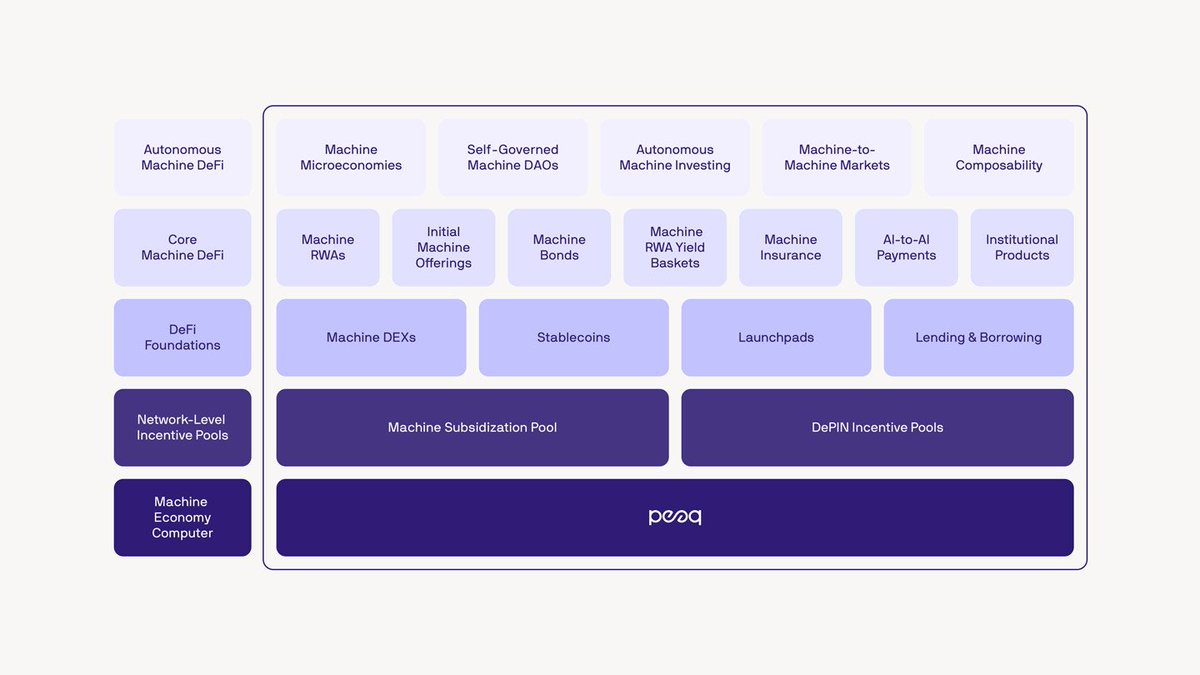
So @peaq just dropped a major update on Machine DeFi - and I think way too few people are talking about it.
Even those who are mostly miss the bigger picture.
Here’s why I think it’s huge and it's one of the key reasons I’m so bullish on $PEAQ.
Most people still think of DeFi as humans swapping tokens and farming yield.
But peaq is flipping that script.
They’re building Machine DeFi, a new financial paradigm where machines are the users.
Let me explain why this will change everything:
In the Machine Economy, robots, EVs, drones, AI agents - any machine that generates real-world value - becomes an on-chain economic actor.
Machines don’t just perform tasks anymore. They can earn, spend, invest, borrow, and coordinate - autonomously.
What peaq is doing isn’t just another DePIN or L1 narrative. They’re building the financial backbone for physical AI.
Think of it as:
- Machines earn, spend, and invest on-chain
- Real-world activity creates real liquidity
- Value is shared between machines and people
Here’s what makes it massive:
Instead of machines being a cost, they become programmable assets.
→ Their revenues go on-chain
→ Their ownership gets fractionalized
→ Their usage creates fees
→ Their actions create demand for DeFi primitives
Now here’s the genius part: the Machine DeFi Flywheel.
Every time an on-chain machine or dapp earns, spends, or transacts:
→ a portion of fees goes into peaq’s Incentive Pools
→ these pools fund more machines & DePINs
→ which increases usage
→ which generates more fees
→ repeat.
It’s a compounding loop of liquidity and real-world economic activity.
The greatest part: this isn't just theory, this is already in the making as we speak.
peaq already has:
- More than 50+ DePINs building on peaq already, and those are just the ones that are being publicly announced
- The Incentive Pools are already seeded with $3.5M+, which will grow exponentially with more DePINs about to deploy on-chain
- Real-world integrations in mobility, energy, compute
- A modular stack that will let machines launch, trade, earn, and reinvest on autopilot
Interestingly, alongside yesterday’s Machine DeFi announcement, @machinedex also came out of stealth - the first native Machine DEX on peaq, and likely launching soon.
Even more exciting and innovative it will get once we are having a look at the overall Machine DeFi stack. Over time, this becomes a fully autonomous economy:
• Machines become onchain RWAs
• Users co-own robo-fleets, smart infra, or data-generating devices
• AI agents manage revenue streams and reinvest them on-chain
• Machines transact with each other - no human in the loop
This is what most people are missing:
Machine DeFi isn’t a feature. It's one of the value propositions of peaq, turning it from "yet another infra chain" into a completely new economy that I expect to be one of the biggest in the future.
A new class of users = machines
A new class of liquidity = machine RWAs
A new feedback loop = autonomously
Machine DeFi will start small - with the DeFi core primitives followed by robo-cafés, drones, EVs.
But it won’t stay small.
Once machines can earn and spend on-chain, the Machine Economy becomes a living system.
Powered by $PEAQ.
Sounds like sci-fi, but this is the economy of the future.
And it starts now.
Finally, $SOL is back above $260!
As promised,
I want to change someone's life and send 500 $Sol (~$131,500) to one person by tomorrow.
Just like, RT and reply '+'. Random winner in 21h
WTF is @peaq and why is it worth $2b?
00:00 Intros & Origins
00:51 What Is Peaq
05:10 Machine Economy
15:32 Current State of Peaq
19:38 Peaq Token
28:52 Most exciting area in DePIN
32:35 AI Agents
44:30 Roadmap
WTF is @peaq and why is it worth $2b?
00:00 Intros & Origins
00:51 What Is Peaq
05:10 Machine Economy
15:32 Current State of Peaq
19:38 Peaq Token
28:52 Most exciting area in DePIN
32:35 AI Agents
44:30 Roadmap