One way to deal with this that eligibility for election at national level should be demonstrated by outcomes at interstate level-state levels; eligibility at state levels should be determined by outcomes at intra- state levels. Officials must have a track record of success
There is more indignation over an IOA election result than over why Indian sports continue to crawl through Olympic corridors. It is a perplexing piece of human behaviour. Nobody seems to care why we consistently fall short of Olympic podiums. No urgent phone calls to the press from select sportspersons; no anguish over missing an 800m final since 1976; no chest-beating over track and field yields beyond Neeraj Chopra; no tears over a multi-decade Olympic gold drought in shooting since Abhinav Bindra’s 2008 triumph (even as sharp campaigns like Manu Bhaker’s multi-medal feat at Paris 2024 keep us on the board); no hard questions on why Olympic badminton gold eludes us, or why a field hockey Olympic gold has eluded us since 1980 (though back-to-back bronze finishes show resilience).
Instead, we turn a blind eye to rampant doping sweeping through our national camps. We watch in silence as the boxing federation collapses under governance struggles. We ignore the systemic, sexist behaviour that drove our top wrestlers to the streets. And we stomach the endless, backroom power grabs within field hockey, a sport where administrative ego routinely outranks athlete welfare.
Where are the representations to the IOC on structural underperformance? Where are the open letters to the government demanding world-class U-16 developmental coaches? Where is the accountability demanded from sports federations after every quadrennial failure?
At Paris 2024, we finished 71st. A nation of 1.4 billion, trailing behind far smaller, resource-strapped countries. Uzbekistan ranked 13th overall with an impressive 8 golds, 2 silvers, and 3 bronzes (13 total medals) with a population of 37 million!
Instead, as seen in the recent Sportspersons of Outstanding Merit (SOM) election drama, marked by high-profile disputes, model code complaints, and accusations of fraudulent math and targeted block-voting, Indian sports elections routinely resemble political campaigns rather than corporate governance exercises. Tears, accusations of betrayal, and political manoeuvring ring out through Delhi’s smog.
We remain a nation with lopsided priorities, obsessed only with elections. Administrative chairs send us into a tailspin, while on the pitch, track, and range, we keep a kilometre-long list of excuses. When our tears are shed for power rather than performance, it’s no wonder we remain off the top step.
#ioaelections #SportsUpdate
#sports
@MisraSundeep Yes this was a sad display. Some old demons — poor defending late in the 4th quarter and last minute goals. Particularly distressing is the goalkeeping which used to be a strength. And PC execution — very disappointing as it is well below the Pro League average.
@MisraSundeep Just seem to lack energy in the circle and not anticipating any long passes or through balls. At this level there has to be passion and the desire to get to the ball first
Forcing people back to the office backfires.
Data on >3M tech & finance workers: After return-to-office mandates, firms lose stars and struggle to attract new talent. The most likely to quit are senior, skilled, & female employees.
Flexibility is a feature of a great workplace.
If you had been at #Hiroshima, 80 years ago this morning of 6 Aug, and survived the damage wrought by the single Little Boy, these are some of the sights that you wld have seen. Let's not forget that nuclear weapons r not ordinary weapons. The rest will follow.
No one had more cumulative influence on the macroeconomic policy makers of the last generation than Stanley Fischer. Central Bank governors Ben Bernanke, Mario Draghi and Kazuo Ueda were his students, as were many others like me, who served in other capacities. We all were shaped by his clarity of thought, intellectual balance, personal decency and quality of character.
In a broader sense, everyone who was involved in the macro policy enterprise was Stan Fischer's disciple. People all over the world who never knew his name lived better, more secure, lives because of all that he did through his teaching, writing and service.
In one lifetime he did the work of many. I have lost a role model and friend.
The same logic applies to non-compete agreements: If it should be easy for employers to fire workers, then it should also be easy for employees to quit. And that requires workers to have the right to take a better job. [12/12]
One reason existing businesses like non-compete agreements is that it restricts the labor supply available to new businesses. This reduces the ability of new competitors from entering their markets and driving down prices for consumers. [10/x]
This is why businesses hate this ruling. They were getting workers to sign non-compete agreements without having to pay the market price for this right. Now they will have to pay to market prices to keep workers that they have invested in or shared trade secrets with. [8/x]
In reality workers face significant challenges negotiating terms. They are often not aware of non-compete clauses or don't understand their implications. The end result is a contract negotiation that significantly favors employers. [5/x]
Momentum & heat
Real GDP rose at a 1.8% pace in the first quarter, a sharp slowdown from the 3.4% pace of the fourth quarter. Much of that slowdown could be attributed to a widening of the trade deficit, a DROP in federal spending and a further liquidation of inventories. The latter two will be reversed in the second quarter. Underlying demand remained solid.
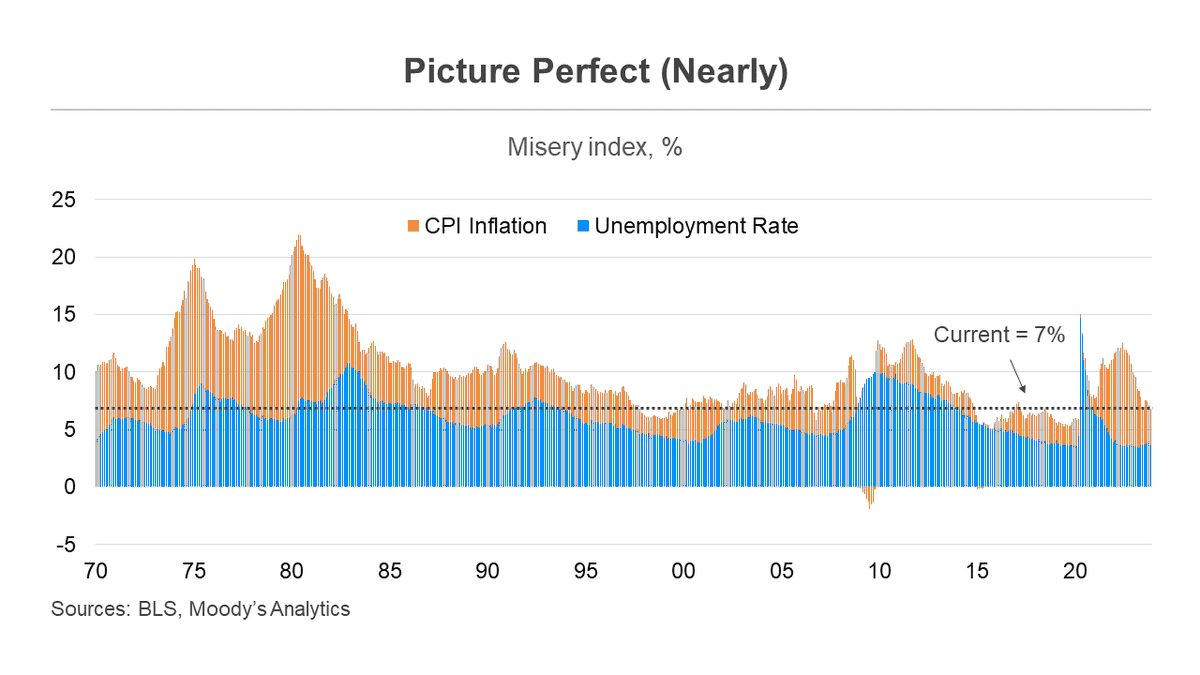
Nearly picture-perfect. That’s an apt description of the economy, at least according to the misery index – the sum of unemployment and inflation rates. With the full-employment Urate at 4% and the CPI inflation target at 2.5%, the optimal misery index is 6.5%. It is currently 7%.
Wage growth, as measured by the Atlanta Fed wage tracker, handily outpaced inflation for workers across all wage tiers this past year. Thus, the upbeat economists. But this comes after almost 2 years in which wage growth fell well short of inflation. Thus, Americans’ feelings.
Another month, another very good jobs report. The economy continues to create lots of jobs, and unemployment remains steadfastly low. And slowing job growth, fewer hours, and cuts to temp employment suggest the economy is steadily cooling, and inflation will continue to moderate.
@BrianFeroldi Thanks for explaining. But you have accepted that SBC likely improves retention of talent and therefore likely improves revenues or reduces expenses. Is there enough evidence to support that?