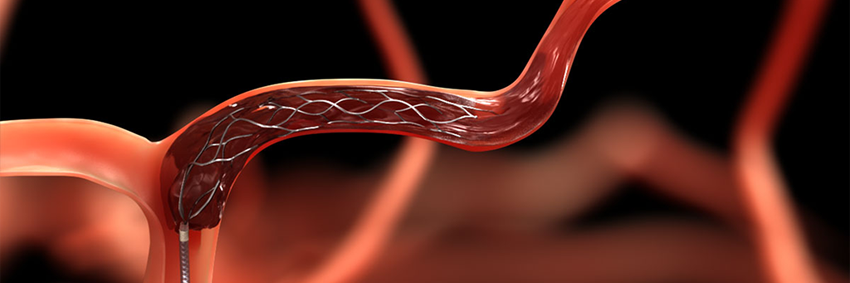
The current status of transradial access for NeuroIntervention is probably best summed up by a quote by author William Gibson:
"The future is here, it's just not evenly distributed."
Yet.
#radialforneuro#radialfirst
Serenity Medical is very pleased to announce that we have received U.S. FDA HDE approval of the River Stent - the first venous stent approved for severe, refractory Idiopathic Intracranial Hypertension (IIH). Learn more: https://t.co/9RhWc2aFWF
Amanda Baker, MD (@amandaebaker), and Brian Snelling, MD (@snellingmd), detail their patient selection strategies for radial neurointervention, providing valuable clinical insights for operators refining their approach. https://t.co/Qnjo1BA3aN
Bernie Marcus is the co-founder and former CEO of Home Depot.
His story is insane ... he was in a gang as a kid, got fired in his late 40s, told Ross Perot he didn't want his money over a Cadillac, and kicked an investment banker out of his car on the side of the highway.
This is how he started one of the most successful retailers in history.
. @synchroninc , a secretive competitor to Neuralink, invited Senior Reporter @EmilyForlini to their NYC headquarters where she got to see a brain implant deployment. Is this the future come to life?
We are unveiling a roadmap to “Cognitive AI”, in partnership with @nvidia. The ultimate destination of BCI will be large scale brain foundation models of cognition. @emilylmullin from @WIRED has done a great job capturing what that means. @petereyoo presented our vision in a masterful keynote at #GTC.
https://t.co/wbCB4Jhjzf
Thanks to @vkhosla@NitaFarahany@MaryamShanechi David Niewolny for comments
1/ No one is talking about this.
Vitalik’s d/acc isn’t just about AI. The real battle isn’t humans vs. AI—it’s who controls cognition itself.
We’ve already lost most of that control. BCIs will become a way to take it back.
https://t.co/QIlIPdR5f9
40 days since my house burned down in large part due to the incompetence of our local officials and I am getting yet another request for a sketch of the house to get the debris removed. Does this work @MayorOfLA?
🧠 The positive results of our COMMAND trial - evaluating the safety and efficacy of our #BCI in 6 participants over 12 months - are live. Congratulations to our participants and partners:
@MountSinaiNYC@UB_Neurosurgery@UPMC@CarnegieMellon
https://t.co/slzlllOcx3
Apple Vision Pro requires hand gestures to make selections on the screen. Synchron is testing a set of brain gestures derived directly from the BCI, to replace hand gestures, for people like Mark with limited limb function due to conditions like #ALS. https://t.co/DEeWAIdacP
“The most important function of BCI is to preserve his ability to make choices.” - @tomoxl, Synchron Founder and CEO
Read more about Mark (a Synchron #BCI user) and his experience with the Synchron #BCI chat feature on CNBC ➡ https://t.co/X0QJL7I2Jc #Stentrode#ChatGPT#AI
1/ Synchron's thesis on Interventional Neurotechnology:
Massive unmet need – neurological disease biggest cause of disability globally.
Only proven procedural solution shown to scale is interventional.
Opportunity to positively impact millions of lives and for a $100B company to emerge (ie $10 billion revenue from 200,000 devices delivered annually)
(our thesis hasn’t changed from first patent in 2011. Brain Computer Interface is just the beachhead)
@synchroninc
Join us tomorrow as two of the leading pioneers of radial access discuss the nuances of transradial approach in the neurovascular space. You will not want to miss this session led by @braincutter & @snellingmd.
Register: https://t.co/bI26Om5kGH
Risk: https://t.co/lAGQLctcOH
Join us on May 10th as two of the leading pioneers of radial access discuss the nuances of transradial approach in the neurovascular space. You will not want to miss this session led by @braincutter & @snellingmd.
Register: https://t.co/Ujfvd8q1T9
Risk: https://t.co/Ys4zuRc3em
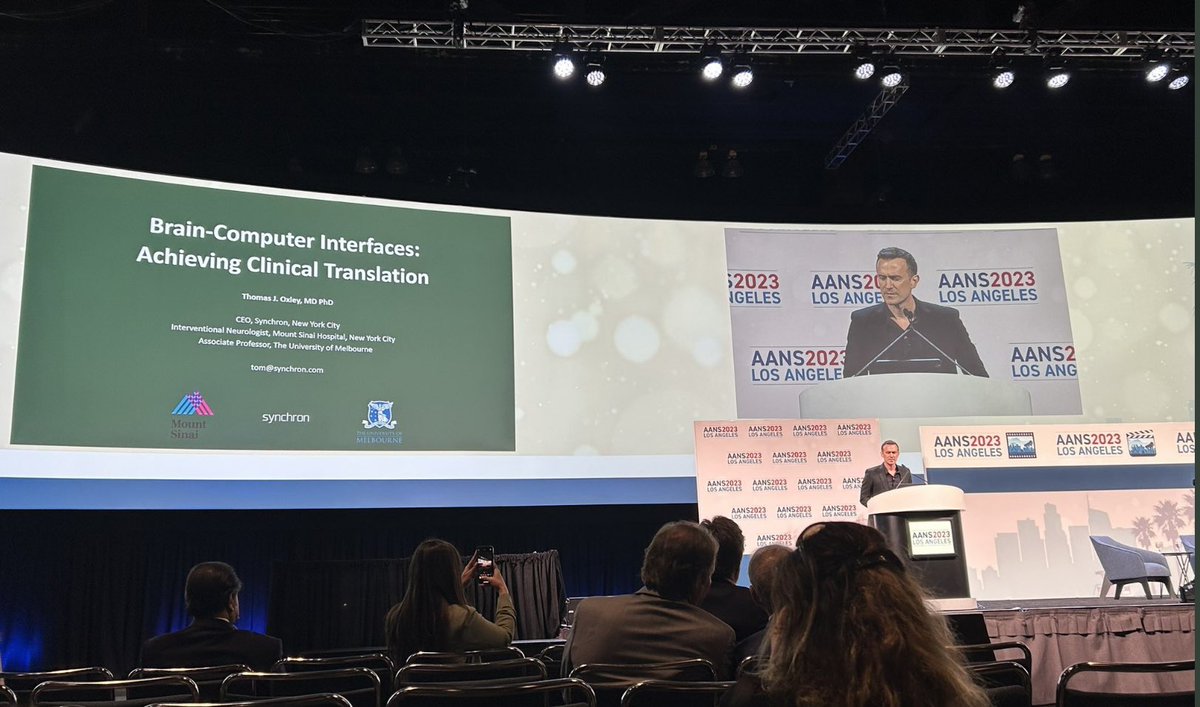
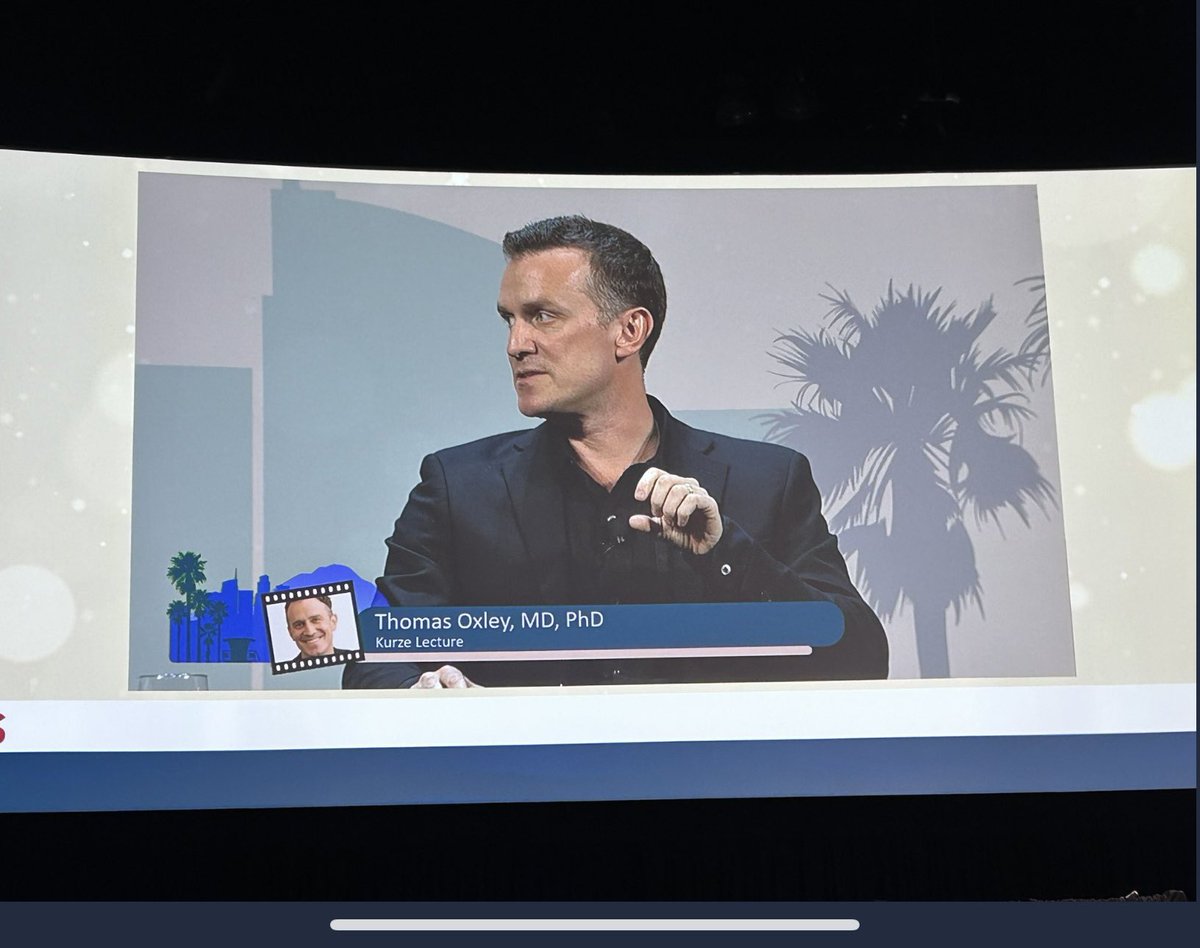
Yesterday I gave a keynote at @AANSNeuro American Association of Neurological Surgeons meeting in LA. President Ann Stroink created a focus on BCI for the first time at this meeting. I showed a video of a user with locked-in-syndrome using the @synchroninc motor neuroprosthetic to control an iPhone with key presses sent from his mind. The system is not as fast or complex as the incredible recent achievements shown by Jaimie Henderson Henderson at Stanford University, however we believe we have identified a robust method of transmitting packets of motor intent from the brain - discrete “digital motor outputs”, or “switches”. This could become a new unit of measure of physiological motor activity used to control external devices. They are objective, measurable, physiological and have implicit functional value. I followed the talk with a fireside chat with Jaimie Henderson about the challenges of achieving functional translation in this field.
The focus of the keynote was ‘clinical translation’ and these were my main points:
- implanted BCI feasibility has been demonstrated in both efficacy and safety
- two fundamental questions the FDA focus on are: 1 long term viability at the tissue/device interface and 2 what is an appropriate clinical metric for BCI efficacy
- categorisation of BCI as medical device needs clarity
- BCI definition: “direct connection with brain’s electrical activity with external device”,
is not the same as,
Neuroprosthetic definition: “implantable device that restores a lost bodily function
- best clinical metric of neuroprosthetic is a direct corollary of underlying physiology that represents clinical utility, for example an accurate representation of an intended motor action
- so a “motor neuroprosthetic, or MNP” restores the transmission of motor intent (a physiological function typically performed by motor neurons and muscles)
- an MNP can therefore treat a range of conditions associated with motor impairment
- a “digital motor output, or DMO” is a measure of performance of the MNP’s ability to restore some degree of motor function
- we used discrete DMOs, or switches, to generate key presses that can be used by users to control an iPhone, or laptop. They can be used alone (such as for iPhone) or in multi modal environment, such as with eye tracking, to do things like left click, right click or zoom
- there are 1 million people with severe limb impairment in the US. There are 100 million globally whose fingers don’t control personal digital devices with perfection due to a range of conditions
- I re-hashed “cognitive liberty” as a guiding ethical principle to protect’s people rights from (privacy invasaion, loss of agency), and rights to (self determination and autonomy) implantable neurotechnology. This was been elegantly enunciated by @NitaFarahany last week at @TEDTalks