🥕Pastanaga Toolbar Demo (WIP, heating engines in preparation for Plone-React Bonn Sprint 2018) So far, basic behavior, support for lazy load menu components, push-pull navigation. #Plone#Pastanaga #🥕 #React#CSS#UI#LetsMakeItReal
🚀 A Iskra continuem contribuint activament a l’open source
Hem participat en la release Guillotina 7.1.x, amb integració MCP, suport per Python 3.10–3.12, millores de rendiment, fixes al mailer i cloud file fields
https://t.co/hXhCo0UOen
#Iskra#OpenSource#Guillotina#Plone
Sprinter's guide to #Plone 7 🏃
Heading to the Beethoven Sprint? @sneridagh runs a fast-paced 101 on Plone 7 architecture so you can hack from day one.
📅 Wed May 6 — 16:00 CEST / 14:00 UTC / 11:00 BRT
📺 https://t.co/6PEIbtKeaE
#OSS#React
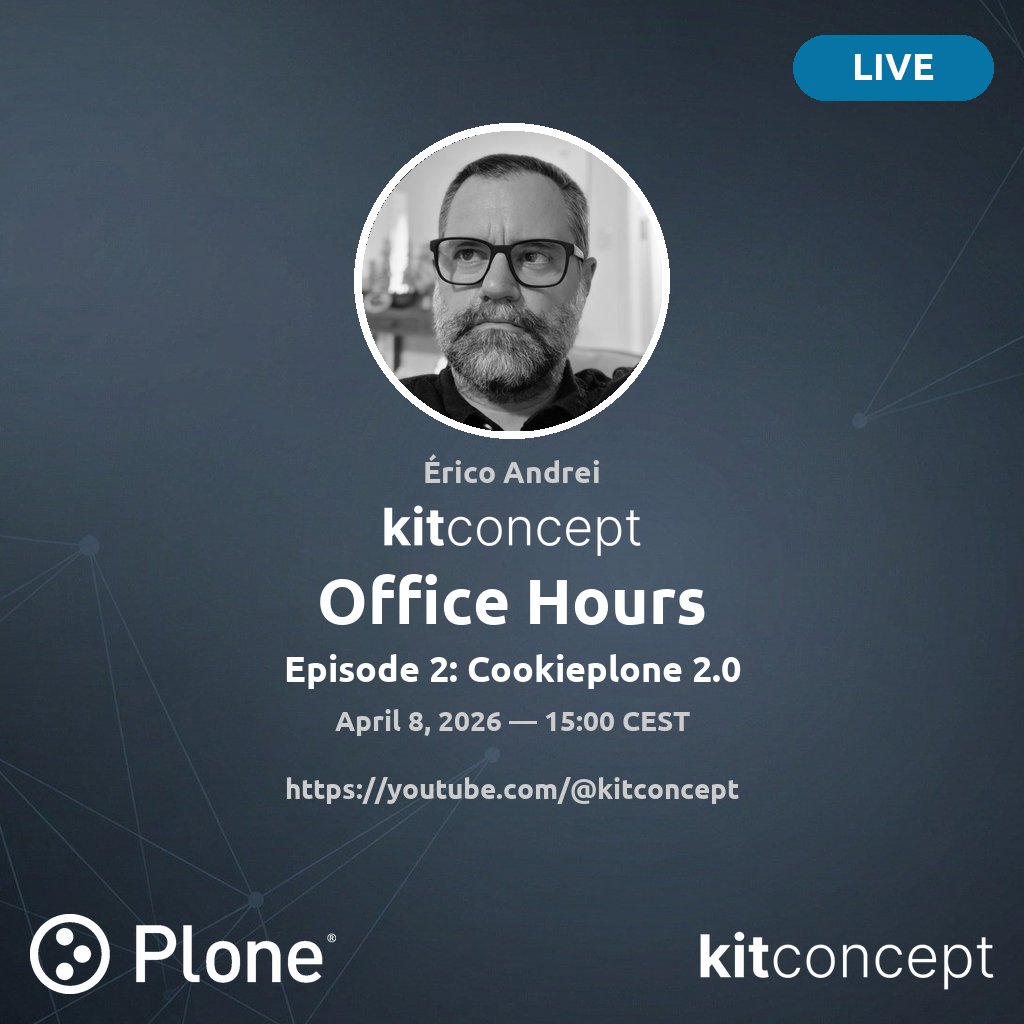
kitconcept Office Hours #2 this Wednesday! 🎬
@ericof covers Cookieplone 2.0 — the latest on the #Plone project scaffolding tool, fresh from the Bucharest Sprint.
📅 Apr 8 — 15:00 CEST / 13:00 UTC 🔴 https://t.co/ocRenSBnYl
Vibe-coding is not the same as AI-Assisted engineering.
A recent Reddit post described how a FAANG team uses AI and it sparked an important conversation about semantics: "vibe coding" and professional "AI-assisted engineering". While the post was framed as an example of the former, the process it detailed - complete with technical design documents, stringent code reviews, and test-driven development - is a clear example of the latter imo.
This distinction is critical because conflating the two risks both devaluing the discipline of engineering and giving newcomers a dangerously incomplete picture of what it takes to build robust, production-ready software.
As a reminder: "vibe coding" is about fully giving in to the creative flow with an AI (high-level prompting), essentially forgetting the code exists. It involves accepting AI suggestions without deep review and focusing on rapid, iterative experimentation, making it ideal for prototypes, MVPs, learning, and what Karpathy calls "throwaway weekend projects." This approach is a powerful way for developers to build intuition and for beginners to flatten the steep learning curve of programming. It prioritizes speed and exploration over the correctness and maintainability required for professional applications.
There is a spectrum between vibe coding and doing it with a little more planning, spec-driven development, including enough context etc and what is AI-assisted engineering across the software development lifecycle.
In stark contrast to the post, the process described in the Reddit post is a methodical integration of AI into a mature software development lifecycle. This is "AI-assisted engineering," where AI acts as a powerful collaborator, not a replacement for engineering principles. In this model, developers use AI as a "force multiplier" to handle tasks like generating boilerplate code or writing initial test cases, but always within a structured framework.
Crucially, the big difference here is the human engineer remains firmly in control, responsible for the architecture, reviewing and understanding every line of AI-generated code, and ensuring the final product is secure, scalable, and maintainable. The 30% increase in development speed mentioned in the post is a result of augmenting a solid process, not abandoning it.
For engineers, labeling disciplined, AI-augmented workflows as "vibe coding" misrepresents the skill and rigor involved. For those new to the field, it creates the false and risky impression that one can simply prompt their way to a viable product without understanding the underlying code or engineering fundamentals.
If you're looking to do this right, start with a solid design, subject everything to rigorous human review, and treat AI as an incredibly powerful tool in your engineering toolkit - not as a magic wand that replaces the craft itself.
@galigan Because they are all children of PHP frameworks and they were missing the CVE-a-day thing, and living dangerously on the edge. 😩 First of many, I guess.
Plone Conf 2025 Jyväskylä: from the early announcements to the final sprints, and everything in between
#plone#ploneconf2025@ploneconf@plone
https://t.co/Lq1EmAnYJW
New blog post! 🚀 What We Did Last Year — a look back at how the #Plone community shaped Seven, the next-generation frontend, through this year’s sprints. https://t.co/upKMbKQeeB #PloneConf2025#reactjs#reactrouter#remix#volto
It’s that time of the year again. After 19 years, this one will be my 17th #PloneConference2025#Plone shaped my life as it is now, in every single aspect you may think of. I hope it continues to do so in the time to come. On my way to Jyväskylä! 🚞🚌✈️🚞
@boladedrac@samfaina_visual A veure vosaltres dos... no em puc creure que no us hagi arribat aquesta tonteria que hem fet xD
https://t.co/hUZgw3fK2l
;)
This year’s Axolote Sprint was a huge success! Plonistas from Europe and North America converged on Mexico City to advance Plone's technical capabilities and celebrated with a boat ride on the magical canals of Xochimilco! Read the full sprint report! https://t.co/qVSeZHj3jQ
The slides for my keynote at #PyConColombia2025 are now available!
It was a pleasure to share the lessons learned by our community over 25+ years of maintaining #Plone.
🔗 https://t.co/hksH13QB5g
Silently, the three weeks ago, we crossed the 1000 releases threshold in the #Plone#Volto ecosystem: https://t.co/o3WPHX5XU0 🚀 A toast for 1000 more 🍻!
🚀 Piero Nicolli presents the best development practices powering Seven, the next major release of #Plone!
Get ready for cleaner code, smarter workflows, and future-proof tech! 🔧✨
🎥 Watch it now: https://t.co/uhDRIpbAry
#BeethovenSprint#OpenSource#Python#CMS#Plone7
WPD2025 Video on Seven: https://t.co/V3VQcz8c4f
Blog post about Seven in my Volto-based blog: https://t.co/McF0uIMiBi
Same post rendered by Seven: https://t.co/mWAlCClerb
🚀 Beethoven Sprint 2025 is starting on Monday! Few pointers for those attending (also remotely).
Seven PLIP: https://t.co/AvgIfDDL9s
Docs: https://t.co/e5Su9trmxB
RR7 official Docs: https://t.co/VNVNhIHXY1
RR7/Remix YT: https://t.co/I7WTXChsFn
#Plone#Seven#Volto#reactrouter