An independent human rights organization founded in June 2011, documents HR violations in Syria, supporting the transition towards democracy [email protected]
#SNHR: Victims must be involved in all stages of the settlement process, with the right to be notified of pending applications, submit statements, challenge proposed terms, obtain information on outcomes, and appeal decisions, as well as access to legal aid and psychosocial support.
#Syria #VictimsRights
#SNHR: Asset freezes must be imposed at the earliest possible stage, before settlement negotiations begin, to prevent capital flight. Recovered assets should be directed to an independent reparations fund for victims, and states hosting Syrian assets should cooperate in tracing, freezing, and recovering them.
#Syria #AssetRecovery
#SNHR calls on the Syrian authorities to adopt comprehensive legislation regulating settlements before negotiating any individual settlement, and to establish an independent settlement body with quasi-judicial powers, including the power to investigate, summon documents and witnesses, and revoke settlement benefits upon non-compliance.
#Syria #Transitional_Justice
#SNHR: The choice before decision-makers in Syria is not between settlements and accountability, but between settlements that reinforce accountability and settlements that undermine it. If settlements are designed without the required conditions, the real alternative is impunity.
#Syria #Transitional_Justice
Fadel Abdulghany, Executive Director of #SNHR: "Settlements with those implicated in political and economic crimes are legally permissible, but only if they meet strict conditions [...] Any settlement that does not meet these conditions is nothing but another name for impunity."
#Syria #NoImpunity
#SNHR identifies six major risks threatening the integrity of any settlement mechanism in Syria: elite capture, impunity, fragmentation of the transitional justice process, capital flight, political manipulation, and transitional justice fatigue and the re-traumatization of victims.
#Syria #Transitional_Justice
Syria’s access to evidence of Assad-era crimes is advancing faster than its domestic criminal framework, writes Fadel Abdulghany.
This gap will determine whether Syria's first chemical weapons trial will be built on a solid legal basis, he writes.
https://t.co/0NIaXLd7Bc
#SNHR: Any settlement framework that excludes economic actors will be structurally incomplete. Under the former regime, economic crimes financed the security apparatus, sustained patronage networks, and generated structural inequalities that persist long after the political transition.
#Syria #TransitionalJustice
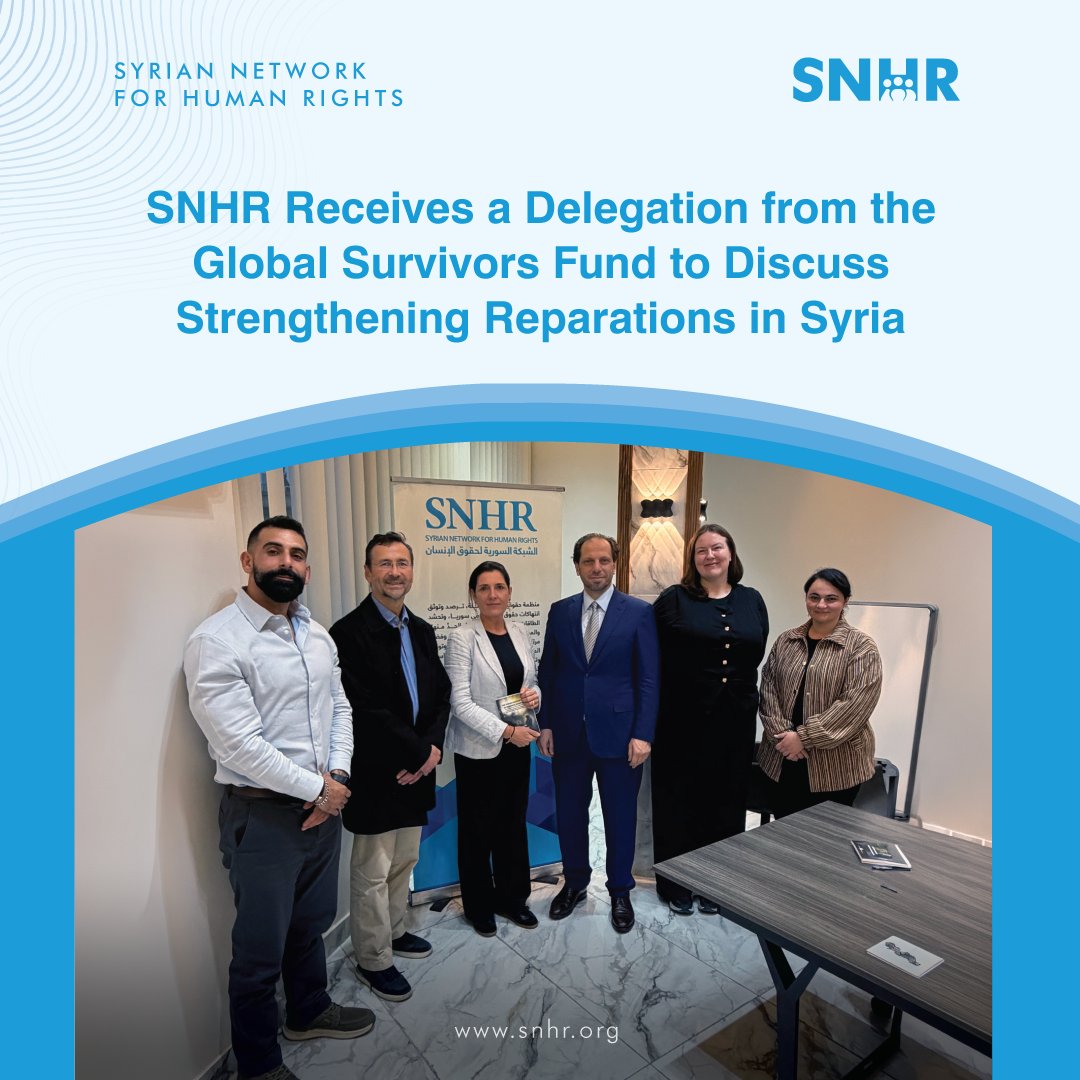
The Syrian Network for Human Rights (#SNHR) received, at its office in #Damascus, a delegation from the Global Survivors Fund (GSF), which included the Executive Director of the Fund, Esther Dingemans. The two sides discussed the latest developments in transitional justice in Syria, as well as the means of strengthening cooperation in the field of reparations and of guaranteeing the rights of victims and survivors.
The meeting focused on the importance of developing reparations programs in #Syria, including interim measures to respond to the urgent needs of survivors, and of enhancing their access to compensation and redress. The two sides also explored the possibility of utilizing the funds and assets recovered from figures of the former regime in support of these programs.
View full statement: https://t.co/pUld6xJBru
@glsurvivorsfund
#SNHR: The categorical exclusion of the most serious international crimes from settlement eligibility is non-negotiable. Genocide, crimes against humanity, war crimes, torture, enforced disappearance, and sexual violence cannot be settled.
#Syria#NoImpunity
#SNHR: Settlements with those implicated in political and economic crimes may be legally permissible under international law, provided that strict conditions are met, chief among them full and verifiable disclosure of the truth, and the effective participation of victims at all stages.
#Syria #TransitionalJustice
#SNHR releases a new report titled: "Settlements with Those Implicated in Political and Economic Crimes within the Transitional Justice Process in Syria: Legal Standards, Normative Conditions, and Policy Recommendations"
#Syria#TransitionalJustice
The Syrian Network for Human Rights (#SNHR) has released a report entitled, "Settlements with Those Involved in Political and Economic Crimes within the Transitional Justice Process in #Syria: The Legal Standards, the Normative Conditions, and the Policy Recommendations." The report concludes that negotiated settlements with the political leaders, the security officials, the business elites, and the officials involved in corruption under the former regime may be legally permissible only within strict conditions drawn from international law and from authoritative institutional guidance. The report further establishes that genocide, crimes against humanity, war crimes, torture, enforced disappearance, and sexual violence must be categorically excluded from settlement eligibility.
The analysis is built on treaty law, international standards, and authoritative United Nations guidance, including the Updated Set of Principles for the Protection and Promotion of Human Rights through Action to Combat Impunity, the 2023 Guidance Note of the United Nations Secretary-General on Transitional Justice, the rule-of-law tool of the Office of the United Nations High Commissioner for Human Rights (OHCHR) on amnesties, and the Rome Statute of the International Criminal Court (ICC).
Read the full report: https://t.co/Y1XE8i86JW
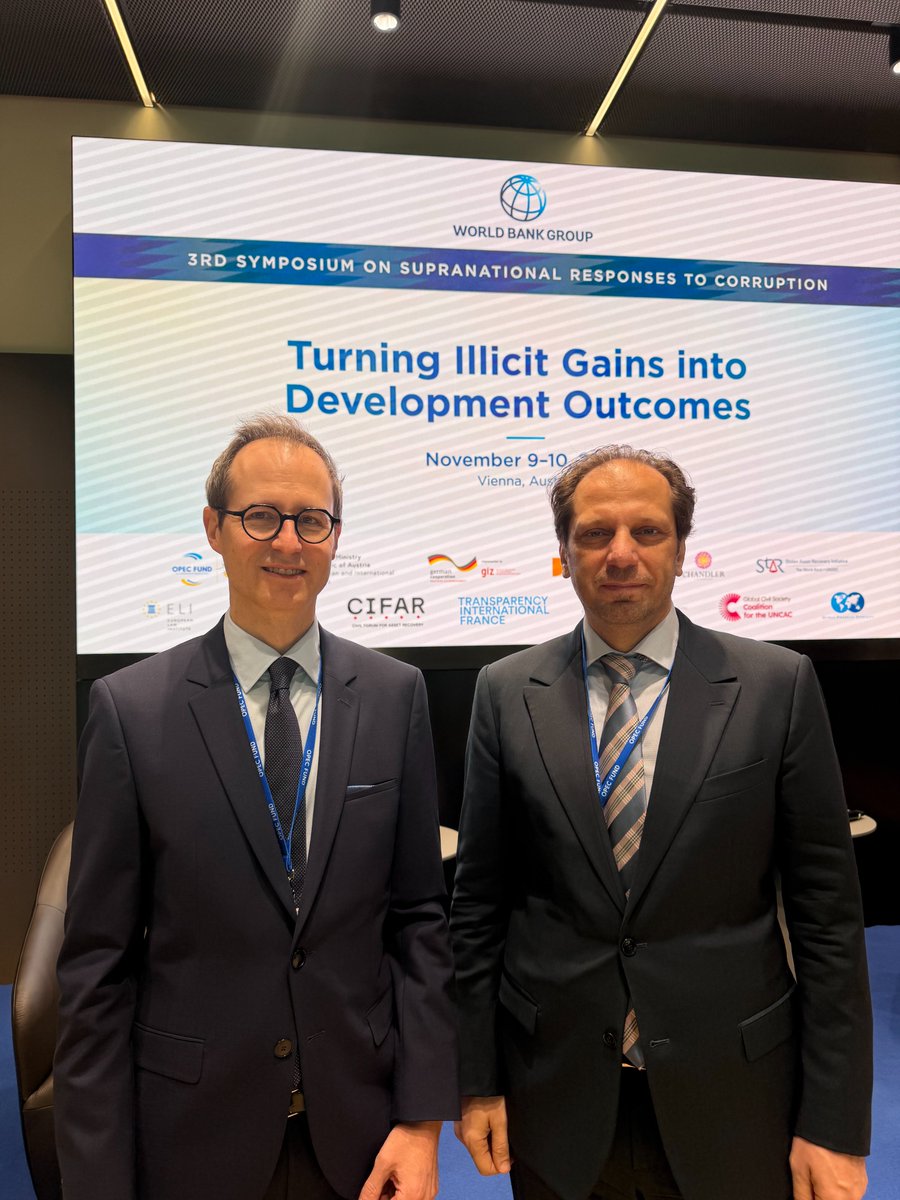
I was honoured today to meet Austria’s Minister of Finance, Dr. Markus Marterbauer, on the sidelines of the Third Symposium on Supranational Responses to Corruption, organised by the World Bank Group and its partners in Vienna on 9–10 November 2026, under the theme “Turning Illicit Gains into Development Outcomes.” The symposium is being held at OPEC headquarters in Vienna.
I am participating in a panel discussion on Asset Restoration in Fragile and Post-Conflict Contexts, where I am addressing approaches to tracing, freezing, confiscating, and recovering the funds and assets of the Assad regime and its associated corruption networks. More importantly, I am examining how recovered assets can be used to finance reparations for victims and survivors, as an essential component of transitional justice in Syria.
In Syria, corruption was not separate from gross human rights violations. Rather, it was deeply intertwined with the system of detention, torture, enforced disappearance, property confiscation, and forced displacement. Recovering these assets should therefore go beyond simply returning funds to the state treasury. It should also contribute to providing justice and reparations for victims through transparent mechanisms that ensure their meaningful participation in decisions about how the recovered assets are allocated and used.
The objective is to transform part of the wealth accumulated through repression and corruption into a tangible means of delivering justice and redress to its victims.
I have also written an article examining this issue in greater depth, which will be published soon.
I will share my remarks from the symposium at a later date. They are based on a jointly authored paper to which we contributed and which we hope the World Bank will publish soon, allowing us to share its findings more widely.
The Syrian Network for Human Rights (#SNHR) has contributed stories of victims killed in Syria to "Memorial 2026", an online memorial published by the Every Casualty Counts organization.
"Memorial 2026" is an online memorial that tells the stories of more than 130 people killed in armed conflicts around the world in 2025, which were gathered and verified by members of the Casualty Recorders Network, and published by the Every Casualty Counts. The Network includes more than 70 organizations that document the victims of wars, SNHR being one of them.
View full statement: https://t.co/YFbf7rKob3
#Memorial2026، #CasualtyRecordersNetwork، #EveryCasualtyCounts #Syria
@everycasualty
The Syrian Network for Human Rights (#SNHR), represented by its Executive Director, @FADELABDULGHANY, has signed a cooperation agreement with the National Commission for Transitional Justice, represented by its Head, @AbdulbassetGen. The agreement aims to strengthen cooperation and coordination between the two parties on the files related to transitional justice and the rights of victims in #Syria.
The areas of cooperation include developing coordination and the exchange of relevant information and data within the applicable legal frameworks and information protection safeguards; cooperating in the documentation of violations and drawing on the accumulated technical expertise; supporting the integration between documentation efforts and the tracks of truth-seeking, accountability, and reparations; and contributing to the building of a more integrated knowledge base for the processes of transitional justice.
View full statement: https://t.co/EgB5YmFata
@SyNCFTJ
The Syrian Network for Human Rights (#SNHR) received, at its office in Damascus, Ms. Karla Quintana, the Head of the Independent Institution on Missing Persons in the Syrian Arab Republic (@IIMPSyria), within the framework of strengthening cooperation and coordination in the efforts to clarify the fate and whereabouts of missing persons.
The meeting addressed the scale and complexity of the issue of missing persons in #Syria, the challenges facing the search for them, and the necessity of strengthening field work and transferring specialized international expertise in a manner suited to the Syrian context. The meeting also discussed the importance of collecting and analyzing information, and of protecting records, documents, and burial sites, as well as the importance of complementarity between the efforts of the relevant national and international actors, in a way that contributes to providing credible answers to the families of the missing.
View full statement: https://t.co/jiNnUCEswn
@kiquinta@FADELABDULGHANY
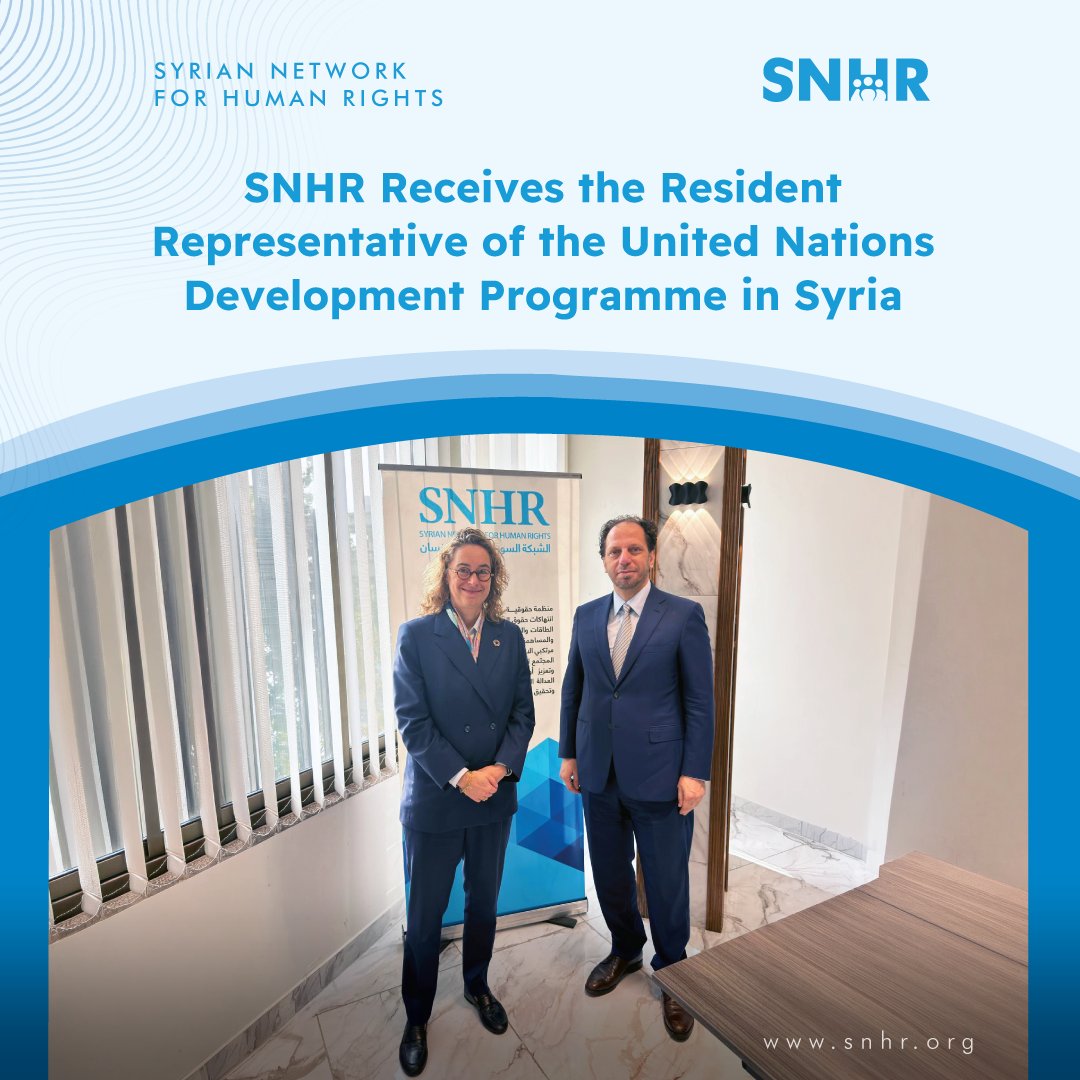
The Syrian Network for Human Rights (SNHR) received Ms. Melanie Hauenstein, UNDP Resident Representative in Syria, at its office in Damascus, to discuss strengthening cooperation on issues of mutual interest.
The meeting addressed the importance of strengthening the rule of law and institutional reform during the transitional period, supporting judicial independence and access to justice, and promoting governance, transparency, and accountability, alongside expanding civil society participation in reform processes.
SNHR emphasized the importance of continued coordination and the exchange of expertise with UNDP to support institutional reform that protects human rights and places them at the heart of Syria’s transitional period.
View full statement: https://t.co/0Vq4zfMAit
#SNHR #Syria
@MAHauenstein@UndpSyria@FADELABDULGHANY