Oh my GOD!!!!
Massive news!
Ladies and gents,
The moment we have been waiting for since 2018
"#Qnt mainnet is live"
Rest in peace to the doubters and $Qnt bears..
The only way is up now..
In sha Allah
🚀
$btc $eth $Hype $link $xrp #Crypto#btc#bitcoin $Sol #eth#ethereum
A decade in the making, we have published an ISO standard for blockchain interoperability.
This is a milestone I've been working towards since 2015, Remitt was founded with the conviction that blockchains could transform financial services but only if the industry solved interoperability and harmonised around global standards. Without that, blockchain would remain fragmented, siloed, and locked out of mainstream institutional adoption.
In April 2016, we published what was the world's first proposal for a blockchain standard (https://t.co/SL83Yl4Ejr) a bold move at a time when the industry was still largely focused on proofs of concept and competing protocol narratives, not standardisation.
The idea was simple but ambitious: if blockchains were going to serve global markets, they needed a common framework that transcended any single protocol or vendor.
Central to this thinking from the very beginning was the concept of a multi-gateway architecture, leveraging the know-how of 20 years of experience in cybersecurity to frame the principle that interoperability shouldn't depend on a single bridge or point-to-point connection, but on a layered gateway model that could abstract away the differences between underlying DLTs and connect them through a common interface. This was the architectural foundation of what would become Overledger, and it was also the design philosophy we brought to the standards process.
The belief was that a viable international standard for blockchain interoperability had to be protocol-agnostic and gateway-driven, enabling any DLT to communicate with any other DLT (any-to-any) and with existing networks, without requiring those ledgers to change how they operate. The standard and the technology were born from the same insight.
That same year, I worked closely with the team from @standardsaus (Standards Australia), who had the foresight in 2015 to champion the initiative at the international level. Together, we pushed for ISO to establish a dedicated Technical Committee for blockchain and not to be absorbed into an existing committee, but to stand on its own as a recognition that this technology warranted its own global standards programme. The industry demand was there, the use cases were multiplying, and the fragmentation was becoming a real barrier.
In September 2016, the New Work Item Proposal (NWIP) received global approval, and ISO formally gave the green light to establish a new Technical Committee (https://t.co/7biJjvHRk9). TC 307 — Blockchain and Electronic Distributed Ledger Technologies — was born (https://t.co/5SsFPIw0HH). The inaugural meeting was held in Sydney in April 2017, and from that moment the real work began.
As the standards work progressed internationally, the mission at Remitt was evolving too. What started as an effort to use blockchains for financial services and solve interoperability grew into something far larger, a full enterprise infrastructure platform for connecting any blockchain to any network. Remitt became Quant, and we built Overledger, the world's first blockchain operating system to deliver on that original vision. The multi-gateway architecture that informed the standards thinking became the core of Overledger's design: a technology layer that sits above all blockchains, providing institutions with a single integration point to access any DLT, any network, and any existing system. The interoperability challenge that drove the standards work was the same challenge we set out to solve commercially and the two efforts reinforced each other throughout.
For close to a decade since TC 307's formation, subject matter experts across the world have contributed their time and expertise to Working Group 7 — Interoperability is the committee I chair.
International standards are not built quickly they are built through consensus, technical debate, and relentless refinement. The same methodology and rigour that created the Internet, through publishing standards. The result is a published international standard for blockchain interoperability.
🔗 https://t.co/GRoR7fXNLQ
A huge thank you to @isostandards as the international standards developing organisation, to the team at @standardsaus who started the initiative in 2015 and worked tirelessly to get TC 307 approved and established globally, and to every subject matter expert who contributed to Working Group 7 over the years. This would not exist without that collective effort.
From a blog post proposing the world's first blockchain standard in 2016, to a published ISO standard in 2026 and from Remitt to Quant, from an architectural concept of multi-gateway interoperability to Overledger and a global standard, this has been a decade-long journey of building both the standards and the technology to make blockchain interoperability a reality for institutions worldwide.
There is still much more work ahead. More standards to develop, more to evolve, and more to build. But today, we mark a significant milestone.
#Blockchain #ISO #Interoperability #Standards #TC307 #DLT #Quant #Overledger
Our Founder and CEO, @gverdian, was recently quoted in @thoughtworks' latest article on #stablecoin infrastructure, highlighting a fundamental shift in how financial institutions must operate:
"Banks face a critical choice: lead in the #programmablemoney era or be left behind as the infrastructure shifts beneath them. The future will feature bank and commercial stablecoins, #tokeniseddeposits and wholesale #CBDCs operating side by side with universal interoperability, each playing a different role."
Read the full article: https://t.co/UMan3lVHGM
The @FT highlights how Lloyds Banking Group and other lenders such as Natwest, Barclays & HSBC are leading UK banking into a new era through tokenised deposits and programmable money, a shift that could fundamentally reshape how money moves, settles, and is used across the economy.
Tokenised deposits bring real cash onto blockchain infrastructure, enabling automation, real-time settlement, and smarter financial products from mortgages to payments and capital markets.
At Quant, we’re proud to be working with leading banks on this transformation. As our CEO @gverdian notes in the article, tokenised deposits represent the evolution of electronic money into digital, programmable money - unlocking efficiency, liquidity, and interoperability across the financial system.
This is about more than innovation. It’s about building the next generation of money and the infrastructure that underpins it securely, at scale, and connected across institutions.
Article: https://t.co/BPitmvYPDB
#TokenisedDeposits #ProgrammableMoney #Tokenisation #DigitalAssets #FinancialInfrastructure #Blockchain #FutureOfFinance
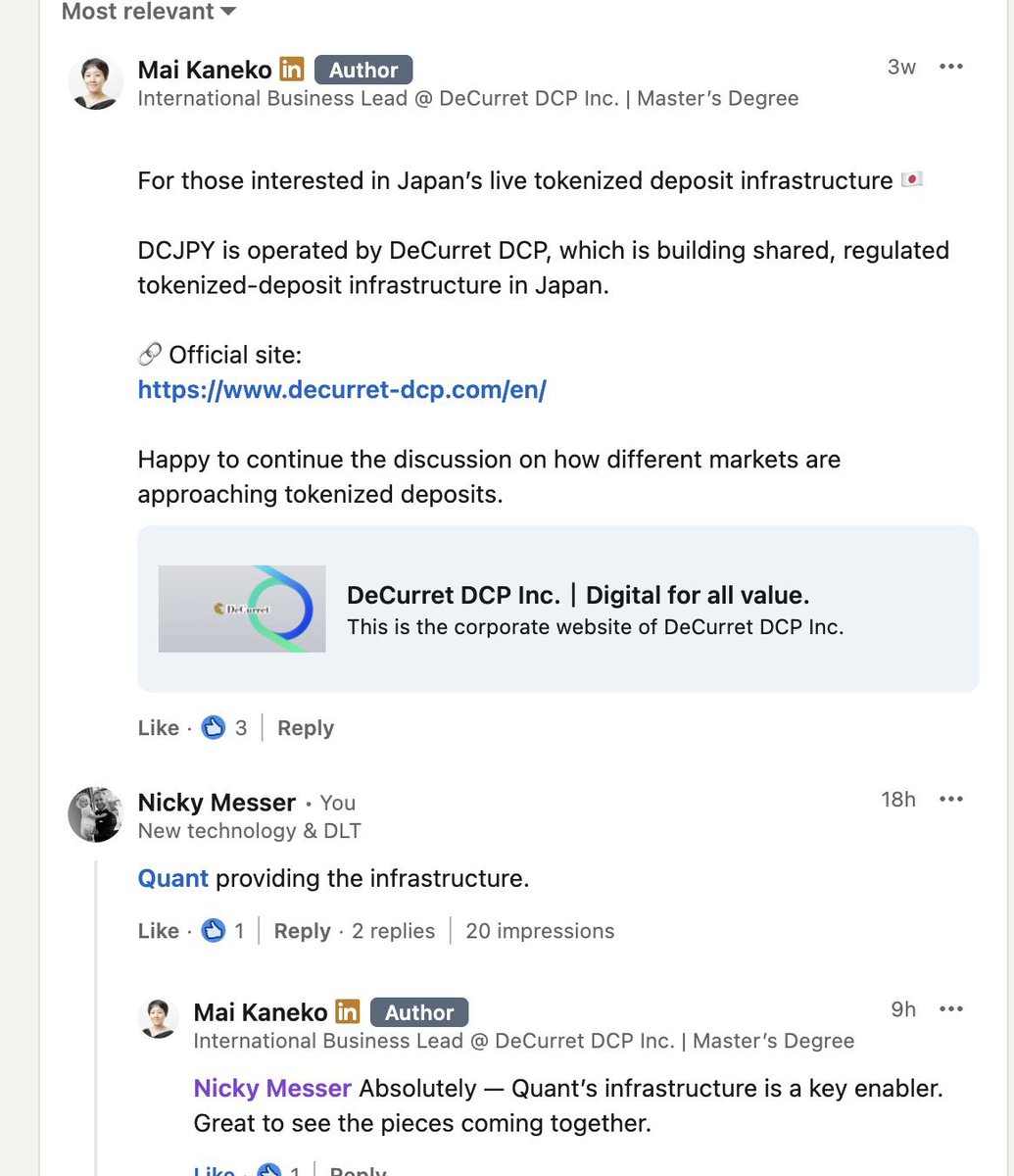
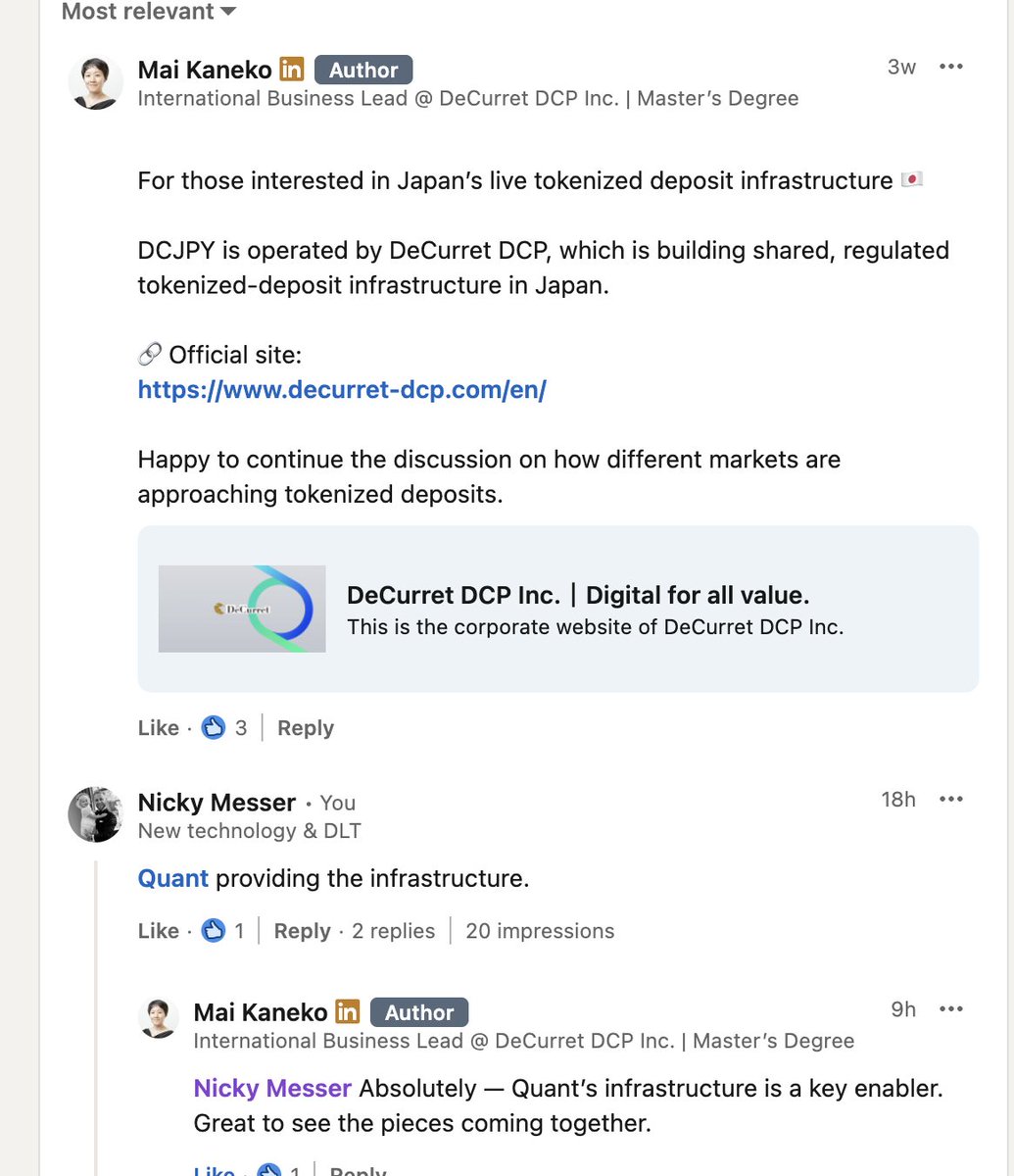
🚨BREAKING 🇯🇵🇯🇵🇯🇵
The DCJPY network involves major Japanese financial institutions like Japan Post Bank, MUFG (Japan's largest finance firm), SBI Shinsei Bank, and GMO Aozora Net Bank, working with DeCurret🔥🔥🔥🔥
Powered by $QNT - confirmed by Mai Kaneko (business lead of DeCurret).
$QNT casually bagging whole of Japan future finance infra🇯🇵💁♂️ and no one in crypto is paying attention
Expected to go live this year after years in the make👀👀🔮🔮
In this video, our Founder and CEO, @gverdian, explains what #QuantFusion is and how it offers an institutional way to use #publicblockchains.
Watch the full video to learn more about how Quant Fusion is bridging the gap between traditional finance and decentralised innovation.
#DeFi #TradFi #Blockchain #Interoperability
Your network, your rules, our interoperability 🤝
With #QuantFusion, you can bring your own nodes and even connect new #blockchains. You have the power to set access permissions, making your network private, permissioned, or public after a review. It's all about providing flexibility and control to the user.
https://t.co/R6hZusTqeF
#NetworkofNetworks #BYON #BlockchainIntegration
🚀 On our 10th anniversary, Quant is redefining what’s possible in #blockchain.
Today, we’re proud to unveil #QuantFusion’s Multi-Ledger Rollup, the world’s first “Layer 2.5” rollup technology.
More than just a scaling solution, it is a transformative step forward: capable of interoperating across multiple ledgers simultaneously and unifying duplicated assets across different blockchains - learn more: https://t.co/a6Jt943aCa
#Interoperability #MultiLedgerRollup
🚀 Ready to unlock universal interoperability with Quant Fusion?
Quant Fusion is a groundbreaking framework that enables secure and seamless integration of assets, data, and logic across any distributed ledger, whether public or permissioned. It's built on two core components: the Multi-Ledger Rollup and the Network of Networks.
Discover how it works in our latest article: https://t.co/JqXQSQ1mo0
#QuantFusion #Interoperability #Blockchain #DLT
We're delighted to announce that Quant has been selected to create the new #payments infrastructure and bank technology of the UK's #TokenisedSterlingDeposits, a groundbreaking financial market infrastructure initiative led by @UKFtweets, in collaboration with major #commercialbanks.
Building on our successful delivery of critical infrastructure components during the initial #RLN experimentation phase in 2024, the project will deliver tokenised sterling deposits (GBTD) and #programmablepayments against three transformative retail and wholesale use cases.
Read more about our involvement here: https://t.co/EKsRB9BAlu
Announcement: https://t.co/XHcbmdvPWM
News: https://t.co/7QHgsV2qUD
#GBTD #TokenisedDeposits
🚀 Quant Fusion Devnet July 11th Update:
- The Multi-Ledger Rollup Sequencer will be using Overwallet for additional security around its on chain transactions.
- The Multi-Ledger Rollup Sequencer to metamask testing passed successfully.
- We are building a connector example implementation that will be released as open source, to serve as a guide for others building their own connectors to integrate with Fusion.
- Explorer screens for the multi-ledger rollup have been finalised.
View the full technical update with implementation details, testing results, and roadmap at: https://t.co/UB25qH1Gz3
#QuantFusion
🔄 Eliminating Wrapped Tokens
Say goodbye to the complexities of wrapped tokens. With Multi-Ledger Rollups, assets from different blockchains can interact directly, simplifying liquidity pools and reducing risks with legacy layer 1 bridges.
#DeFi#CrossChain#QuantFusion #Multiledgerrollup #interoperability
🔗 Learn more: https://t.co/oYfHGBmpFU
Introducing Quant Fusion: The Core Infrastructure for Digital Asset Interoperability
Today marks a significant advancement in the evolution of blockchain infrastructure. We’re proud to introduce Quant Fusion, a pioneering new infrastructure layer that redefines digital asset #interoperability.
Built on Quant’s interoperability-first technology stack of #Overledger and foundational patents which were proven through a decade of real-world, regulated deployments. #QuantFusion interoperates and accelerates public and permissioned blockchains securely and compliantly, making blockchains ready for enterprise-grade demand.
Fusion dramatically accelerates adoption by solving the key institutional pain points of Layer 1 blockchains from fragmentation and compliance hurdles to scalability, speed and security.
We're delighted to announce that Quant was voted the Best Programmable Payment Platform at the @FutureofFinanc3 Awards last week in London.
This recognition is a real testament to the work we’ve put into building our industry-first platform that’s redefining how money works.
We'd like to thank our partners, customers, and our team for bringing our vision to life and supporting us in building a #programmablemoney platform fit for the digital economy.
Learn more about #QuantFlow: https://t.co/LYDcoqSuuI
Overledger Fusion could go live at any moment. The instant Quant says “go,” gateways will spring up across the testnet and every early block will double as a public résumé for uptime, latency and multichain reach.
Staking QNT is about to turn from speculation into bandwidth. Lock it early and you help shape the routing graph. Wait too long and you will handle only the traffic others let through.
The true race is for connectors. The first node to link an unserved public chain or permissioned ledger will own that flow of transactions and its fees for as long as its performance stays on top.
Dashboards that track roll-ups processed, rewards earned and slashing events are already in the works, so transparency will reward good operators and expose weak ones from day one.
Within months we will see enterprise pilots, CBDC test flows and asset-specific chains humming in their niches while Fusion quietly moves value between them, dissolving the silos that used to separate industries. The cross-chain era is about to move from white-paper theory to daily traffic, and the runway starts with the very first Fusion testnet block.
This Is the Chapter We've Been Waiting For $QNT
There’s a moment in every journey when everything that once felt distant suddenly becomes real.
For the @quantnetwork community, that moment is now.
After years of vision, patience, and continuous evolution, the confirmation so many have been waiting for has finally arrived:
🔸QNT staking
🔸Full activation of API Gateways
🔸Introduction of Overledger Fusion
These aren't just technical milestones—they mark the beginning of a new chapter, built on what truly matters:
Participation, Trust, and Interoperability.
Overledger Fusion isn’t just an upgrade- It’s like discovering a hidden corridor in a long-constructed building
One that suddenly opens to reveal new rooms, new connections, and new possibilities.
It’s not just another Layer 2; it’s a true Layer 2.5—an architecture that doesn’t simply sit beside existing blockchains
But actively connects them, fluidly and securely.
Fusion is technology finally meeting the reality of institutional demands: privacy, compliance, control, and security.
And at the heart of it all is $QNT.
Imagine Fusion as a vast railway junction, one capable of linking lines built with different rules, speeds, and directions
Allowing them to interact in real time, safely and seamlessly.
It’s the missing piece that finally enables institutions—those governed by strict regulations and high expectations
To step confidently into the public Web3 space, not with hesitation, but with trust.
And what powers this entire system isn’t just infrastructure—it’s the $QNT token.
Every interaction, every access point, every layer of security flows through it.
$QNT is the passport, the safeguard, the bridge.
Fusion isn’t just a technical achievement—it’s a victory for everyone who dared to look ahead.
Today marks the beginning of a new era. One no longer shaped by promises, but by presence.
And those here now are a part of it.