Good morning everyone
Public names do not always have to mean public transactions.
That is the core idea behind @Americanfort_io Send to Name.
Imagine being able to share a simple, human-readable name publicly, while your actual payment activity remains private.
Instead of reusing the same wallet address every time, each payment can generate a unique stealth address that is known only to the sender and recipient.
That means:
→ No address reuse
→ Less transaction exposure
→ Better protection against address poisoning
→ Reduced phishing risks
→ A cleaner experience for receiving payments
But the more interesting part is what comes next: Provenance Proofs.
A wallet could prove that multiple addresses belong to the same hidden origin without revealing the wallet’s seed, private keys, or complete transaction history.
This creates an interesting balance between verification and privacy.
For example, cross-chain transfers or exchange deposits could potentially become easier to verify because users can prove the relationship between addresses without publicly connecting their entire financial history.
And the architecture is built around some powerful ideas:
🔐 Zero-knowledge technology
🛡️ Post-quantum security
🔗 User-controlled linkability
👤 Privacy-preserving identity
The important part is that privacy doesn't have to mean sacrificing usability.
You can have a public identity when you want people to recognize you.
You can have verifiable provenance when verification is necessary.
And at the same time, you can keep your financial activity private when you need it.
That is the vision behind Send to Name:
Public identity when you want it.
Private financial activity when you need it.
This is the kind of infrastructure that could make crypto payments feel much more natural without forcing users to expose everything on-chain.
A boy and his pet dog were playing at the beach
Suddenly the dog realized that the boy gave him pedigree instead of bones today and decided to have the bone
was checking my usual wallets last night and ended up thinking about @Americanfort_io again.
the interesting part is that you don't have to move to some new chain for this.
Send to Name is meant to work inside the wallet or platform you're already using.
same seed.
same network.
you use a name instead of copying a long address, and the payment can go to a fresh address on that same chain.
that's actually what makes it interesting to me.
if the privacy feature only works after moving everything somewhere new, most people probably won't bother.
we already use the same wallets every day.
and most address mistakes happen while copying and pasting anyway.
so changing that part of the payment flow feels more useful than just adding another chain.
still going through the claim stuff and seeing how it works.
if your current wallet added Send to Name without asking you to move your funds or export your seed, would you use it?
or would you still copy the address like always?
One thief. One impossible escape. And a secret hiding inside the bag. 🕷️
Created with @Flovaai × Seedance 2.5 using the Script to Video Skill.
A mysterious thief, a 40-story bank, a city-wide police chase, and an escape that should be impossible. But just when you think the heist is over… the real story begins.
THE SPIDER THIEF — sometimes the biggest heist isn’t about stealing money… it’s about what you bring back with you.
Project link: https://t.co/fSNbz1FvqL
Explore FlovaAI with my promo code: R7GXDZF7
Personal invite link: https://t.co/cx6lReGvMO
#FlovaAI #FlovaCPP
Happy weekend fam 🐜
AI is developing at an incredible pace, with new models, agents, and AI-powered tools coming out almost every day.
But there’s still an important part of the AI ecosystem that deserves more attention: how people actually access these AI services.
A lot of today’s AI infrastructure is built around centralized platforms, meaning users and developers often depend on a limited number of providers.
That’s where @AntSeed takes an interesting approach.
Instead of putting everything under one platform, Antseed is building a peer-to-peer marketplace for AI services.
The idea is to connect different AI service providers with users, giving people more freedom to choose the service that fits their needs.
Users can potentially compare things like:
→ Price
→ Speed
→ Provider reputation
→ Privacy
→ Service quality
This creates a more open environment where providers can compete and users have more control over what they use.
I think this becomes even more relevant as AI agents continue to grow.
As more applications start relying on AI for different tasks, having an open and flexible infrastructure for accessing AI services could become increasingly valuable.
Antseed is working on an interesting piece of the AI infrastructure stack, and it’s definitely a project worth watching. 🐜
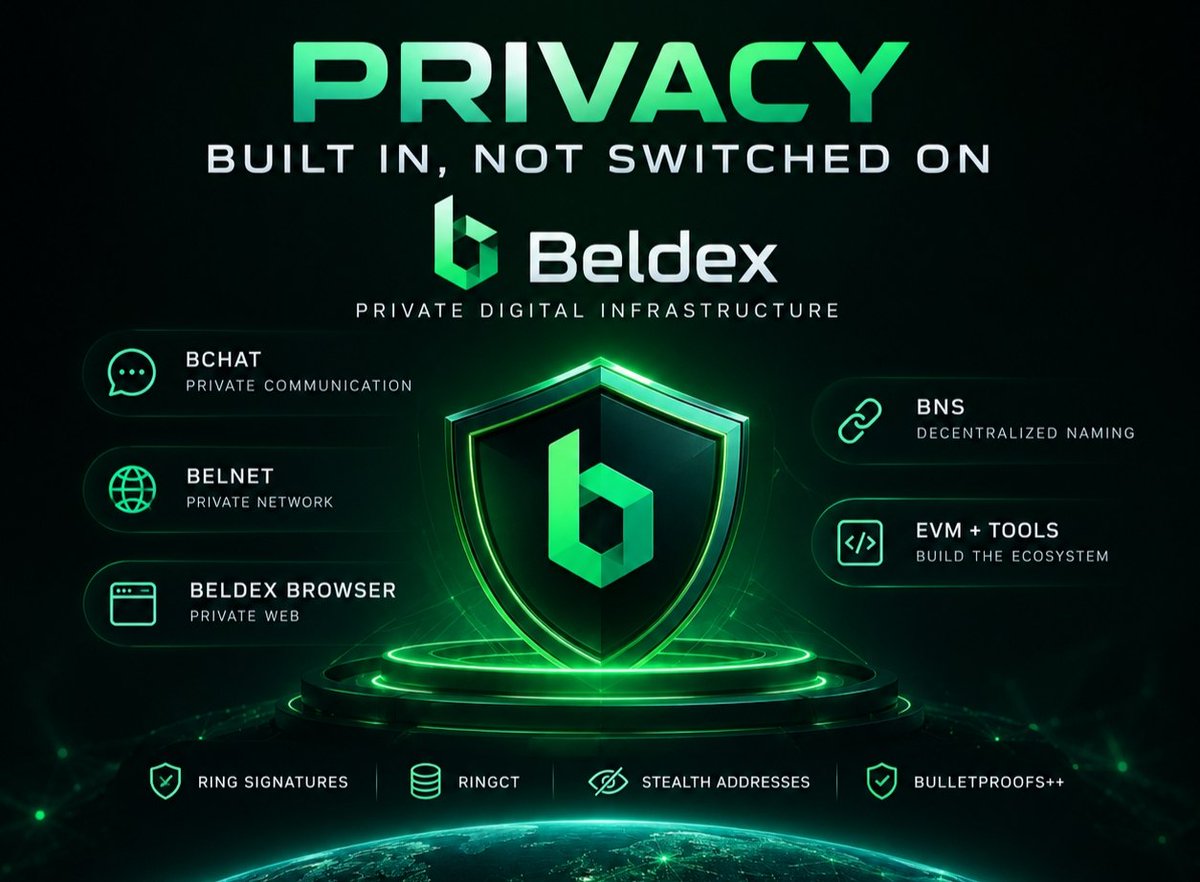
Privacy in Web3 shouldn’t be a feature you remember to switch on.
It should be part of the foundation.
That’s the part of @BeldexCoin that keeps pulling my attention.
Most crypto conversations revolve around ownership, decentralization, and transparency. But there’s an important question sitting underneath all of that:
Does everything you do really need to be public?
Beldex is approaching that problem from multiple layers.
→ BChat for private communication
→ BelNet for privacy focused network connectivity
→ Beldex Browser for a more private web experience
→ BNS for decentralized naming
→ EVM infrastructure + developer tools for building within the ecosystem
$BDX
How to open the drawer in the tasks @axisrobotics
/ camera angle is the same as in the video
/ robot's gripper slightly extended forward
/ pulling toward the bottom right
https://t.co/izTPYb9vGV
Bitcoin has already proven that it can be a powerful store of value.
But there’s another question:
What if BTC could become much more useful without changing Bitcoin itself?
That’s the direction @Starknet is taking with its Bitcoin strategy.
Instead of treating BTC as an asset that simply sits in a wallet, Starknet is building infrastructure around it so Bitcoin can interact with applications, DeFi and programmable financial systems.
And this is where strkBTC comes in.
strkBTC is a Bitcoin-backed asset on Starknet that gives BTC a way to move into this environment and interact with Starknet applications.
From there, BTC can be used across different forms of DeFi, including crypto lending, liquidity, trading and staking through supported protocols.
But Starknet is also tackling another limitation of Bitcoin:
financial privacy.
Bitcoin’s transparency is one of its defining characteristics, but it also means balances and transaction activity can be publicly visible.
With STRK20, Starknet introduces shielded balances and private transfers for supported assets, with strkBTC being the first asset to use the framework.
The important part is that privacy is an option, not a claim that every activity is automatically private.
So the bigger picture starts to make sense:
Bitcoin provides the asset.
Starknet provides the programmable environment.
strkBTC connects BTC to that environment.
STRK20 adds another layer of control over what information is exposed.
And Starknet’s roadmap goes further, with plans for increasingly trust-minimized Bitcoin infrastructure beldexcoin and deeper BTCFi integration.
So I don’t think the interesting story is simply “Bitcoin on Starknet.”
It’s what happens when Bitcoin gets access to an environment where it can be used, composed and programmed, while users get more choice over how their activity is exposed.
Bitcoin doesn’t need to become something else.
The idea is to give the Bitcoin economy more room to build.
This is the kind of update that makes #SocialMining feel even better
@TheDAOLabs keeps improving the WhoTweets and Caffè Barbera Hub experience with faster loading, real time spoiler alerts, Reddit analytics, clearer earnings tracking, and even that satisfying ka ching when you earn 💰
Small details, big difference. The whole flow now feels faster, cleaner, and more rewarding.
This is a great upgrade for #DAOVERSE & #Barbera1870 👏
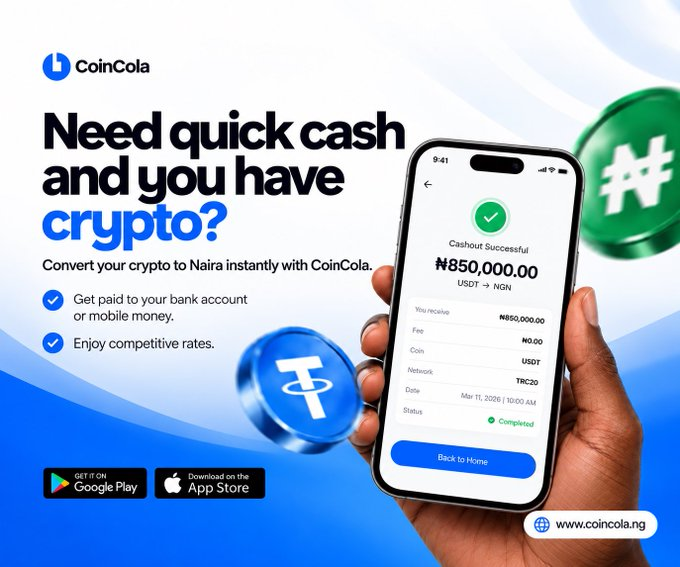
I have used platforms where the experience basically ends at “match buyer with seller.”
But P2P is more than matching two wallets.
◽️ What happens when payment is disputed?
◽️ Who holds the crypto?
◽️ How do you verify the trader?
◽️ What happens when you need help?
CoinCola’s model puts escrow into the trade flow while supporting KYC and local NGN markets.
That changes the experience from:
“Hope this trade goes well to follow the process and keep the trade on-platform.”
Thanks to CoinCola
#CoinColaGiftcard #CoinColaP2P
Founders put a lot of thought into who they hire. Much less into who they spend their time with.
Every member of the Club is screened for more than revenue. We look for people who give as much as they take, and you can tell at the table. A lot of conversations start with two questions: what can you give, and what are you hoping to get? People answer honestly, including about the parts of the business that aren't going well, and that's when the feedback gets useful.
The Founders Club is 1,800+ founders running 7, 8 and 9-figure companies across North America. Around 5% of applicants get in.
If you're a founder running a business doing 7-9 figures, book an intro call.
gSleep
Sleep data is everywhere.
The real question is what happens after you collect it.
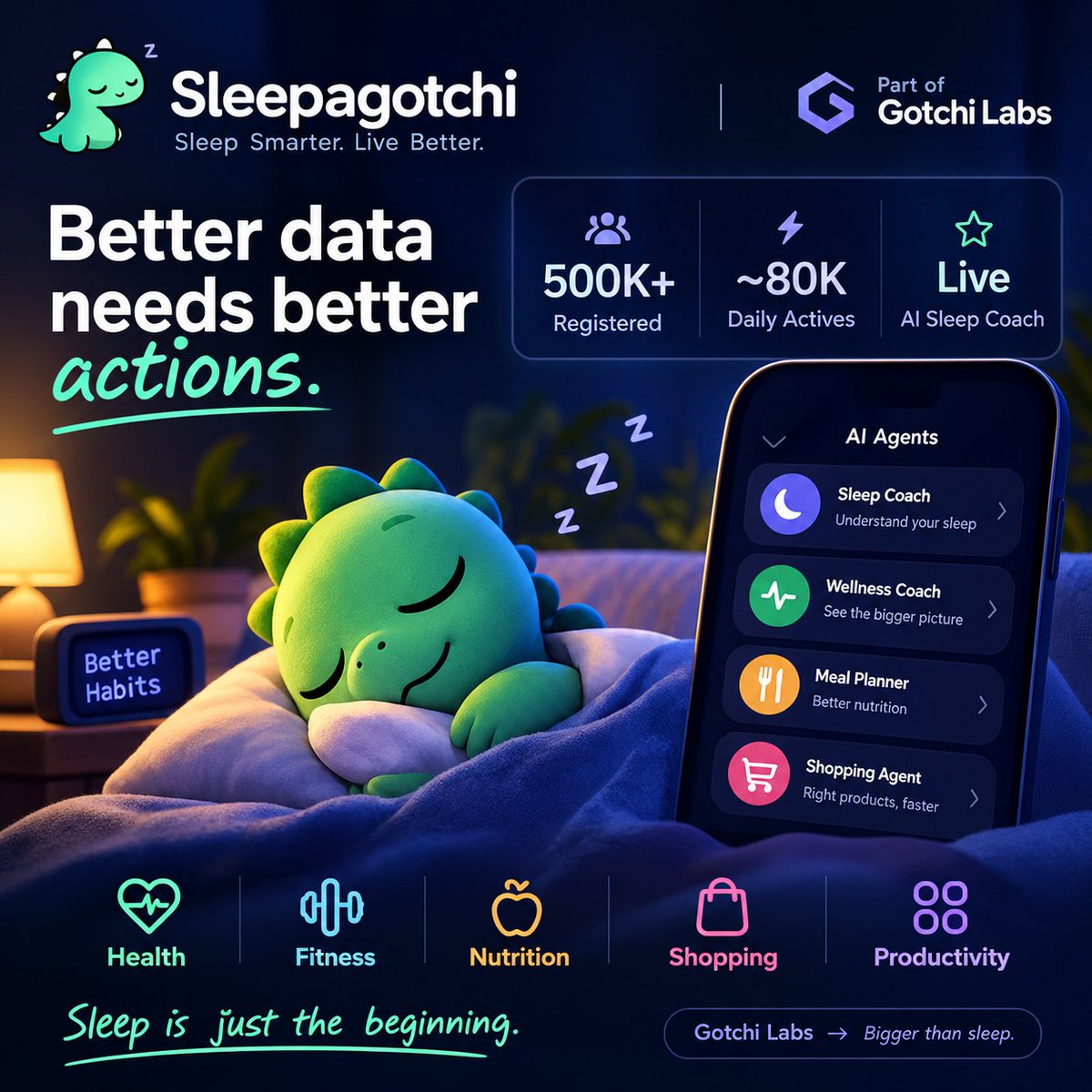
That’s the part I find interesting about @sleepagotchi.
Instead of stopping at sleep scores and charts, it is building an AI layer that can turn sleep, recovery, activity and wearable signals into something more practical: context, recommendations and actions.
Sleep Coach is already live, and the broader agent system points toward something bigger.
Understand the signal → find what changed → decide what to do → actually take action.
The game layer adds another interesting piece. Better routines become something you can build consistently rather than another health metric you check once and forget.
And Sleepagotchi is now the first live Health & Wellness vertical under Gotchi Labs.
500K+ registered users
~80K daily actives
AI Sleep Coach live
But the bigger idea isn't really about sleep.
It’s about building specialized AI that can understand different parts of everyday life — health, fitness, nutrition, shopping, productivity and more.
Sleep may be the starting point.
The real opportunity is turning personal data into useful decisions that happen in the background.
That’s a much more interesting direction for consumer AI.
She thought the house across the lake was abandoned… 🌫️🏚️
Then she saw someone inside who looked exactly like her.
Created with @Flovaai + Seedance 2.5
Skill: Script to Video
Project Link: https://t.co/tOaRgJ43xT
Promo code: SACUS9Y7
Invite link 👇
https://t.co/T5C32eMCHn
#FlovaAI #FlovaCPP
Most people missed @base Builder Roundtable 002.
Here’s a recap of what came up during the discussion, where Luis from Aerodrome, Donjon from Virtuals, Danny from Bankr, Gon from https://t.co/zRmiGqf3Zg, Zips from BaseStonk, and Nick discussed the growing market for tokenized equities on Base.
Luis started with the activity already happening across the ecosystem.
Volume has been strong, with attention moving quickly between different stocks. Meta was particularly active over the previous 24 hours.
On Aerodrome, users can provide liquidity using tokenized equities such as Meta alongside USDC, with current pools offering over 100% APR through AERO incentives or trading fees.