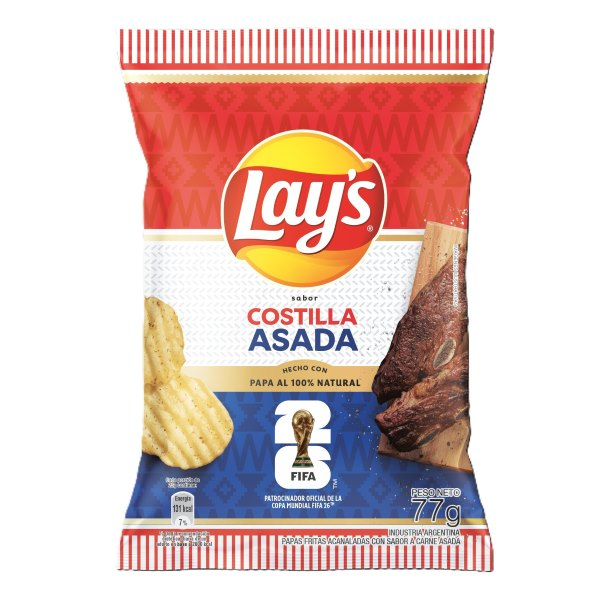
This week, somewhere, a few warehouses are probably scrambling to keep up with one specific Lay's flavor: Costilla Asada. Asunción, where it originated; Boston, where Paraguay pulled off its World Cup feat yesterday; Philadelphia, where they play again in a week.
To explain that, I need to back up. Capturing attention across 104 matches in 39 days is hard enough. It's harder when your biggest competitor owns the official sponsorship and you don't.
Pepsi the beverage has no World Cup rights, because that category belongs exclusively to Coca-Cola. So PepsiCo entered through a different door: Lay's, as a Tier 2 official sponsor. And instead of trying to out-market a rival with deeper tournament rights, they treated it as what it actually is, an execution problem at global scale, with one unpredictable variable at the center: who wins.
It launched a program of 40 flavors inspired by the cuisines of competing nations. Rather than increasing production at a centralized plant, it activated a network of regional co-manufacturing centers and local production hubs near the host stadiums. The company operates more than 30 factories and 200 distribution centers in the US and Canada.
For this tournament specifically, they're deliberately overproducing and building buffer inventory, using digital twins to simulate demand spikes. If an underdog advances, demand for a specific flavor can spike overnight in a single host city.
At Databricks' Data + AI Summit 2026, PepsiCo showed the machinery behind that: 125 million demand forecast combinations run weekly, 80%+ accuracy in direct-to-store distribution, a 60% cut in compute costs. Planners run real-time "what-if" scenarios, and AI agents are starting to catch anomalous demand before a human would notice it.
Meanwhile, the "No Lay's, No Game" campaign is running in 90 markets, with Messi, Beckham, and Steve Carell opening bags on camera. And Paraguayan players like Gustavo Gómez.
That’s the difference between sponsoring an event and running one.
Football unites, technology enables and the teams that build the infrastructure behind those moments rarely get the spotlight. Proud that @Globant is one of them. Four years shaping what happens behind the scenes of the world's biggest stage. Here we go!
Football brings people, cultures, and communities together like nothing else. ⚽️
Proud to have worked alongside @FIFAcom for more than 4 years and with the @fifaworldcup 2026 just one week away, there's no bigger stage to be part of!
#FIFAWorldCup
La noticia del sector retail que más me llamó la atención la semana pasada fue la compra por parte de @marksandspencer de 11.000 licencias de @Microsoft 365 @Copilot para sus gerentes de tienda y centros de soporte.
Esta iniciativa va a incluir programas de capacitación y la adopción de herramientas de IA y de IA con agentes para facilitar tareas como el acceso a información y análisis de forma más sencilla y rápida, liberando tiempo para centrarse en las necesidades del cliente.
No se trata de una operación piloto, sino de un despliegue masivo, y esa diferencia representa una decisión significativa. Aborda un desafío que he presenciado de primera mano con muchos clientes: el uso de la IA ya no puede limitarse a presupuestos reducidos, bajo riesgo y sin un compromiso real; tiene que avanzar hacia la implementación en los últimos metros del negocio, donde se define la relación con el cliente.
La marca tiene más de mil tiendas en el Reino Unido. Si la implementación es exitosa, no estará comprando software, sino tiempo valioso en la tienda.
El problema que aborda es universal. En Estados Unidos, el último informe de la @NRFnews (ver captura abajo) reveló que el 15,8 % de las ventas minoristas anuales se devuelven, lo que representa un total de 849.900 millones de dólares. El 71 % de los consumidores afirma que no volverá a comprar en una tienda tras una mala experiencia de devolución. La atención se centra en la Generación Z, que devuelve un promedio de 7,7 productos al año.
Las empresas que se basan en simulaciones de IA en las oficinas de gestión seguirán perdiendo terreno, mientras que aquellas que se atrevan a tomar decisiones como Marks & Spencer e implementen la IA en sus operaciones diarias ahorrarán considerablemente al conectar mejor con sus clientes.
Regulations are usually treated as a reason to slow down: sometimes they are manual, fragile, and hard to scale. But what if you stop seeing them as a burden and start treating them as an engineering problem?
@SomosCMPC is a pulp, paper and packaging company operating in more than 45 countries, and the EU Deforestation Regulation (EUDR) was creating compliance processes that took up to 12 days. Today it runs in less than 3 minutes.
Working with their team, we rebuilt that process on SAP Clean Core and AI.
But the real story isn't the speed. It's that a compliance requirement became a competitive capability.
The limit forces you to be creative. Regulatory pressure doesn't have to be a bottleneck. Sometimes it's the clearest brief you'll ever get.
Compliance is no longer back-office. It’s a strategic capability. With @SomosCMPC, we built an AI-powered solution that reduces traceability from days → minutes.
How AI is transforming supply chains
👉https://t.co/6qPgaTx74d
I can't stop watching @agustincreevy episodes on his YouTube channel. The guy captained Los Pumas and played over 100 caps for the national team. He retired last year at his lifelong club, San Luis, and now indulges his curiosity and his theatrical side by interviewing people and traveling the world.
I think he's a perfect example of how life takes unexpected turns, and those who learn to adapt to change with a broader set of personal skills are the ones who truly win.
In one of his latest episodes, he visited Alexis MacAllister, a star of the Argentine national soccer team, at his home in Liverpool. Agustín admits that football isn't his main interest, Alexis confesses that he'd rather talk about anything but soccer, and a spectacular exchange unfolds around the grill, fueled by their shared curiosity and enthusiasm.
The episode already has over a million views in just two weeks, so I'm not exactly breaking new ground, but I had a snippet I wanted to share.
Alexis explains that his sleep routine starts after dinner, about three hours before bedtime. He puts his phone on airplane mode and dedicates some time to reading, some to writing in his journal, jotting down what happened during the day or whatever comes to mind, and twenty minutes to meditation.
The effect is undeniable: he sleeps better and wakes up refreshed and ready to train or play.
What he shares evokes two feelings in me simultaneously: enthusiasm and frustration. Like so many of the messages I receive daily on social media where someone explains the three keys to a better life. If you take everything at face value, you quickly become paranoid about having to be someone else to keep up with everybody.
I prefer to let in the reflection of admiration I felt when I heard him speak, and the modesty to propose a small change: today I'm going to turn off my screens a little earlier and read. And I'm going to read differently than I usually do: without X's timeline on the side, I'm going to look for something that pulls me out of the sea of information about AI and physical enhancement that, every now and then, exhausts me.
https://t.co/mo7enVgBIh
This is exactly what CPG, Retail & Manufacturing have been waiting for — and didn't know how to ask for.
Real examples already running with AI Pods:
→ A CPG brand: trade promotion optimization agent → $4M in recovered spend, no incremental headcount.
→ A specialty retailer: inventory intelligence pod → stockouts down 31%, replenishment on autopilot.
→ An industrial manufacturer: SAP migration agent-assist → 40% faster go-live, human experts on governance only.
The shift: clients stop buying IT hours. They subscribe to outcomes. Speed, savings, scale — supervised and governed at enterprise grade.
Flywheel is very much live 🔥
@JulienBek Nailed it — $1T future = agentic software disguised as services, delivering autopilot outcomes.
Globant’s AI Pods deliver it today: AI agents doing the heavy lifting + 24/7 expert supervision for enterprise-grade governance at blue-chip scale. Outcome subs replacing IT spend fast.
Supercharge with our Agentic Hub: onboard your specialized agents (upload/create/publish no-code), orchestrate workflows, and instantly tap our thousands of enterprise clients — security + oversight included. Production revenue in weeks.
Proposals:
1. Onboard a Sequoia agent startup to our Agentic Hub + run a joint pilot at a shared enterprise client → instant traction.
2. Run a pilot: swap a big outsourcing client to AI Pods → 2x speed/savings demo in weeks.
Flywheel live. DMs open (or email me to [email protected] ) let's onboard and build. 🚀🤖 #AIPods #AIAutopilots
5) To be valuable in the long term, you have to think of the business in terms of communities, not sales categories. People's lives dictate the path forward much more than any fleeting purchase impulse.
Dick’s Sporting Goods is one of the most downloaded apps in the United States, on par with ChatGPT, Claude and Gemini, and this article got me thinking about several concepts relevant to the present and future of the retail world 🧵
https://t.co/OVhXgOTQ1c
4) Loyalty isn't built with discounts, but with real value. Dick’s is an example of how a brand wins if it can position itself at the heart of a family's sporting life.
@JulienBek Nailed it — $1T future = agentic software disguised as services, delivering autopilot outcomes.
Globant’s AI Pods deliver it today: AI agents doing the heavy lifting + 24/7 expert supervision for enterprise-grade governance at blue-chip scale. Outcome subs replacing IT spend fast.
Supercharge with our Agentic Hub: onboard your specialized agents (upload/create/publish no-code), orchestrate workflows, and instantly tap our thousands of enterprise clients — security + oversight included. Production revenue in weeks.
Proposals:
1. Onboard a Sequoia agent startup to our Agentic Hub + run a joint pilot at a shared enterprise client → instant traction.
2. Run a pilot: swap a big outsourcing client to AI Pods → 2x speed/savings demo in weeks.
Flywheel live. DMs open (or email me to [email protected] ) let's onboard and build. 🚀🤖 #AIPods #AIAutopilots
Better late than never, Chinese plug-in hybrid cars are invading Argentine streets, and a friend called me to ask which one he should buy.
He knows it's an industry I follow closely and that I'm always up-to-date on the latest developments.
He'd been switching between different Toyota Corolla models for years, but now he has two kids and needs more space. He says he was about to go straight for the new Yaris Cross to stick with the reliability of the Toyota brand, but then he saw that the BYD Atto 2 is much cheaper, and that it also responds to voice commands to open and close the roof.
"Hi, BYD, can you open the roof?". "Yes, of course", the car replies, and the lights come on.
"I know it's a small thing", he told me sheepishly, "but it made me feel like a kid with a toy".
Of course, it's not a small thing at all. What a customer experiences firsthand with a product or service can define everything, even if it's just a small detail.
In that sense, the automotive companies I work with aren't just rethinking propulsion —they're rethinking what a car is. Is it a device? A service? A data platform? The answer changes everything: the business model, the customer relationship, the software stack, the talent you need. Most traditional manufacturers are still organized to build vehicles. The ones moving fastest are those that figured out they're actually in the business of building experiences —and started hiring and investing accordingly.
Today, moreover, the sale is the final stage in the relationship between the brand and the customer, because anyone can arrive at the dealership ultra-informed, if not through websites or social media reviews, then at least through a friend who likes cars and knows a bit more. The salesperson no longer fulfills the omniscient role they once did.
That's why the automotive industry, like so many others, isn't transitioning to electric cars. It's transitioning to something it doesn't yet know how to name.
“How much happiness will that silly thing bring you?”, I asked my friend. And his answer sealed the deal.
Last October, I was at the Austin Grand Prix and witnessed firsthand the level of detail with which @Globant contributed its creativity and technology to provide teams with almost unlimited real-time information and capabilities at 300 kilometers per hour, when a single micro-decision can decide a race.
That meticulous attention to detail has now been incorporated into the @F1 fan app, allowing them to feel even more immersed in the experience, just as we've been doing with @FIFAcom, @LaLiga, and at the @LAClippers Intuit Dome.
Motorsports is not the sport I watch the most, but in a single race I saw the emotion it can arouse. The thrill of watching cars whizz past like lightning was missing the thrill of catching them and having them within reach, and now that's possible. Congratulations to the teams who worked on its development and implementation.
🏁 Before the 2026 season lights go out: in 2025, decision-making in F1 got faster thanks to real-time data and AI at scale integrated by Globant.
Now, as official partners of Formula 1, we’re evolving the official @F1 companion app to bring fans closer to the race than ever. 🏎️⚡
👉 https://t.co/LQnMy4FEUT
The fourth-quarter results show that @Globant continues to demonstrate strength and innovation in a challenging global environment.
The company reported revenue of US$612.5 million, exceeding both the consensus (US$605.7 million) and our guidance, and the market reacted: the stock (GLOB) rose more than 3% on Wall Street after yesterday's close.
As our CEO @migoya stated, Globant is ready to capitalize on the transition from AI experimentation to large-scale production execution. We're already working on it. Our AI Pods are service delivery units powered by AI and overseen by humans. They are increasing productivity, transparency, and customer autonomy over their own projects.
We continue to find growth opportunities in strategic verticals, one of which was highlighted by our CFO Juan Urthiague: “We have seen consumer retail and manufacturing performing very, very well. We continue to expect to see that behavior in that particular industry.”
The fact that consumer retail and manufacturing are driving growth confirms something we see every day: when transformation focuses on real impact—efficiency, experience, and scale—the results follow. I am proud of the team and the work we are doing to turn context into opportunity.