RSVP is French for “Répondez s'il vous plaît” which means “respond, please” and literally means “Respond, if it pleases you”. English uses lot of French phrases verbatim. Some of them are :
1. Faux pas (false step)
2. Quelle surprise (what a surprise)
3. À la carte (by the menu card)
4. Bon appétit (good appetite)
5. Résumé (summary)
6. Fait accompli (thing done / done deal)
7. En route (on the way)
8. déjà vu (I have already seen)
9. Au contraire (on the contrary)
10. Enfant terrible (disruptive child)
11. Touché (valid)
12. Voila (there it is)
13. C'est la vie (that is life)
14. Coup d'état (strikeout of the state)
15. Raison d'être (reason to be)
16. Tour de force (feat of strength)
17. Vis-a-vis (face to face)
18. M’aidez (help me) - distress mayday signal
19. Double entendre (double meaning)
20. laissez-faire (allow to do)
Evil rarely announces itself.
Hannah Arendt didn’t warn us that the greatest danger would come from monsters.
She warned us it would come from ordinary people who stop asking questions. People who trade conscience for slogans, curiosity for certainty, and morality for obedience.
The lesson of the Holocaust was never just about one man. It was about what happens when a society decides that thinking is optional.
Every generation believes it would have stood against evil.
History keeps asking the same question:
Would you have?
Or would you have simply gone along because everyone else did?
That’s why Arendt still matters. And that’s why this conversation matters. Because the opposite of evil isn’t outrage.
It’s the courage to think for yourself.
New #Podcast! "Big Data and Nursing Education" Dean Linda McCauley discusses why nurses need to be prepared in data science and implications for nursing education. #ApplePodcasts https://t.co/AUJJEfpUBc #GooglePlayMusic https://t.co/yP7TtDESwk
New #Podcast! "Faculty Podcast Toolkit"
Podcasts are a popular educational tool that can be used to deliver content in asynchronous online education.
#ApplePodcasts: https://t.co/AUJJEfpUBc
#Spotify: https://t.co/itZSEGKdNU
Do not talk about discernment if you cannot recognise when someone needs compassion more than criticism and correction. There is a time to guide and a time to simply hold space for a person who is hurting. Wisdom knows the difference. And kindness knows it even faster.
Major cheat code in life: Most of your emotions are notifications, not emergencies. That wave of anger? A notification. That pang of jealousy? A notification. You can acknowledge it without acting on it immediately. Not every feeling requires a response within the hour. Most can wait until morning.
Your plastic Tupperware drinks cooking oil like a sponge drinks water. That's why no wash works.
Polypropylene sits at 30 mN/m surface energy. Olive oil sits at 32. Water sits at 72. The plastic and the oil are nearly the same family of molecule. They bond on contact.
The mechanism is solvent chemistry. Polypropylene and polyethylene are long hydrocarbon chains. Cooking oils are also hydrocarbon chains. "Like dissolves like" is the basic rule. After about 30 minutes of contact, oil molecules slot into the microscopic gaps in the polymer matrix. The surface swells. The container becomes an oil-saturated polymer.
This is why soap fails on the 5th wash. Soap is amphiphilic, one end grabs water, one end grabs oil. But it can only act on what's actually on the surface. The oil that absorbed into the plastic wall is sitting below the working zone. You're scrubbing a surface that has nothing left to remove.
Same mechanism explains why your curry-stained Tupperware never recovers. Turmeric and tomato pigments dissolve in oil. The oil dissolves into the plastic. The pigments come along for the ride and embed inside the polymer wall. The orange tint is structural now.
Glass doesn't do this. Surface energy around 300 mN/m, roughly ten times higher than plastic. Oil sits on top. Water displaces it instantly. Soap finishes the job in one pass. That's why your grandma's Pyrex from 1985 still looks new and your six-month-old Tupperware looks ten years old.
One number on a materials chart. That's the entire difference.
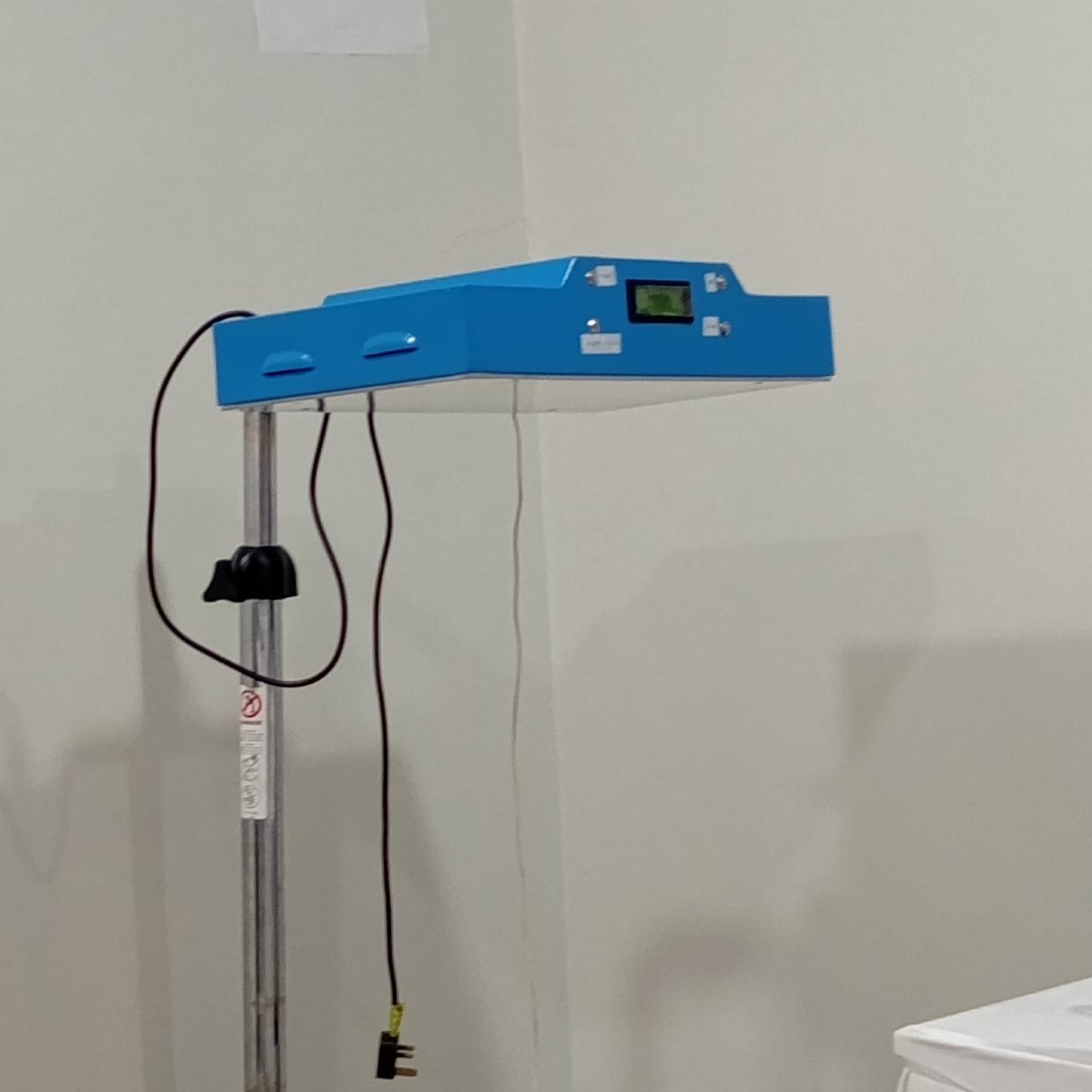
A proud moment unveiling a Proudly Kenyan Newborn Phototherapy Machine 🇰🇪
Locally developed, efficient, easy use, available spare parts & costs 25% of imported devices.
Led by Prof. Eng George Kamucha (technical), Prof. Grace Irimu (clinical).
KEBS approved, clinical trials next.
Maybe you go slower. Tasting it with your entire mouth. Because it’s that good. Maybe you listen like you’re making memories. Because you are. Maybe you give it your full attention. Because loving it is in the details. There. Because your life deserves so much more than brevity.
A list of Restaurants in Nanyuki worth a try.
#Thread
1. Jibs Cafe Bistro- Their lamb chops are 😋. I always come back specifically for that served with mashed potatoes, mixed veggies and mushroom sauce.
Be careful with the idea that ‘everyone is replaceable.’ Some people are truly one of a kind. If you lose them, life won’t hand you another version—you don’t meet certain souls twice.
And who said scholarship transcends commentary? It's still commentary - only interpretive. For every scholarly claim (what we call “research”), there's a counterclaim. Scholarship, then, is not the elimination of subjectivity, but the disciplined negotiation of interpretations.
People can only meet you as deeply as they’ve met themselves and if you carry a lot of depth and have the inner world of an ocean it will feel like drowning to anyone who’s never left the shore
This reminds me of a fascinating story I read,of when in the 1970s Daniel Everett,a linguist and Christian went to the Amazon jungle to convert a tribe called the piraha people to Christianity and completely failed for one crazy reason 😂😂
When Daniel Everett arrived with his wife and kids at the remote Pirahã village in the Amazon, His mission was clear…learn their language,translate the New Testament,and convert this isolated hunter gatherer group to Christianity.
What he encountered instead was one of the most radical cultural and linguistic worldviews ever documented 😂.
From his experience,Everett eventually formalized what he called the “Immediacy of Experience Principle”. What this means in essence is the Pirahã culture and grammar strongly constrain what can be meaningfully discussed or believed…to them,knowledge must be anchored in direct,personal observation or at most in the recent testimony of living people you know.
Things that happened long ago,that no one alive has seen,or that exist only in abstract or supernatural realms fall into the category of what they called xibipío (“gone out of experience”). They don’t deny it outrightly.. to them, such things simply carry no weight and are not worth serious talk.
This principle shapes everything for them… and is why they have No creation myths or origin storis , No numbers beyond rough quantities like “a few” or “many.” , No recursive embedding in grammar (you can’t easily say “kelvin’s brother’s house” … you say two separate sentences). Their Stories and discourse stay tethered to the here and now.
Now Christian theology, by contrast, is built on precisely the kind of claims the Pirahã worldview filters out…A distant creation,Miracles and events from thousands of years ago, A savior no living person has met, Salvation and afterlife described in ancient texts.
Everett tried …He told them the story of Jesus..his birth,teachings,death,and resurrection. The Pirahã listened politely,then asked the questions their language and culture demanded…
“Have you met this man?”
“Did you see him?”
“Did your father see him?”
When Everett admitted he had not , that these events happened 2,000 years earlier and were known only through a book,the conversation effectively ended 😂.
“That’s interesting,” some of them would say, treating the Gospel the same way they treated any other distant tale…as something outside lived experience, therefore irrelevant to how they live and what they believe.
Notice It wasn’t hostile rejection(like the one you’d get from the people of the sentinel islands in India). It was epistemological incompatibility. The theology couldn’t even gain traction because their entire system of knowledge validation rejected second hand ancient testimony.
Everett kept trying for years. He failed to produce a usable Bible translation. Meanwhile, living among people who were profoundly content, generous, and empirically grounded …with no concept of sin, eternal punishment, or a distant deity.
By 1982 he himself started havinv serious doubts about his beliefs and by 1985 he had quietly become an atheist. The man who had come to convert the Pirahã had instead been “converted” by their way of seeing reality.😅
As Everett later wrote and said in interviews, the deepest challenge wasn’t an argument against Christianity. It was living inside a culture where the very criteria for what counts as real knowledge made supernatural historical claims feel as weightless as yesterday’s dream.
The Pirahã didn’t need to debate theology. Their language and worldview simply had no slot for it and, in the process, they helped a missionary lose his faith without ever raising their voices.😂
Makes you wonder, what would a Christian say the fate of these people is? Eternal torment? We can all see how that would be problematic.
Would they somehow make heaven and get judged by how they live their lives? But That would make the whole Christian message irrelevant. 🙂