True, but social democracy holds its ground only under conditions we too readily assume are normal. They are not. They are rare, and they decay.
AOC and Mamdani are not the alternative to that decay. They are its destination, stated openly. Their ideal is democratic socialism, and democracy does not survive socialism’s embrace: once you concentrate economic control, the ballot that installed it can no longer remove it. Voted in, it does not vote out.
The postwar Germans understood this better than anyone, because they had just lived through the alternatives. They built consensus by putting freedom first — property, markets, competition — and treating social peace as the dividend of a productive economy, not as the economy’s master. Social democracy is not a milder socialism. It is capitalism first, with regulation that keeps markets honest and support for those who genuinely fall.
The word order is the entire argument. Every euro of social spending is downstream of a productive economy you have to let produce.
Europe is forgetting this. Redistribution justified by “fairness” is draining the base that funds the fairness. Let “the social” override the economy that serves it, and social democracy reverts, quietly, to the thing the postwar order was built to prevent.
Study us before you emulate us. We’re running the failure mode live.
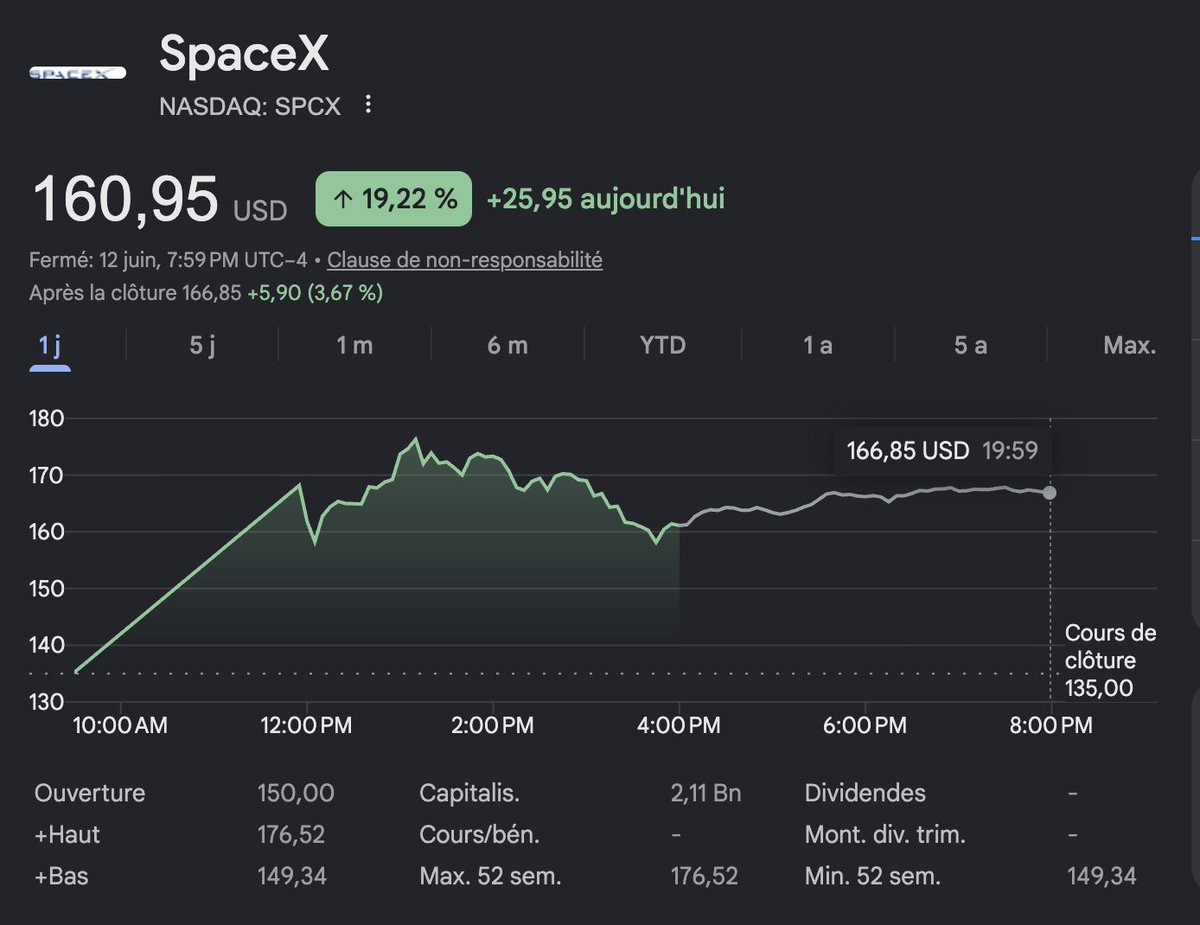
SpaceX a clôturé son premier jour de cotation à 2 100 milliards de dollars, +19%. Tout le monde regarde le chiffre. Personne ne regarde ce qu'il price réellement.
Laissez-moi vous dire ce que le marché vient d'acheter, et pourquoi je pense que cette boîte vaudra 30 à 50 trillions d'ici 5 ans.
D'abord, le symbole. Cette IPO est un référendum. D'un côté, 20 ans de discours sur la décroissance, la sobriété, la redistribution, la fin de l'histoire gérée par des comités. De l'autre, un homme qui a dit "je vais rendre l'humanité multiplanétaire", que tout le monde a traité de clown, et qui vient de créer la plus grosse entreprise cotée de l'histoire en partant d'un entrepôt à El Segundo. Le marché a voté. Le wokisme avait des départements RH, SpaceX avait des fusées. Les fusées ont gagné.
Ensuite, la mécanique économique, parce que c'est là que tout le monde se trompe. Les analystes valorisent SpaceX comme une entreprise de lancement plus Starlink. C'est comme valoriser Internet en 1995 sur le marché du fax. Starship ne réduit pas le coût du kilo en orbite de 20%, il le divise par 100. Et chaque fois dans l'histoire qu'un coût d'infrastructure est divisé par 100, ce n'est pas le marché existant qui grossit, ce sont des industries entières qui naissent. Le coût du calcul divisé par 100 a donné Internet, le smartphone, l'IA. Le coût de l'orbite divisé par 100 va donner une économie spatiale complète.
Faisons la liste de ce qui devient rentable quand le kilo en orbite coûte le prix d'un billet d'avion. Les data centers orbitaux, avec énergie solaire continue et refroidissement gratuit, au moment exact où l'IA fait exploser la demande énergétique terrestre. La fabrication en microgravité de semi-conducteurs, de fibres optiques, d'organes imprimés impossibles à produire sous gravité. Le tourisme orbital de masse, puis les hôtels lunaires, qui passeront du fantasme au business plan exactement comme la croisière de luxe au 20ème siècle. Le transport point à point terrestre, Paris-Tokyo en 40 minutes. L'industrie minière des astéroïdes, dont un seul corps de classe M contient plus de métaux que tout ce que l'humanité a extrait depuis le néolithique. Et Mars en ligne de mire, pas comme destination touristique, mais comme le plus grand projet d'infrastructure jamais entrepris, avec tout ce que ça implique de demande en énergie, matériaux, robotique, IA.
SpaceX ne participera pas à ces marchés. SpaceX possède le péage d'entrée de tous ces marchés. C'est AWS, mais pour la civilisation. Apple vaut 3 500 milliards en vendant des rectangles de verre sur une seule planète. Le premier monopole d'accès à une frontière infinie à 30 ou 50 trillions dans 5 ans, ce n'est pas de l'exubérance, c'est une simple règle de trois sur l'expansion du marché adressable.
Et maintenant, la partie que je préfère. Ce futur n'a pas besoin de bureaucrates. Il n'y a pas de comité consultatif en orbite. Pas de commission Théodule sur Mars. Chaque dollar de cette nouvelle économie sera créé par des ingénieurs, des techniciens, des soudeurs, des pilotes, des entrepreneurs. Les diplômés en gestion de la norme vont devoir apprendre un métier utile, et franchement, c'est une excellente nouvelle pour eux aussi : construire est infiniment plus fun que contrôler.
Parce que c'est ça, le vrai signal d'aujourd'hui. Pendant 50 ans on nous a vendu un futur rétréci : moins d'énergie, moins d'enfants, moins d'ambition, gérer le déclin proprement. Et là, d'un coup, le plus gros actif financier du monde est un pari sur l'abondance, l'expansion et l'aventure. Le pessimisme vient de passer en position vendeuse sur lui-même.
Le futur sera méga fun. Il y aura des hôtels avec vue sur la Terre, des honeymoons en orbite, des gamins qui diront "papa, c'était comment avant les fusées réutilisables" comme on dit "c'était comment avant Internet". Et quelque part dans les années 2030, un humain marchera sur Mars en livestream devant 5 milliards de personnes, et ce jour-là plus personne ne se souviendra du nom d'un seul de ses détracteurs.
Achetez de l'optimisme. C'est encore sous-valorisé.
.@BernieSanders , it is a time to celebrate. @elonmusk has created enormous value for society by building @SpaceX, driving down the cost of rocket launches and creating a global satellite communication network that has brought high speed, low-cost internet and communication access to hundreds of millions and eventually billions of people along with critical advantages for our military and our nation’s defense.
SpaceX and its technologies will cause an acceleration in the growth of wages and wealth creation globally, including in some of the poorest communities in the U.S. and around the world.
Access to low-cost, high speed communications everywhere will allow children around the world to be educated, families to build businesses, and life-saving medical knowledge and care to be available everywhere.
SpaceX will materially bring down the cost of compute, advancing AI and humanity.
Meanwhile, 4,000 SpaceX employees yesterday became millionaires, including hourly wage employees who you claim you are trying to help.
The Elon Musks of the world drive growth, global GDP, and provide access to goods and services at lower cost that would otherwise not exist.
Elon’s nominal trillionaire status is due to his ownership of SpaceX, Tesla, Neuralink, the Boring Company and his other initiatives that have brought new technologies that improve our everyday lives.
Elon is not sitting on a trillion dollar pile of cash, jewelry and gold. He is using his controlling stakes in his companies to advance mankind. Elon’s companies don’t pay dividends. They reinvest all of their capital to accelerate innovation and value creation.
Elon is working 24/7 for all of us. He deserves respect and appreciation, not smears.
Bernie, your socialism would never allow a SpaceX to be built. Socialism has only proven to impoverish mankind and lead to death and destruction.
We need to create the conditions for more SpaceXs to be built, not attack the great entrepreneurs who are helping to advance our country.
If... by regulation... you mean the European disease—that magnificent open-air museum of a continent, which produces in our time precisely two things in great abundance, and they are regulation, and the eloquent and well-footnoted regret of cultivated men explaining at length why they have produced nothing else...
If, when you say regulation, you mean the dead and clammy hand of the commissar—the gentleman who has never in his life built a single thing, drafting rules to govern a thing he cannot define, to be enforced by men who cannot read them; if you mean the form in triplicate, the impact assessment upon the impact assessment, the compliance officer who breeds, in the warm dark of the org chart, further compliance officers unto the third and fourth generation; if you mean the moat—the deep cold moat that the giant digs around his own castle and christens, with a perfectly straight face, public safety—the drawbridge he hauls up behind himself the very instant he is across, lest any hungrier and hungrier man should follow; if you mean the precautionary principle, which, had it governed our grandfathers, would have banned the wheel pending further study of the hill, and left us yet shivering and raw in the mouth of the cave, blessing its excellent ventilation; if you mean the European disease—that magnificent open-air museum of a continent, which produces in our time precisely two things in great abundance, and they are regulation, and the eloquent and well-footnoted regret of cultivated men explaining at length why they have produced nothing else; if you mean the license required to think, the permission slip for honest arithmetic, the king’s wax stamp pressed upon the forehead of every new idea before it may draw its first breath; if you mean the agency dispatched, with trumpets, to slay a single dragon, which arrives at the cave, surveys the accommodations, and moves in—and spends the ensuing century laying eggs and devouring the very villagers it was sworn to defend; if you mean the startup that perishes not of the market’s honest verdict but of the filing fee, the genius decamping by the next tide to a freer and warmer shore; if you mean the law that arrives, faithful as the swallows, exactly one whole epoch too late—helmeted, plumed, and magnificently armed—to regulate the stagecoach—then certainly, my friends, I am against it.
But—but, my friends—if, when you say regulation, you mean instead the humble steel guardrail upon the mountain road at midnight, the very thing you curse on the easy days and bless on your knees the one night the fog comes down; if you mean the brakes—for it is the brakes, and not the engine alone, that permit a sane man to drive fast and yet arrive alive—and the buttress, without which no cathedral was ever flung so high, but only in spite of which, but because of which; if you mean the meat inspector, who is the single homely reason a man may eat a sausage in this republic without first composing his last will and testament; if you mean the firebreak cut clean through the forest before the dry season of the burning, the smallpox cordon, the buoy that marks the channel, the rule of the road that lets ten thousand strangers hurtle past one another in the dark at fearful speed and arrive, by its quiet grace, every one of them home; if you mean the honest scale and the true weight, the reason a pound is a pound and a dollar a dollar from Natchez to Nome; if you mean the firm and decent wall between the counterfeit voice and the widow’s bank account, between the deepfaked candidate and the ballot box on the eve of the vote, between the loosed and loveless machine and the schoolyard it neither knows nor pities; if you mean the simple plank of law that says the strong shall not, in the gray dawn, feed the weak quietly into the furnace and sell the rising smoke as progress; if you mean, in the end, the one slender thread of trust without which no citizen will ever dare to use the marvelous thing at all—for where there is no rule there is no trust, and where there is no trust there is no commerce, and a miracle that no man dares to touch is no miracle, but only a handsome and expensive ghost—then certainly I am for it.
This is my stand. I will not retreat from it. I will not compromise one inch of it.
It was never about technology, but rather about the socialist order. As soon as the ecological narrative gained dominance, a tell showed its hand: the first and most important qualification, it was argued, was that the transformation based on the narrative would need to be socially equitable. Not that we would discover how to create social equity through innovation and new industries working under climate constraints, but that the narrative would legitimize direct social intervention through taxation, regulation, and redistribution to that end. The goal was to rein in the capitalists--the value creators--in favor of state control, and the ecological narrative was the vehicle for its legitimation.
Cette vidéo est un véritable cauchemar éveillé pour l'écologiste décroissant.
Un robot qui traque la nuit les pathogènes et les nuisibles à la lumière ultraviolette, sans un gramme de produit chimique, ce n'est pas un gadget... De quoi faire s'effondrer toute la théologie écologiste. Ici, c'est bien l'entrepreneur et le marché qui offrent une solution réellement efficace aux défis environnementaux.
Pas de contrainte, pas de retour en arrière et pas de renoncement. L'entrepreneur résout le problème en créant de l'abondance là où l'on nous promettait la pénurie. Le rôle du progrès a toujours été celui-là : produire de l'abondance à partir de la rareté naturelle avec comme moyen ultime l'ingéniosité humaine.
Reste alors une question : si la technologie résout réellement les problèmes que l'écologisme prétend combattre, pourquoi l'écologisme la déteste-t-il à ce point ?
Tout simplement parce que ce qu'il veut, ce n'est pas une nature préservée, c'est une société administrée, dont il serait aux manettes. Comme toutes les autres idéologies constructivistes, socialistes et collectivistes, ce qui importe vraiment à l'écologiste ce n'est pas de résoudre les défis de son temps, c'est de régner sur les hommes de son temps.
Le héros sera toujours l'entrepreneur, jamais celui qui le déteste.
We are on the Menu: The Fable Ban and the Difficulty of Reforming a Success
On Friday, the 12th of June, at 5:21 pm Eastern, Anthropic received a letter from the United States government. Citing national security, the directive ordered the company to suspend all access to its two most capable models, Fable 5 and Mythos 5, for every foreign national on earth — outside the United States and inside it, customers and the company's own engineers alike. Under the "deemed export" rule, showing controlled technology to a non-citizen counts as shipping it abroad, so a German researcher in San Francisco was locked out of the model she had helped build at the same moment as a startup in Munich. The stated cause was a narrow jailbreak that Anthropic says other models reproduce without effort. Within hours, the models went dark for hundreds of millions of users. The mechanism matters more than the merits: a capability that Europe had quietly come to rely on was switched off, unilaterally, by a counterparty, overnight.
Tokens have become infrastructure — the priced, traded, substitutable substrate of the next economy, exactly as oil was the substrate of the last one — and Europe is building the same dependency in compute that it spent four years calling a catastrophe in energy. Friday, that argument arrived ahead of schedule. You do not get a clearer demonstration that strategic substrate cannot be outsourced to a partner whose interests can diverge from yours than the partner reaching across the ocean and turning it off. Mark Carney's line is the right one: if you are not at the table, you are on the menu. Europe is not at the table. It has not yet noticed that it is on the menu — not after this, not after Ukraine, not after the energy shock, not after the unrest in its own cities.
The deeper question Friday raises is not technical but generational. Friedrich Merz, taking stock of a difficult first year, made an observation that deserves more weight than it received: it is harder to reform a successful country than to rebuild a destroyed one. This is not paradox. It is the logic of the saeculum, the roughly eighty-year cycle in which a social order is built, codified, and then forgotten by the people living inside it. A crisis forces one generation to learn, fast and under real consequence, what the moment demands. The next generation codifies those hard-won lessons into institutions and rules. By the third, the people who run the order no longer remember the conditions that made it necessary, and begin, in good conscience, to dismantle the load-bearing parts they have mistaken for decoration. Strauss and Howe called the crisis phase the Fourth Turning. The mechanism beneath the label is simpler and harder to argue with: each era solves its defining problem so well that the solution becomes the next era's problem.
The German postwar record reads as a single long instance of this. The generation that had seen scarcity and ruin built a welfare state to abolish destitution, a European project to make another continental war structurally impossible, and, after the 1973 oil shock, a fleet of nuclear reactors to secure the energy a manufacturing economy runs on. Each was the correct answer to a problem its builders had felt in their own lives. Three generations on, the answers have curdled into their opposites. The welfare state, designed to prevent starvation, now sustains a constituency and a political-administrative class, with a direct interest in its own expansion. The European project built to prevent catastrophe now produces the AI Act, whose foundation-model provisions landed hardest on Mistral, the one European company they were supposed to protect. And the nuclear fleet built to end energy dependency was shut down in the name of a different fear entirely — the reactor reframed from solution to threat by people who had never lived the problem it solved. This is not stupidity. It is what happens when prosperity and security stop being understood as things that were built and start being treated as facts of nature. I have called this elsewhere the arrogance of the sated.
Here is the part that makes a success so much harder to reform than a ruin. A working order does not rest only on supply chains, statutes, and institutions. It rests on a settled set of assumptions about what it means to be good, democratic, accountable, and moral — and those assumptions were themselves produced by the order they now hold up. To change the system, you have to change the assumptions, and that is a different and far more painful operation than changing a policy. Because the brutal fact a reformer has to say out loud is that what was good can become bad. Protecting nature was good when the threat was untrammelled industry; it becomes destructive when it blocks the clean, dense energy the next economy needs. Eliminating risk was prudent when the danger was recklessness; it becomes a danger itself when it forbids building anything at all. Good intentions, unchanged, produce bad results the moment the conditions change underneath them. The first task of reform, before any budget or any law, is to say that the moral furniture needs rearranging — and there is no harder thing to say to a people that is proud, with reason, of having been good.
The second obstacle is more concrete and less forgivable: a system of interests built on those assumptions. Around every settled belief grows a constituency that earns its living defending it. People who live on transfers, and the parties who represent them; the NGOs, institutes, and think tanks whose funding depends on the diagnosis staying fixed; the businesses whose margins rest on a subsidy rather than a product. None of these actors is villainous. Each is responding rationally to the incentives the old order created. But together they form a coalition with a stake in immobility, and they have woven the governing beliefs into a single mesh from which no thread pulls free on its own. Nature must be protected, so energy use must be limited. Energy use must be limited, so degrowth becomes the dignified form of adaptation to scarcity. Nuclear, the one abundant low-carbon source, is held to pose unacceptable risk, so abundance is ruled out in advance. And social justice is defined as redistribution rather than opportunity, so the surplus that reform would generate is already promised away before it exists. Each belief braces the others. Pull on one and the whole frame resists, which is precisely why it has held so long against so much contrary evidence.
Set against that frame, the constellation a serious answer requires is not hard to specify; it is only hard to permit. Friday's lesson, read narrowly, is that Europe needs its own AI, and an AI runs on abundant, cheap, reliable electricity. Given that the climate constraint is real, that electricity has to be substantially nuclear, because renewables alone do not deliver the density and constancy that compute demands. A European model also needs capital at a scale the continent's venture markets have never assembled, and — this is the part the immobility coalition cannot concede — it needs deregulation. The bureaucracy that was constructed to eliminate risk, accumulate control, and impose moral ideals through permission and redistribution would have to be partly dismantled, so that its purpose becomes enabling growth rather than preventing the wrong kind of it. Abundant energy, mobile capital, and a state that sets the frame instead of dictating the result: that is the whole of it, and every element of it is currently forbidden by an assumption that was once a virtue.
None of this can be imposed. An authoritarian state could decree the lot and call it efficiency; a democracy that wants to remain one cannot, and should not want to. So the change needs a different driver, and a crisis is the only one history reliably supplies — a shock large enough to make the cost of the old assumptions exceed the comfort of holding them. Friday could be that shock, if Europe lets it land. A single letter, sent at 5:21 on a Friday afternoon, made visible how completely someone else's decision now governs the tools on which the continent's next economy depends. The reactors can be built. The capital can be raised. The rules can be rewritten. The only question is whether it takes this warning, or the next one, or the one after that — and how much menu is left by then.
This is, perversely, good news for Britain, Australia, Japan, Europe, and other countries being cut off that would once have seen themselves as close allies of the United States.
It shows us what the future may hold if AI is the strategically and economically decisive technology of the 21st century and is controlled by the US and China. It is good news because *it may be happening early enough to give us time to act.*
I think this will be rescinded pretty soon, but it’s a sign of things to come. In a future where frontier models cannot be used outside the US, our industries and economies will fall behind and American businesses may not be able to operate overseas. We won’t be able to defend ourselves militarily with defence systems built on obsolete software. Europe 2031 is a good scenario of what a future like this could mean: https://t.co/AMc5LrFJeS
Some of the things we need to do are ‘no regrets’ measures we should do anyway. But some are genuinely costly and risky.
We need cheap electricity – powered by gas, coal (this is costly, coal is very bad), deregulated nuclear fission – whatever can provide *cheap, reliable, 24/7* power. This almost certainly excludes wind power, which is enormously expensive and unreliable. We need projects to be able to connect to the grid in days rather than years by paying for fast-track connections.
We need to make it incredibly easy to build data centres, with the property taxes retained locally and hypothecated for local tax cuts so there is some direct benefit for locals. This doesn’t need to be nationwide.
We need to create new regulatory regimes for innovative businesses that give them the right to hire and fire staff with ease. The difficulty and cost of firing staff is one of the main reasons Europe has fallen behind so badly. We need to create a parallel employment regime that companies and workers can opt in to: https://t.co/YaNOXK1Po2
Even though I think it will probably fail, I think we should probably try to create a good, non-American frontier AI lab. I am quite pessimistic about this – even extremely well-resourced, innovative software companies are struggling to do this. But the stakes are so high that not trying seems foolish.
One thing that might work in our favour is the number of brilliant AI engineers who are not US citizens, who under the current export controls do not have access to Mythos/Fable even if they live and work in the US. What happens to Demis Hassabis, Ilya Sutskever, Andrej Karpathy, and the many other Europeans, Canadians, etc who are working on AI models in Britain and America who are affected by this?
I do not think we should force our own companies to use model, because this would exacerbate their economic weakness – this lab should have to compete on an even playing field. I am deeply sceptical that this can work, but we cannot rule it out. If we do it, it has to be able to pay US salaries, operate without political constraints. https://t.co/Um05rUF4Vq
It is cope to tell yourself that Trump is an aberration or that these export controls are a one-off. To repeat, I think these specific controls will be lifted quickly and it will be easy to move on and forget it happened. But this is a look into a potential future. Every one of us that is not a US citizen is at risk. The standard political divides do not apply here; the question is whether you grasp the enormity of AI as a technology. We have to act!
Two basic movements to restore health to our societies: 1) Treat people as if they were responsible for their actions individually and reward or punish them accordingly, rather than locating responsibility in unaccountable systems, history, race or identity; 2) respect and cherish shared culture as an evolutionary achievement that holds people together, rather than deconstructing it as illegitimate or oppressive. Never allow the interests of a radical minority determine the culture of the majority. Otherwise society fractures, to the detriment af all.
On va m'accuser de racisme pour ce qui suit. Lisez jusqu'au bout : c'est le seul texte authentiquement antiraciste que vous lirez cette semaine.
Voici la démonstration, en trois preuves, que grouper les gens n'a aucun sens. Pas moralement. Logiquement.
Preuve numéro un : la variance.
Prenez n'importe quel groupe : les Noirs, les Blancs, les Juifs, les femmes, les Asiatiques, les gays, les hétéros. Mesurez n'importe quoi : intelligence, valeurs, ambition, goûts, opinions politiques. Le résultat est toujours le même, et il est connu des statisticiens depuis cinquante ans : la variance à l'intérieur du groupe écrase la variance entre les groupes.
Traduction : deux femmes prises au hasard diffèrent plus entre elles que la moyenne des femmes ne diffère de la moyenne des hommes. Deux Noirs pris au hasard ont moins en commun entre eux qu'avec des millions de Blancs, et inversement.
Le groupe ne prédit presque rien de l'individu. C'est un fait mathématique. Celui qui vous parle des Noirs ou des femmes comme d'un bloc ne décrit pas la réalité. Il décrit son ignorance de la réalité.
Preuve numéro deux : l'intersection infinie.
Chaque humain appartient simultanément à des milliers de catégories. Une femme est aussi une ingénieure, une Bretonne, une mère, une athée, une passionnée d'échecs, une propriétaire, une fille d'ouvrier. Laquelle de ces appartenances est SON identité ?
Celui qui choisit pour elle, et qui choisit toujours la race ou le sexe plutôt que le reste, ne révèle rien sur elle. Il révèle tout sur lui : il a besoin de cette case-là, parce que c'est celle qui se monnaye politiquement.
Preuve numéro trois : le porte-parole impossible.
Si le groupe homogène n'existe pas, alors personne ne peut parler en son nom. Chaque association qui prétend représenter « les musulmans », « les femmes » ou « les Noirs » représente en réalité une fraction militante qui a capturé le micro. Les millions d'individus rangés de force dans la case n'ont rien demandé. On parle à leur place, puis on leur reproche de ne pas être d'accord avec leur propre porte-parole.
CQFD : le groupe est une fiction statistique, l'assignation est arbitraire, la représentation est une capture. Il n'existe que des individus.
Maintenant, la nuance qui change tout, parce que c'est ici que tout le monde se trompe dans les deux sens.
Les cultures, elles, existent. Une culture n'est pas un groupe assigné, c'est l'inverse exact : une création émergente. Des millions d'individus libres qui, génération après génération, sédimentent une langue, une cuisine, un humour, des paysages, une manière d'être au monde. Personne ne l'a décrétée, personne n'en détient la carte de membre, et c'est précisément pour ça qu'elle est précieuse.
Macron a dit « il n'y a pas de culture française ». C'est la plus grande erreur de sa présidence. La culture française existe, n'importe quel étranger la reconnaît en dix secondes, et des étrangers l'ont assez aimée pour devenir plus français que nous. Une culture se respecte, se transmet, s'enrichit. Elle ne se déconstruit pas de force, ni la nôtre, ni celle des autres.
D'où les deux règles d'une société d'individus, et elles tiennent en deux phrases.
Règle un : aucune minorité, de quelque ordre que ce soit, n'impose sa vision du monde à la majorité. Vivre sa différence est un droit absolu. La faire payer aux autres, réécrire leurs livres, renommer leurs fêtes, policer leur langue, n'en est pas un.
Règle deux : on juge les actes, et on les juge durement. Celui qui vole, qui tue, qui menace physiquement, tombe sous une justice intransigeante, quelle que soit sa case. Pas de circonstance sociologique, pas d'excuse communautaire, pas de lecture racialisée du crime. Un individu a agi, un individu répond.
Et maintenant vous voyez le scam wokiste dans son architecture entière.
Le wokisme a besoin que les groupes existent, parce que sans groupes, pas de lutte des groupes, et sans lutte, pas de pouvoir pour les courtiers de la lutte. Alors il a fusionné toutes les causes en un seul conglomérat : race, sexe, orientation, religion, tout est devenu un seul front, les « dominés » contre les « dominants ».
Regardez ce conglomérat deux secondes et il s'effondre. Ses composantes veulent des choses opposées. Les féministes et les islamistes dans le même cortège. Les gays défilant pour des régimes qui les pendent. Aucune cohérence interne, et pour cause : ce n'est pas une coalition d'intérêts, c'est un cartel de porte-paroles. La grille oppresseur-opprimé est le même logiciel que la lutte des classes, recompilé. On a juste remplacé le prolétariat, qui n'a pas voulu jouer son rôle, par un patchwork de minorités assignées de force.
Le racisme assigne l'individu à sa race. L'antiracisme woke assigne l'individu à sa race. C'est la même opération avec un signe inversé, et c'est pour ça que plus on le pratique, plus le pays se fracture.
La sortie n'est ni dans la revanche d'un groupe ni dans la promotion d'un autre. Elle est dans la dissolution du concept : des individus libres, jugés sur leurs actes, dans des cultures vivantes qu'on respecte au lieu de les déconstruire.
C'est exactement ce que l'Occident avait inventé, et c'est exactement ce qu'on lui a fait oublier. Aux individus de le reconstruire.
Ok. Finished reading it. The story of Europe's failure in AI is turned into a gripping story (congratulations to the authors on finding this way to write it) and an outstanding SHOUT for action.
I disagree with many things in this scenario (e.g. ASML cannot be used for leverage, I am afraid: all the EUV tech is San Diego-based (Cymer), and the chips are Nvidia, AMD, Intel, etc.) But the key insight is correct: (1) AI is THE critical technology of the future, and (2) Europe is falling badly behind on AI and running out of options.
Both the economic and strategic consequences are brutal.
We will write a reaction in Silicon Continent. In the meantime, please do read it. https://t.co/f0OoqGD2CZ
Absolute Zustimmung. Wir haben den politischen Diskurs Menschen überlassen, die von den Bedingungen der Wertschöpfung, von der wir alle leben, nichts verstehen. Demokratie hält nur, wenn auch das Wissen derer Gewicht bekommt, die den Wohlstand erarbeiten. Die Antwort darauf ist institutionell: ein Netzwerk von Think Tanks nach amerikanischem Vorbild, das Studien erarbeitet, politische Konzepte durchdenkt und auf die Politik einwirkt. Nicht beratend am Rand, sondern gestaltend — und ohne sich dafür zu rechtfertigen. Daraus können wieder Parteien entstehen, die den Rückhalt haben und das Rückgrat entwickeln, unsere Herausforderungen ernsthaft anzugehen.
Was die Unternehmer nun erkennen müssen:
Selbst die Union versteht sich nicht länger als Interessenwahrer der Wirtschaft. Es war falsch darauf zu vertrauen, dass die Politik von alleine wieder zur Vernunft kommt.
Was die Unternehmer nun tun müssen:
Selbst die Initiative ergreifen, den deutschen Diskurs nicht länger wirtschaftsfernen Ideologen überlassen, sondern diesen selbst beeinflussen.
Also:
1. Massiv in Öffentlichkeitsarbeit und Think Tanks investieren.
Im angelsächsischen Raum sind Think Tanks schon lange fester Bestandteil der politischen Kultur. Deutschland hat hier erheblichen Nachholbedarf.
2. Profis bezahlen, die am laufenden Band Studien und Reformkonzepte produzieren.
Es gibt gute Leute dafür, viele davon jedoch nicht in Deutschland, sondern in den USA, Großbritannien und der Schweiz. Deutschsprachige Wissenschaftler an Universitäten, Think Tanks, Beratungsgesellschaften.
3. Strategische Allianzen mit Publizisten, Ökonomen, existierenden Instituten und Stiftungen schmieden, die ähnliche Ziele verfolgen.
4. Unterstützung und Förderung alternativer Strukturen zu den klassischen Medien:
Substack-Publikationen, YouTube-Formate, Podcast-Reihen, Online-Plattformen mit wirtschaftsliberalem oder konservativem Profil.
"... the political left has long had a remarkable lack of interest in how wealth is created. As far as they are concerned, wealth exists somehow and the only interesting question is how to redistribute it."
— Thomas Sowell
Tout ça est du théâtre. Je vais vous expliquer pourquoi, simplement, pour que tout le monde comprenne.
D'abord, c'est quoi le cloud ? Quand vous utilisez une app, un site, votre banque en ligne, vos impôts, votre dossier médical, ces services ne tournent pas sur un ordinateur en France dans un bureau. Ils tournent sur des serveurs loués à des entreprises spécialisées. C'est ça, le cloud.
C'est quoi AWS ? C'est Amazon Web Services, la division cloud d'Amazon. C'est l'infrastructure qui fait tourner une énorme partie d'Internet : Canal+, Air France, des banques, des hôpitaux, des milliers d'entreprises françaises.
C'est quoi Azure ? C'est l'équivalent chez Microsoft. Si votre entreprise utilise Teams, Office 365, Outlook, vous êtes dessus. Administrations comprises.
Maintenant le chiffre qui tue : AWS, Azure et Google Cloud représentent environ 70 % du marché du cloud en France. Sept entreprises et administrations sur dix tournent sur des serveurs contrôlés par des entreprises américaines, soumises au droit américain.
Conséquence concrète : si demain la France ou l'Europe se met à censurer n'importe comment, Washington n'a pas besoin de négocier. Donald appuie sur un bouton et la France s'éteint. Plus de banques, plus d'hôpitaux connectés, plus d'impôts en ligne, plus de visios, plus rien. Le pays s'arrête en quelques heures.
Vous le savez. Eux le savent. Donc toutes ces annonces sur les « manipulations de l'information », c'est de la gesticulation. Un poulet sans tête qui court dans la cour. Vous êtes déjà en échec et mat, la partie est finie depuis des années, vous ne l'avez juste pas annoncé au public.
Mon conseil : arrêtez de gesticuler et commencez votre mea culpa. Avoir eu des idées de merde, ce n'est pas grave. Refuser de l'admettre et continuer le théâtre, ça, c'est grave.
Acceptez. Tournez la page. Et laissez construire ceux qui construisent.
Ich bin alles andere als ein Apple-Fan. Aber in der Frage Apple vs. EU stehe ich ganz auf Apples Seite - oder genauer: auf der Seite vieler Apple-Nutzer.
Apples Erfolgsgeheimnis besteht gerade darin, ein Erlebnis aus einem Guss zu liefern: kontrolliert, integriert, reibungsarm und mit dem Versprechen größtmöglicher Sicherheit. Genau das kaufen die Menschen, wenn sie ein iPhone erwerben.
Dazu passt es schlecht, wenn Drittanbieter weitreichende Rechte im Betriebssystem erhalten sollen, nur damit regulatorisch mehr Wettbewerb bei KIs hergestellt wird. Der CrowdStrike-Ausfall bei Windows hat zumindest gezeigt, welches Risiko entsteht, wenn Drittsoftware sehr tief in ein System eingreifen kann, weil es regulatorisch gefordert wird. Trotz des Fehlers von CrowdStrike lag der Imageschaden für die hunderttausenden BSOD in der öffentlichen Wahrnehmung am Ende bei Microsoft.
Deshalb kann ich Apples Position mehr als nur gut nachvollziehen.
Wer unbedingt andere KI-Systeme tief ins Betriebssystem integrieren will oder grundsätzlich aus Apples Walled Garden heraus möchte, sollte sich eben kein iPhone kaufen. Es gibt genügend Alternativen.
Und das ist für mich genau ein Bereich, in dem der Markt entscheiden sollte - nicht die EU.
Socialists used to build walls to keep people from escaping. Modern socialists just call them an “exit tax.”
Capitalism builds fences to keep people out. Socialism needs walls and taxes to lock people in. If your socialist system works so well, why charge people for leaving?
The Siri/EU situation is a regulatory masterpiece.
Apple cannot launch Apple Intelligence in the EU.
Why? Because under the DMA, if Siri gets deep system access, every other AI assistant must get the exact same. Anything less would be unfair competition. A gatekeeper privileging its own service.
So either Siri ships and every Shenzhen startup, Cyprus shell company, and nephew hackathon project gets identical root access to 450 million Europeans’ digital lives or nothing ships.
Apple proposed a ��Trusted System Agent”: a security intermediary so third-party assistants get capabilities without ripping the phone wide open.
The EU rejected it.
Magnificent.
Apple’s response: fine, then no developer APIs either. No Apple Intelligence, no third-party integrations, no foundation model access for EU developers. The entire layer simply does not exist on this continent.
Excellent.
This is the path. Why depend on American AI when we can build the entire stack ourselves? A European foundation model, trained on a European GPU cluster, running on a European OS, on a European phone, manufactured in a European fab, powered by European nuclear plants we have spent fifteen years closing.
Estimated time to ship: 2047.
Estimated cost: the GDP of three member states.
Estimated outcome: a chatbot that requires a cookie banner before each response.
Worth it.
In the meantime, European users are protected from Apple processing data Apple already holds by ensuring nobody processes anything at all.
Not a bug. The intended outcome.
Regulatory product design with a sledgehammer, swung with precision.
🇪🇺
One of the new, buzzy jobs in Silicon Valley is the AI Forward Deployed Engineer (FDE), an engineer who is embedded within a client organization to help customize solutions, such as building and tuning agentic workflows that suit the client’s particular needs. I’ve heard from people who are wondering anew about the FDE career path since OpenAI and Anthropic started building new teams to place FDEs within client organizations.
The rise of FDEs for AI workloads is one way AI is creating new jobs (and why the jobpolcalypse narrative of upcoming job market collapse is false -- there will be many AI and non-AI jobs). However, I believe there will be far more AI Engineer jobs than FDEs, as I explain below.
The FDE role was pioneered about two decades ago by Palantir, which sent engineers to government locations to work on secure, air-gapped networks. In addition to having good technical skills, FDEs need communication skills and sometimes business skills. For example, they may need to speak with clients to understand their needs, formulate a strategy to prioritize projects, explain complex technology, and respectfully push back if a client asks for something unrealistic. They’re enjoying a resurgence because of the amount of work involved in taking an off-the-shelf LLM and building it into a custom agentic workflow that fits particular business needs.
However, I believe the number of AI Engineer jobs will be far larger. A company might accept a few FDEs to be embedded within its organization. But most companies will want far more of their own employees working on their projects. While my organizations do hire FDEs, we hire far more AI Engineers! Also, a common client concern is that it is hard to find vendor-neutral FDEs — they are, after all, there to deeply integrate a particular vendor’s product into a company. In this moment when it’s hard to predict which AI service will be the best one in a year’s time, optionality (the ability to pick whatever vendor turns out to fit best in the future) is very valuable. In contrast, letting FDEs tightly bind a company’s processes significantly reduces optionality.
Right now, I see surging demand for AI Engineers who can build software applications using AI software components (like LLM prompting, agentic frameworks, evals, etc.) and effectively use AI coding agents (like Claude Code, Codex, Antigravity CLI, and OpenCode). As the AI Engineer role matures, I expect it to fragment into more specialized roles, like the generic Software Engineer role from decades ago fragmented into frontend, backend, mobile, data engineering, devops, and so on.
What will be the future, specialized AI engineering roles? I don’t know. Perhaps there will be AI FDEs, LLMOps Engineers, Evals Engineers, AI Data Engineers, Harness Engineers, and other roles we don’t have names for yet. But for now, I see a lot of AI engineers who are generalists create a lot of value. Skilled AI Engineers are in very high demand! As our field continues to mature over the coming decade, I look forward to new specializations within AI Engineering that create even more job opportunities.
[Original text: The Batch newsletter]
Ça fait un moment que je me pose des questions sur le bilan (provisoire) de Milei en Argentine. On lit tout et son contraire. Alors j'ai arrêté de lire les commentaires et j'ai regardé les chiffres bruts.
L'Argentine, c'est l'expérience grandeur nature que les économistes attendaient depuis 50 ans. Même pays. Même peuple. Même culture. On change UNE variable : la méthode économique.
Avant : des décennies de gestion étatiste et péroniste, "redistributive". Le résultat concret ? 211% d'inflation, 42% de pauvreté, un État en déficit permanent qui finance son train de vie en faisant tourner la planche à billets.
Puis arrive Milei. Méthode inverse, brutale, assumée : on coupe, on déréglemente, on arrête d'imprimer.
Deux ans plus tard (photo à son arrivée (fin 2023) vs aujourd'hui) :
Inflation annuelle : 211% → 31%
Inflation mensuelle : 25% → ~2%
Déficit public : −5% du PIB → +1,8% (excédent)
Croissance : −1,6% → +4,4%
Pauvreté : 42% → 28%
Sans débat. Jugez par vous-mêmes.
Et le point essentiel : ces gains ne vont pas "aux riches" ou "aux marchés". Ils vont d'abord aux plus pauvres.
L'inflation est l'impôt le plus injuste qui existe — elle frappe ceux qui n'ont aucun actif pour se protéger. La diviser par 7, c'est rendre du pouvoir d'achat à ceux d'en bas. Et 14 points de pauvreté en moins, ce sont des millions de gens, pas une ligne Excel.
Pendant un siècle, on a expliqué aux Argentins que l'État les protégerait en dépensant toujours plus. Résultat : un des pays les plus riches du monde en 1910, ruiné. On vient d'inverser la méthode. Regardez le résultat.
À un moment, il faut accepter ce que les faits racontent : sur le terrain économique, la méthode libérale a livré en deux ans ce que des décennies de socialisme avaient promis sans jamais tenir. Et ça profite d'abord aux plus modestes.
On peut détester le style de Milei — la tronçonneuse, l'outrance, les sorties improbables, il n'a rien d'un homme d'État classique. Mais on ne juge pas une politique économique au style de celui qui la mène. On la juge à ce qu'elle fait à la vie des gens.
Et les chiffres ont parlé.
Man muss Strack-Zimmermann eigentlich dankbar sein, dass sie ein Schlaglicht auf das zentrale Problem der FDP wirft:
Es gibt eigentlich zwei Parteien unter einem Label - und sie haben eine fundamental unterschiedliche Auffassung vom Freiheitsbegriff.
Der Flügel um Strack-Zimmermann glaubt, dass Freiheit DURCH den Staat hergestellt wird.
Im Kubicki-Flügel gibt es immerhin noch einige, die Freiheit als etwas begreifen, was GEGEN den Staat verteidigt werden muss.
Konsequent wäre, wenn man anerkennen würde, dass diese Positionen nicht vereinbar sind.
Der Wähler sollte sich für das eine oder das andere entscheiden dürfen.
Dazu braucht er aber klar differenzierte Angebote.
Team Freiheit steht für die Verteidigung der Freiheit GEGEN den Staat.
Für diejenigen, die Freiheit durch den Staat wollen gibt es auch Angebote wie zB Volt.
Nur die paradoxe Vermischung von beidem - die braucht niemand.
"If Europe wants technological sovereignty, it needs cheap and abundant electricity, fast permits, nuclear power, gas where necessary, data centers, engineers, and private money." 🎯







![AndrewYNg's tweet photo. One of the new, buzzy jobs in Silicon Valley is the AI Forward Deployed Engineer (FDE), an engineer who is embedded within a client organization to help customize solutions, such as building and tuning agentic workflows that suit the client’s particular needs. I’ve heard from people who are wondering anew about the FDE career path since OpenAI and Anthropic started building new teams to place FDEs within client organizations.
The rise of FDEs for AI workloads is one way AI is creating new jobs (and why the jobpolcalypse narrative of upcoming job market collapse is false -- there will be many AI and non-AI jobs). However, I believe there will be far more AI Engineer jobs than FDEs, as I explain below.
The FDE role was pioneered about two decades ago by Palantir, which sent engineers to government locations to work on secure, air-gapped networks. In addition to having good technical skills, FDEs need communication skills and sometimes business skills. For example, they may need to speak with clients to understand their needs, formulate a strategy to prioritize projects, explain complex technology, and respectfully push back if a client asks for something unrealistic. They’re enjoying a resurgence because of the amount of work involved in taking an off-the-shelf LLM and building it into a custom agentic workflow that fits particular business needs.
However, I believe the number of AI Engineer jobs will be far larger. A company might accept a few FDEs to be embedded within its organization. But most companies will want far more of their own employees working on their projects. While my organizations do hire FDEs, we hire far more AI Engineers! Also, a common client concern is that it is hard to find vendor-neutral FDEs — they are, after all, there to deeply integrate a particular vendor’s product into a company. In this moment when it’s hard to predict which AI service will be the best one in a year’s time, optionality (the ability to pick whatever vendor turns out to fit best in the future) is very valuable. In contrast, letting FDEs tightly bind a company’s processes significantly reduces optionality.
Right now, I see surging demand for AI Engineers who can build software applications using AI software components (like LLM prompting, agentic frameworks, evals, etc.) and effectively use AI coding agents (like Claude Code, Codex, Antigravity CLI, and OpenCode). As the AI Engineer role matures, I expect it to fragment into more specialized roles, like the generic Software Engineer role from decades ago fragmented into frontend, backend, mobile, data engineering, devops, and so on.
What will be the future, specialized AI engineering roles? I don’t know. Perhaps there will be AI FDEs, LLMOps Engineers, Evals Engineers, AI Data Engineers, Harness Engineers, and other roles we don’t have names for yet. But for now, I see a lot of AI engineers who are generalists create a lot of value. Skilled AI Engineers are in very high demand! As our field continues to mature over the coming decade, I look forward to new specializations within AI Engineering that create even more job opportunities.
[Original text: The Batch newsletter]](https://pbs.twimg.com/media/HJvWmCHagAAnTxQ.jpg)



