Somewhere, a billion-dollar company built a data center to stream games to your city.
It still adds 80ms of latency because it's 3,000 miles away.
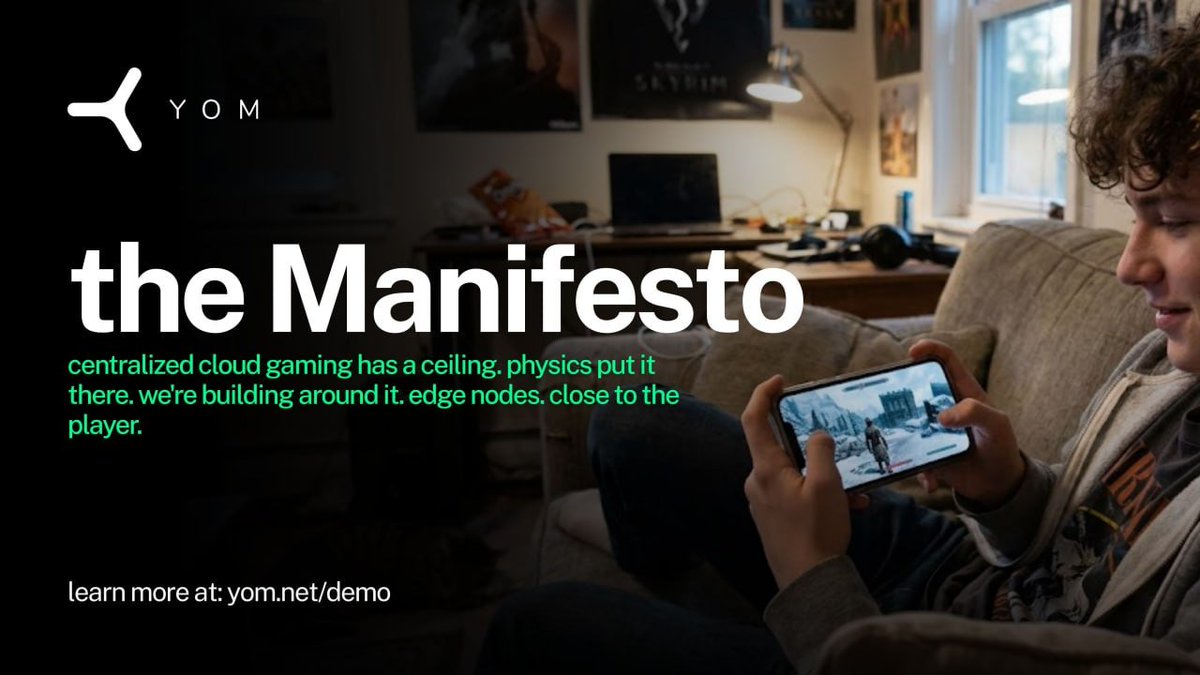
Centralized cloud gaming has a ceiling. Physics put it there.
We're building around it. Edge nodes. Close to the player.
Click. Play. That's it.
https://t.co/EvAydwgc0G
The most important sentence about $YOM
Token utility is downstream of physical network utilization.
What that means
Every session served. Every node contributing. Every byte of compute delivered. All of it flows into the settlement contract. $YOM is the unit that ties it together on-chain, verifiable, automated.
The token works when the network works.
Most Web3 games ask too much before the player plays.
Create a wallet. Fund it. Sign a transaction. Download a client. Install something else.
By the time the game loads, the player is gone.
YOM runs token mechanics under the hood. Click a link. Game streams. The chain stays the friction leaves.
The hidden problem with cloud gaming:
The bigger your audience, the heavier your bandwidth bill.
Centralized infrastructure punishes scale. Indie studios get hit first.
YOM's edge mesh flips the math. Compute moves closer to the player. Cost gets distributed instead of concentrated.
That's the structural alternative.
→ Learn more at https://t.co/EvAydwgc0G
Cloud gaming has a problem nobody likes to talk about.
The data center serving your game session might be 500 miles away. Light itself can't move that distance fast enough for real-time interactive 3D.
It's not a software problem. It's a geography problem.
That's why YOM was built differently local nodes, real-time routing, sessions served from the closest available compute. Distance is the bottleneck. We removed it.
For a decentralized network, this is the starting point.