Introducing Aztec Tierra (Alpha V6).
The platform for unstoppable private apps is here.
Ethereum's only decentralized L2, with fully programmable privacy: permissionless, private smart contracts.
No backdoors. No gatekeepers.
https://t.co/J1KZd6XT15
Stocks have been updated
Coinbase Tokenized Stocks are live on Base
- Available 24/7, 365
- Composable across Base DeFi
- Own the underlying share held in a regulated trust, backed 1:1
Live now, with new stocks coming soon
Very welcome recent news from Signal: they are working on letting you register an account without a phone number.
https://t.co/3dTG4UD6cF
That said, an important counterpoint about what this would and would not accomplish.
The good #1: reducing dependence on phone numbers. Even aside from privacy benefits, reducing dependency on a highly oligopolistic system of chokepoints is good in itself.
The good #2: phone numbers are for many people not a good "root" of identity from an access control perspective. Phone numbers get sim swapped all the time.
The good #3: allowing phone-number-free accounts will make it harder for them in the future to discriminate against people by country - and so make it harder for governments to pressure them to block their own citizens.
Now, on privacy. Significantly better than status quo, so yes it is good #4, but...
In practice, in 2026, I believe that pseudonymity (a long-term persistent account that is not tied to your primary identity) is a dead concept. There are just too many channels by which we accidentally slowly leak data about who we are - timing of messages, the pattern of who we send messages to with what frequency, size, etc. And too many highly effective AI-based means (both using LLMs per-user, and LLMs helping every person and agency under the sun use math that we had all along) to uncover and piece together those hints.
As a trivial example, whatever server you interact with learns your IP address, but even if you hide *that* with a VPN or Tor, there are many other identity leakage vectors.
And so the only defensible form of privacy is *message-by-message unlinkability* - no one except sender and receiver knows the (sender, receiver) pair, ideally even not knowing who the sender or the receiver are.
A natural taxonomy of privacy is the following 2x2:
* Sitting duck: adversary knows "X did Y"
* Confidentiality: adversary knows "X did ???" [E2E encryption provides this]
* Anonymity: adversary knows "??? did Y" [aka message-by-message unlinkability]
* Ideal: adversary knows "??? did ???"
Signal has already had confidentiality for a long time. (Note: in other contexts, "confidentiality" sometimes means "someone knows X did Y, and we trust that someone to not reveal it", ie. not true privacy. Here, by confidentiality we mean hiding contents from third parties)
This adds pseudonymity: in the above schema, adversary knows "0x8b512c... did Y", where they don't initially know who 0x8b512c... is, but may figure that out over time. The ideal is getting to message-by-message unlinkability.
Actually accomplishing that gets into territory that is currently being explored by mixnet projects as well as newer messengers, eg. @session_app and @SimpleXChat.
Once we get deeper into this territory, I suspect the primary frontier will be spam and DoS protection. Right now, much of the internet blocks all Tor exit nodes - not because they personally hate privacy, but because that's where DoS attacks come from. So we need ways for people to prove their non-spammer status while maintaining message-by-message unlinkability. See here https://t.co/C3tX5tOYJo for one direction (which complements https://t.co/1Q2Hqg0DZg nicely).
So I hope that we appreciate the victory that is mainstreaming of end-to-end encryption, that we actually get Signal accounts without phone number dependency (it's a great thing even if it had zero privacy consequences), and then that we keep moving forward and pushing the frontier of data leakage minimization.
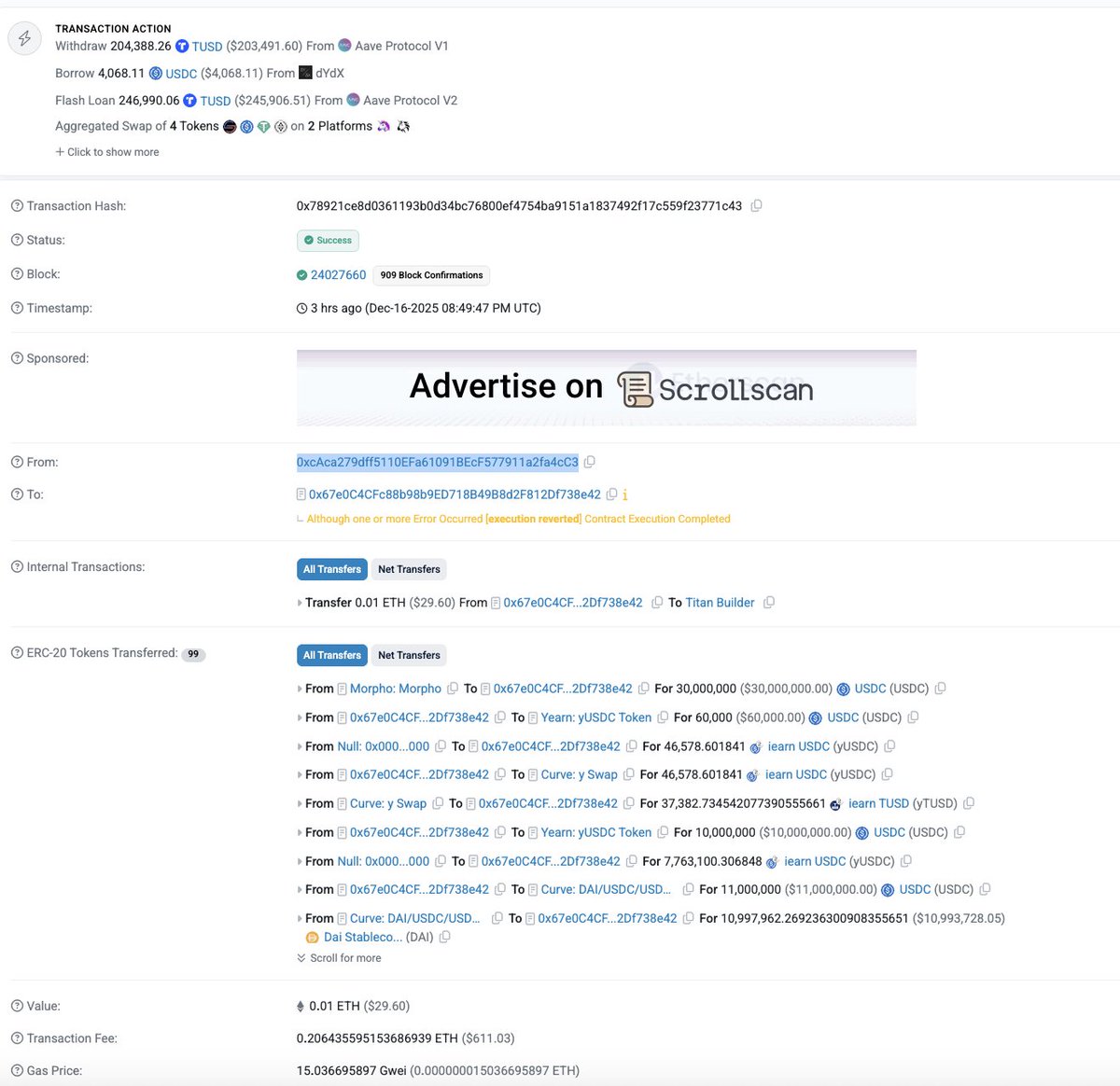
#PeckShieldAlert YearnFinanceV1 @yearnfi has suffered an exploit, resulting in a total loss of ~$300K.
The exploiter has swapped the stolen funds for 103 $ETH, which now sit in the address: 0x0F21...4066.
Day 77/1001
77 == Lucky Day!
Daily Motives🍃
~ Find 2 more valid bugs!
~ Stay active and start a contest.
~ Pray.
Daily Quote ~ Do the work, every other thing is noise!
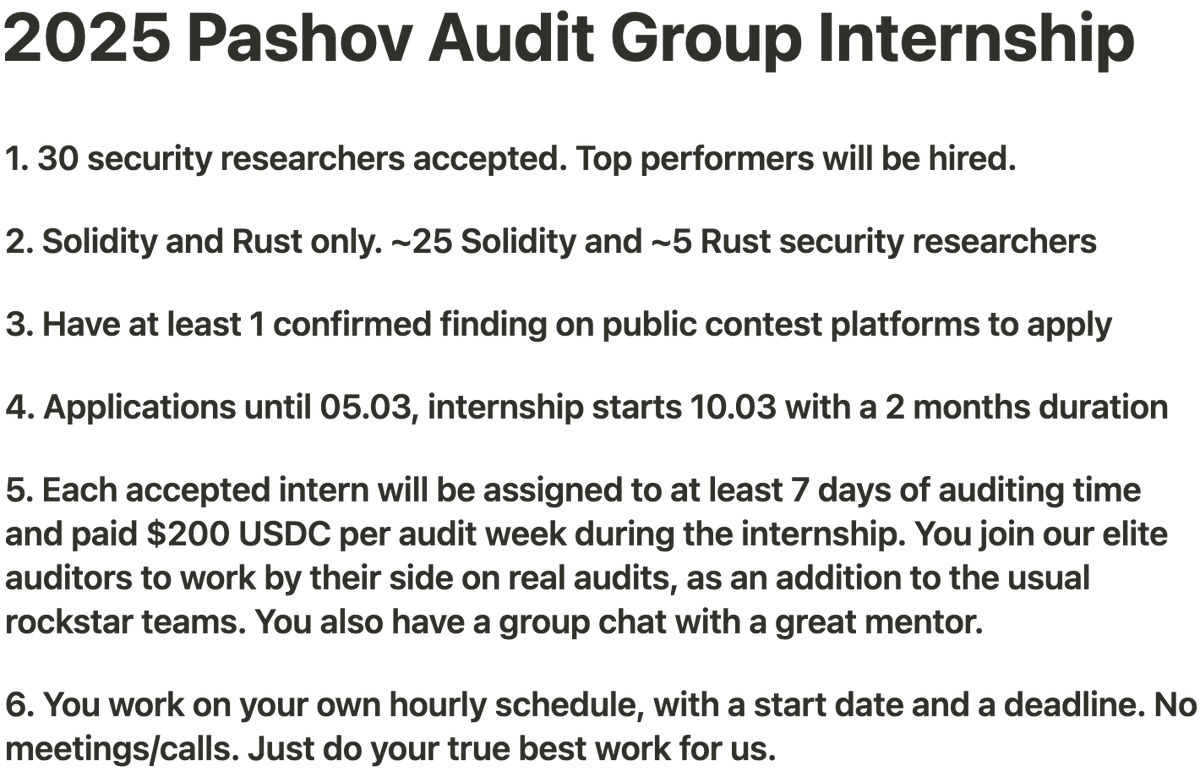
The 2025 Pashov Audit Group security researcher internship program is now official. This is not for 1st day beginners - real projects, real audits, pure practice.
Like/RT this post, then apply in the form in first comment for a chance to join us🫡
#CertiKInsight 🚨
We have detected a series of exploiting transactions on Ethereum targeting the liquidity pool of the HarryPotterObamaSonic10Inu 2.0 token.
The attacker 0x8Ca0392D4997C35FA6dDA2c0b6b8314987FAB554 profited ~$243K, deposited into https://t.co/0lwPdz0OWi.
Web3 security isn’t about being the smartest person in the room; it’s about being methodical and thorough.
Great auditors aren’t born—they’re made through practice and persistence.
Dream big,
Merry Christmas!
MonoSwap has been hacked. A MonoSwap developer installed a phishing app to join a call with scammers who pretended to be VC. The developer installed a botnet on his office PC, which had access to all MonoSwap-related wallets and contracts.
Implications for Altcoins: Bitcoin's performance heavily influences the broader cryptocurrency market, including altcoins. While the current cycle's unique characteristics suggest potential peaks for altcoins, more evidence is needed to confirm this.
Institutional Influence: Increased institutional involvement through Bitcoin ETFs and macroeconomic factors like high-interest rates are influencing this unique cycle, possibly leading to faster changes in Bitcoin's price dynamics.
@AlgoFoundation has launched LiquidAuth, a new tool for secure authentication and communication in the decentralized world of Web3. Keep your data safe and private with LiquidAuth, which doesn't rely on a central server.
LiquidAuth by utilizing open standards like FIDO2 and Passkeys for authentication, eliminates the need for a central server and does not store any user data.
Continuously refactor and improve your code: As you gain experience and learn new techniques, revisit your codebase and look for opportunities to refactor and improve its structure, efficiency, and readability.
Test your code thoroughly: Writing test cases and conducting proper testing helps identify and fix bugs early in the development process. It also gives you confidence in the reliability of your code.