in DeFi, transactions are not the only thing that count; sometimes what counts more is what people can learn from them.
Suppose you have a large portfolio in the DeFi space. You're looking to swap assets, rebalance holdings, transfer funds between chains, or carry out a well planned trading strategy.
The issue is that all interactions can leave information.
A public transaction could show you what assets you are shifting, when you're doing it, the wallets you're transferring, and, in some cases, enough information for someone to see what you are about to do next.
That poses a big problem: You can control your assets, but not always the information your financial activity reveals.
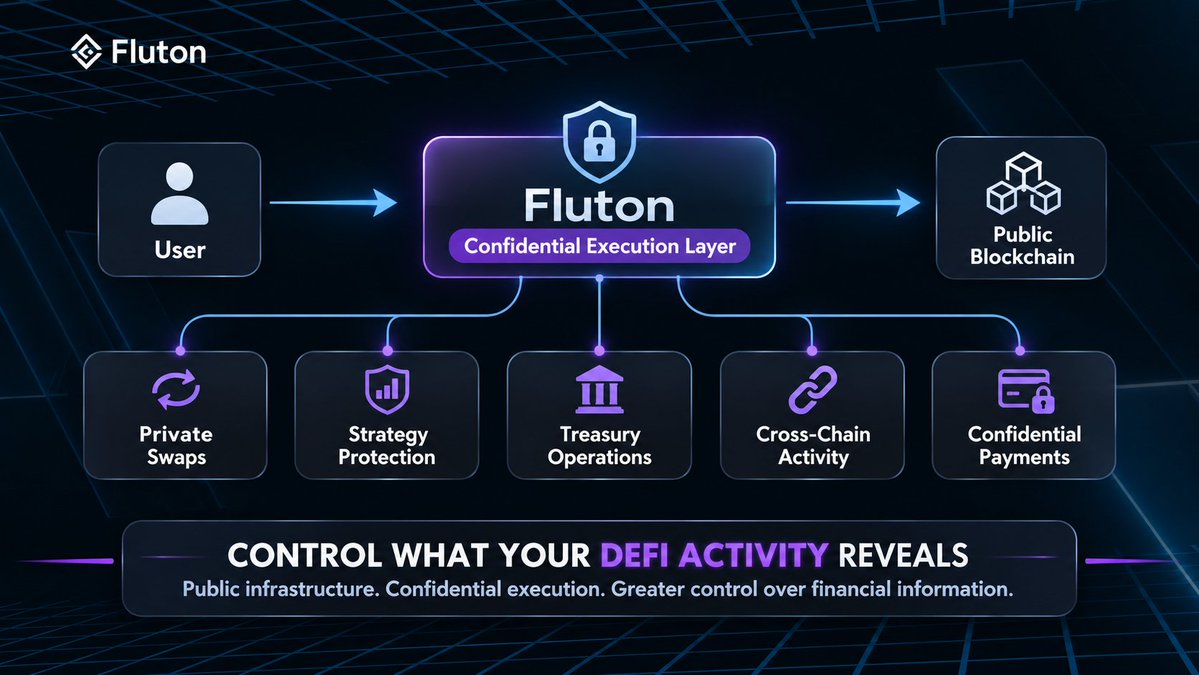
That's where Fluton's confidential execution model takes a turn of interest.
Fluton doesn't think of privacy in transaction-hiding terms, it thinks of it in terms of execution. The idea is to make it possible for users to interact with blockchain applications without revealing information or the logic behind them.
Think about how this would impact in real-world DeFi applications.
1. Private Swaps
Imagine that you ran a huge token swap.
Other market participants can see your activity and respond to it on a fully transparent execution path. They may predict what you are going to do or where you will go.
Confidential execution may be useful for obscuring sensitive execution information and limit the amount of unnecessary information about a transaction's intent that is exposed.
2. Strategy Protection
With a DeFi strategy, the value is often in the strategy itself, rather than in the assets.
The points through which you enter, the time at which you do so, how you allocate and interact with the points can show how your strategy is performing.
Competitors can continually see these, and they could recreate or mimic your strategy.
While providing the logic behind financial decisions could be kept confidential, not all details of operations need be revealed.
3. Treasury Operations
See for example a DAO or an organisation with a large treasury.
Financial activities could include payroll, liquidity management, investment and fund management.
Not all of the specifics concerning the operation have to be exposed openly ahead of running the operation. The information confidentiality in the execution of transactions would ensure greater control of sensitive financial information without any interaction with the public blockchain infrastructure.
4. Cross-Chain Activity
Crossing the multiple networks can unearth more than one transaction.
If activities are linked across various chains, then an observer might be able to paint a more complete picture of the financial activity of a user.
Cross-chain operations may be less revealing if a confidential execution layer is used to help shield sensitive information during these interactions.
5. Confidential Payments
Companies or individuals might decide to implement blockchain transactions without revealing all details of their economic connections.
The amount of payment, commercial deals and operational details may be sensitive.
In such cases, blockchain-based payments might be more appropriate as they ensure information is not exposed to everyone.
The greater concept is that DeFi requires much more than clear infrastructure. It should also be treated in a way that ensures controlled confidentiality.
Public blockchains offer verifiability, composability and open access. All those properties are important, and privacy shouldn't come at the cost of giving them up.
The difficulty is to interact with public blockchain infrastructure without having all of the sensitive aspects of interaction made public.
This is the path Fluton is taking.
At @FlutonIO, they don't feature themselves as another blockchain or a just privacy solution, but as a confidential execution layer that will be placed between users and blockchain infrastructure.
The next generation of DeFi might not be based on privacy.
Perhaps it's about providing the user with control over what should be public, what is confidential, and how it is put into action.
what happens before i open my laptop:
8:00 agent reads linkedin, reddit, github, hn
8:01 37 hot leads scored
8:02 decision makers found
8:03 all of it in my sheet
$0.0001 a signal on @MonidHQ.
What if financial applications could process your data without ever needing to see it?
that sounds like a contradiction, but it's one of the problems Fully Homomorphic Encryption (FHE) is designed to solve
and it's an important part of what @primus_labs is building
here's why it matters 🧵
Finding a market is one thing. Finding the kind of market you actually want to follow is another.
One useful part of @sight_hood is the way its market page organizes discovery.
You can explore different categories, including Crypto, NFT, Sport and Tokens.
There are also different ways to browse:
Trending, Newest, Live Now, Ending Soon, Most Watched and Most Discussed.
I like this because people don't all explore prediction markets the same way.
Some want to see what's gaining attention, others prefer newly listed markets, while some just want to find an active market before it closes.
Having those discovery options makes the platform easier to navigate without forcing everyone into the same browsing experience.
It's a small product detail, but good discovery tools can make a real difference.
$SGT
There's something interesting about how Aethir approaches AI infrastructure expansion.
Most data center developers start with land, power and projected demand.
But what if you already operate a GPU network and can observe where customers need more compute?
That's the idea behind Aethir ACCELERATE.
Here's why I think it matters 👇
#AethirTribe
A sports car cruising through a modern city at sunset… sounds simple, but it makes a pretty epic GTA-style video. 🌆
I shared the concept with ChatGPT and asked it to use the CapCut plugin to generate the scene with Seedance 2.5. No need to figure out the whole process from scratch.
Give GPT-6.2 Astra a try with the CapCut plugin, and enjoy 90% off your first month of CapCut Pro this Black Friday!
https://t.co/gVnjkqePBl
#GTA6 #ChatGPT #CapCutDidThat #CapCut62Astra #CapCutChatGPTPlugin
in DeFi, transactions are not the only thing that count; sometimes what counts more is what people can learn from them.
Suppose you have a large portfolio in the DeFi space. You're looking to swap assets, rebalance holdings, transfer funds between chains, or carry out a well planned trading strategy.
The issue is that all interactions can leave information.
A public transaction could show you what assets you are shifting, when you're doing it, the wallets you're transferring, and, in some cases, enough information for someone to see what you are about to do next.
That poses a big problem: You can control your assets, but not always the information your financial activity reveals.
That's where Fluton's confidential execution model takes a turn of interest.
Fluton doesn't think of privacy in transaction-hiding terms, it thinks of it in terms of execution. The idea is to make it possible for users to interact with blockchain applications without revealing information or the logic behind them.
Think about how this would impact in real-world DeFi applications.
1. Private Swaps
Imagine that you ran a huge token swap.
Other market participants can see your activity and respond to it on a fully transparent execution path. They may predict what you are going to do or where you will go.
Confidential execution may be useful for obscuring sensitive execution information and limit the amount of unnecessary information about a transaction's intent that is exposed.
2. Strategy Protection
With a DeFi strategy, the value is often in the strategy itself, rather than in the assets.
The points through which you enter, the time at which you do so, how you allocate and interact with the points can show how your strategy is performing.
Competitors can continually see these, and they could recreate or mimic your strategy.
While providing the logic behind financial decisions could be kept confidential, not all details of operations need be revealed.
3. Treasury Operations
See for example a DAO or an organisation with a large treasury.
Financial activities could include payroll, liquidity management, investment and fund management.
Not all of the specifics concerning the operation have to be exposed openly ahead of running the operation. The information confidentiality in the execution of transactions would ensure greater control of sensitive financial information without any interaction with the public blockchain infrastructure.
4. Cross-Chain Activity
Crossing the multiple networks can unearth more than one transaction.
If activities are linked across various chains, then an observer might be able to paint a more complete picture of the financial activity of a user.
Cross-chain operations may be less revealing if a confidential execution layer is used to help shield sensitive information during these interactions.
5. Confidential Payments
Companies or individuals might decide to implement blockchain transactions without revealing all details of their economic connections.
The amount of payment, commercial deals and operational details may be sensitive.
In such cases, blockchain-based payments might be more appropriate as they ensure information is not exposed to everyone.
The greater concept is that DeFi requires much more than clear infrastructure. It should also be treated in a way that ensures controlled confidentiality.
Public blockchains offer verifiability, composability and open access. All those properties are important, and privacy shouldn't come at the cost of giving them up.
The difficulty is to interact with public blockchain infrastructure without having all of the sensitive aspects of interaction made public.
This is the path Fluton is taking.
At @FlutonIO, they don't feature themselves as another blockchain or a just privacy solution, but as a confidential execution layer that will be placed between users and blockchain infrastructure.
The next generation of DeFi might not be based on privacy.
Perhaps it's about providing the user with control over what should be public, what is confidential, and how it is put into action.
Privacy doesn't mean making everything invisible. It is knowing what belongs inside the mind should be kept inside the mind and what belongs in the system must be kept in the system.
The most common misunderstanding about blockchain privacy is that to keep information secure, one needs to conceal everything.
Consider how a financial transaction ought to operate, though.
Your bank balance and/or financial plan or business contract arrangements may include sensitive information. Not everyone wants to be privy to those details.
The transaction can still be confirmed, though. The network should be assured that the operation was conducted according to the necessary rules, that the conditions were met, and that the results are valid.
These are two distinct requirements and it is wrong to approach them as the same problem.
When everything is public, sensitive information must be exposed. However, if no one is able to see the answer, it's hard to verify independently.
Both extremes are not the panacea.
This is where selective confidentiality comes into play.
Rather than privacy as an effort to hide all of the information, privacy separates sensitive information from information that is necessary to verify.
In real applications, this means that the execution strategy, private information and the relevant information in the transaction is kept confidential, but it's also possible to verify if an operation has been performed correctly.
That matters because privacy and transparency don't need to be at odds. They can be used for various purposes in the same system.
This is the view that drives the way @FlutonIO does privacy for blockchain.
The goal is not to make it impossible to audit blockchain activity. It's to make sure the information is available to the appropriate individuals for appropriate purposes.
A more adequate privacy model should not be a barrier to trust via verification. It should hide what is not supposed to be revealed that will not be revealed, and preserve what will allow it to be verified.
Blockchain transparency was designed to build trust. But what happens when that same transparency exposes too much?
Public blockchains have made transactions independently verifiable. Anyone can inspect transaction histories, trace wallet interactions, monitor asset movements, and observe how activities unfold on-chain.
This openness is one of the fundamental strengths of blockchain technology. It removes the need to blindly trust a central authority because network activity can be verified publicly.
But transparency also creates a problem that becomes more significant as blockchain usage grows.
A transaction reveals more than the movement of assets. By analyzing wallet activity, transaction patterns, timing, and interactions with smart contracts, external observers can often understand a user's financial behavior and potentially infer their intentions.
For individuals, this creates privacy concerns. For businesses, it can expose trading strategies, operational decisions, and sensitive execution details.
Simply put, the problem isn't that blockchain makes transactions visible. The problem is that every part of an execution doesn't necessarily need to be public.
This is where the need for a different architectural approach emerges.
Instead of treating public execution as the only possible model, blockchain infrastructure needs a way to preserve verifiability while protecting sensitive execution details.
This is the direction @FlutonIO is exploring.
Fluton approaches this challenge through a confidential execution layer that sits between the user's intent and the underlying blockchain.
Rather than requiring users to expose their entire execution process directly to public infrastructure, Fluton introduces an architecture designed to handle execution with privacy in mind.
The distinction is important:
- Public transactions: Execution details and activity can be openly inspected.
- Confidential execution: Sensitive execution information is handled privately while the resulting blockchain interaction can still be settled and verified.
This doesn't mean removing blockchain transparency altogether. It means being more deliberate about what should remain public and what should remain confidential.
Fluton's architectural shift is ultimately about changing how blockchain interactions are handled.
The goal isn't to abandon public blockchains. It's to make interacting with them more private without giving up the benefits of the underlying network.
The next evolution of blockchain infrastructure may not be about making everything visible. It may be about making the right things visible to the right people.
@Spaulhrx zkFHE could help bridge the integrity gap in encrypted computing, though proof voice generation overhead remains a heavy bottleneck to watch.
Blockchain transparency was designed to build trust. But what happens when that same transparency exposes too much?
Public blockchains have made transactions independently verifiable. Anyone can inspect transaction histories, trace wallet interactions, monitor asset movements, and observe how activities unfold on-chain.
This openness is one of the fundamental strengths of blockchain technology. It removes the need to blindly trust a central authority because network activity can be verified publicly.
But transparency also creates a problem that becomes more significant as blockchain usage grows.
A transaction reveals more than the movement of assets. By analyzing wallet activity, transaction patterns, timing, and interactions with smart contracts, external observers can often understand a user's financial behavior and potentially infer their intentions.
For individuals, this creates privacy concerns. For businesses, it can expose trading strategies, operational decisions, and sensitive execution details.
Simply put, the problem isn't that blockchain makes transactions visible. The problem is that every part of an execution doesn't necessarily need to be public.
This is where the need for a different architectural approach emerges.
Instead of treating public execution as the only possible model, blockchain infrastructure needs a way to preserve verifiability while protecting sensitive execution details.
This is the direction @FlutonIO is exploring.
Fluton approaches this challenge through a confidential execution layer that sits between the user's intent and the underlying blockchain.
Rather than requiring users to expose their entire execution process directly to public infrastructure, Fluton introduces an architecture designed to handle execution with privacy in mind.
The distinction is important:
- Public transactions: Execution details and activity can be openly inspected.
- Confidential execution: Sensitive execution information is handled privately while the resulting blockchain interaction can still be settled and verified.
This doesn't mean removing blockchain transparency altogether. It means being more deliberate about what should remain public and what should remain confidential.
Fluton's architectural shift is ultimately about changing how blockchain interactions are handled.
The goal isn't to abandon public blockchains. It's to make interacting with them more private without giving up the benefits of the underlying network.
The next evolution of blockchain infrastructure may not be about making everything visible. It may be about making the right things visible to the right people.
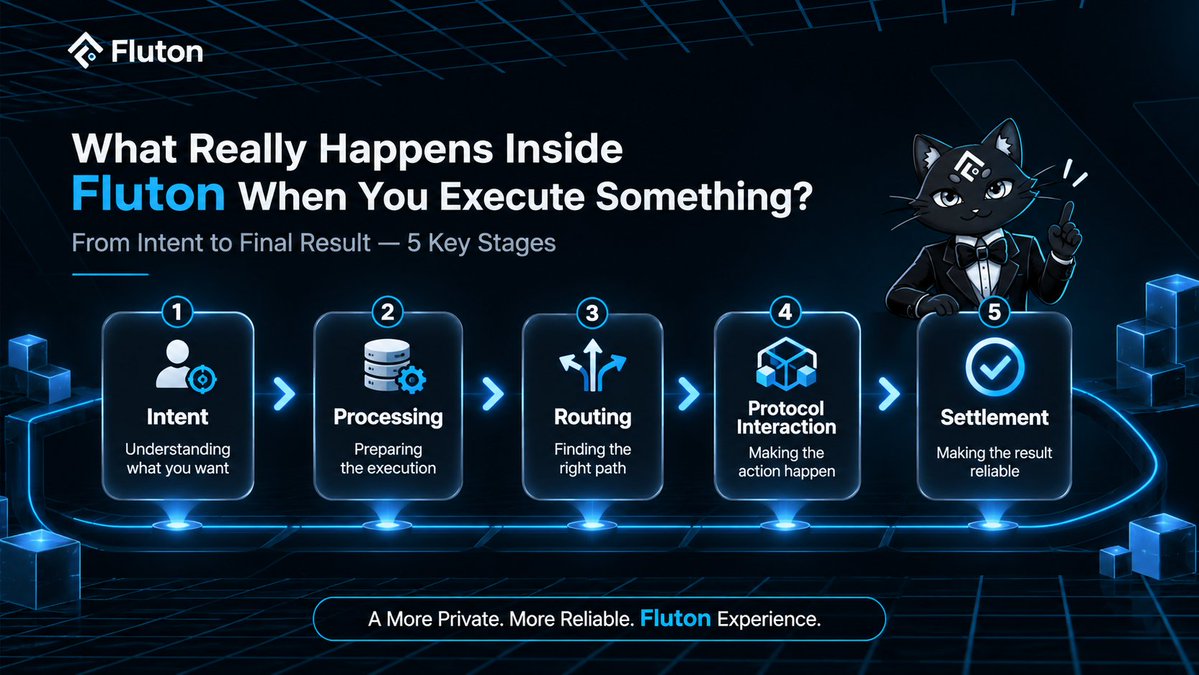
What occurs between the time you make the decision to make a transaction and when the actual transaction is resolved?
For the majority of users, it's only the beginning and the end. They start an action, wait for confirmation, and eventually get the results.
However, a series of operations occurs between that and the person's mouth.
This is where knowing @FlutonIO is fun.
There are 5 key stages to understanding a process being executed through Fluton.
1. Intent understanding what the user wants:
All things start with purpose.
A user may desire to move assets, communicate with an application or perform a specific action. It is here that the most essential element is knowing the actual goal of the user.
The system must recognize the desired action and what information is needed to perform that action.
Consider it to be an instruction to a system. Before anything can happen, that instruction needs to be understood.
2. Processing Preparing the Execution
This is an understanding of the intent, followed by processing.
This is the stage where the operation requested is readied for execution. This system must process the pertinent information, arrange the appropriate inputs, and set up the action for the subsequent phase.
Here too lies privacy.
A user should never be forced to reveal sensitive information without having to do so for accessing a blockchain application.
The object is that of aiding execution, while maintaining privacy element in the process.
3. Routing Finding the Right Path
The execution path of not all operations is the same.
Various apps and protocols might need various interactions. Routing is used to decide the destination and path of the operation that has been prepared.
Consider this like sending a package.
Knowing the contents of the package is one thing, getting it there is another. Another is knowing which destination it should be going to and which route it will take to get there.
Routing is the process of linking the ready intent to the correct execution environment.
4. Protocol Interaction Making the Action Happen
Now is the time that the operation engages with the relevant protocol.
For any kind of application or blockchain operation, the system must interact with the protocol that is handling that operation.
This is where the requested operation leaves the preparation phase and begins to be executed at the protocol level.
The key point to note is that the processing prepares the operation, the routing is responsible for directing it and the protocol interaction is where the desired action is actually performed.
5. Settlement Making the Result Reliable
Execution is not all that matters.
A reliable method must also be used to determine and decide the end result of a blockchain transaction.
This is where settlement comes in.
Settlement allows for the proper recording and validation of the result of an operation, based on the rules of the underlying network.
This is important because privacy in execution shall not compromise blockchain settlement reliability.
Networks should be able to validate and settle transactions while users are not unnecessarily exposed to sensitive information when interacting with applications.
The Bigger Picture
These five stages are linked but each has a specific function:
→ Intent is the user's goal.
→ Processing preps operation.
→ Routing determines where it needs to go.
→ Protocol Interaction carries out the requested action.
→ Settlement establishes the final result.
This is the larger notion of comprehending @FlutonIO.
The objective isn't simply to hide transaction information. It's about the execution process of privacy while maintaining the trustworthiness of blockchain infrastructure.
A better blockchain experience shouldn't require users to sacrifice privacy of their use of applications and trust the network to complete their transactions.
Privacy issues on blockchain should not be about compromising on the infrastructure you already know and trust.
That's the balance @FlutonIO is trying to achieve.
The aim is to maintain the privacy of execution without sacrificing settlement process which makes blockchain transactions reliable.
Simply put, users should have the ability to transact and use apps without revealing any of their sensitive data, and the network should be able to validate and settle transactions.
Security should not be at the expense of privacy. It should operate the system without showing everything that is going on in the system.