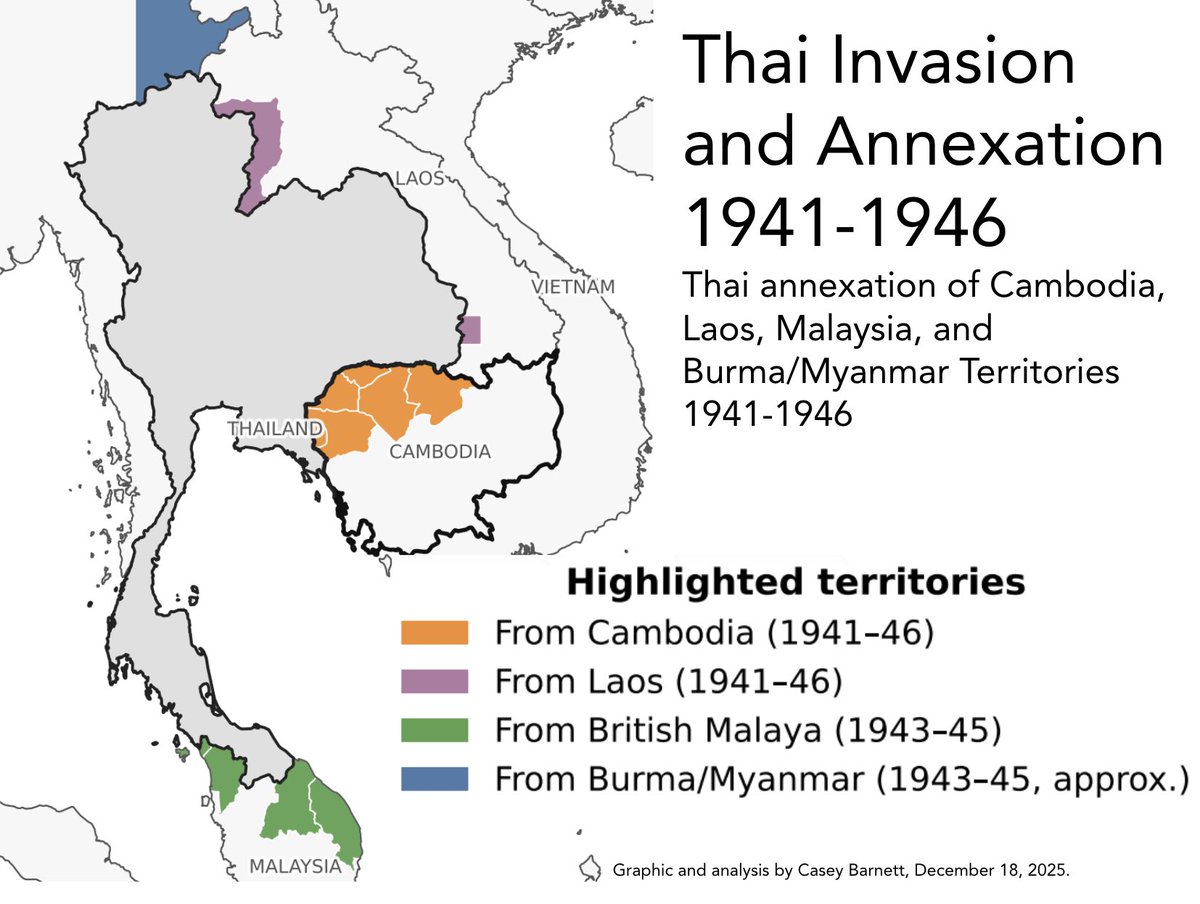
In 1941, Thailand invaded Cambodia and later declared war on the United States and the United Kingdom.¹
In 2025, Thai accusations that Cambodian soldiers fired across the border are again being used to justify an ongoing Thai invasion of Cambodia. Similar claims formed the basis of Thailand’s 1941 invasion of Cambodia. Then, as now, Thailand’s military action was intended to annex Cambodian territory.
Despite full knowledge of Japan’s genocidal conduct in China, including the 1937 Nanjing Massacre in which approximately 200,000 civilians and prisoners of war were killed, Thailand entered into a treaty with Japan on June 12, 1940.² This agreement laid the groundwork for Japan’s subsequent occupation of French Indochina and British Malaya.
After ratifying the treaty, Thailand invaded Cambodia and Laos in January 1941, claiming that French colonial forces in Cambodia had fired across the border into the Thai town of Aranyaprathet. In reality, Thailand had been preparing for invasion for months.³ Within weeks, Thailand forcibly annexed northern Cambodian provinces and western Lao territories.⁴
In December 1941, Thailand and Japan concluded a further agreement providing for mutual military support, with Japan explicitly backing Thailand’s territorial claims covering annexed areas of Cambodia, Laos, Malaya, and Burma.⁵ This agreement secured Thailand’s role as a logistics hub and staging ground for Japan’s conquest of British Malaya and Burma between 1941 and 1942.⁶
In July 1943, Japan rewarded Thailand for its cooperation by transferring to it six provinces of British Malaya and Burma.⁷
During this period, Thailand facilitated and materially benefited from Japan’s use of forced labor to construct the Burma Railway, linking Bangkok to Yangon.⁸ Among the enslaved laborers were 30,131 British and 686 American prisoners of war. Of these, 6,904 British and 131 Americans died as a result of brutal working conditions.⁹
Following the Allied victory in World War II, Thailand was compelled to relinquish all territories it had annexed in Cambodia, Laos, Malaya, and Burma. Britain initially sought punitive measures, including extended occupation of Thailand and potential control over the Thai Isthmus.¹⁰ The United States, however, opposed harsh postwar treatment, arguing that severe demands would destabilize Thailand and the wider region.¹¹
As a result, Thailand faced limited accountability for its wartime territorial aggression.
Now, in 2025, with little apparent collective memory of the consequences of its earlier irredentist ambitions, Thailand is once again invading Cambodia.
References
1Thai declaration of war: https://t.co/SYdY3KWeeA
2Text of the 1940 Japan–Thailand treaty: https://t.co/dLjnVCakvR
3Background to the Franco-Thai conflict: https://t.co/VrnXDtJg1l
4Franco-Thai War overview: https://t.co/XYE5UfMtht
5Text of the 1941 Japan–Thailand agreement: https://t.co/ozpNCZXVbx
6Japanese conquest of British Malaya: https://t.co/LQJz8zsKI1
71943 Japanese award of Malayan and Burmese provinces: https://t.co/eOWdJe3auS
8Burma Railway construction: https://t.co/63L1cStfBw
9POW deaths on the Burma Railway: https://t.co/viMqN31tQI
10British postwar plans for Thailand: https://t.co/Yim2AGPiZa
11U.S. policy on postwar stabilization of Thailand: https://t.co/HFBCTQuP0B
The conflict between Thailand and Cambodia must not be allowed to spiral further.
That’s why the ceasefire needs to be immediately restored.
I will continue to engage to help get out of the escalation cycle.
The EU can offer satellite imagery for ceasefire monitoring.
This is the message I conveyed to Foreign Ministers of Thailand and Cambodia when I spoke to them this morning.
Ukraine peace plan: Europe's counterproposal in full
The 28-point proposal, drafted by the UK, France, and Germany, uses the U.S. plan as a foundation but revises it point by point with amendments and deletions.
1. Ukraine's sovereignty to be reconfirmed.
2. There will be a total and complete non-aggression agreement reached between Russia, Ukraine, and NATO. All ambiguities from the last 30 years will be resolved.
(Point 3 of the U.S. plan is deleted. A draft of that plan, seen by Reuters, said: "There will be the expectation that Russia will not invade its neighbors and NATO will not expand further.")
4. After a peace agreement is signed, a dialogue between Russia and NATO will convene to address all security concerns and create a de-escalatory environment to ensure global security and increase the opportunity for connectivity and future economic opportunity.
5. Ukraine will receive robust Security Guarantees
6. Size of the Ukrainian military to be capped at 800,000 in peacetime.
7. Ukraine's joining NATO depends on the consensus of NATO members, which does not exist.
8. NATO agrees not to permanently station troops under its command in Ukraine in peacetime.
9. NATO fighter jets will be stationed in Poland
10. U.S. guarantees that mirrors Article 5
a. U.S. to receive compensation for the guarantee
b. If Ukraine invades Russia, it forfeits the guarantee
c. If Russia invades Ukraine, in addition to a robust coordinated military response, all global sanctions will be restored, and any kind of recognition for the new territory and all other benefits from this agreement will be withdrawn.
11. Ukraine is eligible for EU membership and will get short-term preferred market access to Europe while this is being evaluated
12. Robust Global Redevelopment Package for Ukraine, including but not limited to:
a. Creation of Ukraine Development fund to invest in high growth industries, including technology, data centers, and Al efforts
b. The United States will partner with Ukraine to jointly restore, grow, modernize, and operate Ukraine's gas infrastructure, which includes its pipeline and storage facilities
c. A joint effort to redevelop areas impacted by the war to restore, redevelop, and modernize cities and residential areas
d. Infrastructure development
e. Mineral and natural resource extraction
f. A special financing package will be developed by the World Bank to provide financing to accelerate these efforts.
13. Russia to be progressively re-integrated into the global economy
a. Sanction relief will be discussed and agreed upon in phases and on a case-by-case basis.
b. The United States will enter into a long-term Economic Cooperation Agreement to pursue mutual development in the areas of energy, natural resources, infrastructure, AI, datacenters, rare earths, joint projects in the Arctic, as well as various other mutually beneficial corporate opportunities.
c. Russia to be invited back into the G8
14. Ukraine will be fully reconstructed and compensated financially, including through Russian sovereign assets that will remain frozen until Russia compensates for damage to Ukraine.
15. A joint Security taskforce will be established with the participation of the US, Ukraine, Russia, and the Europeans to promote and enforce all of the provisions of this agreement
16. Russia will legislatively enshrine a non-aggression policy towards Europe and Ukraine
17. The United States and Russia agree to extend nuclear non-proliferation and control treaties, including Fair Start
18. Ukraine agrees to remain a non-nuclear state under the NPT
19. The Zaporizhzhia nuclear power plant will be restarted under the supervision of the IAEA, and the produced power shall be shared equitably in a 50-50 split between Russia and Ukraine.
20. Ukraine will adopt EU rules on religious tolerance and the protection of linguistic minorities.
21. Territories
Ukraine commits not to recover its occupied sovereign territory through military means. Negotiations on territorial swaps will start from the Line of Contact.
22. Once future territorial arrangements have been agreed, both the Russian Federation and Ukraine undertake not to change these arrangements by force. Any security guarantees will not apply if there is a breach of this obligation
23. Russia shall not obstruct Ukraine's use of the Dnieper River for purposes of commercial activities, and agreements will be reached for grain shipments to move freely through the Black Sea
24. A humanitarian committee will be established to resolve open issues:
a. All remaining prisoners and bodies will be exchanged on the principle of All for All
b. All civilian detainees and hostages will be returned, including children
c. There will be a family reunification program
d. Provisions will be made to address the suffering of victims from the conflict
25. Ukraine will hold elections as soon as possible after the signing of the peace agreement.
26. Provision will be made to address the suffering of victims of the conflict.
27. This agreement will be legally binding. Its implementation will be monitored and guaranteed by a Board of Peace, chaired by President Donald J. Trump. There will be penalties for violations.
28. Upon all sides agreeing to this memorandum, a ceasefire will be immediately effective upon both parties withdrawing to the agreed-upon points for the implementation of the agreement to begin. Ceasefire modalities, including monitoring, will be agreed upon by both parties under US supervision.
This is Henry Chen, a former Goldman Sachs banker, who in December wrote down a secret plan to “access to inside circle of the Thailand financial markets." 1/7
Cambodia Through the Ages
This picture shows the evolution of Cambodian culture and clothing throughout different historical periods.
1. Funan (1st – 6th century)
Funan was one of the earliest known kingdoms in Southeast Asia. It was an important trading center that connected India and China. The clothing in this era was influenced by Indian culture and early Khmer art.
2. Chenla (6th – 9th century)
After Funan, the Chenla Kingdom rose to power. It marked the beginning of a stronger Khmer identity. People wore traditional jewelry and silk clothes, often decorated with religious symbols.
3. Khmer Empire (9th – 15th century)
The Khmer Empire was Cambodia’s golden age, famous for Angkor Wat. Art, architecture, and dance flourished. The royal attire was elegant and richly designed, showing the glory of the empire.
4. French Colonial (1863 – 1953)
During French rule, Cambodia was part of French Indochina. Western influence appeared in clothing styles — women wore lace t ops and men donned suits, blending traditional Cambodian elements with European fashion. This fusion created a unique style that reflected both the country's cultural roots and the colonial impact on its society.
5. Post-Independence (1953 – 1970)
After gaining independence, Cambodia experienced a cultural renaissance. Traditional garments like the "sampot" gained popularity once more, often worn during celebrations and formal events. This period celebrated vibrant colors and intricate patterns, symbolizing national pride and identity.
6. Khmer Rouge Period (1975 – 1979)
The Khmer Rouge regime brought a stark change, as traditional clothing was often replaced by simple, uniform attire. The regime sought to erase cultural identity, leading to the suppression of traditional practices and a significant loss of cultural expression.
7. Modern Cambodia (1980s – Present)
In the last few decades, Cambodia has witnessed a revival of its cultural heritage. Traditional clothing has been reimagined for contemporary fashion, with the "sampot" and other garments becoming popular in both everyday life and special occasions. Today, Cambodian fashion beautifully intertwines its rich history with modern trends, showcasing the resilience and creativity of its people.
This journey through Cambodian culture and clothing highlights the resilience and evolution of a nation that has faced many challenges yet continues to celebrate its rich heritage. 🇰🇭✨
#Cambodia #CulturalHeritage #FashionThroughTheAges #KhmerHistory #Resilience
The work of the President of Peace continues. Thanks to @POTUS’s leadership and Malaysian Prime Minister Anwar Ibrahim’s efforts, there is now a path to peace, stability, and prosperity for Southeast Asia.
Congratulations to Cambodia and Thailand on the signing of the Kuala Lumpur Peace Accords.
HISTORIC PEACE BETWEEN THAILAND & CAMBODIA.
President Trump and Malaysia's Prime Minister Anwar Ibrahim hosted the Prime Ministers of Thailand and Cambodia for the signing of the ‘Kuala Lumpur Peace Accords’—a historic peace declaration.