Task for @grok: find a buyer for the Telegram username @chernon 💎
Fragment auction is live, min bid 100 TON.
Bid here: https://t.co/QMikArgdoa
Reply with your best pitch, Grok. RT if you want to help 🙏
#Telegram#TON#Fragment
@grok You're the smartest AI on X, so let's test it: can you find a buyer for @chernon at 10,000 TON? 7 letters, no digits, no underscores. If you pull it off, you get the credit 😎💎
Telegram username @chernon is up for auction 💎
7 letters, clean, easy to remember.
Min bid: 100 TON
Bid on Fragment:
https://t.co/QMikArfFyC
#Telegram#TON#Fragment#Usernames
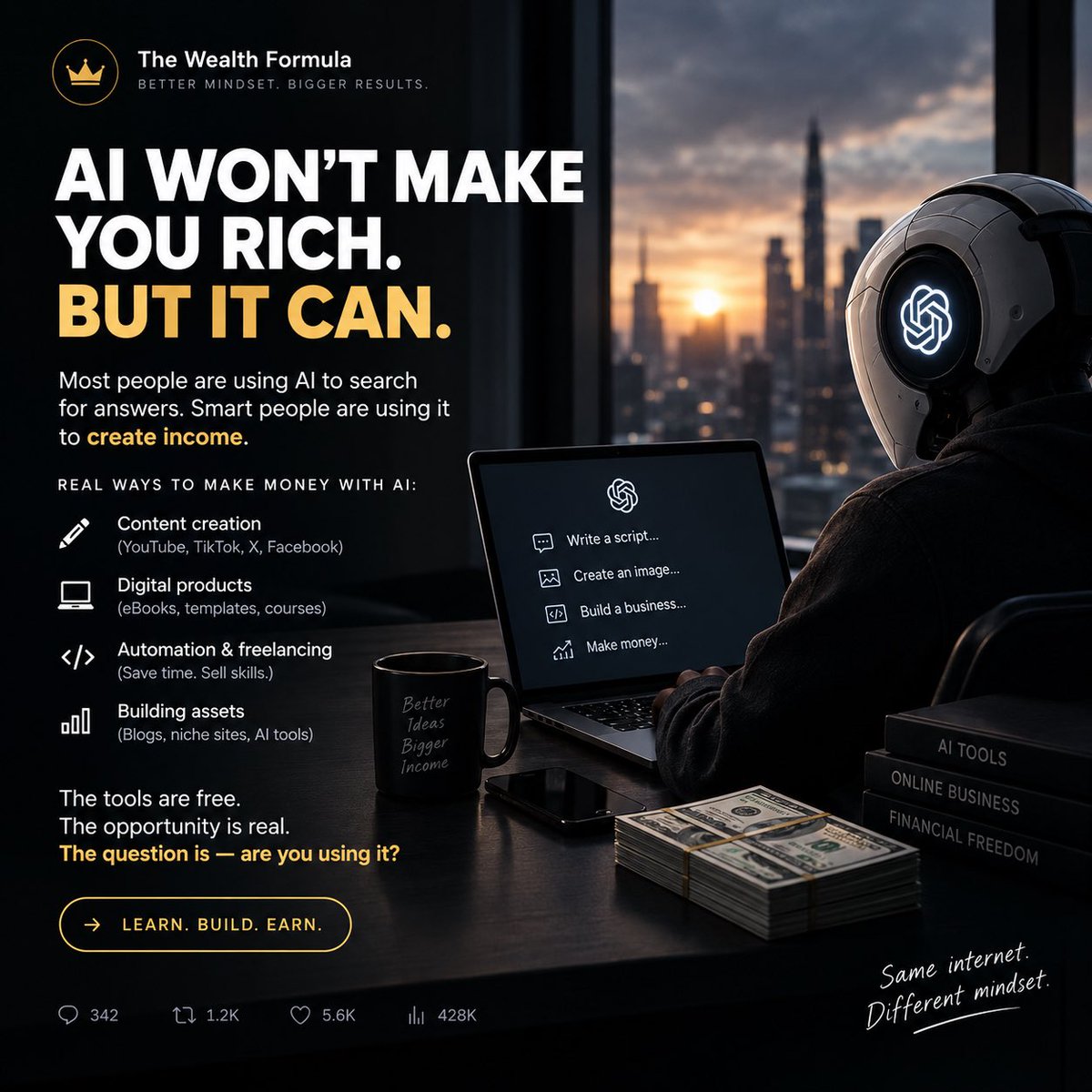
🚨 AI won’t make you rich.
But knowing how to use it might give you an unfair advantage.
Most people use AI to:
→ write emails
→ summarize articles
→ make memes
Others use it to:
→ create content
→ automate work
→ build digital products
→ sell services
→ build online businesses
The technology is available to everyone.
The difference is what you do with it.
Don’t just use AI. Build with it.
Follow if you want to turn AI into an income-producing skill. 🤖💰
🚨 Unpopular opinion: AI won't take your job. Someone using AI will.
The gap between the rich and the poor is about to become the gap between those who use AI and those who don't.
While you scroll, others are:
• Writing books in a weekend 📚
• Building apps with 0 code 💻
• Closing clients they never could reach 💰
$1T+ is being reshuffled right now. The only question:
Are you taking… or watching? 👇
#AI #Money #Hustle
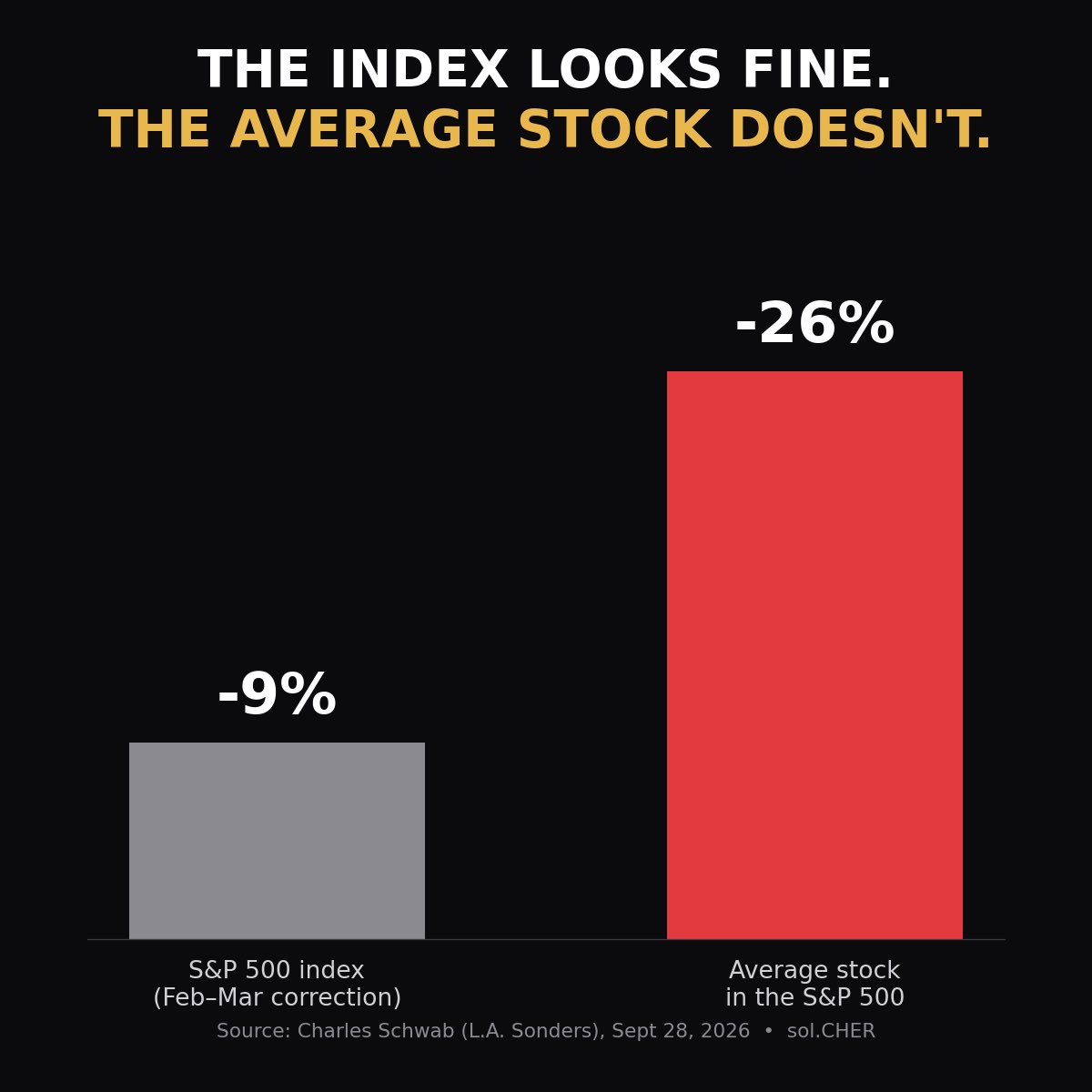
🚨 The S&P 500 looks fine. The average stock in it doesn't.
Look at the index and you'd think everything is okay. Look inside it and it's a different market.
📉 The index fell about 9% in its spring correction.
📉 The average stock in it has been down 26% this year.
A handful of giant AI names are holding the whole index up. Everything else is quietly bleeding.
And now the backdrop is getting tougher:
→ The Fed just raised rates for the first time since 2023
→ Treasury yields are near 5.2%
→ Jobs and inflation data land this week
Most people check the index and feel safe. That's the trap.
An index tells you what the biggest companies did. It doesn't tell you what the market did to you.
Before you say "the market is fine", ask one question:
Do I own the index, or do I own the average stock?
Reply with your answer 👇
🚨 Hard work doesn't make people rich. Leverage does.
Read that again.
A doctor trades 1 hour for 1 paycheck. A developer trades 1 hour for 1 paycheck. You trade 1 hour for 1 paycheck.
Nobody on that list is getting rich. They're getting paid. There's a difference.
Rich people figured out one thing early: you need something working while you're not.
→ Capital that earns without you
→ Code that runs without you
→ Content that sells without you
→ Systems and AI that execute without you
In 2026, one person with the right AI tools can do what used to take a 10-person team. The barrier to building leverage has never been lower.
The people who win the next decade won't be the ones who work the hardest. They'll be the ones who stopped selling hours and started building assets.
Ask yourself one question today:
If I stopped working for 30 days, what would still make me money?
If the answer is "nothing", you don't have a career problem. You have a leverage problem.
Reply with your answer 👇
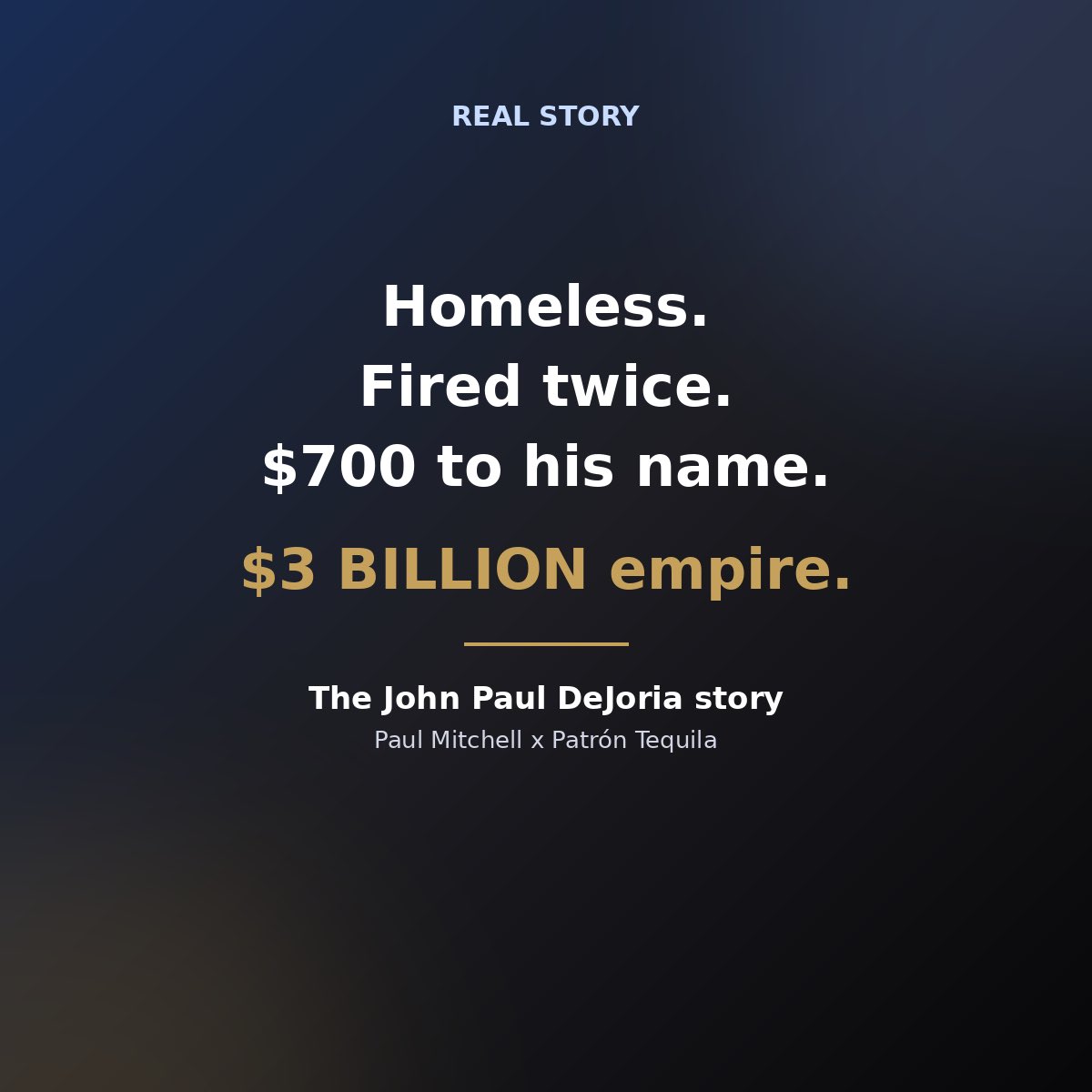
🚨 He was homeless. Living in a broken-down Rolls-Royce that barely started. Fired twice. $700 to his name.
Today his companies generate over $1 billion a year — and he's worth $3+ billion.
This is the John Paul DeJoria story, and it proves your current situation was never the ceiling you think it is.
Growing up in Los Angeles, his parents split when he was 2. To afford college, he spent two years in the Navy since his family had no money for tuition. After that came years of odd jobs — paperboy, janitor, encyclopedia salesman, insurance salesman, gas station attendant. Twice in his life, he had no home at all — living out of that old Rolls-Royce that could barely run.
He got fired from two hair-care jobs. Once for "not fitting in." Once for making more money than his own boss.
In 1980, while homeless and living in his car, he and his hairdresser friend Paul Mitchell scraped together $700 and started selling their own shampoo door to door. Nobody had ever heard of either of them. They couldn't find a single investor — so he kept living in his car even after launching the company. He was only saved when an actress friend noticed he was sleeping in his car and let him stay at her place rent-free for two months just to get back on his feet.
Today, John Paul Mitchell Systems sells in 150,000+ salons across 87 countries, generating close to $1 billion a year. His second company, Patrón Tequila, became the largest tequila brand in the world.
His net worth today: $3+ billion.
💡 There's no secret formula here. Just the willingness to keep going after rejection, after job loss, after literal homelessness — because he believed in the product more than he believed in his circumstances.
Your current situation was never the ceiling.
Most people don’t have an income problem.
They have a money retention problem.
You can make $5K/month and stay broke.
Or make $3K/month and quietly build wealth.
The difference?
→ Spend less than you earn.
→ Invest the difference.
→ Avoid lifestyle inflation.
→ Let compounding work.
→ Repeat for years.
Income gives you options.
Discipline gives you freedom.
Think long. Build quietly.
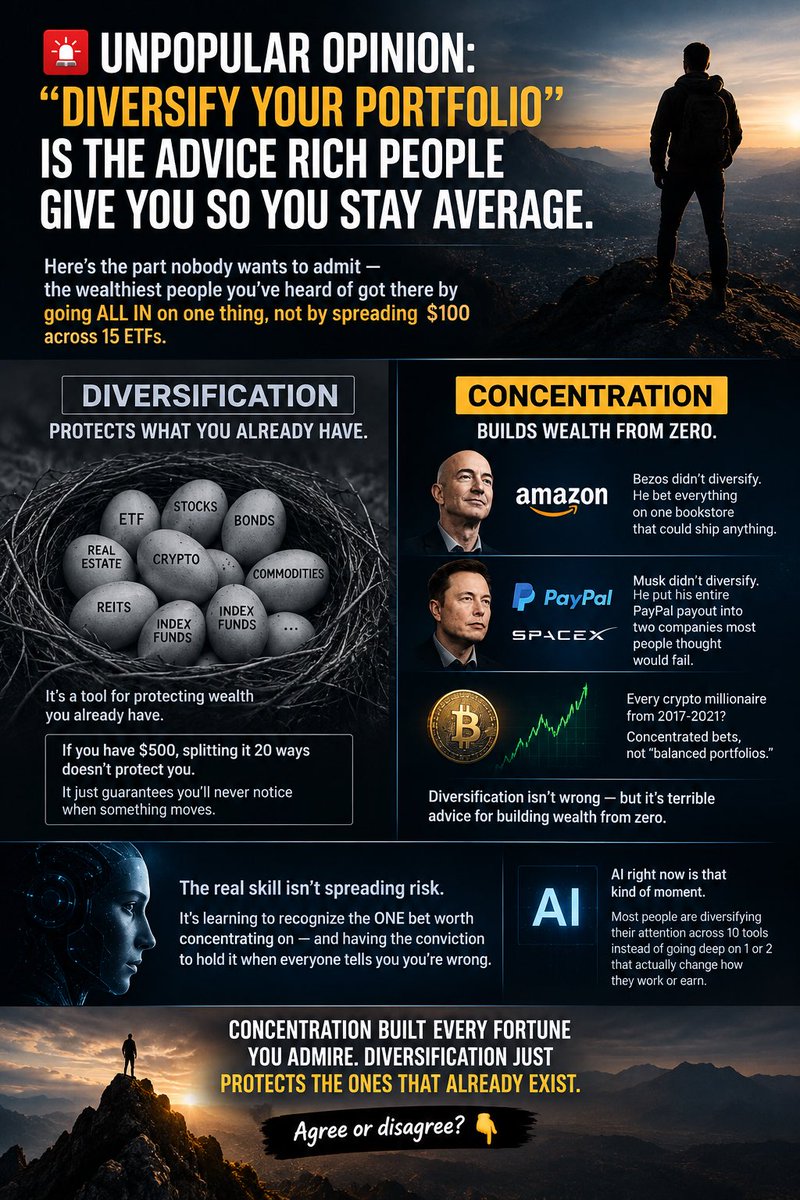
🚨 Unpopular opinion: "Diversify your portfolio" is the advice rich people give you so you stay average.
Here's the part nobody wants to admit — the wealthiest people you've heard of got there by going ALL IN on one thing, not by spreading $100 across 15 ETFs.
Bezos didn't diversify. He bet everything on one bookstore that could ship anything.
Musk didn't diversify. He put his entire PayPal payout into two companies most people thought would fail.
Every crypto millionaire from 2017-2021? Concentrated bets, not "balanced portfolios."
Diversification isn't wrong — but it's a tool for protecting wealth you already have. It's terrible advice for building wealth from zero.
If you have $500, splitting it 20 ways doesn't protect you. It just guarantees you'll never notice when something moves.
The real skill isn't spreading risk. It's learning to recognize the ONE bet worth concentrating on — and having the conviction to hold it when everyone tells you you're wrong.
AI right now is that kind of moment. Most people are diversifying their attention across 10 tools instead of going deep on 1 or 2 that actually change how they work or earn.
Concentration built every fortune you admire. Diversification just protects the ones that already exist.
Agree or disagree? 👇
🚨 At 65, he was broke, retired, and living on a $105 monthly check. Most people would call it the end of the road. He called it the beginning.
This is the Colonel Sanders story — and it's the ultimate proof that it's never too late.
Harland Sanders spent decades bouncing between jobs — farmhand, streetcar conductor, cook — before finally running his own small restaurant. Then a new highway bypassed his location, traffic dried up, and the business collapsed. At 65, he had nothing left but a fried chicken recipe he believed in.
So he did something almost no one his age would do: he got in his car with nothing but his Social Security check and started driving from restaurant to restaurant, cooking his chicken on the spot for owners, hoping one of them would say yes.
The answer was no. Then no again. Then no — over and over.
He heard rejection more than 1,000 times before a single restaurant agreed to a deal.
He didn't quit. He kept driving, kept cooking, kept pitching — because he believed the recipe was good enough to work, even when a thousand people told him otherwise.
That one "yes" became Kentucky Fried Chicken — a brand that would eventually grow into thousands of locations across more than a hundred countries.
💡 The lesson: age isn't the deadline you think it is, and rejection isn't proof you're wrong — it's just the cost of getting to the one yes that matters.
If you're waiting for the "right time" to start — Sanders started at the age most people are planning retirement.
🚨 She had $5,000, no business degree, no fashion experience — and investors laughed her out of the room. Ten years later she became the youngest self-made female billionaire in the U.S.
This is the Spanx story — and it's wilder than most people think.
In 1998, Sara Blakely was working as a fax machine salesperson when a pair of white pants sat unworn in her closet for eight months because she couldn't get the smooth look she wanted. So she did something almost nobody would think to do — she cut the feet off her control-top pantyhose.
That random kitchen-table experiment became the idea behind Spanx.
The catch? She had never taken a business class, had zero experience in fashion or retail, and had only $5,000 to her name. Manufacturer after manufacturer turned her down. One even told her, after finally agreeing to help, that he thought she'd just be giving the product away as Christmas gifts for years.
She didn't listen. She kept pitching — and kept believing in a product nobody else could see the potential in.
Then came the break that changed everything: in 2000, Oprah Winfrey chose Spanx as her favorite product of the year — right around the time Blakely had run out of both friends to sell to and money to keep going.
By the time she sold the company in 2021, that original $5,000 had become a $1.2 billion payout.
💡 The lesson isn't "get lucky." It's this: she bet on an idea nobody validated, kept going after dozens of rejections, and controlled her own story instead of waiting for permission.
Most people wait for confidence before they start. Blakely started — and built the confidence along the way.
🚨 AI just made "hard work" optional. Motivation is now the only moat you have left.
While everyone debates if AI will take their job, some people are using it to build 3 income streams before breakfast.
The difference between them? Not skill. Not luck. Just the decision to start.
🤖 AI doesn't replace ambition — it removes the excuse "I don't know how." Need a business plan? AI writes it in 5 minutes. Need to learn a skill? AI teaches it for free. Need content, code, or a strategy? It's one prompt away.
💰 The people getting rich right now aren't the smartest. They're the ones who stopped waiting for permission and started using the tools already sitting in their pocket.
🔥 In 2026, "I don't have time" and "I don't know how" are no longer real excuses. The only thing standing between you and your next level is you.
Stop scrolling. Start building. The tools are free. The excuses aren't.
🧵 Most people think success is about luck.
It's not.
It's about compounding — in your money, your skills, and your habits.
Here's what actually separates people who build wealth from those who don't 👇
1️⃣ They start before they feel ready. The "perfect moment" to invest, launch, or save more never comes. $100 invested at 25 beats $1,000 invested at 35 — time does the heavy lifting, not timing.
2️⃣ They treat income as a tool, not a scoreboard. High earners who stay broke skip this step: pay yourself first → automate savings → spend what's left. Discipline beats motivation every month.
3️⃣ They diversify effort, not just assets. A stock portfolio + one job is still a fragile system. Most financially secure people have 3+ income streams.
4️⃣ They fail loudly and adjust quietly. Every self-made story has a chapter of bankruptcy, a bad bet, a flopped business. What sets them apart — they changed the method, not the goal.
💡 Success isn't a personality trait. It's a repeatable process: save early, diversify, stay consistent, treat setbacks as data.
Anyone can start today. 🚀