Where does a Rayls gas fee go, and can you check it yourself?
Short answer: partly. I read the Rayls chain directly on 14 Nov 2026 (block 14,476,507, no wallet, no transactions sent). In the block I checked, the fee was paid at 69.12 gwei per gas: 48 gwei base fee and 21.12 gwei tip. The tip reached the block producer. Where the base part goes, I could not confirm.
What the portal says
- USDr is "a USD-backed stablecoin gas token, backed 1:1 by USDC.e".
- RLS is "a capped supply that is progressively burnt and staked".
What I verified (my run, 14 Nov, 12:19 UTC)
- Block 14,476,387: the transactions paid 0.007877 USDr (113,967 gas x 69.12 gwei). Base part 0.005470, tip part 0.002407.
- baseFeePerGas was 48 gwei in all 200 blocks I read, and 195 of them were empty. Ethereum's EIP-1559 lowers the base fee on empty blocks. Here it stayed flat, so it looks fixed or floored.
- 8 addresses produced those 200 blocks. The portal shows 8 validators.
- 0x0, 0xdEaD and 0x...0400 hold 0 USDr.
- Portal total transactions 363,823 vs explorer 363,820, read about 13 minutes apart.
My calculation
- Producer 0x90ae...7789 gained 0.003325048 USDr over 1,000 blocks. That is exactly 157,436 gas x 21.12 gwei, the tip part only. One producer, one window.
- Average transaction cost: portal $0.00342982, mine about $0.00381 (explorer gas used today / transactions today x 69.12 gwei, USDr taken as $1). About 10% apart. I don't know the portal's time window.
Still unconfirmed
- Where the 48 gwei base part goes: burned or sent elsewhere.
- Whether the producer gets exactly the tip in every block. I did not check block by block.
- Who the 8 producers are.
- The RLS burn the portal shows (68.59M), and how the portal computes TVL and average cost.
One snapshot, not an audit. Script, raw JSON and sources in the first reply.
@RaylsLabs could the team say where the base part of the fee goes, and who runs the 8 producers?
Script (Python standard library, read-only, no wallet): https://t.co/z6G1BM07M4
Raw output: fee_probe_evidence.json in the same repo. README has the arithmetic.
Sources
- Rayls Transparency Portal: https://t.co/HrUwA36xGX
- Rayls Explorer: https://t.co/zMK4iPpSym
- Block 14,476,387: https://t.co/M2hRLY76Mv
- EIP-1559: https://t.co/2m9M8Hd15H
- Rayls docs: https://t.co/1wlwnYKcR4
Just finished Lecture 12, the final lecture of the Arc bootcamp by @encodeclub 🎓🚀
Biggest lesson: a deterministic trade lifecycle means pricing certainty, execution certainty, and no principal risk.
From developer-controlled wallets to CCTP, Gateway and StableFX, this bootcamp covered a lot. Excited to keep building on @Arc
Just finished Lecture 11 of the Arc bootcamp by @encodeclub 🚀
Learned how StableFX tackles the biggest problems in traditional FX: idle capital in Nostro/Vostro accounts, opaque costs, and principal risk.
Biggest lesson: on-chain FX removes the gap where one party has sent funds and the other hasn’t 🔐
Excited to keep building on @Arc
How does a dollar get from Ethereum onto @RaylsLabs , and who can mint it on the other side?
Short answer: through LayerZero/Stargate. I traced the mint path and the exit path on the Rayls explorer and checked the numbers I could on-chain (2, 4 and 5 Nov 2026).
What Rayls documents
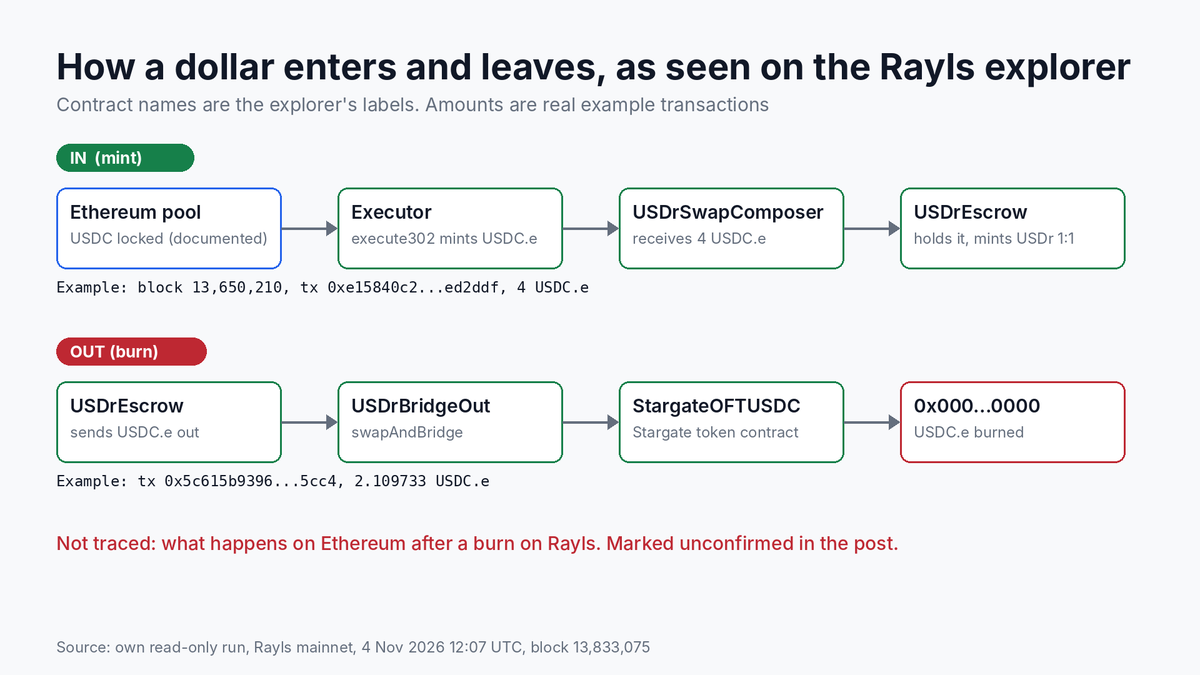
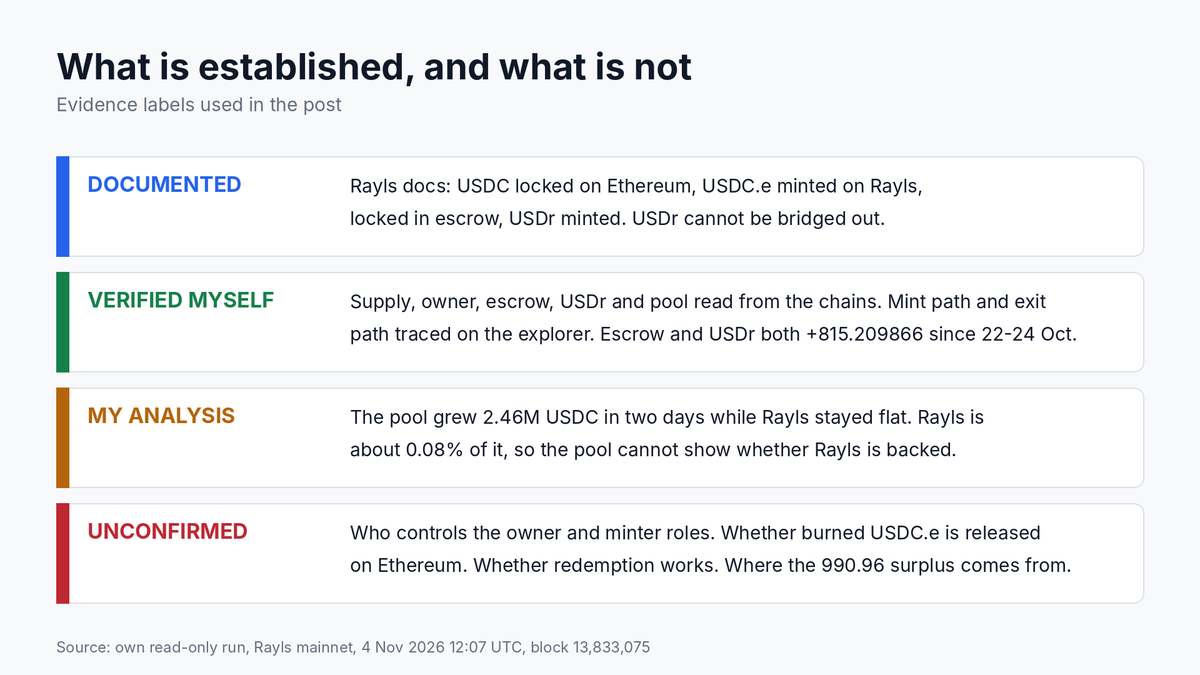
- USDC is locked on Ethereum, USDC.e is minted on Rayls and locked in an escrow, and the escrow mints USDr 1:1.
- USDr can't be bridged out.
What I verified (Rayls mainnet)
- Way in: a transaction sent to a contract called Executor (method execute302) mints 4 USDC.e from the zero address to USDrSwapComposer, which passes it to USDrEscrow. Tx 0xe15840c22c19e5341f1c7255f0efcd5209fb0314c764b5b83dbf3af666ed2ddf
- Way out: a swapAndBridge transaction moves 2.109733 USDC.e from USDrEscrow to USDrBridgeOut to StargateOFTUSDC, which burns it to the zero address. Tx 0x5c615b939648c4fb049da6a192ee5c1b0a356a717425968f06066ab9ae2e5cc4
- USDC.e is a proxy with verified source on the explorer. USDC.e, USDT0.s and WETH share one owner(): 0x4414...4120. It is a contract (7,197 bytes), not a Safe or timelock by interface.
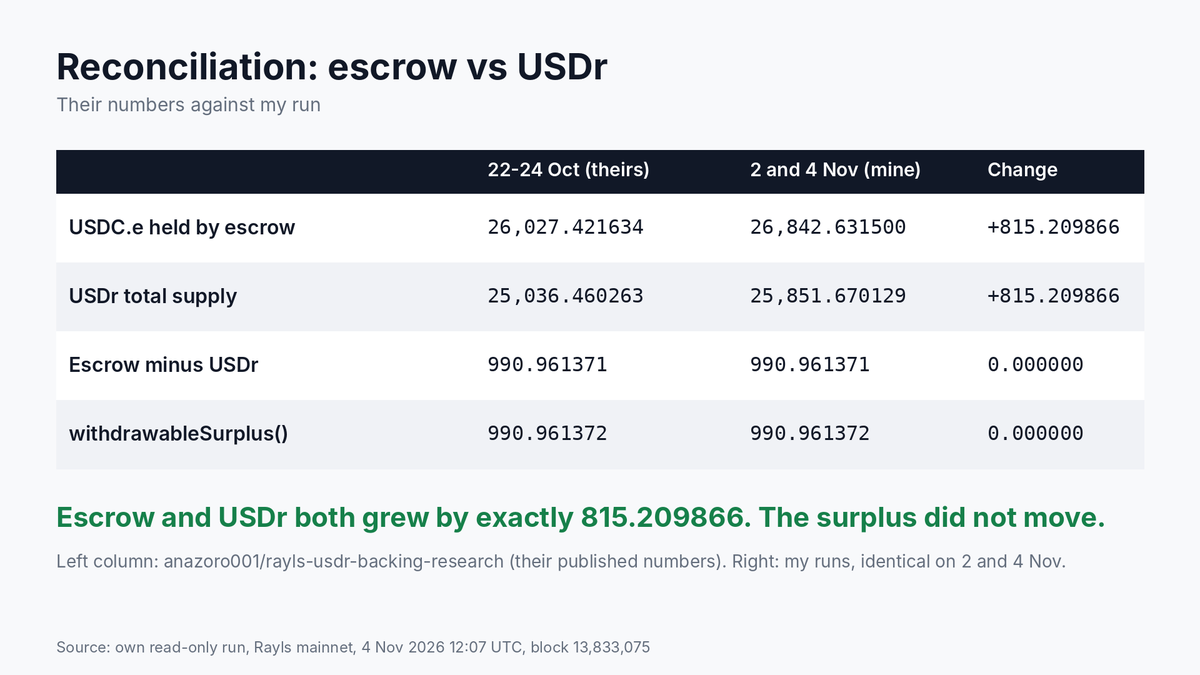
- The escrow holds 26,842.631500 of the 27,012.613155 USDC.e (99.37%). USDr supply is 25,851.670129. The gap is 990.961371, which the escrow itself calls withdrawableSurplus().
- Another researcher published escrow 26,027.421634 and USDr 25,036.460263 on 22-24 Oct. Both have since grown by exactly 815.209866. The surplus did not move.
My analysis
- The Ethereum pool went from 30.69M to 33.15M USDC between my 2 Nov and 4 Nov runs while every Rayls number stayed flat. Rayls USDC.e is about 0.08% of that shared pool, so the pool balance can't show whether Rayls is backed.
- What can be checked is escrow against USDr. They move together to the sixth decimal.
Still unconfirmed
- Who holds the owner and minter roles on USDC.e.
- What happens on Ethereum after a burn on Rayls. I traced the Rayls side only and did not test a redemption.
- Where the 990.96 surplus comes from.
One snapshot per run, not an audit, no transactions sent. Script, raw JSON and sources in the first reply.
@RaylsLabs could the team say who holds the minter roles on USDC.e, and who controls the owner at 0x4414...4120?
Just finished Lecture 10 of the Arc bootcamp by @encodeclub
Learned how Circle Gateway works: deposit USDC once on Arc, get a unified balance, and mint native USDC on any supported chain. No bridging, no wrapped tokens.
The flow is simple: sign a burn intent, submit it to the Gateway API, get an attestation, then call gatewayMint on the destination chain.
Biggest lesson: always use the deposit function, never send USDC directly to the Gateway contract 🔐
Excited to keep building on @Arc
Pictures of the same findings: the two paths, every claim with its label (documented / verified / my analysis / unconfirmed),
escrow vs USDr, and what is still open.
How does a dollar get from Ethereum onto @RaylsLabs , and who can mint it on the other side?
Short answer: through LayerZero/Stargate. I traced the mint path and the exit path on the Rayls explorer and checked the numbers I could on-chain (2, 4 and 5 Nov 2026).
What Rayls documents
- USDC is locked on Ethereum, USDC.e is minted on Rayls and locked in an escrow, and the escrow mints USDr 1:1.
- USDr can't be bridged out.
What I verified (Rayls mainnet)
- Way in: a transaction sent to a contract called Executor (method execute302) mints 4 USDC.e from the zero address to USDrSwapComposer, which passes it to USDrEscrow. Tx 0xe15840c22c19e5341f1c7255f0efcd5209fb0314c764b5b83dbf3af666ed2ddf
- Way out: a swapAndBridge transaction moves 2.109733 USDC.e from USDrEscrow to USDrBridgeOut to StargateOFTUSDC, which burns it to the zero address. Tx 0x5c615b939648c4fb049da6a192ee5c1b0a356a717425968f06066ab9ae2e5cc4
- USDC.e is a proxy with verified source on the explorer. USDC.e, USDT0.s and WETH share one owner(): 0x4414...4120. It is a contract (7,197 bytes), not a Safe or timelock by interface.
- The escrow holds 26,842.631500 of the 27,012.613155 USDC.e (99.37%). USDr supply is 25,851.670129. The gap is 990.961371, which the escrow itself calls withdrawableSurplus().
- Another researcher published escrow 26,027.421634 and USDr 25,036.460263 on 22-24 Oct. Both have since grown by exactly 815.209866. The surplus did not move.
My analysis
- The Ethereum pool went from 30.69M to 33.15M USDC between my 2 Nov and 4 Nov runs while every Rayls number stayed flat. Rayls USDC.e is about 0.08% of that shared pool, so the pool balance can't show whether Rayls is backed.
- What can be checked is escrow against USDr. They move together to the sixth decimal.
Still unconfirmed
- Who holds the owner and minter roles on USDC.e.
- What happens on Ethereum after a burn on Rayls. I traced the Rayls side only and did not test a redemption.
- Where the 990.96 surplus comes from.
One snapshot per run, not an audit, no transactions sent. Script, raw JSON and sources in the first reply.
@RaylsLabs could the team say who holds the minter roles on USDC.e, and who controls the owner at 0x4414...4120?
Script (Python standard library, read-only, no wallet): https://t.co/HIpQIbff8c
Raw output: bridge_trace_evidence.json plus dated snapshots in the same repo. README has the claims table with full addresses.
Sources
- Rayls docs, bridging: https://t.co/Ov9FV0R1wA
- Rayls docs, tokenomics: https://t.co/1wlwnYKcR4
- Other researcher's USDr check: https://t.co/Yeb7Jojb7G
- Rayls x LayerZero: https://t.co/RQRKx5z9sc
- USDC.e: https://t.co/rhnoZdx0KU
- Owner contract: https://t.co/vsKKkdoVa6
- Escrow: https://t.co/2VOeYolqmv
- USDrSwapComposer: https://t.co/PZqpc79WEj
- Example mint: https://t.co/LyY1Uokxo0
- Example exit: https://t.co/SP5IWiRJwX
We’re pleased to have @LayerZero_Core joining Rayls as a launch partner.
LayerZero adds bridge infrastructure to the Rayls ecosystem, enabling assets and OFT-standard tokens to move in and out of the network from connected chains.
For Rayls, this matters because interoperability is what allows capital and tokenised assets to reach Rayls from wherever they currently sit.
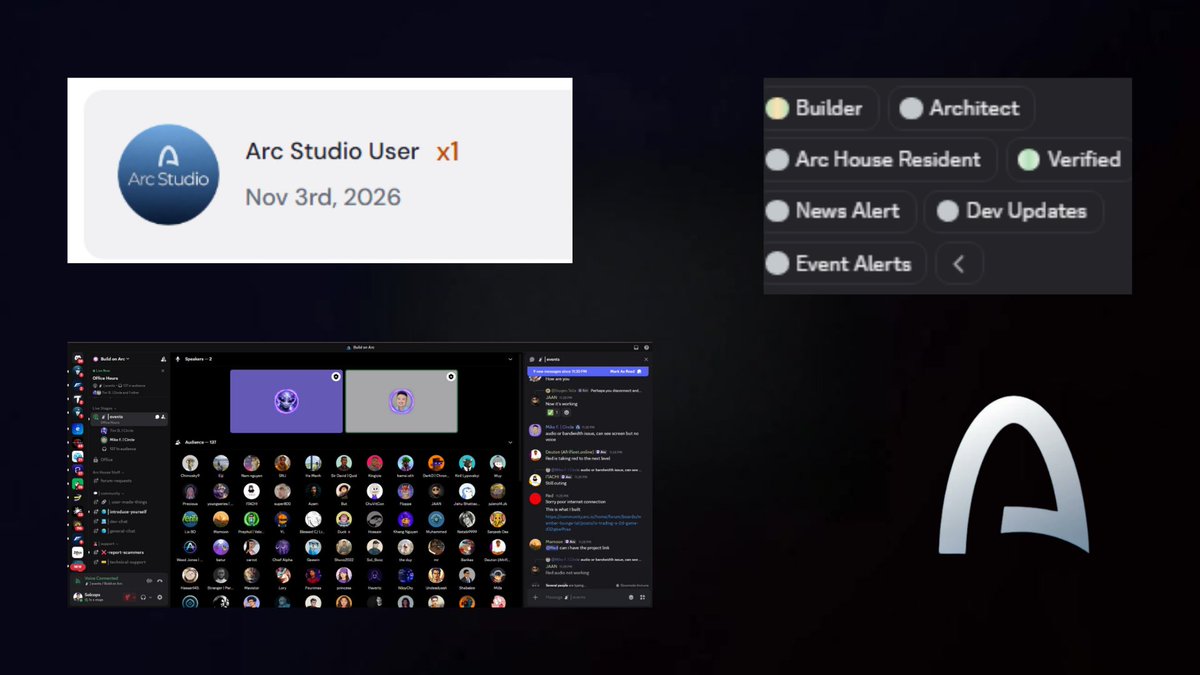
Today has been a really special day in my @arc journey
Unlocked the Arc Studio Builder Badge on Arc House, earned the Architect role on Discord, and also got the new Arc House Resident role!
Today's Discord Office Hours were another highlight. Loved seeing other builders showcase their projects, share creative ideas, and present what they've been working on. Some really impressive builds!
Days like these make the journey even more exciting.
Grateful to be part of this growing ecosystem. More building, more learning, and more to come 💙
Day 2/30: @arc opened its code and its nodes.
As Per the Apr 9 Arc House post, the testnet code is public at circlefin/arc-node, anyone can run a full node, and a bug bounty ran Apr 9 to Jun 1 with local-only testing.
Have you run a node? Unofficial.
Starting Again
Day 1/30: @arc House, read from Arc’s own intro post. It’s the community hub for education, events, hackathons, announcements and groups.
The Architects Program is not application-based.
How do you use Arc House as a builder?
Unofficial.