The goal would be to incorporate a huge corpus of text in a structured format, and to replace Google/etc as the go-to for basic knowledge queries.
e.g you should be able to link to any chapter of any book, everything available offline trivially.
Project Description: Library Hyperboria, Cloud Runemacs
Thesis: Editing, Archiving, and Indexing text is the primary use case for computers, most (not all) of the challenges there come from systemic disorder, not essential technical complexity.
Goal: Fully self hosted, offline first, knowledge database, library, and communication platform.
Feature: Excellent text editor in PLAN, fully self hosted. First class emacs/vim/kak bindings (can support all at once fairly seamlessly using modes)
Feature: no Unicode, 8bit text, monospace, European languages only. (Massive decrease in difficulty)
Feature: p2p messaging, mail, and publishing. Integrated directly into the editor. (New protocols)
Feature: all content published via a network of p2p swarms / merkel dag. Like IPFS/BitTorrent, but PLAN native.
Featue: no web, SSL, HTTP, SMTP, SMS, DNS, etc. (massive decrease in difficulty).
Feature: Offline Global search index (full text over global corpus)
Feature: fully integrated local LLM to achieve "talking library" dynamic.
Feature: specific targeted Hardware/Software bundling (Strix Halo, etc)
A very basic version of this is realizable fairly easily, expand capabilities slowly over a long timespan.
Could potentially drop newline, as it is not actually a character, and just have a hard 80 character cut off (using multiple spaces to encode line endings).
Complicates some things, but it would make "move forward 10 lines" trivially "move forward 800 bytes", etc.
LLM summary of this character set sketch:
An 8-bit linguistic encoding for modern European text, prioritizing strong support for Germanic (English, German, Swedish, Norwegian, Icelandic) and Romance (French, Spanish, Portuguese) languages, plus Greek and Russian as neighboring scripts with major literary traditions. Space is saved primarily through cross-script glyph unification (shared forms like A/Α/А collapse to single code points), a global "no accented capitals" rule (caps-accents being conventionally droppable in Greek, French, and Italian anyway), and the rejection of non-linguistic content — math symbols, currency variants, editorial marks, and curly quotes all cut in favor of $, --, ..., and bare letters. ASCII compatibility was abandoned to free the lower 128 slots, and hard monospace was preserved by forbidding combining marks and escape codes.
"Personalized" software should mean dynamically assembled by you, for you.
When your computer is truly yours, personalization stops being corporate extraction and becomes the sovereign production of your inner world.
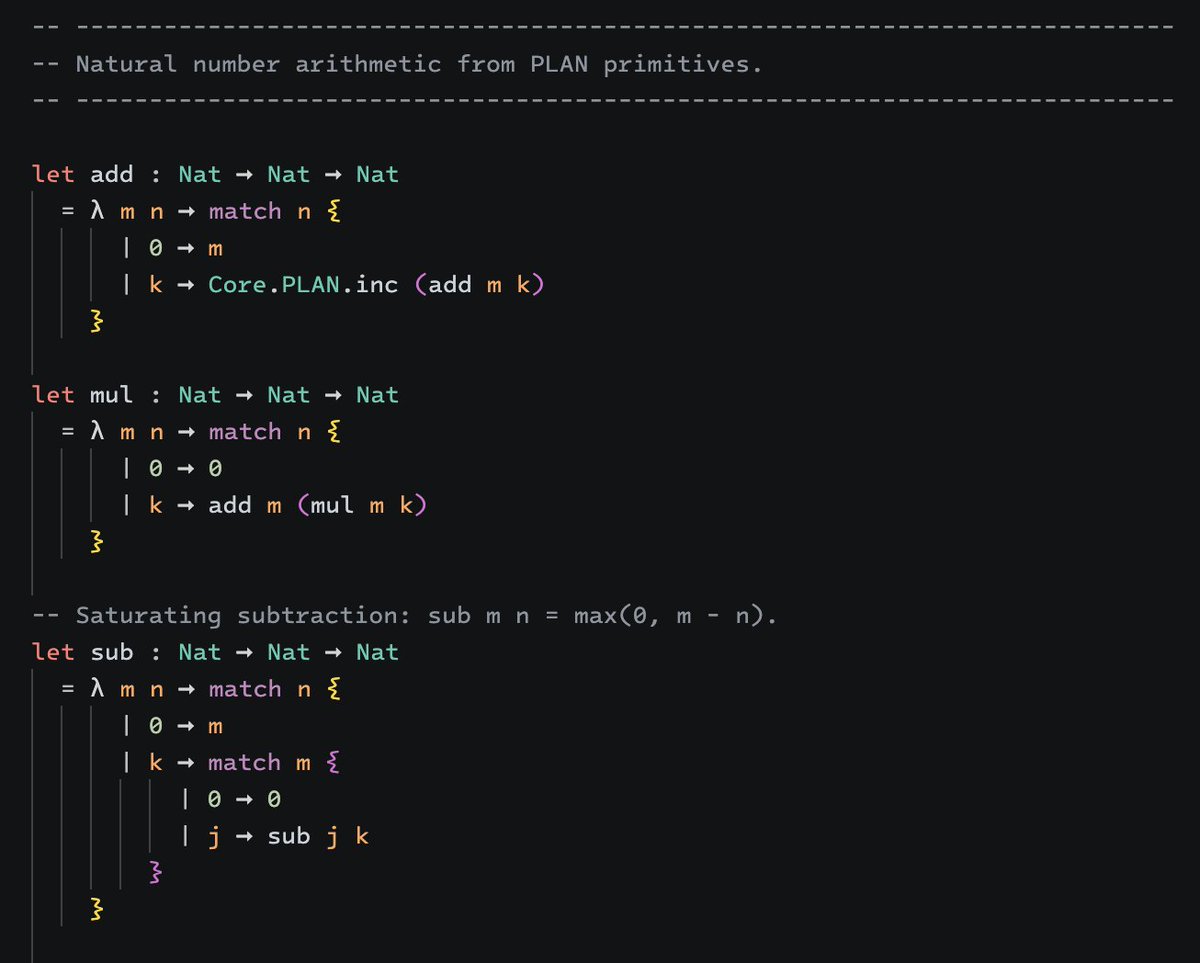
Gallowglass v1.0 releases today ⚔️.
A programming language targeting the PLAN ISA by @sol_plunder & Elliott, designed for LLMs to write and reason about. The compiler now compiles its own source under Reaver with bytewise correctness.
https://t.co/tZNXIK8brX
@IndividualistPE The goal is to take something like X and combine all of it's concerns together into one abstract universe: one coherent system of language/law
The thesis is that the integration costs compound with scale and that the reduction in construction costs can therefore be incredible.
The cog stuff from earlier architectures is no longer a part of PLAN. It has been replaced with direct support for side-effects, with virtualization to run code in a pure sandbox.
We have shipped some demos w/ Gallowglass; they run in CI but are difficult to run right now pending cog I/O.
The PLAN runtime situation is under active flux today and we expect stable ways to run a PLAN OS soon. A byte-compatible Python PLAN interpreter ships w/ Gallowglass.
@IndividualistPE And that is just the three biggest monoliths in something like X. If you look at the X software system as a whole, there are dozens of monoliths, each with their own ontologies.
Every interaction between these systems needs a custom system for translating between them.
It's mostly an efficiency thing.
PLAN programs can make syscalls as side effects, and an outer layer decides what to do with them.
This is more efficient than the pure SSI model of returning a "please do this" object and a callback.
In the non-effectful version, you don't need any special sandboxing because there are no effects at all, only request values.
With the effectful version, you need to run the code "virtualized" with an effect handler.
This is a generalization of an Urbit idea (mock and scry).