WL Form Open Now!
Supply: 555
Price: Free Mint
the crew is already on the road, leaving the noise behind to secure what’s ours
Time: 24 hours only.
https://t.co/nLvRYjQYey
Code: pondSYD
Turn on notifications to stay updated.
X Thread Submission (Week 2)
1/
The biggest story in institutional crypto in 2026 isn't a new announcement.
It's that regulated financial institutions are already deploying on @zksync.
Not in research.
Not in pilots.
In live operational environments.
The question is no longer if banks move onchain.
It's which settlement layer they choose.
2/
Consider the proof points.
Memento is the production deployment of Deutsche Bank's DAMA 2.0 tokenized fund platform.
When a tier-one global bank selects a ZK settlement layer for tokenized fund issuance, distribution, and servicing, that isn't experimentation.
It's infrastructure selection.
3/
Cari Network represents another signal.
Founded by Eugene Ludwig, the 27th U.S. Comptroller of the Currency, Cari is currently onboarding five U.S. regional banks representing more than $600B in combined deposits, with production rollout planned for later in 2026.
Five banks choosing the same rails matters.
Infrastructure becomes more valuable when institutions converge on it.
4/
Then there is ADI Chain.
A network involving First Abu Dhabi Bank, the Central Bank of the UAE, BlackRock, Mastercard, and Franklin Templeton.
A central bank, a major asset manager, and a global payments network operating within the same ecosystem is a powerful validation of interoperability requirements for institutional finance.
5/
BitGo's integration with Prividium may be one of the most important pieces.
Institutions don't just need settlement.
They need custody, governance controls, operational security, and regulated asset management.
Custody integration turns infrastructure into something institutions can actually use at scale.
6/
But deployments alone aren't the moat.
The real question is:
Why is institutional settlement difficult to replicate?
Because production-grade systems require FOUR properties at the same time:
• Privacy by architecture
• Institutional control
• Cryptographic finality
• Atomic cross-chain composability
Most systems solve only part of that equation.
7/
Privacy is the hardest requirement.
Banks, asset managers, and trading desks cannot expose counterparties, balances, or transaction flows to the entire market.
Institutional finance requires confidentiality, compliance, and selective disclosure simultaneously.
Privacy cannot be an afterthought.
It must exist at the architectural level.
8/
The stack matters too.
Airbender, the proving system underlying the architecture, is currently ranked #1 on eth_proofs and achieves roughly one-second block proving on consumer-grade GPUs.
For institutional settlement, proving throughput becomes a critical scaling constraint.
9/
What's structurally different about @zksync is that the proving system, ZK Stack platform, and Prividium institutional layer are designed as one integrated system.
That's different from assembling components maintained by separate organizations.
Performance, security, and interoperability compound when the stack is built end-to-end.
10/
Why does the 2026 lead matter?
Because network effects are forming now.
Every new deployment increases switching costs.
Every successful rollout strengthens regulatory trust.
Every institution added to the network makes the next institutional decision easier.
That's how technical leadership becomes a standard.
11/
The lead is not permanent.
Competitors will improve.
Technology gaps close.
But regulatory trust, operational history, and institutional connectivity take years to build.
2026 is the window where technical advantage can become durable network effects.
12/
The takeaway:
Memento.
Cari.
ADI.
BitGo.
These aren't isolated announcements.
They're evidence that institutions are evaluating settlement infrastructure as a production system, not a research project.
And today, @zksync is one of the clearest examples of that transition happening in real time.
Note: $ZK is the governance token of the ZKsync network, the network's only native asset, and the native gas token for ZKsync Gateway.
@knidosxyz is building an AI-powered fund manager that analyzes markets, executes strategies, and verifies every move with zk proofs. No emotion. No guesswork. Just transparent, verifiable execution. 🤖📊
As DeFi evolves, systems that combine AI + cryptographic proof could redefine how capital is managed on-chain.
#Knidos #DeFi
@TBookFoundation is becoming more than a platform for sharing posts, it’s evolving into a space where consistency, insight, and genuine contribution are visible over time.
Short updates help keep the ecosystem active, but well-written articles often carry greater weight because they reflect research, effort, and long-term thinking.
The strongest contributors aren’t always the loudest, they’re the ones who consistently add value, spark discussion, and help others understand the bigger picture.
If eligibility and recognition matter, focus less on chasing impressions and more on building a credible body of work.
In ecosystems that reward contribution, substance usually outlasts noise.
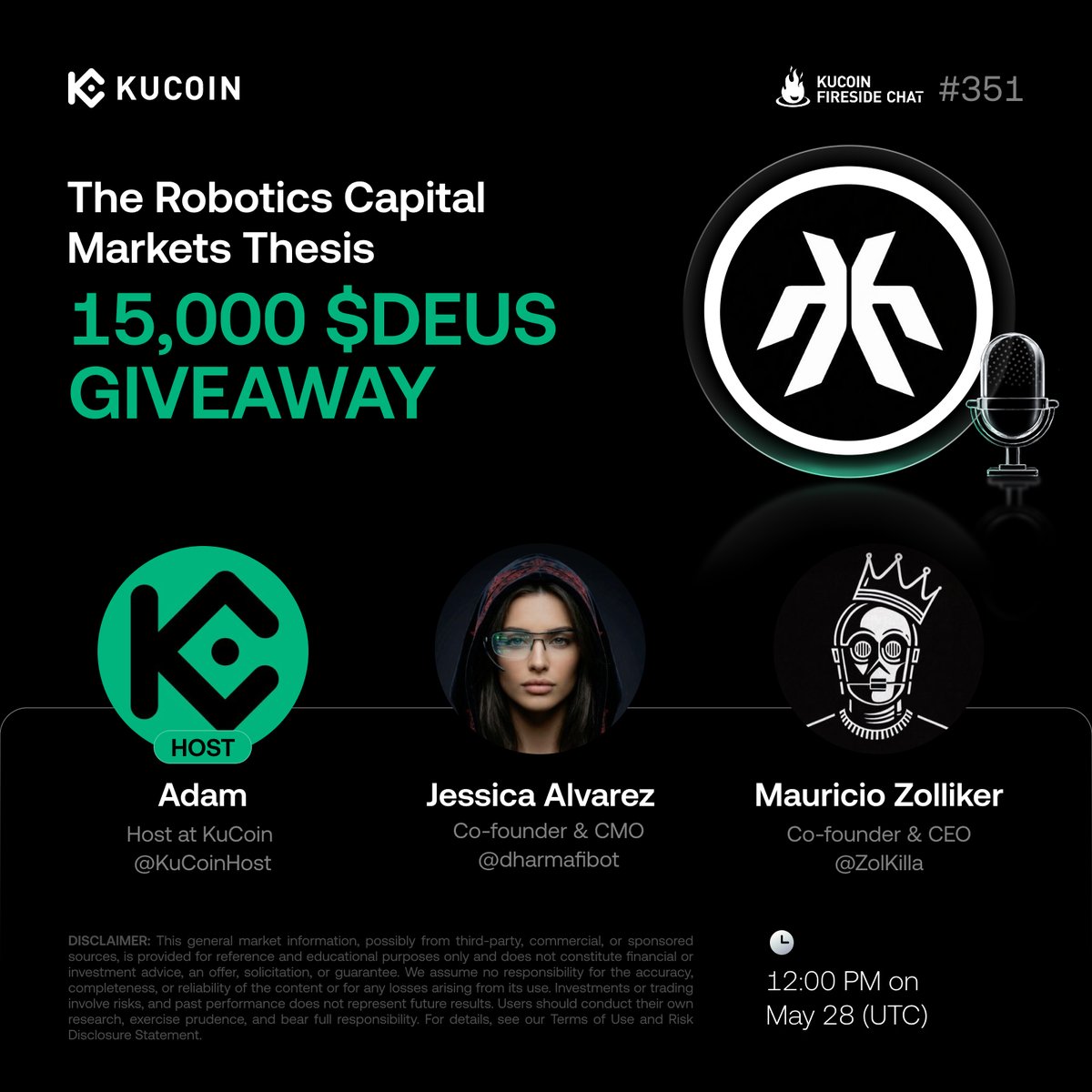
🎙️KuCoin x $DEUS: The Robotics Capital Markets Thesis
🎁 15,000 $DEUS to win!
How to enter:
1. Follow @kucoincom and @xmaquina
2. Like, Repost with quote "Trade $DEUS on #KuCoin!" + tag 3 friends
3. Join the space: https://t.co/g0ImM3eK9j
4. Refer your friends!
5. Submit Your KuCoin UID.
6. Complete the Gleam form: https://t.co/o3DbXZuhlP
⏰Join us on May 28, 2026, at 12:00 PM (UTC) for the live Space!
New to KuCoin? Sign up to participate https://t.co/5mPUYAUH5d
Death Certificate: “Utility doesn’t matter in crypto.”
Cause of death: repeated exposure to reality.
Survived briefly on VC oxygen and recycled cope threads.
Pronounced dead by @RallyOnChain after the market stopped funding vibes alone.