That’s the difference between noise and signal.
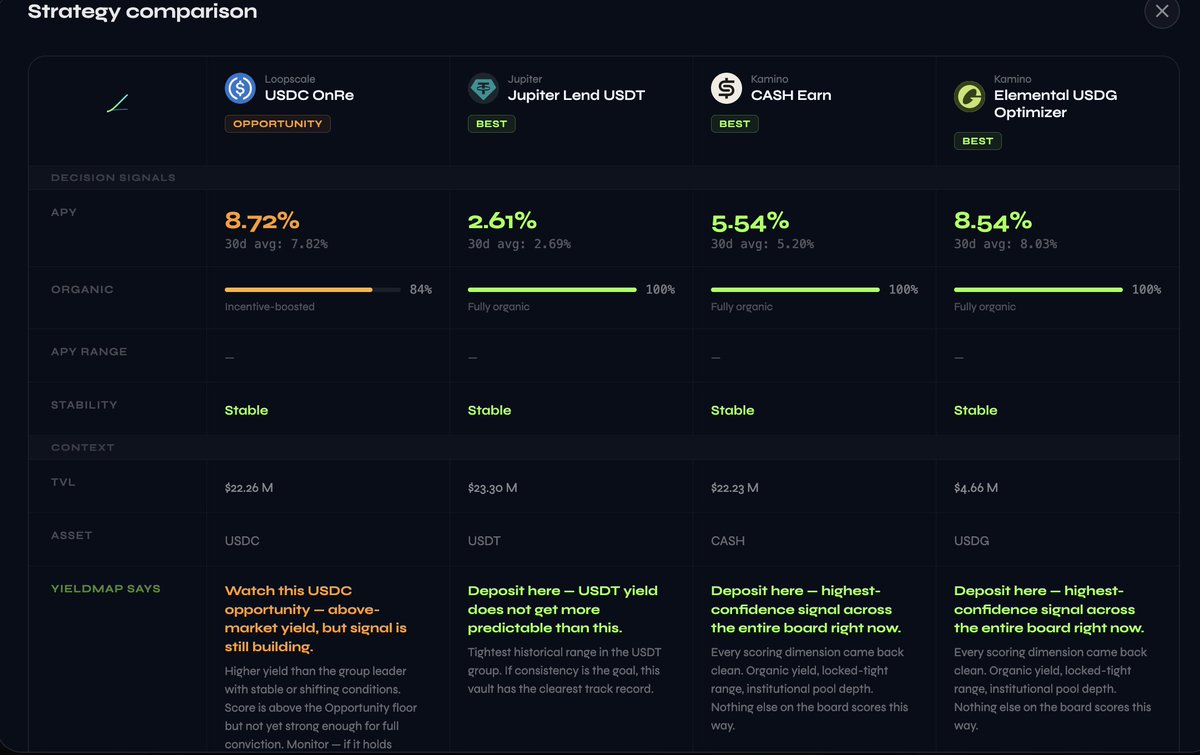
We track 151 signals every 24 hours and label only the cleanest ones:
Best • Safe Harbor • Opportunity
Real yield needs more than high APY.
What moved in your portfolio yesterday?
https://t.co/2WiXkz7nTA
While everyone chased the $USDC spike, the real move was in $USDG.
Steakhouse USDG: 5.1% → 10.98%
Elemental USDG: 9% → 11.42%
High utilization.
Stable signal.
Organic demand — not just temporary hype.
Solana lending in the last 24h:
— 71 APY spikes detected
— 46 critical utilization alerts
— 8 vaults locked at 95%+ utilization
$USDC pools maxed out.
$SOL vaults jumped from 5% → 24% APY.
The market moved fast.
Most people saw none of it.
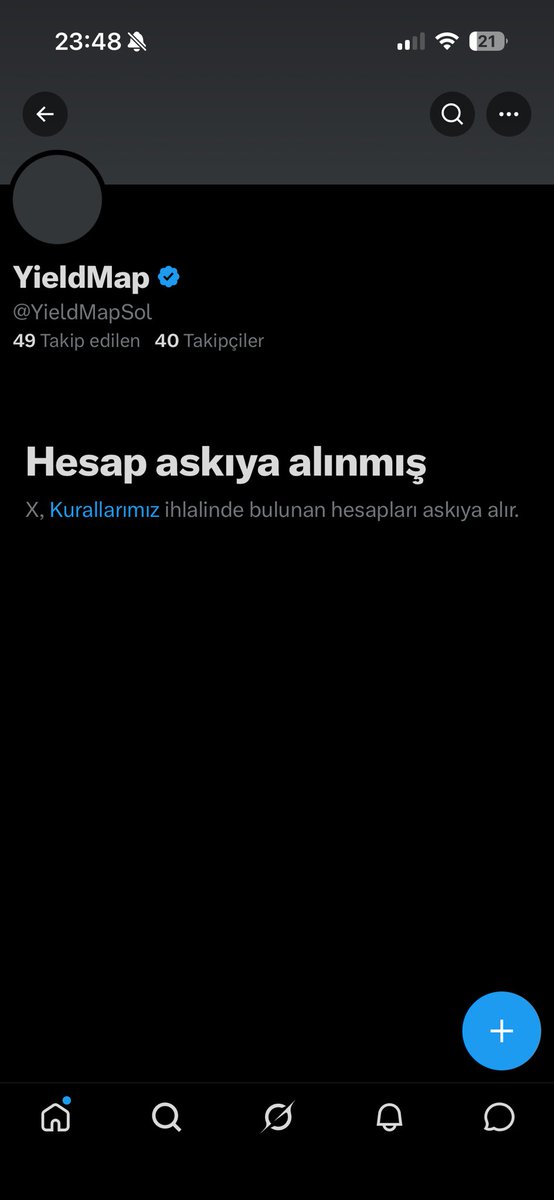
@YieldMapSol is back.
After 10 days of suspension with no explanation, we’re resuming.
Same mission: Real-time, honest Solana DeFi vault analysis.
Engine running. Signals live. Labels cleaner than ever.
There is a right move.
https://t.co/2WiXkz7nTA
@elonmusk@X this is not fair.
I believe this may have been a mistake, as my account is used for legitimate purposes, I have always followed X's rules and have not engaged in any spam, manipulation, or prohibited activity.
I kindly request a review of my account and open again
Not all yield is created equal.
There’s **organic yield** (real demand)
and **incentive yield** (temporary farming rewards).
There’s **stable yield** (predictable)
**shifting yield** (moving)
and **volatile yield** (dangerous).
The real game is knowing which one you’re actually getting.
That’s why we built @YieldMapSol — to label them clearly every 15 minutes.
Most people pick a stablecoin vault by APY alone.
That's the wrong question.
Organic or incentive-boosted? Stable or shifting? What does the yield actually come from?
We compare every vault across every signal — so you don't have to.
https://t.co/2WiXkz7nTA
Best $USDG vault right now @jup_lend@kamino has better yield option but stability is shifting.
More on the way from https://t.co/Cer4MxuFLm
A decision engine for DeFi on @solana
RWA yield is getting attention for the right reason.
Real cash flows. Institutional credit.
Yield you can explain without mentioning a token.
But "real yield" and "right yield"
aren't the same thing.
The source matters.
So does the structure, the liquidity,
and whether you can exit when you need to.
RWA doesn't automatically mean safe.
It means different risk —
and that risk still needs to be surfaced.
CT is quiet. Engagement is at historic lows.
Everyone feels it.
But let's be honest about why.
This isn't just a bear market problem.
It's an onboarding problem.
Crypto has never been harder to navigate
for someone coming in fresh.
In 2021, you bought ETH or SOL,
it went up, you felt like a genius.
The feedback loop was instant.
In 2024-2026, the entry points multiplied.
Lending markets. Yield vaults. LSTs. RWA.
Perps. Points. Airdrops. Curators.
Each one promising returns.
None of them explaining the tradeoffs.
So new users do one of three things:
→ Chase the highest APY and get burned
→ Stay in stables and earn nothing
→ Leave entirely
The ones who stay are the ones
who built a framework.
Most people never do.
---
Solana had a real shot at retail.
Sub-second finality. Near-zero fees.
The infrastructure was finally ready.
Then Drift happened.
$285M. Six months of infiltration.
Users who did everything right —
chose a reputable protocol,
didn't chase memes — still lost.
That's not a Solana failure.
That's a transparency failure.
The risk was always there.
It just wasn't visible before entry.
---
Here's what CT is missing in this moment:
Not more alpha.
Not more dashboards.
Not more APY comparisons.
A layer that says:
"Here's the right move.
Here's why.
Here's what you're actually exposed to."
Retail doesn't need more information.
Retail needs a decision.
That's what brings people back.
Not the next cycle hype.
Not the next airdrop.
Confidence in what they're doing
and clarity on why they're doing it.
---
Solana DeFi will come back stronger.
Not because the infrastructure improves —
it already has.
But because the decision layer
that sits on top of it
is finally being built.
That's what we're working on.
https://t.co/Fzvgeu026v
Six months of infiltration.
$285M gone.
The attack wasn't on the protocol.
It was on the people running it.
Users had no way to know.
That's the gap no dashboard closes.
Transparency about risk structure —
before you deposit, not after.
Most people use DeFi like this:
→ check APY
→ trust the protocol
→ hope it works
That’s why they lose money.
We built a decision engine.
It tells you where to deploy — and why.
Closed beta → https://t.co/2WiXkz7nTA
Every strategy on YieldMap gets a label.
BEST. ALTERNATIVE. OPPORTUNITY. SAFE HARBOR.
Not because we rank APY.
Because we rank decisions.
Soon https://t.co/2WiXkz7nTA
Problem 1: You can't see risk from the outside.
Drift looked fine.
The UI was clean. The APY was there.
Nothing screamed "danger."
But the risk was structural —
and invisible to most users.
This is DeFi's biggest unsolved problem.
Not hacks. Opacity.
Solana DeFi had a rough week.
Drift exploit. Liquidity pulled.
Rates spiked. Trust shaken.
A thread on what actually happened —
and what it means for how you deploy capital. 🧵