The Heidelblog published an article by John Fonville, rector of Paramount Church and author with Moody Publishers, today.
Enthusiasm Is Not a Means of Grace
In an age that often looks to feelings, experiences, and inner impressions for spiritual certainty, this article reminds us where God has actually promised to meet and strengthen His people: through His ordained means of grace.
Be sure to give it a read and share it with others:
https://t.co/sovdN9fGyz
Happy Ascension Day!
49. What benefit do we receive from Christ’s ascension “into heaven?”
First, He is our Advocate in the presence of His Father in heaven.1 Second, we have our flesh in heaven as a sure pledge, that He, our Head, will also take us, His members, up to Himself.2 Third, He sends us His Spirit, as a down payment,3 by whose power we seek those things which are above, where Christ sits on the right hand of God, and not things on the earth.4
1 Rom 8:34; 1 Jn 2:1; 2 Jn 14:2, 17:24; Eph 2:4-6; 3 Jn 14:16; Acts 2:33; 2 Cor 1:21-22, 5:5; 4 Col 3:1-4
The Comfortable Words may be among the greatest summaries of Reformation pastoral theology ever written.
Matthew 11:28
John 3:16
1 Timothy 1:15
1 John 2:1–2
Every text directs sinners away from self and toward Christ.
“If any man sin, we have an Advocate with the Father, Jesus Christ the righteous: and He is the propitiation for our sins.”
The beating heart of the 1662 Ordinal:
The ministry exists for the proclamation of the gospel of Jesus Christ through Scripture, preaching, sacrament, and pastoral oversight.
Heidelberg Catechism, Q. 56
What do you believe concerning the “forgiveness of sins?”
That God, because of Christ’s satisfaction, will no longer remember my sins,1 nor my sinful nature, against which I have to struggle all my life;2 but He graciously imputes to me the righteousness of Christ, that I may never come into condemnation.3
1 Ps 103:3-4, 10, 12; Mic 7:18-19; 2 Cor 5:18-21; 1 Jn 1:7, 2:2; 2 Rom 7:21-25; 3 Jn 3:17-18, 5:24; Rom 8:1-2
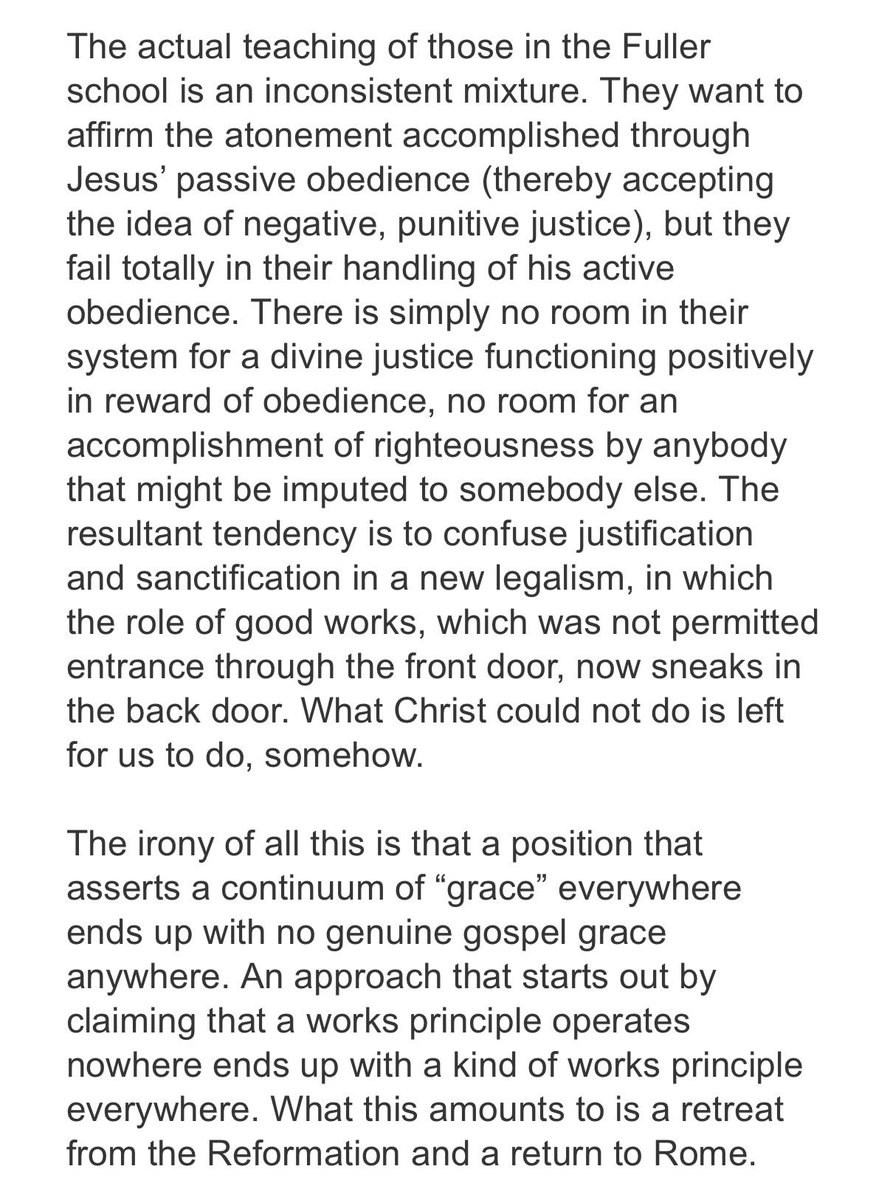
MGKline: “An approach that starts out by claiming that a works principle operates nowhere ends up with a kind of works principle everywhere. What this amounts to is a retreat from the Reformation and a return to Rome.”
Almighty God, you alone can order the unruly wills and passions of sinful men: grant that your people may love what you command and desire what you promise so that among the many and varied changes of this world our hearts may be firmly fixed where true joys are to be found through Jesus Christ our Lord. Amen.
"This is just one of the several problems with any two-stage scheme, any program whereby believers are said to be initially justified but awaiting a final adjudication by works. Any such scheme necessarily means that a believer is not really and truly justified here and now. We are still under the law, the covenant of works, for our final standing with God."
—@RScottClark
https://t.co/Pz18lXnIVX
@heidelcast@HeidelbergRefo1
John Calvin, drawing on Augustine of Hippo, explains that good works are gifts of God’s grace, not the basis of our salvation or assurance. Even our best works are mixed with sin and cannot stand on their own before God. Yet God graciously “crowns” these works—not as earned merit, but as His own work in us—so that all confidence rests in Christ alone while the fruits of faith are publicly recognized at the final judgment.
https://t.co/8vSrfWY2QW
The idea that good works function as an “antecedent adjunct” to obtaining salvation fails to preserve the Reformed distinction between grace and works.
To place works anywhere prior to obtaining salvation—even while denying they are the cause—is to make them a condition in principle, which confuses law and gospel.
The Reformed confessions do not merely deny works as the ground of justification; they exclude them as anything wrought in us that precedes or contributes to obtaining it in any sense.
Good works are a consequent necessity, not an antecedent one. They follow from union with Christ; they do not prepare for it, qualify for it, or fit us to receive it.
The Reformed confessions speak with clarity:
Thirty-Nine Articles of Religion, Article 12 — Of Good Works
“Albeit that Good Works, which are the fruits of Faith, and follow after Justification, cannot put away our sins, and endure the severity of God’s judgment; yet are they pleasing and acceptable to God in Christ, and do spring out necessarily of a true and lively Faith; insomuch that by them a lively Faith may be as evidently known as a tree discerned by the fruit.”
Westminster Confession of Faith 11.1
“Those whom God effectually calleth, he also freely justifieth… not for anything wrought in them, or done by them, but for Christ’s sake alone… not by imputing faith itself… or any other evangelical obedience to them, as their righteousness.”
Heidelberg Catechism, Q. 60
“God… grants and credits to me the perfect satisfaction, righteousness, and holiness of Christ… without any merit of my own, out of mere grace… only by true faith.”
If it is “wrought in them” or “done by them,” it is excluded—not only as a cause, but as any antecedent contribution to obtaining salvation. Good works confirm and follow; they never precede as a condition, adjunct, or fitness.
The Scots Confession says the cause of good works is not free will but the Spirit of Christ dwelling in believers by true faith. It also says regeneration and sanctification occur without respect to any merit proceeding from us.
Chapter 12- Faith in the Holy Ghost
. . . And so as we confess that God the Father created us when we were not; as his Son, our Lord Jesus redeemed us when we were enemies to Him: so also do we confess that the Holy Ghost does sanctify and regenerate us, without all respect of any merit proceeding from us, be it before or be it after our regeneration. To speak this one thing yet in more plain words, as we willingly spoil ourselves of all honour and glory of our own creation and redemption, so do we also of our regeneration and sanctification: For of ourselves we are not sufficient to think one good thought; but He who has begun the good work in us, is only He that continueth us in the same, to the praise and glory of his undeserved grace.
“the Reformed churches are very clear on three things about merit: 1, we believe in merit, 2 we confess that Christ’s (condign) merits are imputed to believers as the ground of their justification and salvation, and 3 we deny that believers have any merit, condign or congruent”
Do Any Reformed Confessions Teach Salvation by or through Good Works?
Read the full breakdown and see what the confessions actually say.
https://t.co/JvU96IxlPM
The Heidelberg Catechism and the Church of England: A Historical Clarification
https://t.co/0flOw9klon
This brief article show how @RScottClark provides compelling historical evidence of the significant and often underappreciated influence of the Heidelberg Catechism on English Reformed theologians within the Church of England, particularly through its formal use at Oxford and its role in theological formation.