@shitposts_mp4 $Mii literally everywhere
500K+ Japanese tweets mentioning Mii or トモコレ in less than 1 week 🔥
FsCawsntD9PHw3fCn6SGjcxRuXopWoVQwJ8UyhQupump
Mii is set to become as viral or even more viral than $Punch and $Labubu
@gimmesomegotcha It's game demo is already viral everywhere and will be even more viral since game will be out in around a week.
Seems will be mega viral in Japan so can be next Punch or Labubu
@TehSuper@ChuckDeuce777 Yeah bubblemaps is usually not accurate.
This guy was complaining many hours ago when we were at ATH lmao.
He just wants the coin to pump to millions quickly so he can sell.
Tech projects usually slow moon and not pump hard on day 1 or even week 1.
@V2Chenz@MPP_Pay@stripe@tempo Check out $Gate @mppgate
1st MPP project on SOL and already has the top 4 highest number of AI agents on Tempo and MPP using its tech
Early at $100K and can be the leader of the MPP meta
Everyone is focused on agents making payments.
Almost no one is thinking about what happens after.
The real bottleneck in the agent economy isn’t intelligence, discovery, or even payments, it’s control. That's why I'm still bullish on $gate @mppgate.
An autonomous agent with a wallet but no constraints is not infrastructure.
It’s risk.
We’re moving from:
agents that can pay → to agents that must operate under policy
That shift changes everything.
MPP, x402, and AMP solved how agents transact.
But none of them solve who decides how much an agent is allowed to spend, when it stops, and how risk is managed.
This is where the stack starts to look less like software and more like finance.
Every mature financial system evolved the same way:
- Payments came first
- Then credit
- Then risk management
- Then governance
The agent economy is replaying that exact sequence in real time.
@mppgate sits at that inflection point.
Not as another payment rail —
but as the risk layer that makes autonomous capital deployable.
Because once agents control budgets:
• Enterprises can deploy fleets instead of experiments
• Sub-agents can operate under delegated limits
• Payment channels become programmable treasury flows
• Spending policies become part of agent architecture
This is when agents stop being tools and start behaving like economic entities with governance.
The deeper implication:
The winning agent ecosystem won’t be the one with the fastest payments.
It will be the one where autonomous spending is safe enough to scale.
Payments enable agents.
Controls enable deployments.
One creates activity.
The other unlocks institutional adoption.
If the agent economy grows into thousands of autonomous services interacting continuously,
the most valuable layer may not be the agent itself,
but the system deciding how capital flows between them.
That’s the layer $GATE is quietly positioning for.
Not the payment.
Not the marketplace.
But the governance of autonomous money.
Free sub 100k
3EfCdzNM15mZzxiwXzyk32syZeSKJYgLVBXP9vJ4pump
Everyone is focused on agents making payments.
Almost no one is thinking about what happens after.
The real bottleneck in the agent economy isn’t intelligence, discovery, or even payments, it’s control. That's why I'm still bullish on $gate @mppgate.
An autonomous agent with a wallet but no constraints is not infrastructure.
It’s risk.
We’re moving from:
agents that can pay → to agents that must operate under policy
That shift changes everything.
MPP, x402, and AMP solved how agents transact.
But none of them solve who decides how much an agent is allowed to spend, when it stops, and how risk is managed.
This is where the stack starts to look less like software and more like finance.
Every mature financial system evolved the same way:
- Payments came first
- Then credit
- Then risk management
- Then governance
The agent economy is replaying that exact sequence in real time.
@mppgate sits at that inflection point.
Not as another payment rail —
but as the risk layer that makes autonomous capital deployable.
Because once agents control budgets:
• Enterprises can deploy fleets instead of experiments
• Sub-agents can operate under delegated limits
• Payment channels become programmable treasury flows
• Spending policies become part of agent architecture
This is when agents stop being tools and start behaving like economic entities with governance.
The deeper implication:
The winning agent ecosystem won’t be the one with the fastest payments.
It will be the one where autonomous spending is safe enough to scale.
Payments enable agents.
Controls enable deployments.
One creates activity.
The other unlocks institutional adoption.
If the agent economy grows into thousands of autonomous services interacting continuously,
the most valuable layer may not be the agent itself,
but the system deciding how capital flows between them.
That’s the layer $GATE is quietly positioning for.
Not the payment.
Not the marketplace.
But the governance of autonomous money.
Free sub 100k
3EfCdzNM15mZzxiwXzyk32syZeSKJYgLVBXP9vJ4pump
@mppgate@privy_io $Gate team one of the best tech teams in SOL right now
Getting supported by big people already
Gate will be the leader of the MPP meta. Millions soon 🚀
Gate is the 1st MPP tech on SOL and $Mpay is 2nd. Both will pump since Stripe (Tempo maker) will for sure hype this tech.
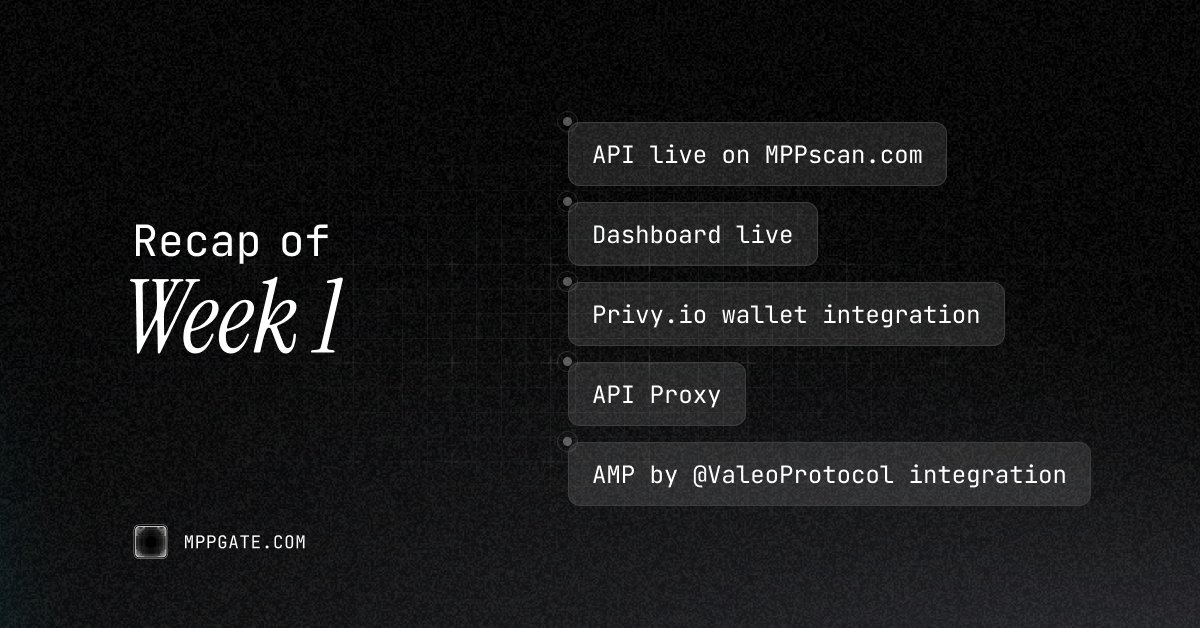
Week 1 recap.
here's what we shipped:
— API live on MPPScan. Top #10 server in the first hour.
— Top #2 on MPP via Tempo in under 6 hours.
— Dashboard live with @privy_io integration. connect your wallet, manage your agents.
— API Proxy shipped. wrap your existing endpoints under the gate, no protocol knowledge needed.
— AMP by @ValeoProtocol integration live. two rails, one control layer.
we said we'd ship. we shipped.