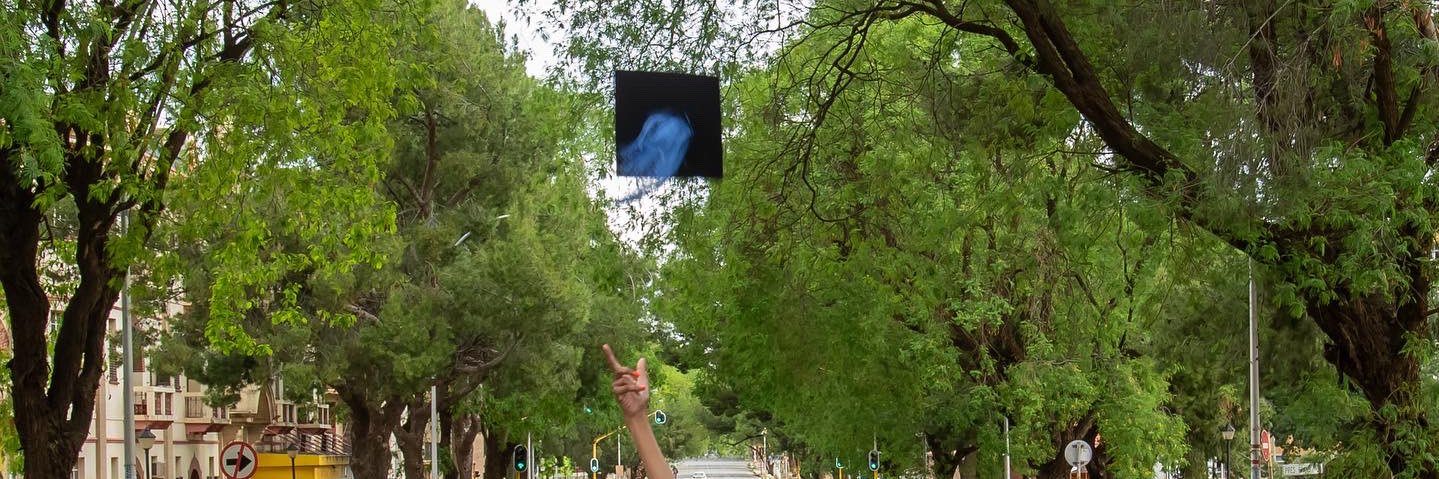
Guys, I bumped into this video on TikTok of a guy asking people to buy tickets for his event 🎫 You can really see how much this means to him. Please guys, let’s kindly support our fellow brother 🤌🇿🇦🇿🇦🇿🇦🇿🇦🇿🇦
A sex therapist with 30 years experience revealed the real reasons so many couples go from passionate to platonic in under 2 years.
It's not stress, kids, or age.
It's these seven dynamics shifts…
10 AI tools I actually used in 2025:
1. ChatGPT. Drafting, planning, analysis
2. Gemini. Literally everything.
3. Claude. Long docs, all my writing workflows
4. WisprFlow. System-wide voice dictation
5. Perplexity. Answer engine with citations
6. Elicit. Literature search and screening
7. Consensus. Peer-reviewed evidence summaries
8. Granola AI. Meeting notes without bots
9. Gamma. Slides on AI steroids.
10. Litmaps. Citation-network mapping
Not hype. Just what worked.
PhD Students - Here is an example of a good abstract.
A good abstract should have the following 6 parts.
1. Importance of your study
2. Gap in the existing literature
3. Objective of your study
4. Method used to conduct the study
5. Key findings of your study
6. Implications of your study
Making a Research Proposal
-
It is a quite tricky job to make a research proposal. If you have written a research conference or journal paper before or if you have read conference/ journal papers before. Then it is quite easy to understand how to write it.
*** Research proposal is just like a research paper but without exact results description and conclusions.
But if you do not have any experience of writing or reading research papers, i will tell you step by step in 5 steps.
1) Defining research directions
Define research directions for PhD you are going for. If research project is already given, then finding research question from it. What are research directions? Research directions are the proposals in the project on which you want to work. The problems or improvements in the project that you want to work on.
2) Creating significance / references/ Review
You have to create significance of the research directions you want to work on and giving references with previous literature and their expected importance /improvements from existing work.
3) Research Design and Methodology
Your expected design of working on the project proposal. Mentioning each step of how you will work on that proposal. Even making a block diagram of whole process of proposal implementation and explaining it with references from previous literature and explaining about expected results. You have to search for research gaps also in the project / proposal given. This you can find by reading research papers in that topic and easy way is to see that in the project you are working on, on which topic in that people are mostly working on. That is one of the main gaps. Also you can find gaps by checking each individual step of your research proposal with other papers published in that area.
4) Proposed Timeline
You can give the proposed time line regarding steps of the proposal. This timeline you can discuss with professor also if you are in contact with him
During my PhD, I submitted 400 pages of brilliant research.
Supervisor: "None of it makes sense together."
Chapter 3 referenced Chapter 5 findings.
Lit review came after methodology. Introduction promised arguments that never appeared.
"Your research is excellent. Your thesis doesn't tell a story."
Words that fail PhD theses:
"This study shows...",
"It is important to note...",
"As mentioned above..."
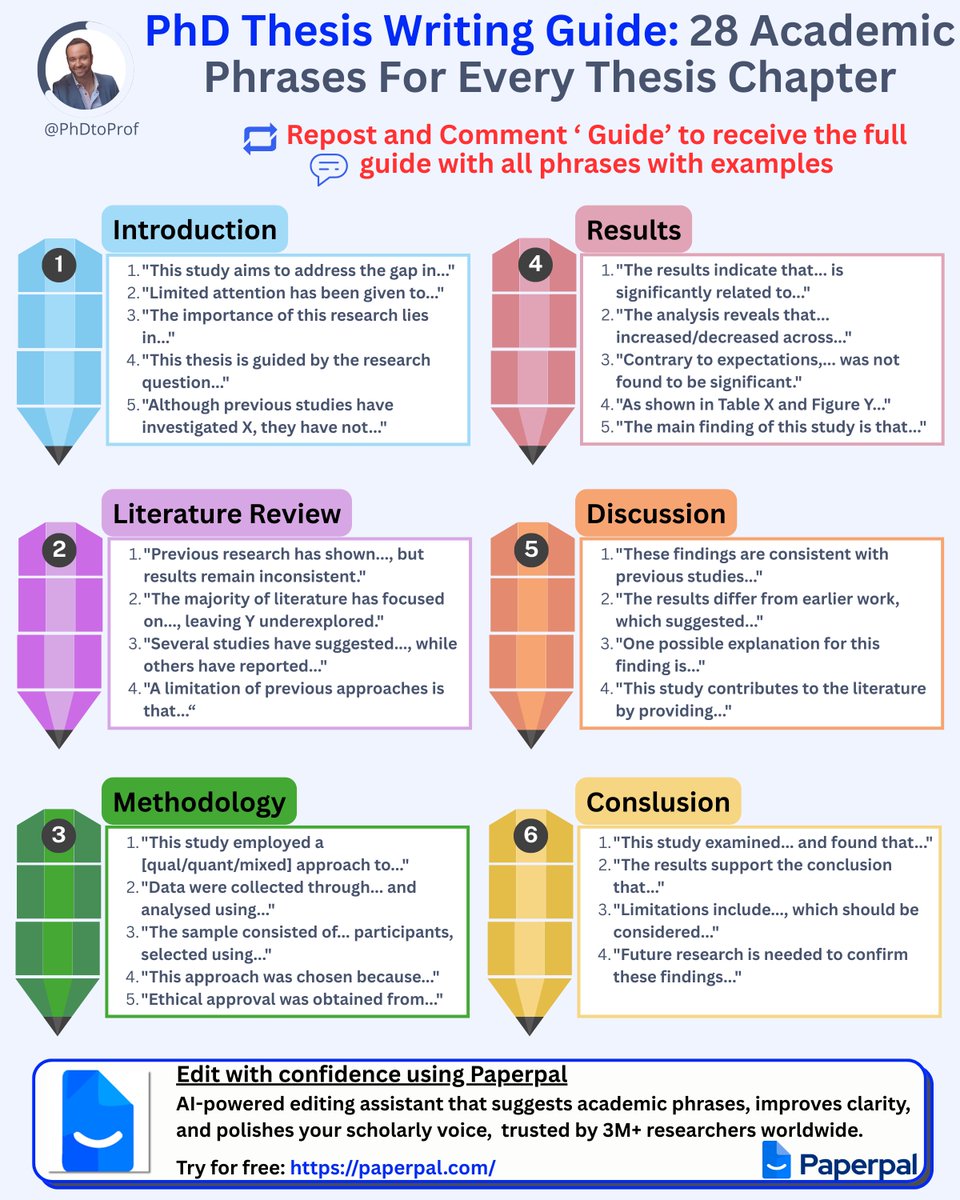
After reviewing 25 successful theses, I mapped exact phrases for each chapter:
Repost & Comment 'guide' for full phrase guide 👇
What a PhD Really Means: Beyond the Thesis
Many people think a PhD is only about writing a long thesis or conducting advanced research. But the truth is much broader.
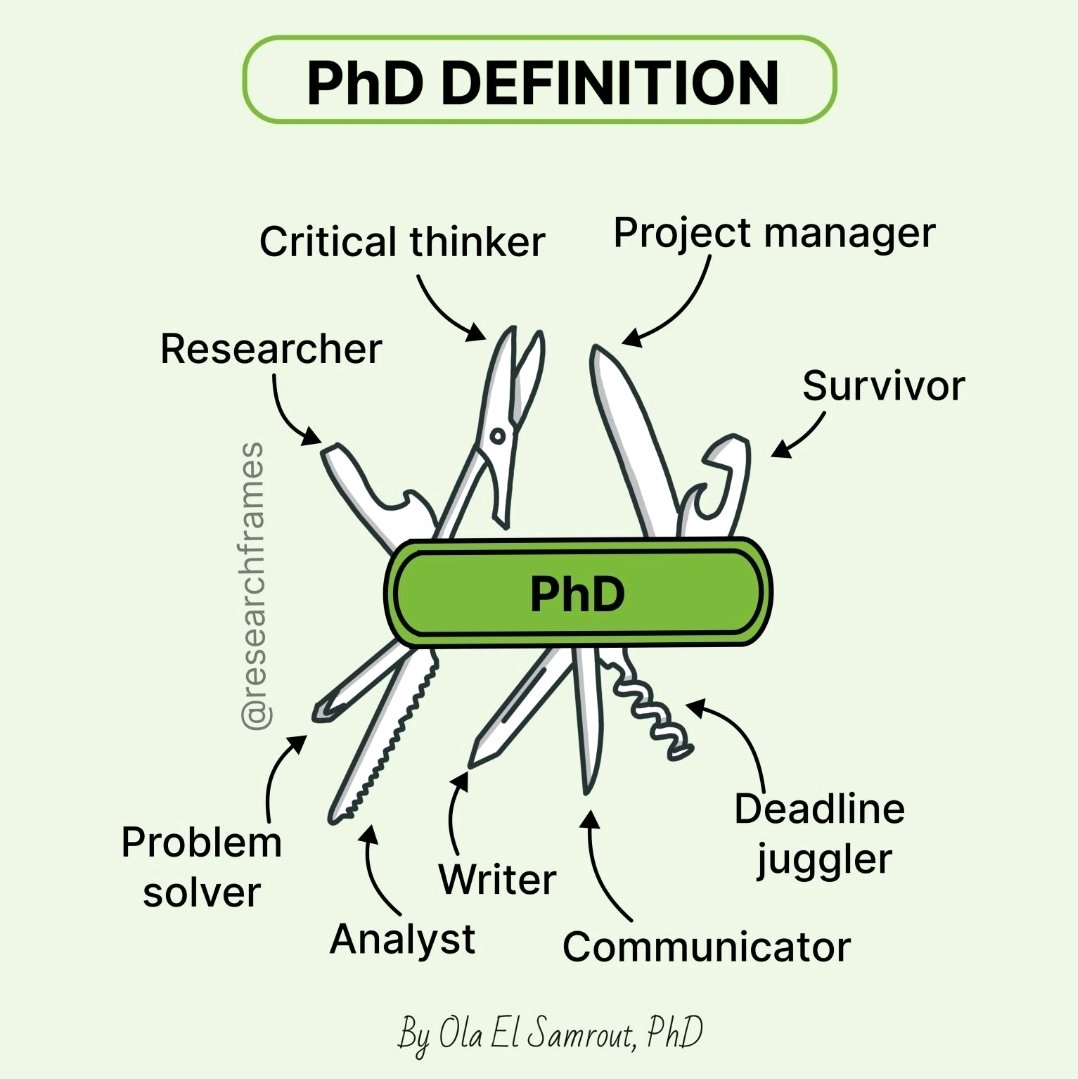
A PhD is not just a degree. It is a full training ground where you learn many skills at the same time. A PhD student does not wear one hat. They wear many.
1. A PhD turns you into a writer. You write reports, articles, proposals, and presentations. You learn to express complex ideas in simple words. You also revise constantly, which teaches patience and discipline.
2. You become a critical thinker. You question everything. You learn to check assumptions, evaluate methods, and identify gaps in knowledge. This habit stays with you for life.
3. You also become an analyst. Whether you work with numbers, texts, images, or experiments, analysis helps you see patterns and draw conclusions. This skill is valuable in both academia and industry.
4. A PhD forces you to be a problem solver. Research is full of challenges. Experiments fail. Data gets messy. Deadlines come fast. You learn to think creatively and find solutions.
5. You slowly turn into a project manager. You plan your time, organise tasks, track progress, and manage long-term goals. You balance multiple responsibilities at once.
6. You grow as a researcher. You learn how to read papers, design studies, collect data, and interpret results. You understand what good evidence looks like.
7. You also become a deadline juggler. You handle coursework, supervisor meetings, research work, writing tasks, conferences, and personal life. You learn how to prioritise and keep going even when it is difficult.
8. Most importantly, you become a survivor. A PhD is mentally demanding. Some days you feel confident; other days, confused or stuck. You learn resilience, courage, and emotional strength.
9. Finally, you become a communicator. You speak at conferences, present ideas to your supervisor, and discuss results with peers. You explain your work to people inside and outside your field.
Every day in a PhD is different. Some days you read. Some days you fix problems in the lab. Some days you write all day. Some days nothing works. But through it all, you keep learning, adapting, and finding your path forward.
See the infographic for best summary: a PhD is like a multi-tool. It equips you with many abilities that go far beyond the thesis.
The truth is simple:
A PhD is less about knowing everything and more about learning how to figure things out. It is about growth, resilience, and becoming someone who can handle complexity and uncertainty with confidence.
That is the real definition of a PhD.
So, go for it. It is worth it.
Image Copyright: Ola El Samrout, PhD.
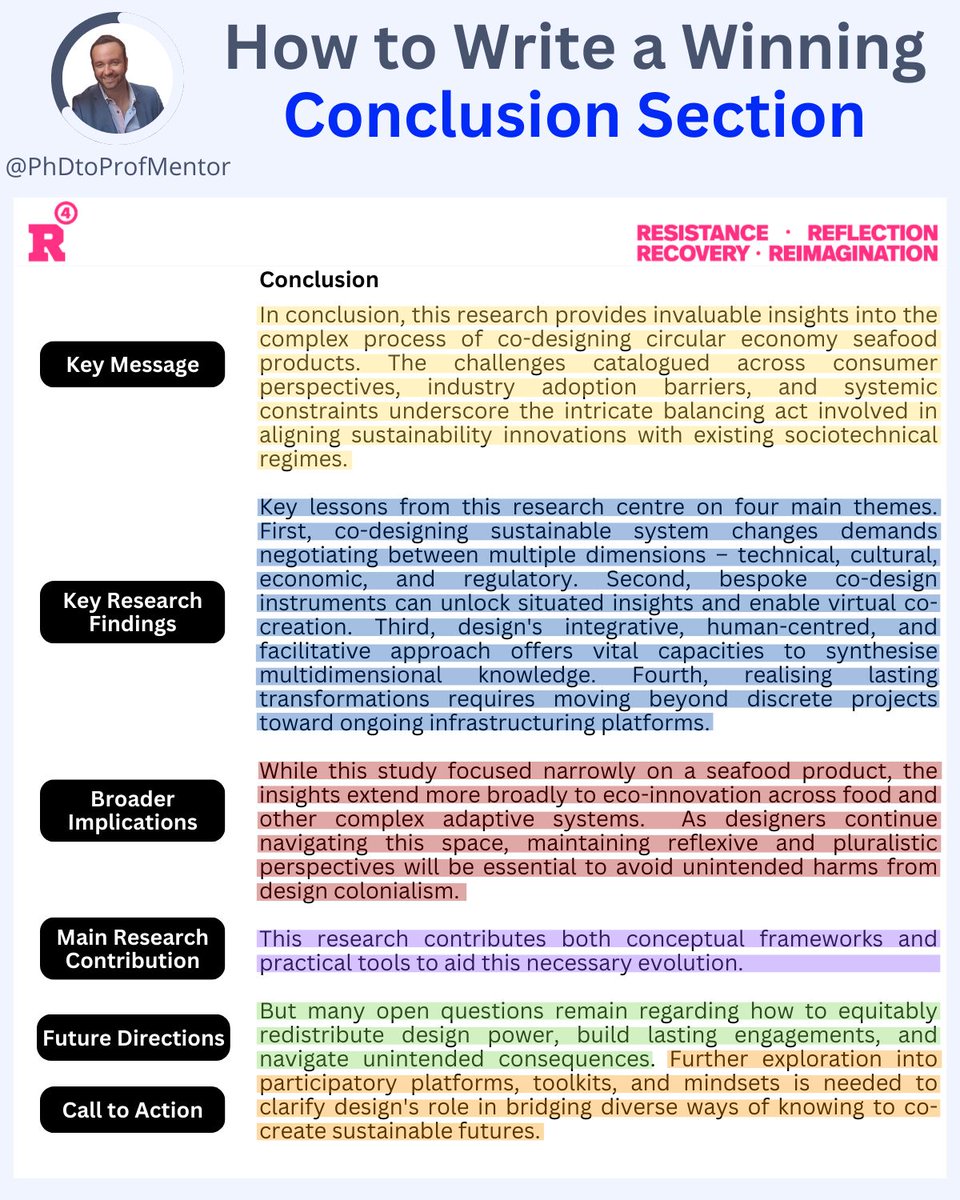
My journal reviewer destroyed my conclusion in 3 words:
"Weak and unconvincing."
8 months of research. Solid methodology. Clean data. Important findings.
But my conclusion? I just summarized.
After 3 rejections, I figured it out:
My PhD took 4.5 years. Should have taken 3.
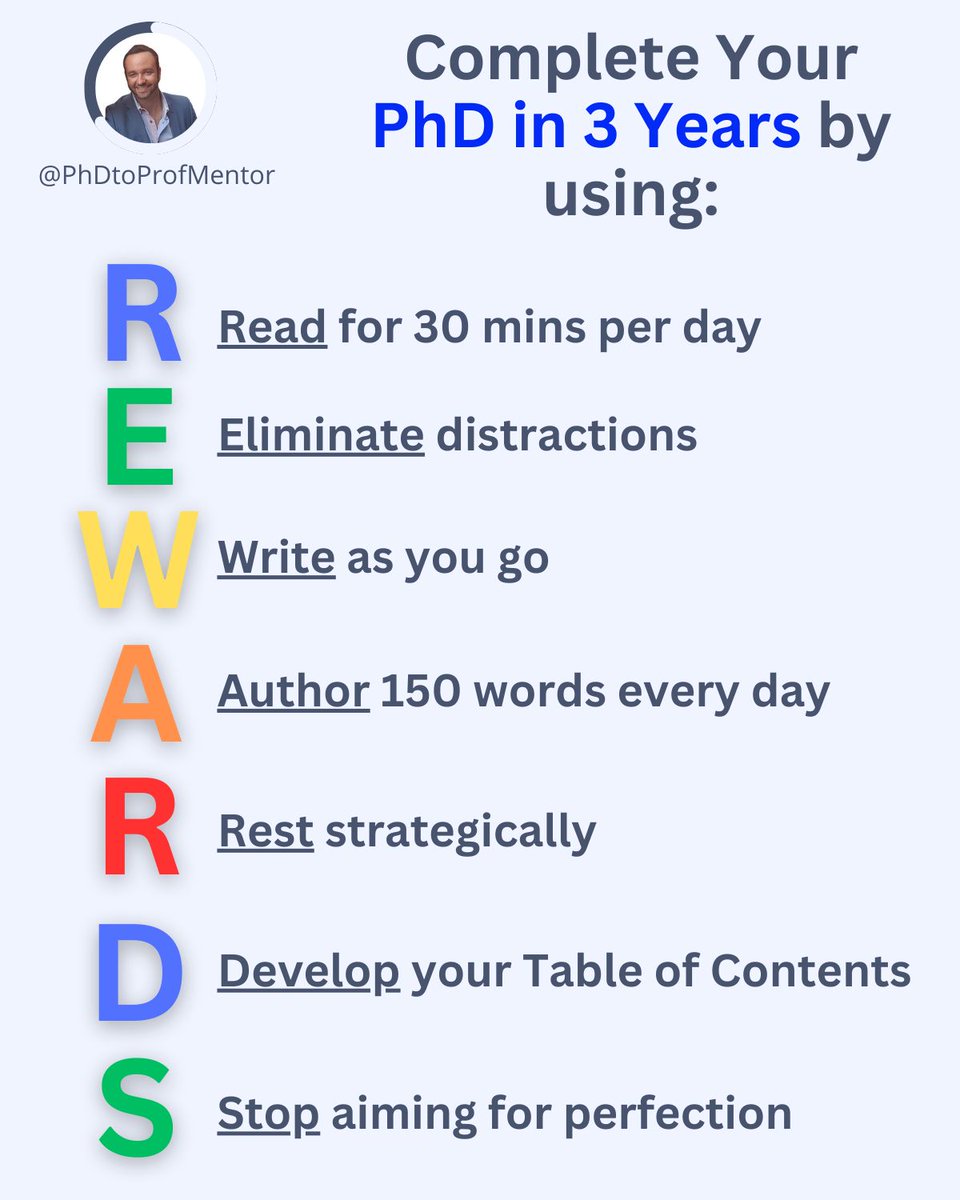
I wasted 1.5 years because no one taught me what actually matters.
Year 4: I was drowning. 47 articles read. 23 more on my list.
"I need to read everything before I can write."
That belief cost me 18 months.
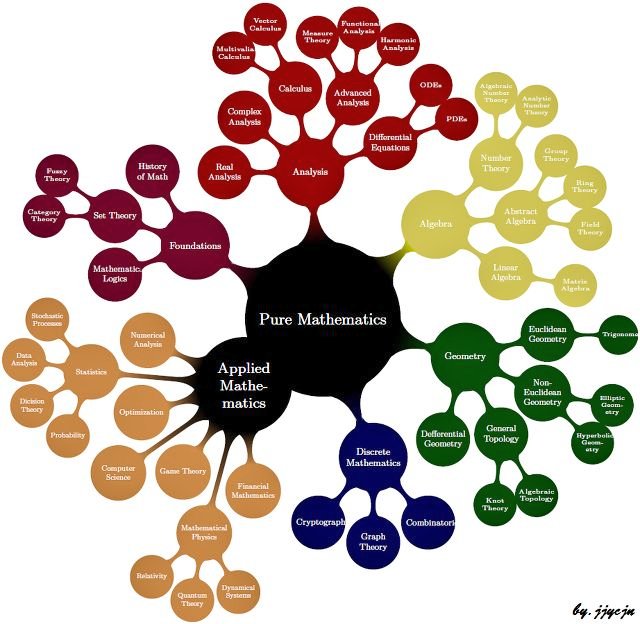
Budgeting is applied arithmetic.
Geometry shapes the homes we live in.
Statistics guide our health and habits.
Algebra builds logic behind daily choices.
Probability drives every risk we take.
Calculus powers the tech we depend on.
Ratios balance our diets and workouts.
Graphs reveal hidden patterns in life.
Measurement turns chaos into order.
Mathematics silently upgrades every human lifestyle.
Add your views.