Most poker players lose for one reason:
They don’t know how to use numbers.
Here’s the dead-simple math that turns you
from break-even to dangerous: 🧵👇
I have been playing poker for more than 15 years now.
I started with $1 SNGs, grinded my way up playing $5000 SNGs, and then transitioned to playing Tournaments.
Here are the most valuable lessons I have learned
(It might help you, especially in times of downswings).
You try to improve at Poker but don't see the results?
Do you feel overwhelmed and confused?
Before I dive into a particular spot, I'll focus on one very thing.
It's not Valuebetting, Preflop Ranges, or ICM.
Before I study anything, there is something else I do.
▶️ Identifying the most money printing spots📈. ◀️
(I'll share an example further below)
You can study all day on perfect flop sizings, having proper GTO bluffs and call downs, yet be a complete sucker at Tournament Poker.
Your day only has 24 hours.
You only have a few hours to study. 🧠
The goal is not to mindlessly scroll through one solve after another, look at Turn or River spots, and feel good about GTO hero calls or bluffs.
The goal is to identify the spots that bring you the most money!
This is challenging, though, and it requires a few things.
First, experience.
Example: If you start playing soft live casino cash games or online low-stakes tournaments, you will realize that running big bluffs is unnecessary. Therefore, your return on investment studying these situations is very low.
But it requires experience to learn this (and the ability and self-awareness to realize this).
Sit down, list the most common mistakes, and study those spots. Evolve your studying around exploiting your opponents to the ABSOLUTE MAXIMUM.
Again, FIRST, identify those spots. And then, you will go deep.
Deeper into those spots.
Calling stations? Learn how to go razor-thin for value.
People folding too much vs 3bets? How far can you push it? K6o 3bet BU vs CO? Let's go!
Do people raise/fold too much off 15-20bb stacks? Adjust the ranges and learn how wide you can rejam.
Chip leader exploiting their big stack too much and raising too much?
Learn to 3bet wider and reshove wider even as a mid-stack.
Is someone bullying you? It annoys you because you don't know how to counter it profitably. Learn to 4bet jam the right hands against someone 3bet bluffing too much.
I am not listing the top spots that you need to focus on. These are just examples. It depends on your opponents.
You need to find the most significant leaks of your population at your stakes or specific opponents.
If you can't list any or don't know how I have bad news. You are the sucker.
I have good news as well. You can improve faster than you think.
Review with poker buddies. Learn from each other. Analyze your database. Get a coach.
Do something to understand which spots are overbluffed/underbluffed, and align your studying time around your opponents' leaks. Keep an eye on the fundamentals and revisit them, but don't prioritize random GTO studying.
I see students having a study plan based on their own weaknesses.
What if improving your weakness will enhance your ROI by 0.x% (because others suck even more or it is not exploited), and it comes with countless hours of studying.
Evolve your study plan around your opponents' weaknesses.
You could improve in areas that will drive your win rate up by 10%, 20%, and even more by studying the same amount of time or even less!
Let me share an example from my study (it is just one of many).
I started looking into 3-bet bluffing vs. 15/20bb stacks from LP vs. EP/MP opens. I ran some sims, practiced some scenarios, and reviewed some hands. I felt pretty good.
I applied my new learnings for a few weeks but didn't feel like doing well. What did I miss?
▶️To identify my opponents' weaknesses. ◀️
I was mindlessly studying some spots where I felt insecure. Do these spots matter? NO! Why?
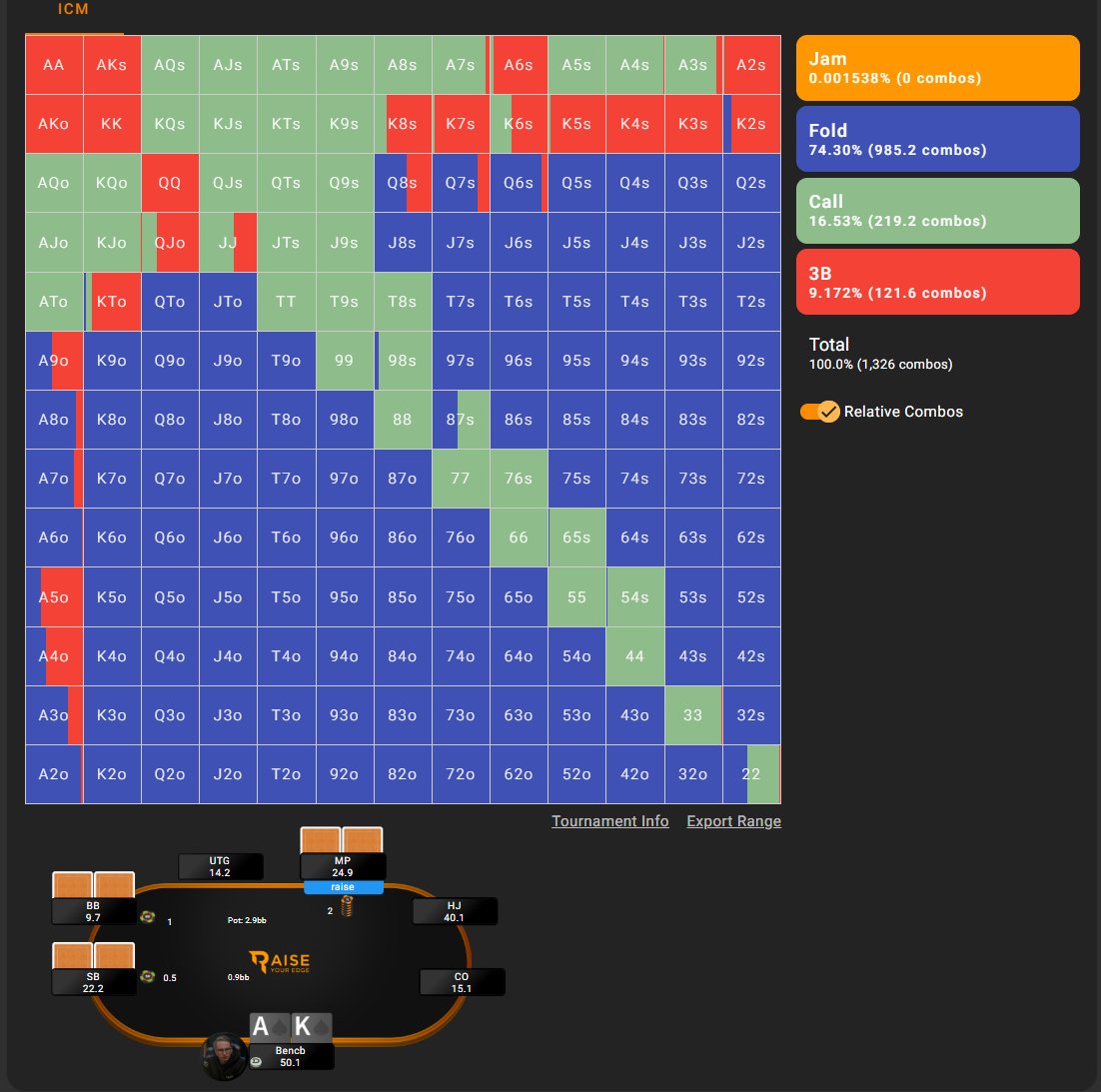
I realized that most of my opponents are not opening as wide as they are supposed to and likely are stickier against 3bets. If I remove some of the low-frequency opens, a lot of my bluff 3bets turn -EV, and it is not worth it, and I don't need to really study these spots.
I'll make enough money with my flat calls, playing IP, and waiting for strong hands to 3bet/call and only 3bet/bluff the most profitable hands.
(See screenshots below, FT scenario GTO 3bet range, villain RFI, and response vs. 3bet. Most players on FTs with those short stacks wouldn't open QJo and some of the other's hands, resulting in our 3-bet bluffs losing EV and turning -EV).
Of course, I'll keep an eye on it. If I see my opponents adjusting and opening wider, I will be prepared.
Also, these days, with all the YT footage available, it is easy to study and learn more about your opponents. I also saw ridiculous open folds from mid-stacks and realized I was doing a bunch of stupid (but theoretically correct) 3bets.
Lesson learned.
So before you study any bluffing, barreling, hero calling, pre-flop, or whatever, ask yourself, is it worth my time, or should I focus on something else?
How do you do that? How do you identify leaks and maximize your ability to exploit them?
Don't strive for perfection. It isn't easy. But understanding this and following this principle will push you already ahead.
Here is some inspiration:
1) Watch, study, and learn YT Final Table Replays.
2) Review with more experienced Poker Friends
3) Help/Coach others (for free) (you get to learn the struggles of less experienced players, which makes you more aware of leaks of beginners).
4) Take a Poker Coach
5) Analyse your own database (Filter for scenarios you feel are misplayed)
6) Engage in Discord/Forum chats around Pokerstrategy (Learn how others think & roll)
7) Grab your hands on our CHAMPIONS BUNDLE and save up to 55%, teaching you all the exploits you need to know, specially designed to help you crush the deeper stages around money bubbles, Final 2 Tables, and dominating Final Tables. See the link below 📈👇
#Profit
Thank you for reading this. If you found value, please RT. Follow @bencb789 and @raiseyouredge for more on Poker and Mindset.
1: Equities run a lot closer together
2: You should c-bet a lot less often OOP
3: You can use big bets on paired boards
These are just 3 of the 6 things that aggregate reports can teach you about playing OOP as the PFR.
Miss the issue?
Catch up here: https://t.co/TZBFDEBUSw
Here's how to learn the overarching flop strategies much quicker:
1. Create/find aggregate reports
2. Filter by different flop types & textures
3. Note down the big takeaways
4. Work out the 'why'
Now you have a better idea of what to do on lots of different boards.