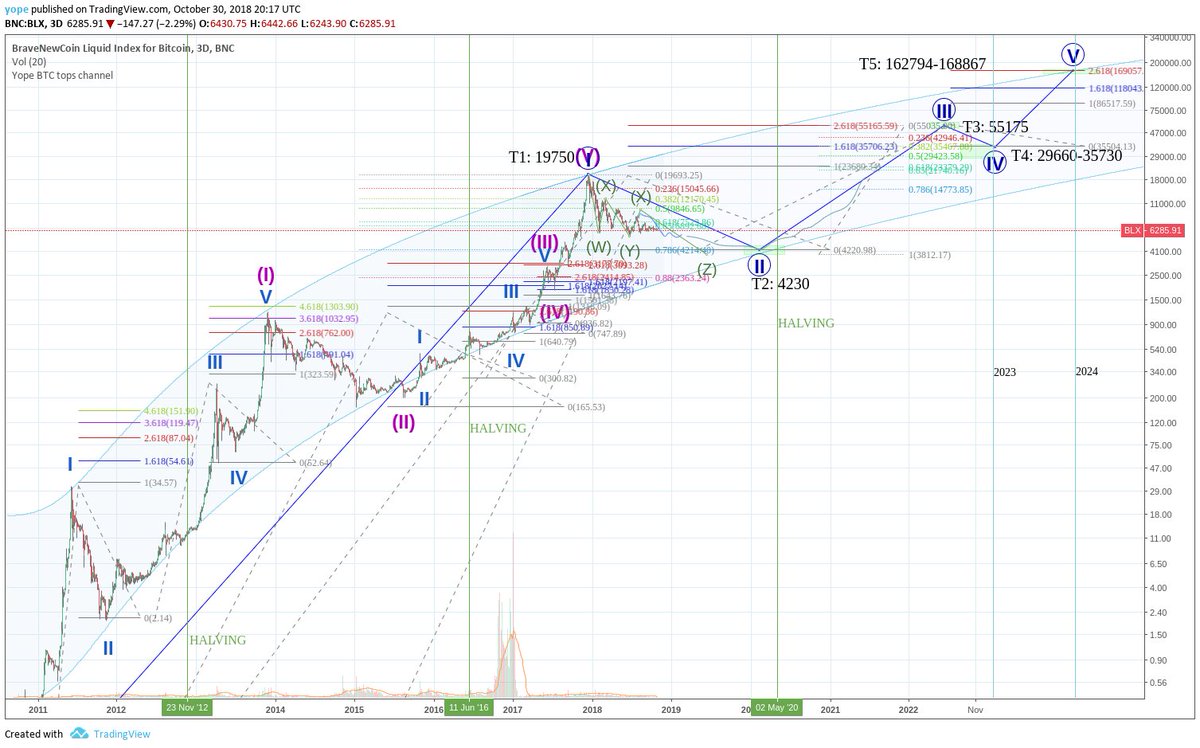
1/ #bitcoin $BTC historical Elliott Wave count and extrapolation exercise.
Back around July this year, @AkumaldoCrypto discovered a quite pervasive fib extension of 3rd and 5th waves that seem to occur historically: 2.618. I decided to play with that a little. Read more below...
@murchandamus@calibrated_lies@oomahq Those right there: the continued snobbish and condescending attitude you are displaying right now.
Do you really pretend that double digit percentage of nodes switching to knots and a small but rapidly growing number of bip110 blocks is a non-issue? That claim alone is the issue.
@murchandamus@calibrated_lies@oomahq And it makes all suspicions worse by constantly repeating the same strawman argument, as you just did, instead of ever honestly engaging with the core issues (pun partially intended) raised, with some humility that at this point would be more than adequate, given the backlash.
@murchandamus@calibrated_lies@oomahq It's not mine. But I can't blame those who herald it tbh. You have to admit that core developers kinda deserve that reaction due to how the whole issue was handled by them, even if they were right. It was childish, snobbish, despicable and totally unprofessional behavior.
@oomahq@georgje@murchandamus Curious. Yesterday I spent a while thinking who the least corruptible bitcoin developers would be. I think Luke is on top of that list. Mara van der Laan probably close.
@calibrated_lies@oomahq@murchandamus I agree with Ghost.
It's telling to see that Murch will always just gaslight with the same "bip110 doesn't stop spam", instead of engaging with the real issue when confronted. 🤷🏾♂️
This doesn't help restore core's credibility a single bit.
@LynAldenContact Not only podcasters, but apparently also even bitcoin core developers.
Hidden conflict of interests is a pre-stage of corruption IMHO.
@calibrated_lies That's a fair explanation. It explains why that particular filter still has an effect today. See how powerful it is?
We'll have to see how long it lasts, now that the default is 100k in core going forward, but the takeaway is that core's excuse for the uncap just doesn't hold up.
@calibrated_lies What's with OP_IF? What do you mean?
You mean that the OP_IF envelope is cheaper? AFAIK the break-even point is around 250 bytes or so. That does nothing to explain the sharp drop off at exactly 81. Why 81? Why not 200?
@calibrated_lies So smaller quantities above 81 bytes look much bigger than they actually are. The amount of OR with a size above 81 bytes, up until the whole block size is just a tiny, tiny fraction of a percent. This is NOT an opinion.
@calibrated_lies It is not an opinion. It is evidence. I admitted that it isn't hard proof, but it's the best we have. Saying filters don't work is not only just an opinion, it is also ignoring the evidence.
Also, be aware that the Y axis of the histogram is logarithmic!
@calibrated_lies That's just not true. A simple no-tresspassing sign on a lawn will have some effect on some people, even if it is trivial to get around.
In the same way, policy filters can have an effect on users, making them decide not to put more than 80 bytes in an OR for whatever reason.
@calibrated_lies Because the histogram is strong evidence, but not hard proof.
Scientifically, the histogram shape is the best evidence we have by far. Everything else is unusable due to the survivorship bias fallacy, and IMHO should be disregarded. Core supporters repeating them are gaslighting.
@calibrated_lies The <1s/vb transactions are a different story. Here we only know for sure that it wasn't a perfect filter. Probably far from it. But you just can't say it didn't work at all.
@calibrated_lies Yes, it is indeed unprovable. But the OR size histogram has this odd shape that needs explaining if anyone is to claim that filters don't work.
The only explanation for this odd shape so far is that default datacarriersize has worked indeed impressively well up until core 30.
@calibrated_lies Do you have evidence to back up that claim?
Be careful not to commit the survivorship bias fallacy though. So merely looking at what's on chain doesn't work. You need to be able to prove that the existence of a filter hasn't stopped any potential transaction.