From Fulani Bandits to Berom Militia: Zagazola Will Continue Naming Criminals, No Matter Who They Are
By Zagazola Makama
Yesterday, we published a report identifying the attacker killed during the attempted assault on the National Institute for Policy and Strategic Studies (NIPSS), Kuru, as a suspected Berom militia member. That simple act of calling the attacker by his known identity immediately made many people uncomfortable.
The reaction was predictable. For years, many have demanded that security reports identify Fulani attackers whenever communities are assaulted. We have consistently done so. When armed criminals of Fulani extraction carry out attacks, we do not hide behind vague descriptions such as “unknown gunmen.” “Armed attackers or assailants. We identify them as Fulani bandits or Fulani attackers where the facts support it. So why should the standard suddenly change because the attacker is Berom?
At Zagazola Makama, we made a deliberate decision while reporting the Plateau crisis that every attacker would be profiled according to established facts, including identity and area of operation. If an attack is carried out by Fulani criminals, we say so. If it is committed by Berom militia, we say so. If Erigwe are responsible, we report it. If Mangu militias are involved, we identify them accordingly. Criminality must never enjoy the protection of ethnicity, religion, or politics.
No community has a monopoly on victimhood, and no community is free from criminal elements. Pretending otherwise is one of the reasons the Plateau conflict has remained difficult to resolve.
The hypocrisy is striking. Many people are comfortable sharing our reports when Fulani criminals are exposed. They praise objective journalism and demand accountability. But the moment a criminal from their own ethnic group is identified, the complaints begin. Suddenly, facts become “divisive,” reporting becomes “biased,” and journalists are accused of profiling an entire community. It cannot work that way.
Justice cannot have two standards.
The individual neutralised during the attempted attack on NIPSS was not an anonymous figure. Within minutes of the operation, residents around Kuru and Trade Centre were already identifying him by his name (PETER) and pointing to his Berom background. That information was already circulating locally long before it appeared in our report.
Yet many of the loudest voices who routinely condemn violence suddenly went silent. There were no emotional statements. No passionate calls for justice. No public condemnation of the attack on security personnel. No acknowledgement of the professionalism displayed by troops who repelled yet another assault on a strategic national institution. Instead, the energy shifted to questioning why the attacker’s identity was mentioned.
That silence speaks volumes. The soldiers who defended NIPSS prevented another deadly attack. They recovered a service rifle stolen months earlier from a soldier killed by the Berom Militia. Those soldiers deserved commendation but Instead, some preferred to grumble in WhatsApp groups because the facts disrupted a convenient narrative. (Any youths caught with arms is a defender of his community) and he is innocent.
This is exactly why Nigeria’s security challenges persist. Too many people judge violence not by the crime committed but by who committed it.
A murderer does not become less of a murderer because he shares your language. A militia fighter does not become a freedom fighter because he belongs to your ethnic group. An armed attacker does not become a victim simply because exposing him makes your community uncomfortable.
At Zagazola Makama, our position remains unchanged. We will continue to expose Fulani bandits. We will continue to expose Berom militias, Erigwe or the Mangu militias. We will continue to expose every criminal organisation, regardless of ethnicity, religion, or political affiliation.
🪖 A SOLDIER SPEAKS: The Katsina Airport airport arrests and the dangerous game of “DIALOGUE”
Brothers and sisters, something significant just happened in Katsina.
Seven suspected t£rr0r!sts were arrested right at the airport upon landing from a Hajj-bound aircraft. Let that sink in.
These individuals allegedly used the sacred journey of Hajj as cover, only to be nabbed the moment they touched down. This is not random. This is intelligence at work.
Now, let's connect the dots with the recent explosive claim by respected security analyst Dr. Bashir Kurfi that some n0t0rious b@nd!t commanders were allegedly given ₦10 million each by the Katsina State Government to perform Hajj.
If these arrests are linked in any way, then we are looking at a very dangerous pattern: using public resources to fund or appease criminals who turn around and continue t£rr0rizing citizens.
As a soldier on the ground, I will say this clearly:
Dialogue and rehabilitation have their place but only when it is backed by strength, verifiable commitment, and iron-clad monitoring. Paying off hardcore commanders while our troops are bleeding in the forests is not peace-building. It is playing with fire.
These arrests are a major win for our intelligence agencies and security forces. They prove that no matter how sophisticated the criminals think they are, the net is tightening.
What must happen now:
1️⃣ Thorough investigation trace every kobo, every contact, every enabler.
2️⃣ Prosecute these 7 to the fullest extent of the law. No plea deals that return them to the bush.
3️⃣ Those still at large must be hunted relentlessly. No safe haven.
4️⃣ Any government official or politician found complicit in funding bandits must face justice. No sacred cows.
5️⃣ Strengthen border and airport security screening, especially during major religious travels.
To the people of Katsina and the North-West: stay vigilant and continue supporting the troops with credible intelligence.
To the authorities: this is the moment to show that Nigeria’s security is not for sale.
We did not sign up to d!£ so that b@nd!ts and t£rr0r!sts can enjoy pilgrimage on public money.
THE FIGHT CONTINUES. NO RETREAT. NO SURRENDER.
What are your thoughts, Nigerians?
This clash you're reporting is a significant development in the complex security landscape of Nigeria's northwest. It's the first publicly reported major confrontation between the Islamic State Sahel Province (ISSP) and the Lakurawa group, and it has the potential to reshape the balance of power in the region.
Both groups are vying for control and influence in the same borderland areas of Sokoto and Kebbi states. Lakurawa, often described as a "hybrid jihadist-criminal group," emerged from Malian fighters and local militias to fill a governance vacuum. It has established itself by offering protection and enforcing a strict social order, including a "zakat" tax. ISSP, a more established and robust jihadist network, is expanding into the area. A confrontation between a local hegemon and a rapidly expanding international franchise was almost inevitable.
Lakurawa fighters view ISSP as an "existential threat." This is understandable. ISSP's expansion is not just about territory; it's about ideological dominance. A successful ISSP takeover would mean Lakurawa must either pledge allegiance, be absorbed, or be destroyed. The "intensified search" for ISSP members and the threats to communities that were hiding them are signs of a group in survival mode.
You correctly note that Lakurawa is "no match" for ISSP, yet they are still willing to clash. This is a strategic move. They are "marking its territory" to signal to ISSP that expansion into its operational area will be contested, potentially deterring the larger group from moving deeper into its core strongholds. It's a high-risk play for survival.
The outcome of this clash, and the weeks that follow, will be telling. Several scenarios are possible:
♦️Lakurawa, facing a more powerful adversary, could fragment as some members surrender or seek alliances with other groups.
♦️ISSP could prevail, subsuming Lakurawa's fighters and resources into its own network.
♦️If Lakurawa survives the initial clash, it could lead to a protracted and bloody conflict for control of the borderlands, further destabilizing an already volatile region.
The Nigerian government and security forces will be watching closely. This inter-t£rr0r!st conflict presents a unique opportunity. As both groups engage each other, they may be more exposed and vulnerable to military action.
However, it also risks driving one group to seek an even closer alliance with other jihadist factions, potentially creating a larger, more dangerous threat. The Sahel is changing fast.
🎥🔥🔥D£@TH FROM ABOVE: KOGI GOVT DOUBLES DOWN ON B@ND!TS WITH AERIAL SURVEILLANCE OVER ILUKE FORESTS 🚁🔥🔥🔥🔥🔥🔥🔥🔥
🫡The Kogi State Government is intensifying pressure on armed b@nd!ts as aerial surveillance operations continue across deep forest areas near Iluke, Bunu District, Kabba/Bunu LGA.
This is not a show of force it is a show of intelligence. Eyes in the sky tracking criminal elements, mapping hideouts, and denying b@nd!ts the cover of dense forests.
The operation is part of ongoing security efforts to strengthen safety across vulnerable communities in the state.
When the government combines ground troops with aerial surveillance, b@nd!ts lose their greatest advantage: the ability to hide.
🔥🔥NOW THEY ARE BEING WATCHED.
🔥🔥NOW THEY ARE BEING HUNTED.
Did you know that #ISWAP has a weekly newsletter? It is called Al-Naba.
When Abu Al-Minuki, a top commander, was killed, it was sent out to boost the morale of the group.
Also, in its 550th episode titled “Africa Between Yesterday and Today”, it addressed the group's questions of migration.
We analysed both newsletters here: https://t.co/IEXkHAdr2H
💔💔I am not happy, Court sentenced each of the five masterminds of Papiri School attack to 25 years in prison….💔💔
💔💔What happened to Life imprisonment?
💔💔What happened to death by hanging?
It seems judiciary is complicit to insecurity in Nigeria and it's making it difficult to fight with this kind of judgement.
💔💔💔Seriously I am heartbroken 💔💔
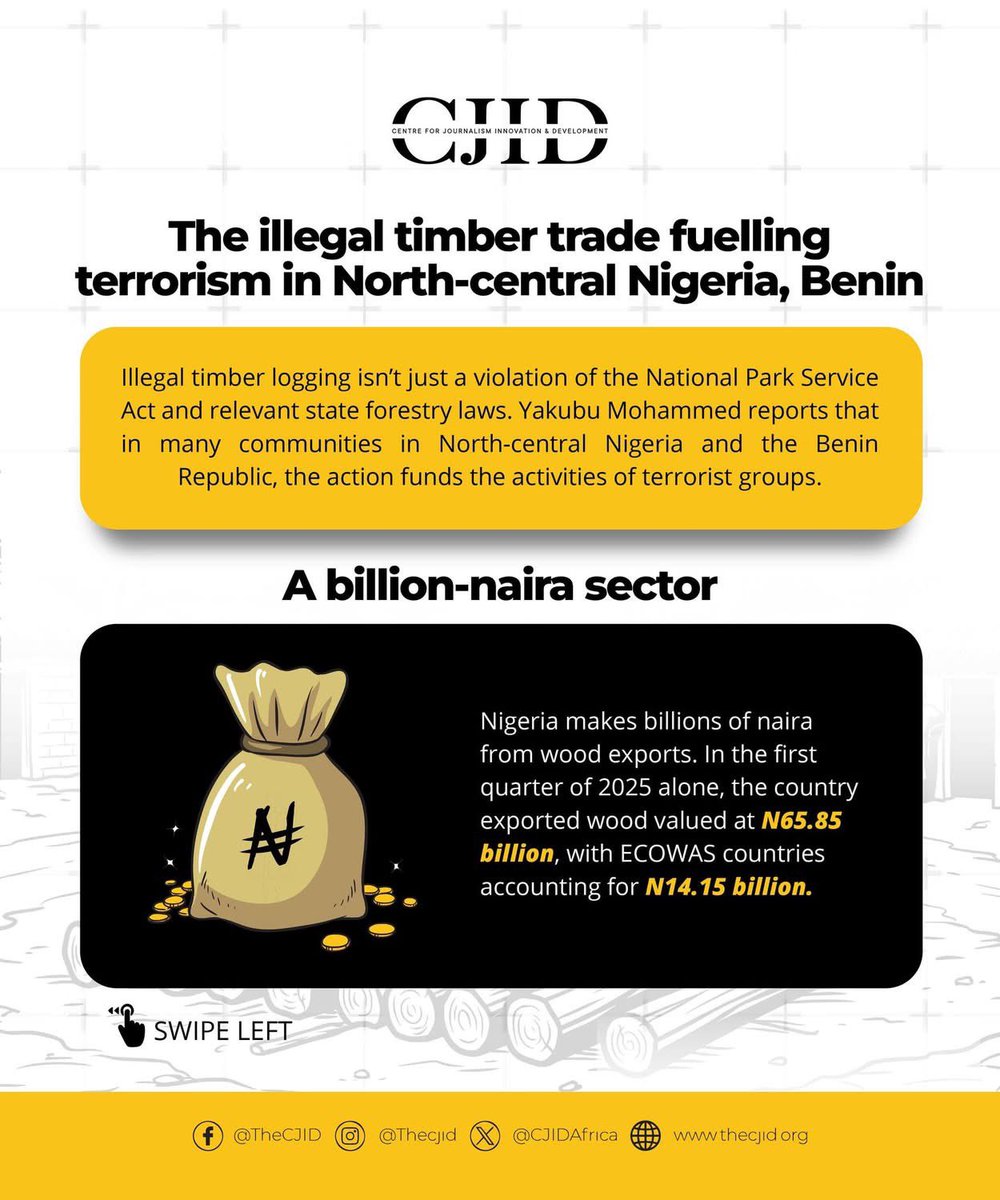
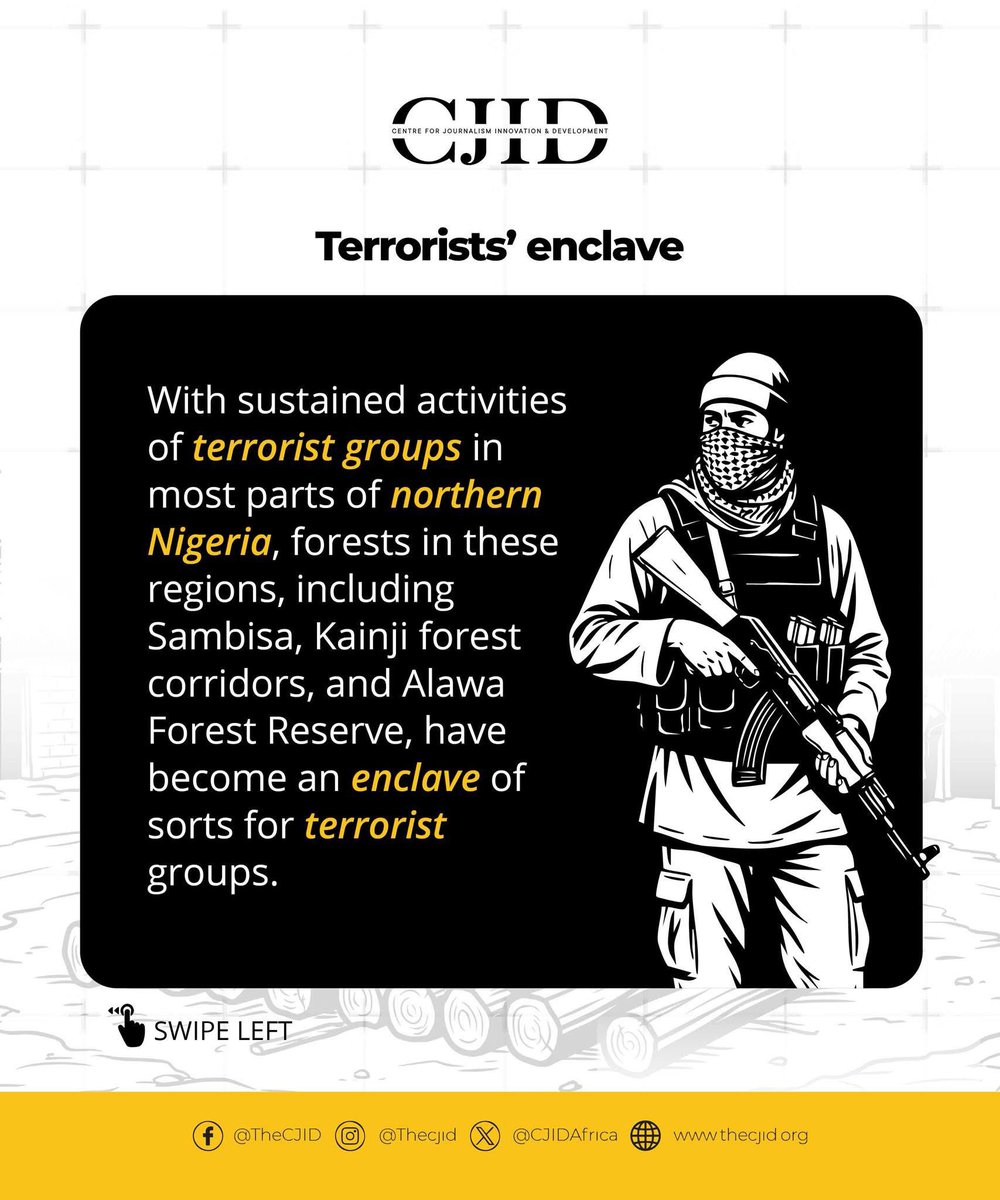
At a time when insecurity has once again become a major national conversation, I am resharing another investigation commissioned by #CJID on how illegal timber trading continues to fuel terrorism across parts of North-Central Nigeria and the Benin Republic 🇧🇯.
One of the things investigative journalism has taught me is that the most important stories are often the ones that connect issues we typically think of as separate.
For many people, timber is an environmental story.
For others, it is a trade and economic story.
For communities living around forests, it is a livelihood story.
This investigation shows how it can also become a security story.
The more I study insecurity in Nigeria, the more convinced I become that we often analyse problems in silos while the actors driving them do not.
Terror groups operate within ecosystems. They leverage economic networks, supply chains, informal taxation, natural resources, local grievances, and governance failures to sustain their activities.
Addressing insecurity therefore requires a broader understanding of the systems, incentives, and illicit economies that sustain violence over time.
Behind many attacks are financial networks, resource flows, taxation systems, and informal economies that make violence profitable and sustainable.
The investigation we published in March explores one part of that ecosystem and why understanding it matters for national security.
See the slides and the full investigation as published by @PremiumTimesng
🎥VIDEO: “As I speak from yesterday till now we have picked most of them, as I speak to you now we've picked another Two of them and let me tell you we don't have department of arrest once we get you we will send you to where you belong.
This is our land. This is our state. We cannot leave it in the hands of criminals. Give us credible information. Do not harbour criminals, and do not provide them with logistics or support.
I am not afraid of any criminal or their sponsors. They will come, and we will deal with them.
Enough is enough.
We are not going to play politics with the lives of our people. I am ready to protect you all.”
~ Governor Usman Ododo of KOGI STATE
We are only at Stage 1 for now.
The Senate still has to pass the bill, and at least 24 of the 36 State Houses of Assembly must also approve it.
After that, states will need to demonstrate that they meet the requirements for implementation.
Then comes the real test: states must establish, operate, learn from inevitable challenges, and improve their systems.
Only after all these steps can we truly say that State Police is fully operational in Nigeria.
The American airforce has deployed a very sophisticated surveillance spy plane in search of the oyo kidnapped kids, this beast has been working in the area for days and pattern analysis points to good results.... The Southwest seems not ready give terrorist cash-out means through ransom payment.... ✌️✌️✌️
Despite ₦145 billion spent on the Safe Schools Initiative, kidnapping attacks on Nigerian schools is almost a daily occurrence. A fatal raid in Kogi proves Nigerian classrooms remain undefended.
✍️: @_frinkie
When this incident happened they claimed it was a Fulani bandit attack, only for the police to arrest two suspects who are from the Southeast and Southwest zone. The point is this, stop ethnic profiling, many of the criminals get away under the guise of ethnic profiling.
🪖 My Boss in arms, I feel your frustration loud and clear! As a serving soldier, seeing these clean, modern rifles (M4-style with optics, suppressors, and all the attachments) makes any fighter dream of better tools. We are the Giant of Africa we deserve gear that matches our status.
But let me speak from the field:
The AK platform, though old, is battle-proven in our terrain dust, mud, rain, and extreme heat. It rarely jams when you need it most. These fancy AR-15/M4 systems are more accurate and modular, no doubt, but they demand constant cleaning, high-quality ammo, proper maintenance, and intensive training. Switching isn’t just about buying guns it’s about logistics, spare parts, armourer training, and billions in new supply chains.
We need upgrades, yes! Better rifles, body armour, night vision, comms, and vehicles. But it must be done strategically, not emotionally. Nigeria has the potential. What we need is serious investment in local production (DICON), better welfare for troops, and priority on what actually wins battles.
To the Federal Government: Our men and women at the frontlines are giving everything. Equip us like the giants we are. Modernise smartly.
Fellow soldiers and Nigerians, what’s your take? Should we push for full transition or phased upgrade?
The Nigerian army has issued a statement concerning the unauthorized incursion of Cameroonian troops into Cross Rivers. A dispute over the collection of levies on farmland situated along the border between Danare community in Nigeria and Dadi community in Cameroon reportedly sparked the incursion of Cameroonian troops into Nigerian territory.
Following the incursion, troops of the Nigerian Army Forward Operating Base, Danare, established contact with Cameroonian authorities, which led to the withdrawal of Cameroonian troops from Nigerian soil.
Now this is the army's explanation. The fact that Cameroonian troops have no qualms making authorized incursion into Nigerian territory at the slightest provocation shows they have little concern about facing significant consequences from Nigeria. Years of similar incursion have been met with a lackluster response from Nigeria.
This is not limited to Cameroon. We've had incidents of Chadian troops making unauthorized incursions into Nigerian territory in recent years. These nations are not oblivious of Nigeria's military capabilities. They do this because Nigeria has failed to establish a credible deterrence posture.
Not once in history has Nigerian troops made unauthorized incursions into the territory of its neighbors, not because Nigeria lacks the capability, but because it has generally exercised restraint. That restraint has not always been reciprocated. This is what you get when there is no credible deterrent against repeated violations. If Nigeria does not treat breaches of its territorial integrity with the level of seriousness and consequence they warrant, such incursions will be repeated.
Data shows Nigeria’s external debt rose less under Tinubu than Buhari era, with increase partly linked to currency revaluation effects.
https://t.co/ThCTtQ6U2f
In a significant security development, the Defence Headquarters has disclosed that the strategic partnership between Nigeria and the United States has significantly degraded the operational capability of the Islamic State West Africa Province (ISWAP) and other terrorist groups. Director of Defence Information, Major General Samaila Uba, stated during an X Spaces engagement on strengthening security through strategic information sharing on the Nigeria-US military partnership that recent collaborative efforts had contributed to intelligence-driven operations that disrupted terrorist networks and destroyed terrorist enclaves and logistics infrastructure.
The United States Africa Command confirmed that more than 200 ISIS fighters were eliminated during the operations, including Abu Bilal al-Minuki, the global second-in-command of ISIS, alongside several key operational and media leaders. Terrorist checkpoints, weapons caches, logistics hubs, and training sites were destroyed.
This morning, we examine a partnership that is delivering results and the continued work required to secure the nation.
"We brought the war to them. Yesterday, we were lucky. The kidnappers have been coming in from this area. We got proper intelligence, we activated it, and we came here waiting for them. Luck ran out on them; we neutralised some, apprehended some, and the victims were liberated." — Ahmed Sanusi, FCT police commissioner, speaks on the rescue operation in Byazhin