📢 Our new #compchem preprint: A fully-polarizable KS-DFT/AMOEBA embedding scheme for plane wave basis sets through the MiMiC framework
Preprint link: https://t.co/2Nv1D92zZx
In collaboration with: @foeroyingur @OlivierApp@Thomas__Ple@jppiquem@lcbc_epfl@PiquemalGroup
Very proud to see we are in third position in the ranking of best Spanish masters in Exprimental Science and Technology. This is only possible thanks to our amaizing staff of coordinadors, lecturers, admin managers and students.
#compchem rules 😎🤟
https://t.co/l74oIjxWsD
This is my first first-author publication. I am grateful to co-authors @DavidCdeB, Klaus B. Møller, and @foeroyingur for their contributions and insights. The project is funded by @VILLUMFONDEN and @VILLUMscience. [3/3]
Our work has just been published in @JCIM_JCTC. We propose our PE-MIC model as an improvement to fix artificial boundary polarization in standard cut-off models used within polarizable embedding. [1/3]
https://t.co/CeuThBFldK
We investigated various systems and different routinely-used cut-off models with respect to the PE-MIC model to assess the magnitude of inaccuracies in modeled electrostatic and molecular properties in those systems. [2/3]
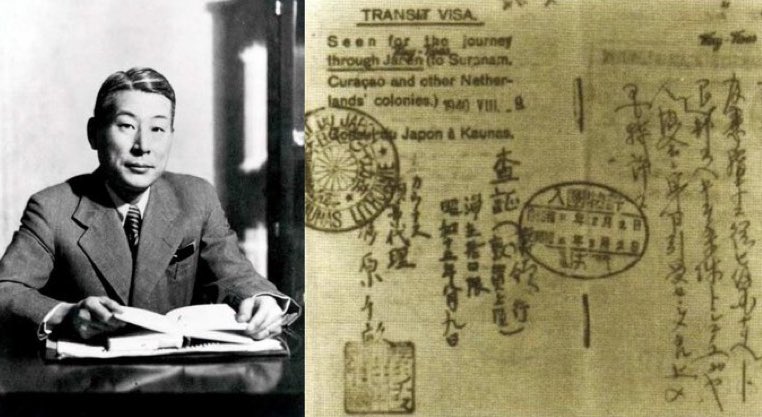
Chiune Sugihara was assigned as the vice-consul of the Japanese consulate in Kaunas, Lithuania in 1939.
Lithuania was occupied by the Soviet Union in June 1940, and many Jewish refugees from Poland and other countries had gathered in Kaunas, hoping to find a way out of Europe.
They heard that Japan was a possible destination for them, as Japan had not yet joined the Axis powers and had maintained diplomatic relations with some European countries. However, they needed transit visas from the Japanese consulate to cross the Soviet Union and reach Japan.
Hundreds of Jews in desperate need of visas approached Sugihara, imploring him to assist them. Despite his efforts, Sugihara was unsuccessful in obtaining permission from his superiors in Tokyo to issue visas to the refugees. He made three separate requests, but each time his appeal was turned down. The Japanese authorities stipulated that only those individuals who possessed valid passports, adequate funds, and confirmed exit visas from Japan were eligible to receive transit visas.
Sugihara decided to disobey his government, and worked more than 18 hours a day issuing hand-written visas to the Jews.
He continued issuing visas until September 4th 1940 when he had to leave Kaunas with his family due to the closure of the consulate. According to eye witness accounts, he was still busy writing visas and tossing them out of the train as it departed. Overall, his efforts saved the lives of over 6000 people. Despite his heroic actions, his story remained largely unknown until 1985, just a year before his passing.
It is believed that up to 100,000 individuals who are alive today are descendants of people who received visas from Sugihara.
Allies took key decisions at a critical moment for our security. We agreed a package to strengthen #Ukraine & provide a clear path towards #NATO. We also approved our most comprehensive defence plans since the Cold War, backed by an enduring commitment to invest more in defence.
Aiming at highly sophisticated multiscale dynamics with MiMiC 🚀 Looking forward to #ICQC2023 poster session today, my poster is PB33. Pass by!
@foeroyingur
Today 🇱🇹 Aurimas Valujavičius completed his journey across the Atlantic Ocean in a single seat rowing boat, becoming the 3rd in the world& the 1st Lithuanian to accomplish such mission.
Congratulations, Aurimas!
Human willpower& determination beat even the force of the ocean!
China is trying to discredit the legitimacy of Ukraine and the Baltic nations because the CCP supports Putin's might makes right view of the world. But wouldn't this include Russia, also a "former Soviet country"? Worth consideration...
On this day, 19 years ago, Lithuania joined NATO. If events had taken an unfavorable turn at that time, I would probably be sitting in trenches instead of pursuing a Ph.D. #WeAreNATO
📢Excited to share our new #compchem preprint📢
We present the PE-MIC model in which we enable periodic boundary conditions through the minimum-image convention for the induced electrostatics within the polarizable embedding model.
https://t.co/BIR8ih0otB
@foeroyingur @DavidCdeB
Yesterday I presented my PhD project progress at @UAM_Madrid. Thanks to my former supervisor J. Cerezo for hosting! It's always nice to visit the institution and remember very good years of @EM_TCCM.