Last night I listened to David Reich’s interview with @dwarkesh_sp on his new Nature paper, “Ancient DNA reveals pervasive directional selection across West Eurasia.”
https://t.co/PE7auH87TW
Reich and his team present a method for detecting directional selection in ancient DNA time series, testing for consistent trends in allele frequency over time. They find that hundreds of alleles have been under strong directional selection, including alleles correlated with measures of cognitive performance.
I have followed David Reich’s work for over a decade now and cite him in my economic history courses all the time. Nothing has changed my view of ancient history as much as his research, and the research his methods have triggered.
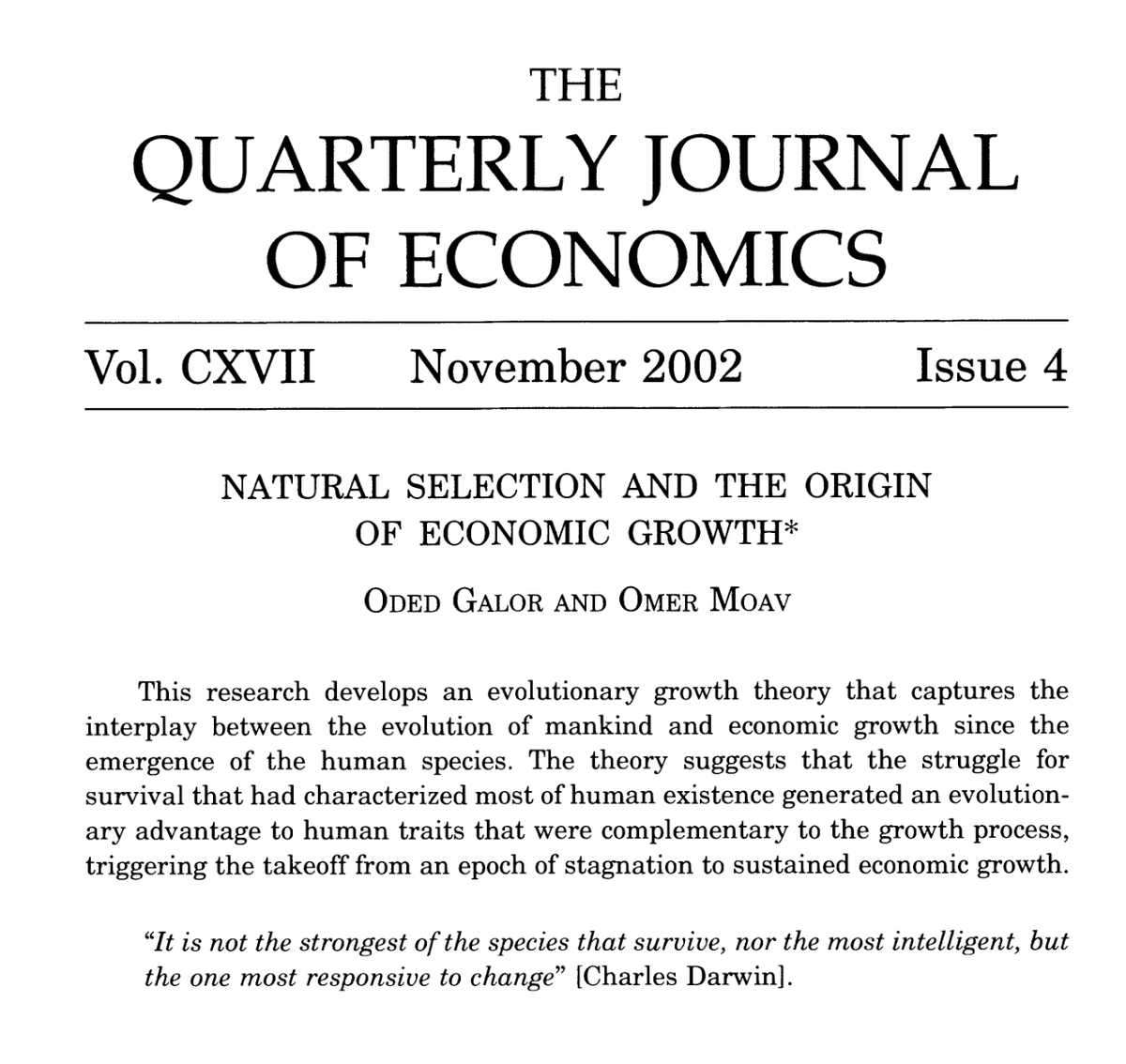
His findings also bear directly on another line of work, “Natural Selection and the Origin of Economic Growth” by @GalorOded and @Omer_Moav at the Quarterly Journal of Economics, which proposes a similar mechanism. Reich’s results give a serious empirical boost to Galor and Moav's research agenda.
Reich returns several times in the interview to behavior related to what economists call the discount rate (without using such a term). The evidence suggests that humans began discounting the future less with the advent of agriculture, because directional selection favored patience.
I’ve long thought modern schooling serves this same function, training people to defer immediate rewards for long-term gains, and that such training is the most valuable trait one can have in daily life. Contrary to the Foucaults and Freires of the world, that schools are boring is a feature, not a bug. I don’t expect anyone at the schools of education to get this.
The deadline is here! Last call for applications to the Chicago School in Experimental Economics in Japan. This free summer school will take place June 22–26, 2026 at the University of Osaka.
This intensive one-week summer school is designed to deepen scholars' understanding of frontier experimental methods. The curriculum closely follows my forthcoming textbook, Experimental Economics: Theory and Practice (https://t.co/Wg5c5XcMQg), and participants will also have the opportunity to present and discuss their own research.
I'm honored to be joined by an outstanding group of lecturers: Gwen-Jirō Clochard, Luca Henkel, Justin Holz, Michael Price, Julia Seither, Haruka Uchida, and Karen Ye.
There is no program fee, and financial assistance for accommodations is available.
Application deadline: January 21, 2026
Apply here: https://t.co/pHhSUsWqiu
Questions? Contact Melissa De Vries at [email protected]
We look forward to seeing you in Osaka!