Do you know why brides throw paddy or turmeric rice behind them when leaving their father's house after marriage ?? And why does their mother collect it with her sari pallu ??
It's because when Maa Mahalakshmi leaves the house, she takes all the wealth, prosperity, happiness, and peace with her.. However, a daughter is like a Bhagya Lakshmi for her parents, so even when she leaves her parental home after marriage, she ensures that the blessings never leave her parents' home.. She leaves a part of her virtue, wealth, prosperity, and happiness for her parents and enters her new house to create her own destiny.. That's why daughters throw paddy and turmeric rice behind them at the time of farewell after marriage, leaving their blessings in their father's house.. The mother collects this blessing of Bhagya Lakshmi residing in her daughter and keeps it in the Mahalakshmi pot in their home temple along with paddy and turmeric rice..
Isn't it beautiful ??
#JaiMaa #SanatanaDharma
A kid drew himself sleeping in bed between mom and dad and labeled it 'safe.'
In Japan, this exact sleeping arrangement has a name. They call it 'the river.' Mother is one bank. Father is the other. The child between them is the water. Roughly 70% of Japanese mothers sleep this way with their kids, sometimes through the teenage years. The Western model of putting a kid alone in their own bedroom is barely 200 years old. For most of human history, in most cultures still alive today, kids slept beside their parents.
James McKenna runs the Mother-Baby Behavioral Sleep Lab at Notre Dame. He spent decades watching what happens when parents and kids share a bed. The bodies sync up. Heart rates align with the parent's, breathing falls into the same rhythm, and by morning even sleep stages have started matching. The parent's body, in McKenna's words, acts as a kind of biological jumper cable for the child's.
In 2013, researchers in the Netherlands tracked 193 babies through the first year of life. They measured cortisol, the brain's main stress hormone. Babies who had spent more weeks co-sleeping in the first six months produced less cortisol under stress at 12 months. Sleeping near a parent had rewired the kid's stress system to be calmer under pressure.
Inside the kid's brain at night, the amygdala, the fear alarm, gets more sensitive as the body gets tired. Darkness makes it worse. A 2021 paper in PLoS One from Australian researchers showed that light directly suppresses amygdala activity. Lights off, alarm louder. The whole brain is wired to read 'alone in a dark room' as a threat.
Now add a parent's body to that bed. The kid's nervous system reads warm body, breathing nearby, familiar smell. The threat alarm dials down. Two parents on either side dial it down twice. The drawing is the kid's brain calculating maximum safety: I am surrounded by the people who keep me alive, and nothing can reach me without going through them first.
The arrangement in this drawing is what most of human history called 'sleeping.' Sleeping the kid alone in another room is a 200-year-old Western invention that we forgot was an invention. Every kid who has ever padded into your room at 3am and crawled into the middle of the bed is just trying to redraw the picture.
At this point, the US-Iran crisis looks a lot like that ESPN wrestling we all grew up watching in which there was a ton of jumping, yelling, threatening, falling and bouncing off the mat to only be bounced back by the ring and thats just about it!
While the ground shook and fear took over, the horse didn’t run—it stood its ground. Shielding the woman with pure instinct, it chose protection over panic. In a moment of chaos, that animal showed more courage and loyalty than most ever could.
@PanasonicIndia@panasonic
Amazing poor service by Panasonic. ordered AC on 18 Apr from official website,delivery promisd on 22 Apr. No intimation of delay or next date.Customer service number always off. Got through on repair number. promised call back. Still waiting! No hope
9-month-old baby with Down syndrome says his first word ever.
"This season has been hard and a bit isolating at times BUT it's so much more bright than the internet or doctors lead us to believe," the boy's mother said.
"God doesn't waste a single step and he's building something new, I'm learning to rest in that and I'm SO grateful to have Hank as our proof. He is working and blessing us in unique ways."
An estimated 67% - 85% of pregnancies in the United States with a Down syndrome diagnosis are aborted.
While most people with Down syndrome experience cognitive delays, they go on to live fulfilling, productive, and happy lives.
May God bless this child.
Video: aestheticartist_angelina / ig.
Its true. Everybody quite naturally has the innate need to feel included. But not everybody is inclusive. Inclusivity needs to be taught early in childhood as an important social responsibility and a marker of emotional intelligence. Kudos to this teacher!
TWENTY- EIGHT years on, we remember the #IndianBraves 🏵️
Paratrooper Baldev Raj, Shaurya Chakra (P) & Lance Naik Prahlad Singh Gurjar, Sena Medal (P), both of 6 PARA made the supreme sacrifice in separate areas during #OpAhgam in Pulwama, J&K #OnThisDay 15 April in 1998.
#LestWeForgetIndia🇮🇳
@foodpharmer2 Completely agree. Some schools will even ask for a compensation to issue a TC if you wish to remove your child mid session due to dissatisfaction. They make money in admissions and in students leaving them too. Mind you, 'cash only!'
Bollywood celebrities do not promote baby food products! In fact, all baby food product ads are banned in India since 1990s. But do you know the man behind it?
Meet Dr. Arun, Nestle’s biggest enemy!
Dr. Arun started his fight with Nestle in 1980s. He noticed that Nestle’s sales agents dressed up as nurses and went to hospitals to convince mothers to stop breastfeeding and give formula to babiesinstead.
The sales agents would also give free baby formula samples to mothers. Mothers would get overdependent on formula, and their breast milk would dry up. As a result, they would have no choice but to give their babies formula.
Dr. Arun and his team fought aggressively, and got the Milk Substitutes Act passed in 1992 which banned all forms of baby food ads!
Breastfeeding has numerous benefits including reducing the risk of obesity and diabetes, and the entire country should thank Dr. Arun for his role in fighting against baby formula!
@anandmahindra This is beautifully illustrated in NCERT hindi textbook in class 3rd. The song is also mentioned there. Indeed it is such a beautiful festival. Also speaks of redistribution of rice and other grains in Phooldehi through children to maintain order and balance in community.
No one tells you that parenting is just relearning the world through someone who thinks worms are friends & birds are miracles. It’s the most healing thing I’ve ever done. My daughter looked out the window this morning & said, everything is green & growing. I told her, you too. And something inside me whispered, so are you. Now I’m watching her hold flowers up to the sun while the light bends like it recognizes her. It’s funny, every spring I think I’m teaching my child about the world & every spring she proves she’s the one teaching me how to see it.
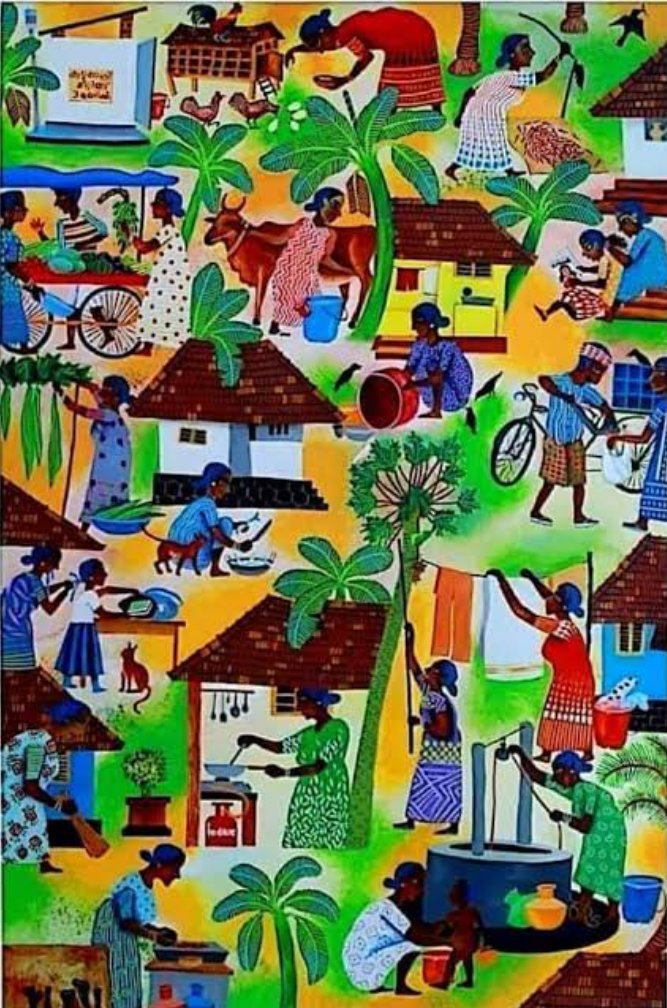
In 2020-21, a 9th-grade student named Anujath Sindhu Vinaylal from Thrissur, Kerala made this painting titled it "My Mother and Mothers in the Neighborhood"
There is a popular story that he did it when his father told him that his mother doesn't work....not sure of this.
Whatever it is, more importantly the picture captures a relentless, often invisible labor that women perform every day - a work that is unpaid.
Respects to all women on #WomensDay2026
@msteckchandani
I get blown away every time I read this paragraph by Carl Jung:
To love someone else is easy, but to love what you are, the thing that is yourself, is just as if you were embracing a glowing red-hot iron: it burns into you and that is very painful. Therefore, to love somebody else in the first place is always an escape which we all hope for, and we all enjoy it when we are capable of it. But in the long run, it comes back on us. You cannot stay away from yourself forever, you have to return, have to come to that experiment, to know whether you really can love. That is the question-whether you can love yourself, and that will be the test.
The Case for Childhood Boredom.
A strange thing has quietly disappeared from childhood.
Boredom.
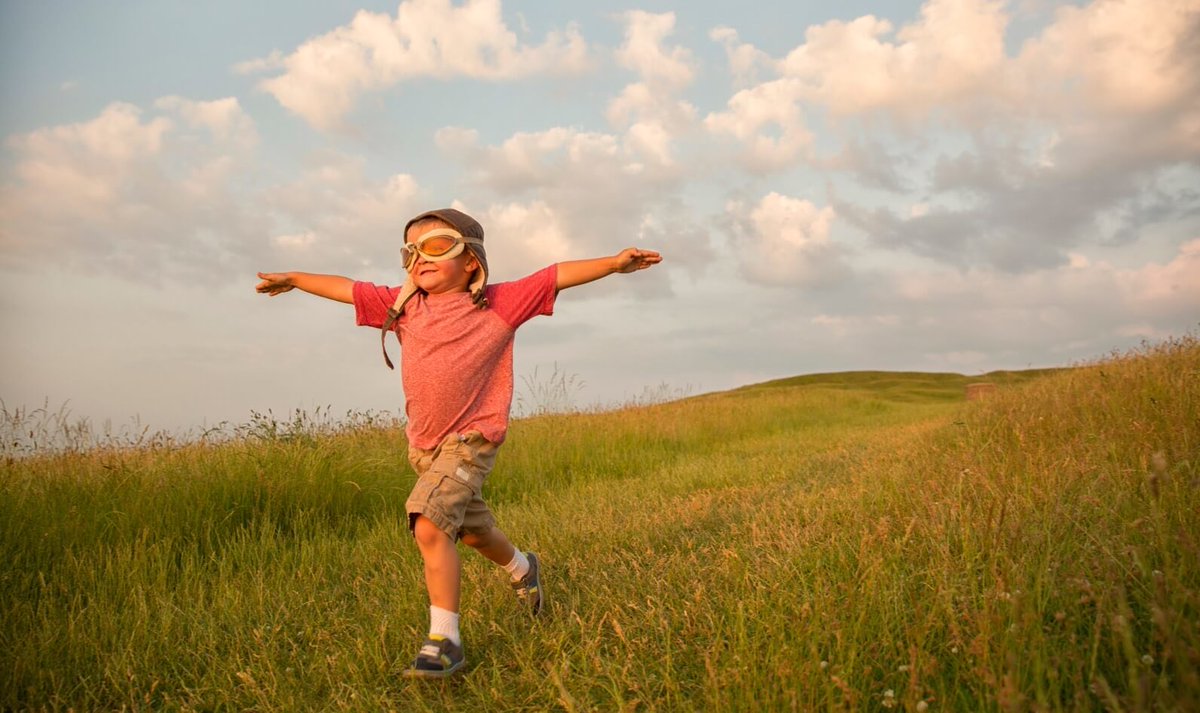
For most of human history, boredom was unavoidable. Childhood unfolded in long, uneven stretches of time that nobody bothered to organize. Summer afternoons drifted by without a schedule, car rides lasted hours with nothing but the passing landscape, and children spent entire days outside with only a loose instruction to be home before dinner.
And something curious tended to happen in those empty spaces.
Children invented things.
A stick became a sword, and then a fishing rod, and then, without warning, a wand capable of defeating imaginary monsters. A patch of grass became a battlefield. A cardboard box became a spaceship. Entire worlds emerged out of nothing more than idle time and a restless mind.
Neuroscientists now understand that the brain behaves differently in those moments. When external stimulation fades, a network deep in the brain called the default mode network begins to activate. It is the circuitry associated with imagination, memory integration, and abstract thinking. When the mind has nowhere specific to go, it begins to wander, and while it wanders it starts connecting dots that rarely meet during structured activity.
Creativity often lives in that wandering.
Modern childhood, however, has undergone a quiet redesign. Empty time has been steadily replaced with organized activity. Sports leagues, tutoring sessions, music lessons, enrichment programs. Even the small gaps between activities tend to be filled with screens engineered with extraordinary precision to eliminate boredom the moment it begins to appear.
Parents worry when boredom surfaces. A child announcing “there’s nothing to do” can feel like a problem waiting to be solved, a signal that the environment lacks sufficient stimulation.
But boredom is simply the brain beginning a different mode of operation.
The mind starts generating its own stimulation instead of consuming someone else’s.
Look closely at the childhoods of unusually creative people and a pattern emerges. Steve Jobs spent long stretches wandering the neighborhoods of Silicon Valley, exploring electronics shops and experimenting in garages. Albert Einstein famously described hours of quiet daydreaming as a child, staring out windows and imagining physical problems in his head. J.K. Rowling began inventing elaborate stories long before she had any audience for them.
Each of them had something that has become surprisingly rare.
Psychological whitespace.
Modern childhood often resembles a corporate calendar. Every hour accounted for. Every activity supervised. Every quiet moment quickly filled by a glowing rectangle designed by teams of behavioral scientists whose job is to make sure attention never drifts into silence.
And yet many of the qualities parents hope their children will develop—creativity, resilience, independence—tend to emerge from precisely the conditions we have learned to eliminate.
Unstructured time confronts a child with a deceptively simple problem.
What should I do next?
That question trains the brain in powerful ways. It forces the mind to generate ideas, to tolerate the mild discomfort of inactivity, and eventually to invent something interesting enough to fill the gap.
Children who rarely encounter boredom often struggle to resolve it on their own.
They wait.
They look outward for stimulation rather than inward for possibility.
Childhood boredom, in that sense, becomes a kind of workshop. It is the place where imagination practices building things from nothing, where the mind experiments freely without instruction, and where curiosity slowly learns how to entertain itself.
Left alone long enough, the mind begins to wander.
And wandering minds have a peculiar habit of discovering entirely new worlds.