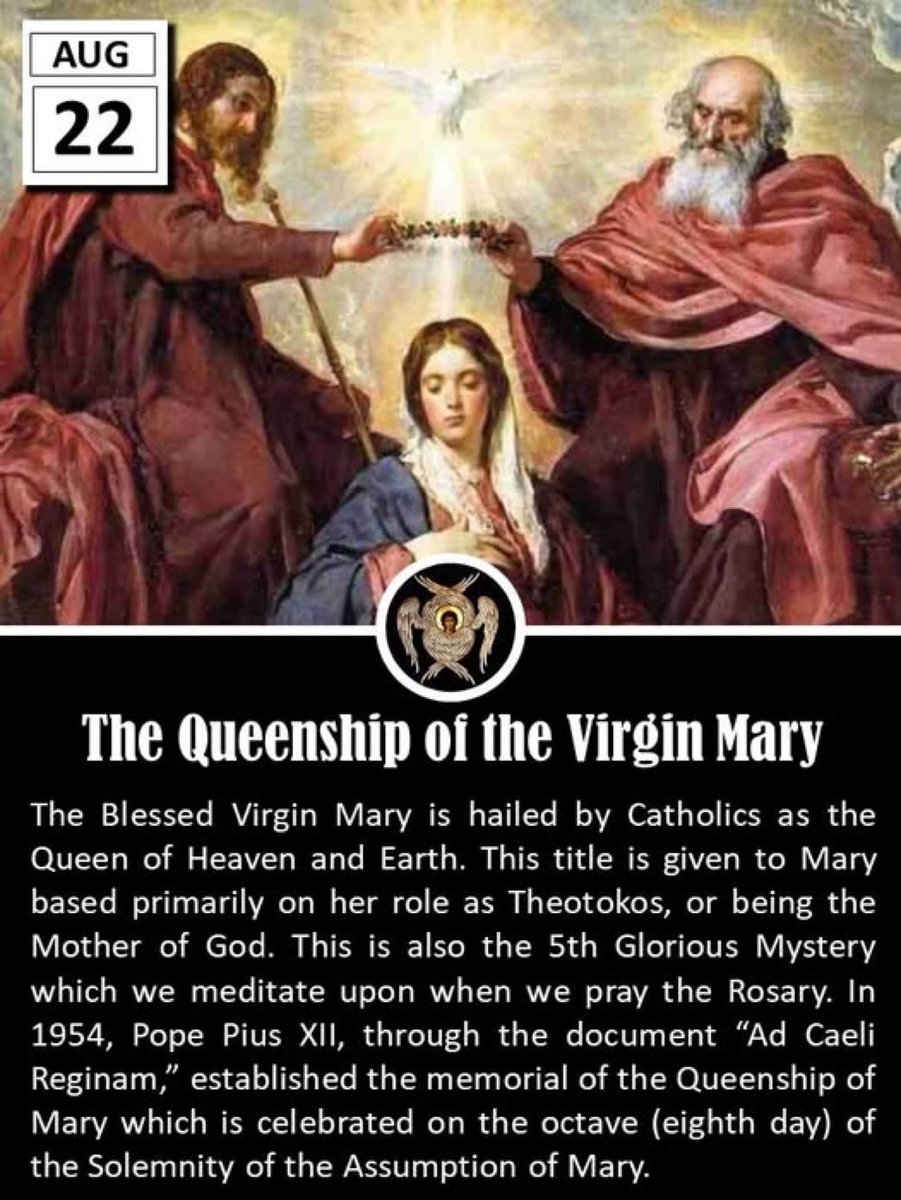
Today, the Church celebrates the Memorial of the Queenship of Mary, a feast that honors the Blessed Virgin Mary as Queen of Heaven and Earth. This commemoration, instituted by Pope Pius XII in 1954 through the encyclical Ad Caeli Reginam, underscores Mary's unique role in salvation history and her exalted position as the Mother of Jesus Christ, the King of all creation.
The title of "Queen" for Mary flows from her divine motherhood. As the Mother of Jesus, who is both fully God and fully human, Mary holds a singular place in the divine plan. Her queenship is not one of earthly power or dominion but of spiritual motherhood and intercession. She is seen as the perfect disciple, who faithfully followed God's will, from the Annunciation to the Cross, and now reigns with her Son in heaven. This feast, celebrated one week after the Assumption, emphasizes her glorification and her role as a bridge between humanity and Christ.
The Queenship of Mary also reflects her role as a model for Christians. Her fiat—her "yes" to the will of God—exemplifies humility, obedience, and trust. As Queen, she intercedes for humanity, guiding the faithful toward her Son ("Do whatever He tells you" Jn. 2:5). The feast invites believers to reflect on her example and seek her maternal intercession in their spiritual journey.
@BreeSolstad This! I've recognized as I go deeper in my journey to become closer to God, it's getting easier to not fight back with insults and trade jabs. My patience is growing and my heart is softening. Thanks be to God! 🙏🏻❤️
🔸 August 15 - The Dormition of the Mother of God 🔸
Today, we celebrate the Great Feast of the Dormition (Falling Asleep) of the Most Holy Theotokos and her bodily translation into heaven. This is one of the most joyous feasts of the Church, for the All-Holy Virgin, as the Mother of our Lord and Saviour Jesus Christ, is exalted above all the saints. The Theotokos was all-holy and sinless, not in the absolute sense which belongs to God alone, but through the abiding grace of the Holy Spirit working within her.
Nevertheless, she reposed like all humanity, not voluntarily as her Son did, but by the necessity of her mortal human nature which is indivisibly bound up with the corruption of this world. Having been foretold of her departure from this life three days prior by the Archangel Gabriel, the Theotokos returned to her home and prepared for this event, praying that the Apostles would be notified. At the time of her repose, the Apostles, who were preaching all throughout the world, were miraculously transported to Jerusalem to behold this event.
The body of the Theotokos was taken in a solemn procession, and was laid in a tomb near the Garden of Gethsemane. According to God’s providence, the Apostle Thomas arrived three days after her repose and was greatly saddened that he had not been present. When the Apostles opened the tomb so that Thomas could venerate her body, they found it empty. The Church thus celebrates that the Mother of God was taken bodily into heaven and glorified by her Son.
The icon of the Dormition shows the Theotokos lying upon her deathbed, surrounded by the grieving Apostles. On either side, Saint Peter censes her body, while Saint Paul bows reverently before her. But the most beautiful scene in this icon is Christ, who, having descended in glory and surrounded by angels, receives the pure soul of His Mother which is represented by a small child clothed in white.
This beautiful image reverses the familiar scene of the Mother of God holding the infant Christ in her arms. She who once carried and embraced Him as a Child is now herself received into the arms of her Son and God, who bears her soul into His heavenly Kingdom.
The Assumption of the Blessed Virgin Mary
1. It is generally believed that Our Blessed Lady died, since she would not have wished to escape death any more than her divine Son did. Our Lord, however, had seen her sharing in His agony and death upon Mount Calvary, and He willed that her own death would be so peaceful as hardly to justify the name.
The just die in the love of God and the martyrs died for the love of God. But Mary died consumed by the love of God. It was not disease which brought an end to her life, but love. Her love for Jesus was more ardent and more perfect than that of any other creature. She loved Him when she held Him in her arms in the stable at Bethlehem, when she fled with Him into Egypt, and when she offered Him in the temple to His heavenly Father. She loved Him when she found Him after He had been lost and when she looked after Him in their home at Nazareth. She loved Him as she followed Him to His death on Calvary. She loved him in the joy of His Resurrection and, subsequently, of His Ascension into Heaven. Jesus desired her to remain on earth for a while to comfort the infant Church and to initiate the loving patronage which she would exercise over it in Heaven. Her love grew from day to day until it entirely consumed her and her immaculate heart could no longer contain it. Mary fulfilled in a most perfect manner the Creator's command to His creatures to love Him with all their hearts and with all their strength. Consequently, her love reached such a peak that her soul in its final ecstasy glided from her body.
Let us ask our Mother, Mary, to help us to die with the love and grace of God in our hearts, and with the names of Jesus and Mary on our lips.
2. Even as Christ by His own power rose from the grave, so by reason of His intervention the soul of Mary was reunited, after a short separation, with her body, and she was taken up body and soul into everlasting glory. It was fitting that this privilege should have been bestowed on the Mother of God. It would have been unbecoming for the immaculate flesh in which the divine body of Jesus was formed to have been allowed to corrupt in the grave. It was fitting, too, that she who was to be proclaimed Queen of Angels and of men should have come immediately to her throne of glory with her humanity integral and unimpaired. Her resurrection was, moreover, the reward of her virginal purity. From the first moment of her conception she was preserved free from original sin and from every evil inclination, and throughout her life she had advanced farther and farther in the way of perfection.
We shall rise one day also, O Blessed Mother. Grant in your great love for us that we may so imitate your example as to deserve to rise in glory and to be associated with you in everlasting happiness.
3. After she had risen, Mary was gloriously taken up into Heaven. Jesus has ascended into Heaven by His own power, but Mary was borne aloft by the Angels, whose Queen she was soon to be proclaimed. She reigns in Heaven with her divine Son and looks down in love and mercy on her exiled children, whom she is ever ready to assist. She was the humblest and most exalted of creatures (Dante, Par. XXXIII, 2) for when told that she was to be the Mother of God, she desired to be called His handmaid.
Humility is the Mother of all the virtues even as pride is the source of all the vices. If we wish to share in Mary's triumph, we must first of all share in her humility.
“Everyone who exalts himself shall be humbled,” Jesus has said, “and he who humbles himself shall be exalted.” (Luke 14:11) “God resists the proud,” we are reminded by the Apostle James, “but gives grace to the humble.” (James 4:6) The glorious Assumption of Mary contains a lesson in humility for all of us. (Antonio Cardinal Bacci)