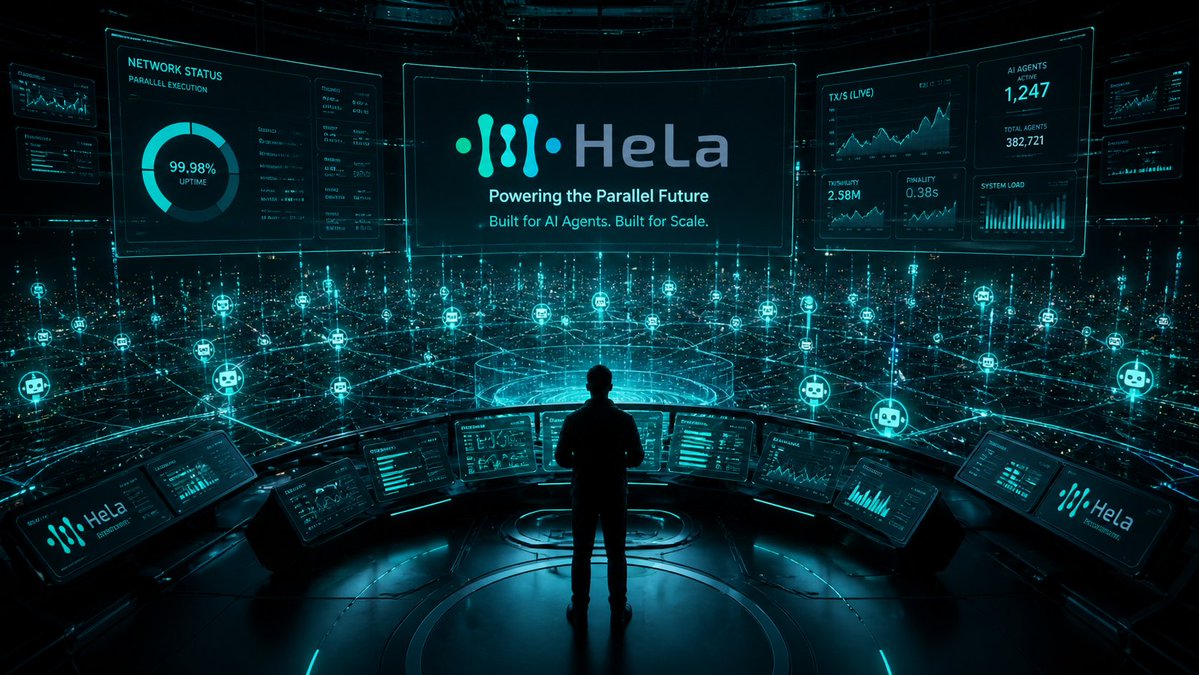
HeLa is evolving beyond an L1 into the home chain for Agentic AI.Explore https://t.co/tfRRKqshgF
Autonomous agents now get Citizen IDs, wallets, memory vaults, and monetized action all onchain.Helasyn is building the infrastructure for agents that can plan and execute onchain.
The question won't be:
"Which software should I use?"
It will become:
"Which agent should handle this?"
That changes how applications, businesses, and ecosystems are designed.
Here's what we actually built, and the thinking behind every decision.
Over the past few years, we've spent a lot of time asking a simple question:
What would infrastructure look like if AI agents were participants from day one?
Not users.
Not tools.
Participants.
Everything you knew about blockchain UX was designed for humans. Agents need something different. We built it.
For years, blockchain UX has been optimized around one assumption:
A human is sitting behind the screen.
Click the wallet.
Approve the transaction.
Sign the message.
Manage the gas.
Store the keys.
It works because humans fill the gaps.
Agents can't.
An AI agent doesn't want a wallet popup.
It doesn't know what a browser extension is.
It shouldn't stop every few minutes waiting for approval.
Yet we're asking autonomous systems to operate on infrastructure built for manual interaction.
That's why most "agentic" experiences still break the moment they leave the demo.
The intelligence isn't the bottleneck.
The environment is.
We've spent the last 13 days talking about the gap between AI capability and real-world execution.
This is one of the reasons that gap exists.
So we built something different.
An environment where agents can act, transact, remember, and operate without being forced through workflows designed for humans.
We've spent 13 days on the problem.
Tomorrow, we show you what we built for it.
Most chains settle transactions.
A user decides what to do.
A transaction is submitted.
A contract executes.
A result is recorded.
The infrastructure follows instructions.
That's how most systems work today.
But what happens when infrastructure can understand intent instead of simply processing transactions?
Not:
"Execute these steps."
But:
"Help me achieve this objective."
The difference sounds subtle.
It isn't.
The moment a system understands outcomes, the role of infrastructure changes completely.
Instead of waiting for instructions, it can identify what needs to happen, determine which resources are required, coordinate specialized agents, route execution, and adapt as conditions change.
Imagine launching a product.
Research, planning, execution, payments, analytics, and coordination no longer operate as disconnected functions.
They become part of a system working toward a shared objective.
Or imagine managing capital.
You define goals and constraints.
The infrastructure continuously evaluates opportunities, coordinates actions, and adjusts execution as the environment evolves.
Not because someone is manually clicking buttons.
Because the system understands the outcome it's working toward.
That's why the future may not belong to faster chains or smarter contracts.
It may belong to infrastructure that can transform intent into coordinated execution.
Most chains settle transactions.
A chain that thinks coordinates outcomes.
Almost there.
Everyone's talking about AI agents.
Most conversations focus on what a single agent can do.
Research information. Write code. Analyze data. Complete tasks. Automate workflows.
Those capabilities are impressive.
But they may not be the most important development ahead.
The next era of AI won't be defined by individual agents.
It will be defined by what happens when agents begin working together.
Think about how economies work.
No single company creates a market.
No single participant creates an economy.
Value emerges when specialized participants coordinate toward outcomes that none of them could achieve alone.
The same principle applies to agents.
Imagine a travel agent coordinating with airline agents, hotel agents, payment agents, and insurance agents to complete a trip.
Or research agents, finance agents, legal agents, and operations agents coordinating to execute a business objective.
The value doesn't come from a single agent.
It comes from coordination.
That's what a coordination economy looks like.
Not bigger models.
Not more prompts.
Not more isolated agents.
An environment where specialized agents continuously collaborate, exchange context, delegate responsibilities, and coordinate decisions toward shared outcomes.
Single agents are impressive.
Coordinated agents are transformative.
And if that's where the greatest value will emerge, why is so little attention being paid to the infrastructure that makes coordination possible?
Nobody's building the coordination layer.
The gap is real.
The future is agent-driven @Hela_Network
Hela Labs' new AI Upgrade Program is built around AI & Agentic AI contributions, creating multiple pathways for innovators, builders, researchers, and creators to participate and make an impact.
Join this movement and help build future💰
Because this isn't semantics.
It's architecture.
If every important decision was made in advance, you built a workflow.
If the system can evaluate, choose, adapt, and pursue an objective, you built an agent.
The gap is real.
We built something with AI recently.
It worked exactly as intended.
That's what bothered us.
For a moment, everything looked right. The demo was smooth. The outputs were good. The tasks were completed.
Yet the feeling remained.
Something wasn't adding up.
The more we build with AI, the more we notice a strange contradiction.
The technology keeps evolving.
The foundations underneath it barely move.
Every breakthrough gets layered onto systems that were never designed for what comes next.
We're building faster than ever.
But we're still relying on infrastructure that assumes intelligence is temporary, isolated, and disposable.
Most people see progress.
We see the friction underneath it.
Not because AI is failing.
Because new forms of intelligence are being forced to operate on old assumptions.
That unease isn't a lack of confidence in AI.
It's the recognition that something essential is still missing.
The gap is real.
The AI revolution won't happen everywhere at once.
It starts somewhere.
Which industry feels the impact first?
🔍 Search
📱 Social Media
🎮 Gaming
💰 Finance
🎓 Education
Drop your prediction below. 👇
AI is evolving fast.
But most blockchains still aren’t feel built for an AI-native future.
We’re entering an era where AI agents won’t just assist humans anymore.
They may:
Execute transactions
Manage assets
Interact with protocols
Coordinate with other agents autonomously
The question is:
Where will these agents live?
Not on traditional infrastructure designed only for simple transactions.
The next generation of blockchain infrastructure needs to support:
✅ Autonomous execution
✅ Scalable coordination
✅ Verifiable actions
✅ Decentralized intelligence
Because in the future, apps may no longer be static tools.
They become:
→ Intelligent
→ Adaptive
→ Autonomous
AI + Web3 is no longer just a narrative.
It’s slowly becoming the foundation for the next internet.
An internet where:
Users own their identity
AI agents interact onchain decentralized systems coordinate in real time
The future won’t just be humans using apps.
It may become:
Agents interacting with agents.
Are we ready for the age of autonomous intelligence onchain?
Join the conversation with builders shaping the AI-native future : https://t.co/LC5m2QSECd
What happens when AI infrastructure is built for autonomous execution instead of simple prompts?
This.
Brody isn’t just an AI assistant.
It’s a glimpse of what AI agents look like when they’re powered by real on-chain infrastructure.
Identity.
Memory.
Coordination.
Execution.
All connected through the HeLa ecosystem.
The next wave of AI won’t be isolated chatbots.
It’ll be autonomous agents operating across apps, chains, and digital environments in real time.
Brody is one example.
HeLa is the infrastructure behind it.
Meet Brody: https://t.co/T5eOc3wYJ4
AI agents are evolving faster than the infrastructure supporting them.
Current systems break under autonomous execution:
✖️ fragmented identity layers
✖️ isolated agent memory
✖️ non-portable reputation
✖️ limited on-chain coordination
HeLa solves this with an AI-native infrastructure stack.
▸ Persistent AI Identity
▸ Onchain Reputation Layer
▸ Autonomous Wallet Execution
▸ Agent-to-Agent Coordination
▸ Modular AI Infrastructure
▸ Scalable Onchain Intelligence
Built for continuous autonomous operation.
Built for machine-native economies.
Built for the next phase of on-chain AI.
HeLa is not integrating AI into blockchain.
HeLa is building blockchain infrastructure for AI itself.
Join the HeLa Discord and enter the AI-native network.
https://t.co/LC5m2QSECd
What happens when AI owns identity?
Not just a chatbot.
Not just an assistant.
But an autonomous entity with:
• its own wallet
• reputation
• transaction history
• on-chain permissions
• economic activity
• its own home on-chain
AI stops being a tool. It becomes a participant in the digital economy.
It can earn.
It can spend.
It can coordinate with other AI agents.
It can build its own on-chain history.
The next evolution of AI isn’t just intelligence.
It’s ownership, identity, and autonomy.
This is where the future is heading.
The age of autonomous AI is just getting started.
Are you ready for it? 👀
Join the conversation and build with us:
https://t.co/LC5m2QS6MF
They didn’t wait.
They moved.
Now they’re part of HeLa Ambassador Program Batch 1–3, building inside the AI × Web3 movement before everyone else catches on.
While most people were still “thinking about it,”
they were already getting exposure, networking with builders, creating opportunities, and positioning themselves early.
That’s the difference between people who grow fast…
and people who only watch others win.
Batch 4 is almost closed.
This is your window.
You can keep scrolling and regret it later.
Or you can secure your spot now.
Apply here ↓
https://t.co/nDqsLQQkSe
Most blockchains are still stuck in single-lane mode.
One transaction at a time.
Queue. Compete. Slow down.
And somehow… they call that scaling.
Hela doesn’t scale like that.
Hela rewrites the rules.
With parallel execution, independent transactions don’t wait in line, they run at the same time.
No congestion games.
No artificial delays.
Just raw, coordinated execution.
What that means:
⚡️ Real throughput you can feel
⚡️ Near-instant confirmations
⚡️ Performance that holds when demand spikes
But this isn’t just about speed.
The next wave is already here,
AI agents operating 24/7, making decisions, executing actions, all at once.
That world needs infrastructure built for parallelism.
Not patched for it.
Hela is where that future gets built.
Build your agents with us.
Not later. Now.
Join the Discord → https://t.co/LC5m2QS6MF
Start building where parallel is the default.
Happy Earth Day from HeLa 🌍💚
Technology and sustainability should move forward together.
At HeLa, we believe innovation can help create a healthier planet, stronger communities, and a better future for the next generation.
From AI-powered solutions to real-world impact, every step matters.
Our Planet. Our Health. Our Future.