I've been thinking a lot lately about Trust for consumer products.
Like for Apple, Disney, Mercedes-Benz or Lego. Benz has had the fewest safety recalls. Disney and Lego make experiences and products respectively for kids.
At least these four brands have premium pricing. Sure it's the price for all the COGS, marketing and whatnot.
But what consumers are paying for, implicitly perhaps, is also trust and risk mitigation.
It takes a time to build this kind of trust. But it is also a question that investors or VCs should ask startups with consumer-facing products - how they plan to build this kind of brand trust over time.
Even if they don't intend to price them at a premium. Because trust is indeed a scalable asset.
Warren Buffett is stepping down as Berkshire Chairman at 96 years old.
In his goodbye letter, he says that “Father Time always wins. He has, however, been generous with me.”
His son Howard will take his place (“Howard has been a Berkshire Director for 33 years. That’s a longer apprenticeship than I served before taking the reins at the age of 34. Greg [Abel] runs the company. Howard will guard its culture and values.”)
Incredible 60+ year run. 🐐
i’m surprised no one has built a super well designed bottled water / beverage company where the water is free or heavily subsidized by advertising.
basically liquid death x monocle x ooh advertising except the economic innovation is that the advertiser is the customer & the drinker is the audience.
each bottle could have different ads, & the impressions are counted through sales.
From a @TechCrunch article on why so many leading startups are now emerging from Sweden….one of the reasons is “first generation of entrepreneurs, who are providing resources and mentorship to the latest generation”.
This actually matters a lot more than we give it credit - having role models and guiding forces.
As Walt Disney said, “if you can dream it, you can do it”. But sometimes, you need someone to show and support the dream.
This is happening in other countries too, like India. With some government push too.
We can expect that 10 years from now, there will be many other successful entrepreneurship startups from countries where it was not the trend in the past.
https://t.co/VfB7qg5E6M
We used to think of ‘circular economy’ as one that is environmentally regenerative and sustainable.
Now, a circular economy is the AI industry with all its financing and supply interrelationships.
5 years from now, with all the space buildout, my guess is circular economy will refer to the crowd of satellites circling earth and delivering solar energy, wireless connectivity and data packets to us.
A significant step in medical innovation.
A personalized mRNA cancer vaccine developed by Moderna and Merck was effective in preventing melanoma from coming back or spreading in a late-stage study.
Covid was awful for many reasons. But it accelerated mRNA technology in so many ways by being a proof of concept of sorts. It pushed mRNA tech from labs into the real world by forcing companies and regulators to remove the bottlenecks.
I'm hoping for so much more now. F*** Cancer!
From a users’ perspective, AI is getting more organized.
More companies are labeling their products with AI badges (@Spotify), watermarks (@Anthropic) and detection tools (@Substack and @LinkedIn).
Every new technology goes through this arc. The initial chaotic diffusion and then somebody builds the structure, the standards, the categories, the rules of engagement.
The WWW got organized through HTTPS and SSL certificates, SEO best practices, domain reputation systems. Social media through verification marks
AI is in this second phase.
The third phase is where all of the above becomes the invisible infrastructure. The unlabeled AI content gets downranked by default.
And as AI gets even better and more ‘everywhere’ than it currently is, the fourth phase will be where it flips to human content getting the rare + valuable badge, akin to CAPTCHA.
I’m always scanning for white spaces in tech as a default mode. Here are some signals about next decade trends pulled from two recent ‘Emerging Patterns’ issues in the newsletter…
- Intelligence will continue to shift to the edge - as edge computing morphs into Edge AI. Here, the device isn’t just processing, it is also reasoning.
- Building on top of satellite connected phones - opportunities for startups to innovate and develop consumer apps or services on top of this infrastructure
- Nuclear reactors getting smaller and ‘stackable’ - as more startups reach criticality with new models
- Progress in biotech requires investment in various distribution technologies - such as cold chain for GLP-1s and biologics and microneedle patches
- New research on 3D printing reveals opportunities to print batteries around the components - very few startups exist in this space. More room available for new business ideas.
- Drone delivery certification process creating a moat for companies like DoorDash that clear it early - since the process is cumbersome and complex
That strategic choice on how to bring drones into your business model, exists because of how hard that FAA certification is to get. And that certification becomes the bottleneck as this method propagates.
DoorDash was all over the news a couple of weeks ago for announcing the launch of its drone delivery service.
The FAA regulates drone package delivery and DoorDash is only the eighth drone operator to get certified for it.
Now, more companies will consider drones as a last mile delivery method.
But, that strategic choice, however, on how to bring drones into your business model, exists because of how hard that certification is to get.
And that certification becomes the bottleneck as this method propagates.
So whichever company can push through and get certified creates a moat of sorts.
DoorDash becomes the aggregator and drone makers provide the hardware while DoorDash provides the service.
At least until the FAA adapts its existing framework like it did for eVTOL.
Every few weeks, alongside my usual focus on business models and frameworks, I zoom out to highlight emerging patterns in tech and markets…..the shifts that can shape how we invest, operate and make decisions.
In this issue-
- Drone delivery of packages is here but regulation is still catching up
- Nuclear reactor miniaturization nears commercialization; 4 startups reached criticality in the last few weeks; could be positive news for AI data centers
- Satellite direct-to-device (phone) connectivity is approaching mainstream. It’s an emerging white space for startups
In each case, the underlying innovation has been around for some time. But recently, a formerly slow moving external gate, whether a regulator, a standards body or a spectrum allocation, is opening up and years of technological progress seemingly rushing out.
https://t.co/dSc9YCC2St
A VC I recently spoke with said that part of the reason for investor interest in higher risk technologies like defense tech is that “everything else is taken” or has lost its relevance… B2B SaaS is dead (his opinion), AI investing has many buyers and sellers….so this trend is capital seeking another outlet. Perhaps.
Either way, I decided to dive into the why there is more private investment flowing into defense tech. And no, it’s just because of the ongoing conflict.
Newsletter link in bio.
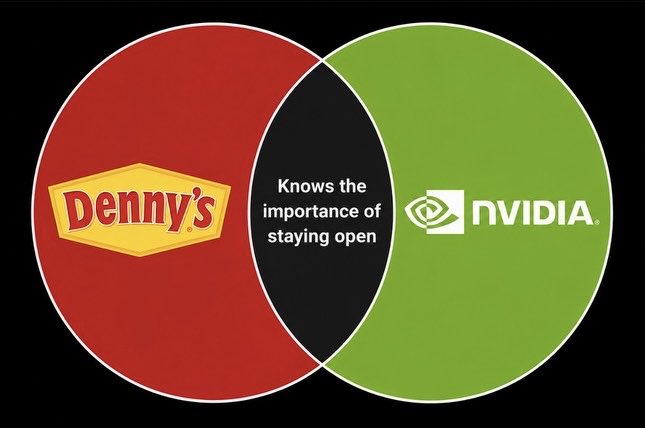
@nvidia Jensen Huang has joined the club supporting open models. Palantir’s Alex Karp, Microsoft’s Satya Nadella and some others have recently shared warnings about the labs’ closed end models.
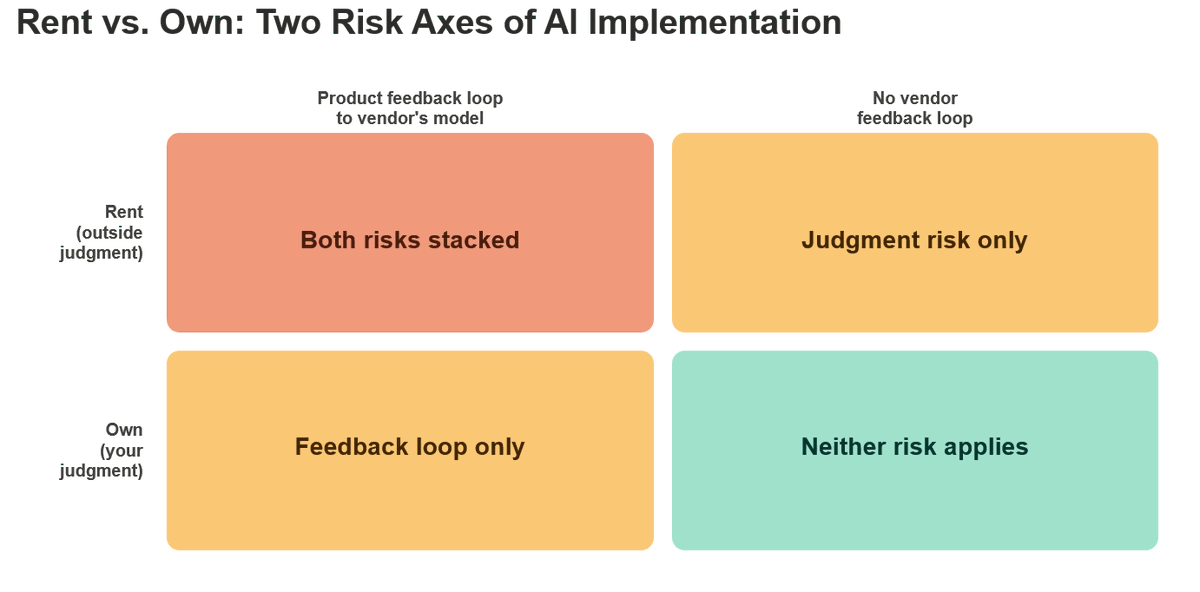
As more enterprises seek out forward deployed engineer services and other vendor support for AI deployment inside their orgs, the decision that needs to be weighed carefully esp. with respect to the risk to IP is whether to use the rent or own approach.
A 2×2 thinking-through-this-decision framework is pasted below. Details in the newsletter in bio.




![TrungTPhan's tweet photo. Warren Buffett is stepping down as Berkshire Chairman at 96 years old.
In his goodbye letter, he says that “Father Time always wins. He has, however, been generous with me.”
His son Howard will take his place (“Howard has been a Berkshire Director for 33 years. That’s a longer apprenticeship than I served before taking the reins at the age of 34. Greg [Abel] runs the company. Howard will guard its culture and values.”)
Incredible 60+ year run. 🐐](https://pbs.twimg.com/media/HSgTPuSboAA2ATm.jpg)