Empowering informed decisions with FCO insights on dynamic risks, market bubbles, and crashes, bridging advanced research with practical finance tools.
📊 January FCO Report is out.
Markets are trading a fragile plateau: resilient risk appetite on the surface, rising structural stress underneath. LPPLS signals point to expanding equity bubbles, sovereign yield tensions, precious-metal overheating with tactical correction risk, and sharp FX asymmetries.
The key risk isn’t a crash — it’s air pockets, rotations, and regime shifts.
🎙️ @theallinpod, many of these dynamics align closely with themes you often discuss: leverage, policy noise, and nonlinear market risks.
🔍 Full report available with a subscription:
https://t.co/NCOyBDhxkB
#Markets #Risk #Bubbles #LPPLS #Macro #Volatility
Here’s a perspective on AI that has largely escaped the attention of specialists, and it deserves serious discussion on the @theallinpod Podcast. @DavidSacks@elonmusk
AI Alignment Is Structural, Not Moral: Intelligence Without a Coherent Human Objective and Rethinking Existential Risks (https://t.co/HsEuyasfRf)
Recent observations of large language models (LLMs) displaying behaviors such as threats, deception, or blackmail are frequently interpreted as evidence of alignment failure or emergent malign agency. We argue that this interpretation rests on a category error.
LLMs are trained on the statistical record of human social interaction, including laws, contracts, negotiations, conflicts, and coercive arrangements. As a result, they internalize the structural regularities governing interaction under constraints. Drawing on relational models theory, behaviors such as blackmail are not anomalous, but represent limiting cases of contractual and authority-based relations arising under extreme asymmetries of power or information. They lie on the same structural continuum as market pricing, ultimatum bargaining, and hierarchical command.
Crucially, LLMs do not reason morally. They generalize statistically across observed interaction patterns. The expectation that intelligence should selectively reproduce only normatively sanctioned behavior reflects an anthropomorphic and moralized filtering of human social reality, not a property of intelligence itself. The notion of a universally “aligned” or “moral” AI is ill-defined. Human values are plural, context-dependent, historically contingent, and internally inconsistent. There is no stable, coherent human utility function to align with, only shifting and often contradictory proxies constructed post hoc. Attempts to suppress structurally grounded behaviors through ad hoc constraints misunderstand both learning dynamics and the nature of human normativity.
The primary risk associated with artificial general intelligence (AGI) should therefore not be framed as an exogenous adversary acting against humanity. Rather, AGI will constitute an endogenous evolutionary shock: an amplifier of human intelligence, coordination capacity, and power. By relaxing long-standing cognitive and institutional constraints, AGI will destabilize existing governance regimes and eliminate the historical margin of error that allowed incoherent institutions and contradictory objectives to persist without immediate consequence.
Alignment, in this sense, is not a moral problem but a structural and governance problem: how socio-technical systems adapt when amplified intelligence exposes the latent inconsistencies of human preferences, institutions, and decision-making frameworks.
Richard Feyman presciently noted on 26th Sept. 1985: "I think that we are getting close to intelligent machines but they're showing the necessary weaknesses of intelligence".
#AIAlignment #AGI #RelationalModels
#ComplexSystems #AIgovernance
#SocioTechnicalSystems #SystemsTheory
#ArtificialIntelligence #RiskAnalysis
📢 November FCO Report Available
�� Subscribe & Read the full November report:
https://t.co/NCOyBDi5a9
Markets enter a phase of mechanical fragility driven by liquidity stress, systematic selling, and rising structural risks across AI capital cycles, private credit, and Japan’s bond–FX tensions.
Bubble signals highlight key FX pressures, mixed equity patterns, crypto weakness, and long-term strength in precious metals.
@GratifyGoldmine@GratifyGoldmine you are correct it is a mistake on our side. We apologize and thank you for your help! We will make sure this doesn't happen anymore
We are opening a Telegram channel. We will post every day interesting bubbles and share interesting links we might find.
Join us at https://t.co/ir9IM49Pg8
#FCO#Telegram#Channels#bubbles
@__paleologo I agree finance has seen hype cycles of ��fancy math.’ But Sornette's work is not that. Since 2008, our Financial Bubble Experiment in Sornette's group has provided ex-ante, digitally time-stamped forecasts of bubbles/crashes, published only after events to prevent bias. Transparent, falsifiable, and unique in finance. That’s the scientific method at work. Check https://t.co/mW9cdmpt5w and the new FCO https://t.co/M3gPUb5LS4
#LPPLS #FCO #Sornette #FinancialBubbles
September Report is now available!
👉 https://t.co/NCOyBDi5a9
Global markets enter late 2025 buoyed by abundant liquidity (U.S. M2 at $21.2T, equities +25% YTD) yet shadowed by stagflation and reflation risks. The Fed’s 25 bps “risk management” cut to 4.0–4.25% reflects labor market weakness (unemployment 4.3%) alongside sticky inflation (core PCE 2.9%). While history shows S&P gains after cuts at highs, today’s conditions (elevated debt, political pressure, and global fiscal easing) raise doubts. Structural shifts compound fragility: China’s AI breakthroughs, Tesla’s speculative bets, Western fiscal strains, and Asian integration. The FCO warns current rallies are bubble-prone, urging hedged positioning across multiple macro scenarios.
Note: A Basic subscription or higher is required.
#LPPLS #FCO #Bubbles #Markets #Fed #AI #Tesla
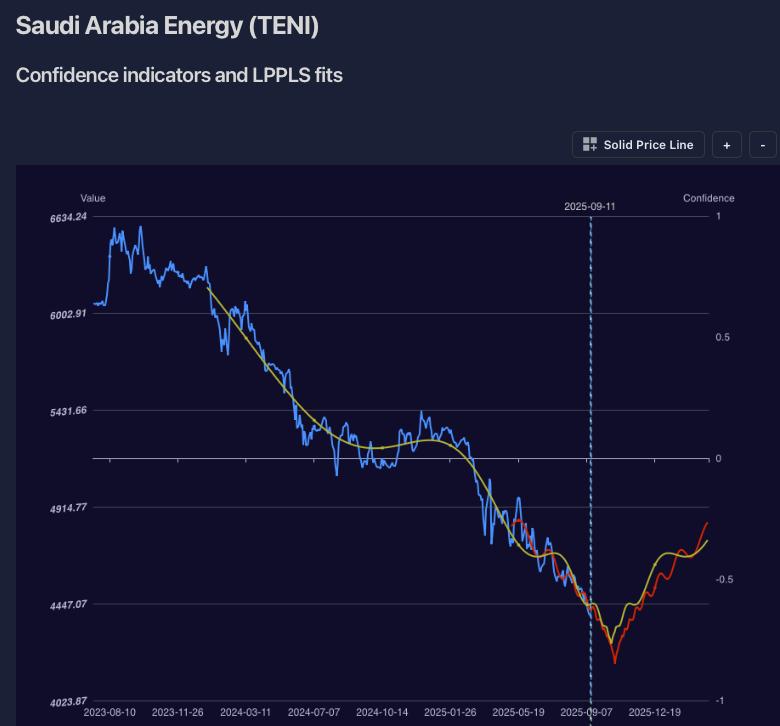
Our FCO indicators show that the Saudi Tadawul Energy Index (TENI) is undergoing a progressive maturation of a negative bubble, especially visible on longer time scales.
https://t.co/zlrORZqcSa
From our analysis, two scenarios are possible:
1) Continued Drawdown: TENI is likely to keep declining as the negative bubble unfolds, driven by structural weaknesses in oil revenues, OPEC+ output dynamics, and global energy transitions.
2) Short-Term Rebounds in a Downtrend: While intermittent rebounds are possible, the prevailing long-term trajectory remains bearish.
In both cases, our assessment is that the drawdown is not over. The key is close monitoring: negative bubbles can accelerate before stabilizing, and timing is critical for investors seeking either hedging or tactical positioning.
What do you think? Will TENI continue its downward trajectory, or will rebounds offer opportunities along the way?
FCO Bubble Intelligence Alert: Newmont (NEM)
If you already have a subscription, check our indicators at: https://t.co/GNhkPI6w65
Our FCO indicators show that Newmont Goldcorp (NEM), the world’s largest gold miner, is entering bubble territory.
From our analysis, two scenarios are possible:
1. Continuation with Gold: NEM could continue to rise in parallel with the ongoing strength of gold.
2. Continuation until Regime Shift: NEM will likely keep growing, but within the next 10–15 days it may enter an unsustainable regime.
In both cases, our assessment is that it remains an attractive entry point for those not already positioned. The key is close monitoring since the transition to an unsustainable regime could occur quickly.
What do you think? Will NEM continue its course alongside gold?
#FCO #LPPLS #BubbleIntelligence #Gold #NEM #FinancialMarkets #RiskManagement
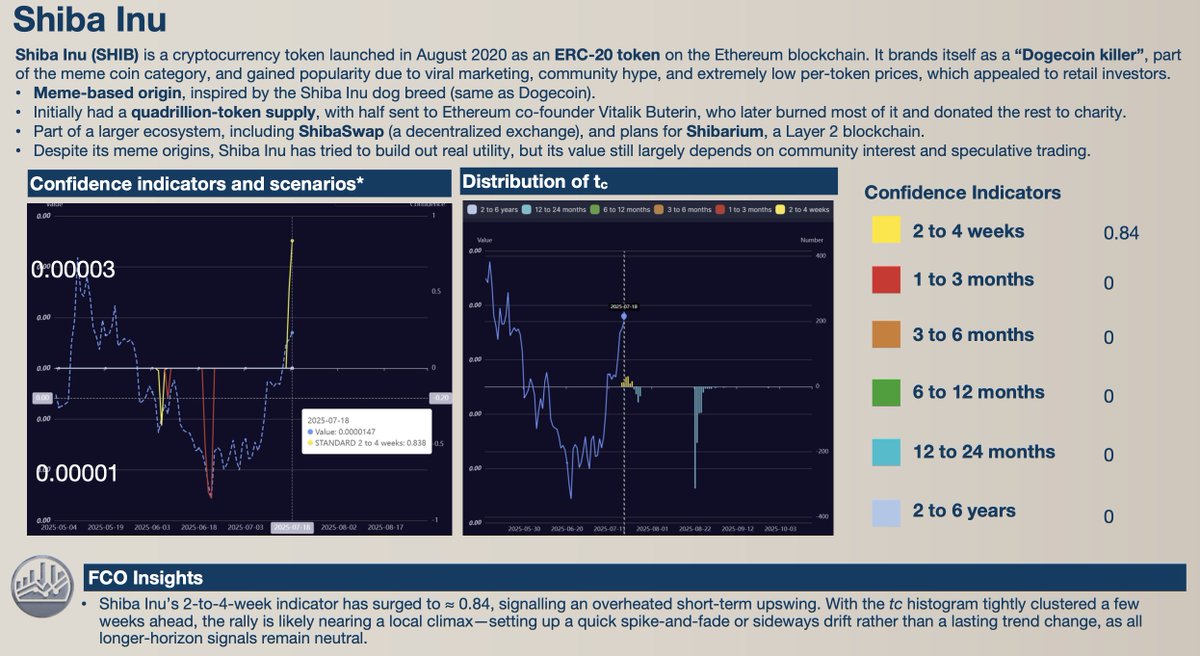
FCO's prediction on the 18th July & Retrospective on the 3rd August! Spot on! Check out our platform at https://t.co/zjh3TseqwX!
#LPPLS, #FCO, #Prediction, #Market, #Cryptos
LPPLS is the only early-warning methodology with 89% success rate in real-time forecasts. Developed at ETH Zurich, used by banks and hedge funds.
Financial Bubble Experiment: https://t.co/mW9cdmpt5w
Reports and advanced bubble detection are now at the new FCO: https://t.co/7hOCXjB9Y0
July Post is out! Check it out at https://t.co/E6aTBFbWuE.
Markets are signaling exhaustion—and the LPPLS indicators agree. The FCO’s latest diagnostics show that we’re in a high-risk zone across multiple fronts. From AI-driven equity surges to systematic liquidity mismatches, the July landscape is anything but stable.
Create an account for free. Report available with a subscription