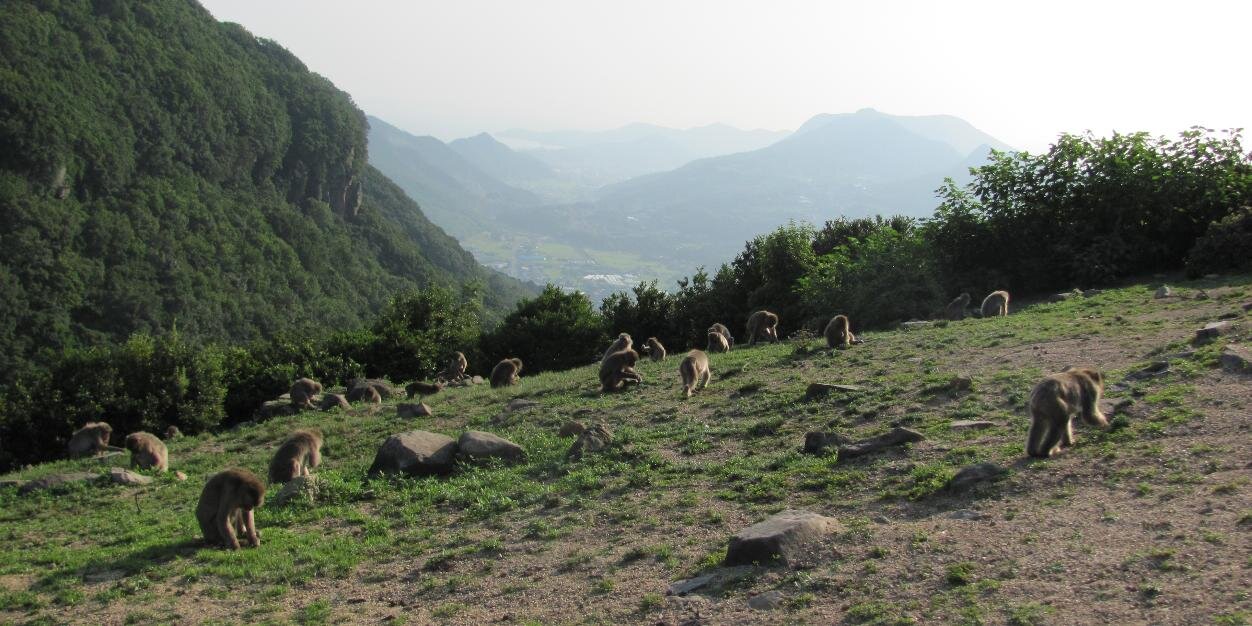
Checked twitter on my way out the door to choir rehearsal after reading and coding about convergent evolution all day, and what should I find but this gem? Amazing! #SingingScientist#Convergence#PorcupinesRock
I can speak to @grahamallie1's awesomeness as a collaborator. She is thoughtful, creative, generous with her time, and fantastic at training students. Any institution that hires her will be so lucky! #evolution#futurePI#rockstarscientist
Is your department looking to add another faculty member - I am (still) on the job market!
I got it all...
Interesting research questions? ✅
Lots of publications? ✅
History of funding (NIH, NSF)? ✅
A good mentor, and collaborator? ✅
Commitment to broadening participation? ✅
.@aintzane11 infers a phylogeny for 123 Acanthuriformes fish and uses it to identify transitions between planktivore and non-planktivore diets. Diet is related (imperfectly) to tooth morphology and to climate. Some planktivorous lineages share positively selected genes #Evol2023
Erik Iverson looks at mitonuclear incompatibilities in swordtail fish and Scytapulo bird hybrids. He shows evidence for effects of drift and elevation-related selection in these incompatibilities #Evol2023
.@ferrisifolius assesses the impact of varying selection in space and time on monkeyflower species isolation. She & her lab measure selection on morphology and mating system across years and sites. Variation in space promotes divergence and in time relaxes selection #Evol2023
.@Hagar_k_Soliman studies intrinsic reproductive isolation in Mimulus constrictus x whitneyi monkeyflowers. She sees variable effects of hybridization on seed size and viability (endosperm failure) depending on population of M. whitneyi, explaining apparent asymmetry #Evol2023
John Wakeley presents a model for inferring the age and number of mutations underlying an observed allele under selection. Using coalescent theory, he shows that results are similar for rare neutral and selected alleles, under certain assumptions #Evol2023
Dharani Matharage assesses suitability of C. elegans worms as a model for studying recombination rate variation. Using crosses between strains, she observes differences in recombination rate between strains but not between sexes, and reduced recombination under stress #Evol2023
.@colorfulagamids asks how gene flow affects adaptation and isolation in Mimulus guttatus & laciniatus monkeyflowers. In F2s from crosses with different levels of sympatry/allopatry, she sees different genetic architecture of UV patterns. Up next: pollinator preferences #Evol2023
.@jacjacs_ looks for effects of interspecific mating on reproductive output in Caenorhabditis worms and finds negative effects in one pair. Assortative mating assays show C. becei males are choosy but not other species. Next she will look at resource use. #Evol2023
.@PerrierEcoEvo tests for heterosis (hybrid vigor) in Campanula bellflowers to look for signatures of drift load at the rear edge of a moving species range. He finds heterosis at the rear edge is similar to that in the core range, and is now testing for other scenarios #Evol2023
.@carriewessi identifies regions of the genome highly differentiated between two species of Penstemon, some of which overlap with QTL for pollination syndrome. High recombination in these regions breaks down local LD and allows high resolution for likely causal genes #Evol2023
So proud of grad student Michael Tene and his 1st conference talk, on streamlining a pipeline for associating molecular evolutionary rates with convergent phenotypes. He applies this to mammalian diets and finds associations with amino acid and muscle genes. @Lehigh_CAS#Evol2023
.@k_wilsterman finds that when exposed to hypoxia, lowland but not highland deermice give birth to low birthweight pups. Many genes have hypoxia-responsive expression in each population, but there is limited overlap. Plasticity appears to change with environment #Evol2023
.@BKissmer uses experimental evolution + backcross introgression to assess repeatability of evolutionary rescue in adaptation to a lentil host by seed beetles. He observes some overlap across populations in high FST regions that are resistant to introgression (SVs) #Evol2023
.@bugs_in_bugs et al. discovered a novel endosymbiont in nematodes that infect Drosophila. This clade, Symbiopectobacterium, occurs in many insects and is closely related to a plant pathogen clade. Symbiont genomes are rearranged and TE-rich relative to free-living #Evol2023
.@corlettwwood asks: Why do mutualists increase parasite infection of their hosts? She found an effect of a mutualist-provided resource (nitrogen) on nematode infection in Medicago, but not an effect of symbiosis (nodules) alone. Effects remained after size correction #Evol2023
Eunnuri Yi asks how host age affects ability of mutualists to colonize in Medicago-rhizobia interactions. Data support a "sweet spot" of 3 week age for colonization. Host age also influences the impact of mutualists on nematode parasite colonization and vice versa. #Evol2023
.@TreyJScott_ cross-infects Dictostelium social amoeba hosts with Paraburkholderia symbionts and finds evidence of adaptation in host with natural symbiont in one of two symbiont species #Evol2023
.@changyu_chang measures microbial extended phenotypes of plant hosts - PCA of traits including biomass, nodule and root traits - following rhizobial transplants. He observes overlap in traits across host elevations and suggests gene flow may be involved #Evol2023