I've always had things to say but never posted.
Not because I didn't care but building a startup always felt more urgent than writing.
But a founder without a voice is invisible.
So I built a bot that pings me twice a day and won't let me forget.
Systems > Willpower
@pejmanjohn Was exploring GBrain and couldn't figure out what I'd actually use it for. After reading this, the problem I've been living with daily got words.
Context dies every time I move between agents. The reasoning stays behind. Now I know exactly what to solve for.
Everyone is comparing Google Omni to Sora or Seedance.
Wrong comparison.
Google isn't competing on which model generates the best video. They're competing on what the entire creation workflow should look like in the future.
Old workflow: Generate a clip on Sora → export → import into Premiere → edit → export again → upload to YouTube manually.
Five tools. Same process as before, just with one AI step added.
Google questioned the need for multiple tools in this flow. One ecosystem. Ideation to publishing. No exports. No imports.
That's a much bigger game than "our model is better."
Our product iteration improved 10X because of one change: debug app.
AI needs context about your existing product and what you are thinking next. So we gave every non-coder on the team GitHub access.
Not to ship code. To experiment.
They give AI full codebase context - design system, data, existing flows. Then ask it to build whatever idea they have in mind.
The real impact: they view the change directly inside the app.
Real device. Real data. Haptics. Animations. Audio. Things you cannot feel in Figma.
Ideas that took weeks to get from "thought" to "I can experience this on a device" now take hours. By non-devs.
We tried Lovable earlier for this. It got us partway. But without the actual codebase context, the design system never matched. Once Claude works on the real repo, the output fits the product instantly.
This is not about replacing Figma or developers. We still design properly, still build properly.
But the exploration phase shrank from weeks to hours.
(7/10) At this moment, with multimodal AI, we are giving feedback that is inherently 'super personalised' to the student — making a real impact on their problem solving skills. & Homi is remebering the mistakes for future roadmap!
See these copies -- all these are actual school students in India using @HeyHomiApp in beta.
(3/10) At Homi @HeyHomiApp, we have been trying to solve a peculiar Indian problem -- while keeping the same thesis of "not making kids dumb".
250+ million school students in India.
Every single day, we (students) write in our notebooks, it's an endless phenomenon!
(2/10) Every edtech founder understands this, and is trying to chase how to replicate 1:1 learning with AI.
Education is the biggest orbit shifter, everywhere in the world, and AI gives us the opportunity to democratise impactful learning at scale!
And AI that thinks for the child is the worst thing we could build or rely!
(1/10) The journey so far towards personalised learning has been worth noting.
From Khanmigo → ChatGPT Study & Learn → Claude's introduction of interactive equations → Koji
I saw the new product @brilliantorg and it's the most engaging, delightful, and well thought-out product — keeping the legacy of Brilliant alive.
This is a massive leap in 1:1 learning.
Building agents has the same emotional arc as programming. I start every project thinking it should be easy to get what I want, then end up deep in retrieval quality, context engineering, and cross-modal eval loops before anything actually works.
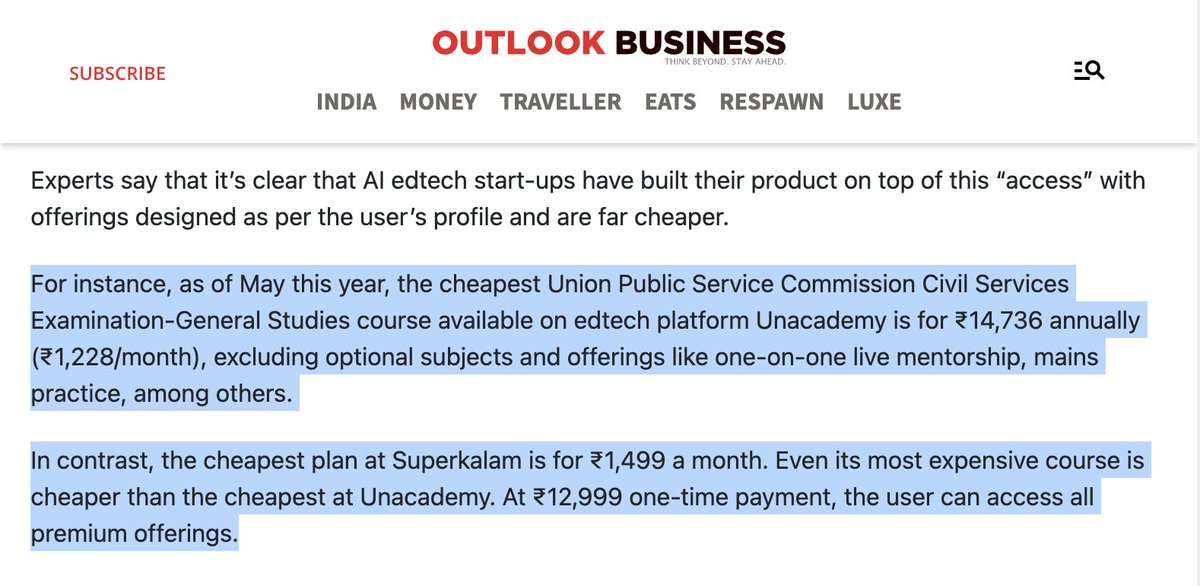
65% of UPSC Prelims 2026 GS paper came from @SuperKalam_ resources.
We have been building at the intersection of AI and education for 3 years now. The belief was always simple. Go deep enough into the exam, understand nuances & insights of the user's life and then use AI to personalise that depth at scale, the results will show up when it matters.
Today it showed up.
Students were solving 1 lakh+ MCQs in a single day on our platform before the exam. We used to look at that number and wonder what's happening, does it actually translate to exam results? Now we know.
The engagement is translating into real exam preparedness.
We have been working for days on an agentic workflow which helps in creating the most accurate answer key, question classification, exam analysis, and resource depth - that went live in production on exam day. The whole team was working on a Sunday to ship, debug, and keep it running.
Everyone has agents these days. Very few have full agentic workflows producing output in production. We intentionally spend a lot of time upskilling our team with AI - hackathons, small projects, AI workflows across the team's daily functioning helping us in making this day happen.
AI x Education
To build in education, one has to go really, really deep. It's not about building cool gimmicks with AI. It's about achieving reliability, personalisation, and learning outcomes at scale. We've been focusing on this diligently.
Utility will always beat gimmicks.
Bob McGrew has a framework I keep thinking about: in the AI future there are only two jobs. The Lone Genius and the Manager.
That's it. Everything else gets absorbed.
The Lone Genius is the person sitting alone at a computer, amplified 1000x by AI. One person with taste, vision, and relentless focus who can now do what used to take a team of 50.
The Manager is the person who becomes CEO of their own "firm" where most of the employees are AI agents. They define the goals. They decide what matters. They coordinate. The AI does the execution.
The Marxists will hear "two jobs" and panic. "What about everyone else?!" But here's what they're missing: AI doesn't shrink these two categories. It explodes them open. More people get to be geniuses. More people get to be managers. The barrier to entry for both just collapsed.
What actually gets eliminated? David Graeber called them "bullshit jobs." Graeber was no libertarian! He inspired Occupy Wall Street.
His words: "Huge swaths of people spend their entire working lives performing tasks they secretly believe don't really need to be performed. The moral and spiritual damage that comes from this situation is profound. It is a scar across our collective soul."
Graeber said bullshit jobs are "a form of spiritual violence directed at the essence of what it means to be a human being." They induce "hopelessness, depression, and self-loathing."
This is who the left should be fighting for. Not to preserve those jobs. To liberate people from them and give them better ones.
The dirty secret of the modern economy: millions of people sit in roles so pointless that even they can't justify their existence. Compliance layers. Reporting layers. Coordination layers. Meeting-about-the-meeting layers. They know it's meaningless. It eats them alive.
AI eats those layers. Good. That's a jailbreak.
What I love about Bob's framework is where it points. The Lone Genius used to require a PhD, a lab, institutional backing. Now a 19-year-old with taste and Codex can ship what took a research team a year. The genius bottleneck was never talent. It was access.
The Manager used to mean you needed to hire 50 people, raise money, build an org chart. Now you can orchestrate a fleet of AI agents from your laptop. The management bottleneck was never skill. It was capital.
AI doesn't concentrate genius and management into fewer hands. It distributes them into more hands. The working class kid in West Virginia. The single mom in Ohio. The 55-year-old who got laid off and now builds software for the first time. Those are some of Bob's future geniuses and managers.
The best founders I see at YC are already living this. They toggle between both modes in the same day. Morning: lone genius, creative insight, the thing nobody else sees. Afternoon: manager, spinning up agents, steering, shipping.
The cycle time between genius and manager IS the new productivity metric.
So when someone tells you AI means "only two jobs and everyone else starves," quote Graeber to them, they’ll get it.
Graeber knew the real violence was making people do meaningless work and pretending it was dignity. AI ends that. More genius. More agency. Fewer spiritual prisons.
@garrytan Agreed.
The dashboard won't show what you doesn't know to look for. You only learn what matters by doing it manually and hitting errors.
Insights & nuances are in the mistakes and experiences one makes in this process.
I can’t take your opinion on taste in software seriously if you don’t watch movies, listen to music, read books, get brunch with friends, enjoy baths and long drives, kiss someone under the moonlight, eat a flaky croissant with a bitter coffee…
this is not a joke post.