@SauravDassss@rohini_sgh Take a leaf out of Gandijis book - boycott the brands who advertise on godi media. Godi media does what it does because it pays them well.
Citrini’s piece is a fun read but has some major flaws.
I’ll go over a few of them: lump of labor fallacy, ignoring the cost of living, capex fallacy, and wrong on SaaS.
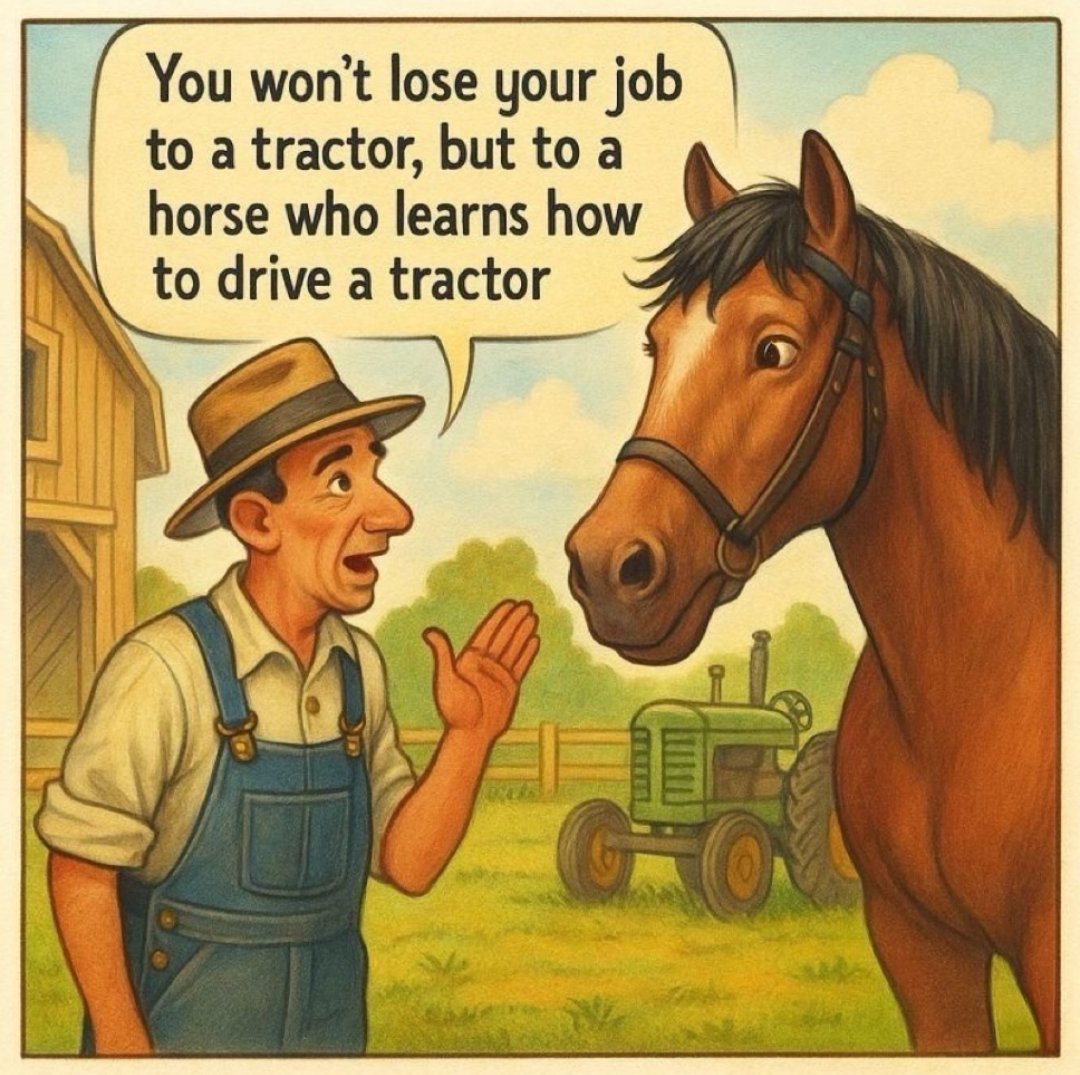
The overarching problem in the piece is the so-called “Horse Fallacy.” When the tractor and car were invented, the horse couldn’t get a better job. He became completely obsolete. But humans are not horses.
Horses simply supplied labor. They never demanded much beyond food. Humans, though, are the origin of all economic demand. The whole point of the economy is to satisfy human desires.
The lump of labor fallacy assumes that humans have a fixed checklist of problems to solve. But every time technology checks an item off the list, we invent another desire. Human desires are infinite.
Maybe if AI does all the work here on earth, we'll terraform Mars, build O’Neill cylinders, and Dyson spheres. We’ll certainly not sit idle, desiring nothing more.
As long as human desire is infinite, demand for work will be infinite.
There’s an additional point on jobs: there are some jobs that will ALWAYS be done by humans. One example is sports. Your iPhone can beat Magnus Carlsen in chess but nobody cares, they want to watch humans playing chess, so chess today is a bigger sport than ever. One day robots will skate better than Alysa Liu but nobody will care, they’ll want to watch Alysa instead.
Citrini models incomes collapsing but doesn’t model the massive deflation in the cost of living. If AI makes all these white collar workers unnecessary, this means that the price of products and services will be much lower (since much less labor is needed). You’d have a scenario where a household earning $40k per year could consume what previously took $120k per year.
And there’s all this mysterious wealth accumulated by the owners of the GPUs and what are they spending it on? How can there simultaneously be massive wealth and mass layoffs? Will there be new jobs invented? Quite likely. This has been the pattern over the last 200 years: technological revolutions → deflation → demand for new things → new jobs get created. Because humans have infinite desires.
The piece assumes that the hundreds of billions of capex go into a black hole and vanish from the real economy. In reality, it is highly stimulative as all the money ends up with many white collar workers at fabs, utility companies, cooling system manufacturers, as well as with blue collar workers.
On SaaS, Citrini could have picked a long tail of point solutions that are easily vibe-codable, but they ironically instead picked one of the widest moat enterprise software companies, ServiceNow, which is in fact an AI beneficiary. Their point is: even this impossible-to-displace business won’t survive.
True if you wave a magic wand, but not true in the real world where, after 20 years of cloud computing, companies are still running mainframes and IBM is still growing their mainframe installed base (yes, look it up). Of course, part of the magic wand is “this time is different!” because AI will do absolutely everything.
It will vibe code the product, talk to regulators, obtain SOC2, HIPAA, FedRAMP, GDPR compliance, and do this globally too, not just in the US; it’ll somehow suck all the embedded data in these systems (ServiceNow owns the Configuration Management Database with a map of all the hardware, software, user hierarchies, permissions, and workflows inside an enterprise).
More fantastically, AI will also somehow vibe code B2B enterprise go to market teams. The reality is that software is sold, not bought. At the extreme, the article is arguing that someone at PepsiCo will open the Terminal on their Mac Mini, type “Claude,” ask it to replace ServiceNow, and Claude will go to work, doing all this work autonomously, and then maintaining itself, patching itself, securing itself, talking to users inside PepsiCo to ask for new features to develop, integrate with 200+ other tools, etc.
Meanwhile, the CTO at PepsiCo is like, “Yeah, cool, let’s do that, it’ll save us millions a year” while ignoring that any downtime or bug will cost the company millions per minute. All that operational liability, SLAs, uptime figures, which used to be ServiceNow’s liability, PepsiCo will now take on itself. Simultaneously, the thousands of engineers working at ServiceNow’s R&D department are sitting idle and not using AI to accelerate their own roadmaps and build new features.
When you start really filling in the details of what needs to happen for this scenario to unfold, you realize it crumbles very quickly.
Hopefully the discussion above on infinite human needs puts to bed the “seat count” debate: there will be more seats because there will be more employment because of the infinity of human desires.
Meanwhile, ServiceNow has been charging a hybrid seat/consumption model since about 2023 when it introduced its Pro Plus SKU. These AI agents are tackling human labor, both work that was already done and new work that was never done. The TAM for this is orders of magnitude greater than the TAM for pure seat-based software.
ServiceNow will get its fair share of this new TAM because it already has the customer relationships, distribution, brand, trust, technology, and product.
To quote François Chollet: “The maximalist form of my thesis is basically this: SaaS is not about code, it is about solving a problem customers have and selling them the solution. Services + sales. If the cost of code goes to *zero*, SaaS will *not* go away. It will *benefit*, since code is a cost center.”
To expand on this, the more likely scenario is NOT that the price of software collapses; it’s that incumbents offer their customers so much more value within the existing seat price they already pay, it becomes financially irresponsible for the customer NOT to be a subscriber. This will INCREASE their incumbency.
This has already been the SaaS playbook for decades. Decades during which the cost of producing software has always gone down (more open source options and cloud computing, to name just two inputs, have dramatically lowered the cost of entry for newcomers; and yet, the per seat price of the best SaaS companies has only gone in one direction).
Every SaaS company worth its salt is always improving its products, adding features, fixing bugs, and shipping updates. Many will do this for several years before changing pricing. Pricing is an output: are we delivering enough value to the customer that gives us the permission to charge more?
With the deflation in the cost of producing software, a couple of things should happen:
- Existing software companies will be a lot more productive and will ship a lot more products and features than before
- Because they own the customer relationships and customer trust, they are in pole position to deliver new solutions and make their seat subscription ever more compelling
- Customers of those software companies will get a lot more value within their per-seat price and increase their reliance and trust on the best vendors
The debate in tech is always, “Can the innovator get the distribution before the incumbent gets the innovation?” In this case, there is no question: the BEST incumbents already have the distribution AND the innovation. This allows them to widen their moats as they become even more essential and irreplaceable to their customers.
Another mental model missing from this debate is power laws. Outcomes in the real world follow power laws: 20% of the people make 80% of the income, 4% of stocks generate all the net wealth, 10% of YouTube videos generate 90% of watched hours, etc.
Power laws will continue to dominate and what does this tell us? That the most likely outcome is that the gains will accrue disproportionately to a small cohort of top software businesses. This is another framing of the “Increasing Returns” mental model of Brian Arthur.
Personally, I believe that ServiceNow will be one of those power law winners. After all, they already are a winner in the power law distribution and have all the attributes necessary to continue winning.
Dileep walked free today.
The legal case will continue.
But let’s take a moment to sink this day. These eight years ushered in a cultural reset that cannot be reversed by any court decision.
The legal case itself made abstractions like patriarchy and power structures suddenly acquire physical weight, became things you could point to, document, fight in a courtroom.
But the case’s true significance lies in how it equipped a Malayali to hold powerful men accountable, how male impunity became slightly less absolute, how silence became slightly less obligatory.
When the survivor filed her complaint on that February night in 2017, she couldn’t have known she was tipping the first domino in a sequence that would topple structures standing for decades. The crime itself—abduction and sexual assault in a moving car, recorded by the perpetrator—was horrific enough. But the complaint’s filing set off a chain reaction that would dismantle the Malayalam film industry’s carefully maintained architecture of silence.
Something changed in how Malayalis talk about gender and cinema. Before this case, discussions of “casting couch” culture existed in whispered rumors, blind items, and knowing jokes. After 2017, these conversations moved to op-eds in major newspapers, prime-time news debates, social media discourse with real names attached.
Young women I’ve interviewed for various stories now reference post-actress assault case as a temporal marker, a before-and-after in their consciousness about gender dynamics in Kerala. They can’t point to what changed exactly, but they know something did.
Kerala’s film industry long maintained a self-image as somehow more progressive, more artistic, less crass than Bollywood or South Indian commercial cinema. The WCC’s formation and the testimonies that emerged shattered this exceptionalism. Malayalam cinema was revealed to be just as patriarchal, just as structurally violent toward women, just as invested in protecting powerful men.
This loss of innocence punctured collective myth-making.
The survivor’s decision to continue her career, to be photographed smiling at events, to do romantic scenes, challenged Kerala’s narrow conception of how assault survivors should behave. She didn’t subscribe to visible suffering, withdrawal from public life or performance of permanent trauma.
Her refusal of that script didn’t just help her personally; it expanded imaginative space for other survivors. The idea that you can be assaulted and still be sexual, ambitious, glamorous, professionally successful. This cognitive shift ripples outward in ways impossible to quantify.
The Women in Cinema Collective didn’t exist before May 2017. Now it does with office space, regular meetings, official spokespeople, institutional memory. You can attend their press conferences, read their statements, trace their interventions.
The Hema Committee Report didn’t exist before 2017. Now there’s a 235-page government document sitting in archives, cited in academic papers, referenced in parliamentary debates. 30+ FIRs were filed.
A.M.M.A’s entire leadership went into resignation, leaving a vacuum that forces institutional restructuring. These are concrete institutional realities that exist independently of how anyone feels about today’s verdict.
Then there are things you can feel but can’t put a finger on. On film sets, a moment of calculation exists now before certain jokes get told, before certain demands get made, before power gets exercised in certain ways.
It’s not that harassment stopped. It’s not that power dynamics disappeared. It’s that there’s a new variable in the risk calculation: Could this get documented in ways that damage me even if I’m never convicted?
Tired of wasting money while scaling your Meta ads?
You need a methodical scaling strategy.
I’ve created a blueprint that breaks down exactly how to scale efficiently and effectively on Meta Ads.
Want to grab it?
RT & Comment "Scale", and I’ll send it to you right away.
I built this AI marketing agent to run my entire $100K media company...
(and I’m nuts for open-sourcing it)
4 months of prompting and integrations to create an agent that replaced my entire content team
How it works (the magic):
→ scrapes Reddit, HN, X, Google News → ships a Morning-Brew-style daily AI newsletter (10 k daily readers)
→ repurposes that content into viral Twitter threads (like this one), viral short form videos (for TikTok / IG), Reddit posts, and hooky LinkedIn updates
→ prints viral content that has generated millions of impressions
→ creates custom brand-aligned images for any unique piece of content
all this is powered through voice commands with ElevenLabs + n8n integration (see video below)
no manual content creation
no team management overhead
runs while I sleep
Want the full system + setup guide?
1. Comment 'AGENT' below
2. Retweet
3. Follow me
and I'll send it over (must be following so I can DM)
Hitting your first $100K in business is brutal.
The doubts never stop:
→ “Is my offer strong enough?”
→ “Am I priced right?”
→ “Why is client acquisition so damn hard?”
Every founder I’ve coached has hit these same roadblocks.
And the difference between those who break through and those who stay stuck?
They get the right answers—from someone who’s already done it.
That’s why I’m giving away a recording of one of my private coaching calls.
Here’s what it covers:
→ How to structure your offer so it actually sells
→ The acquisition systems that book calls on repeat
→ Mindset shifts every founder needs at $0–100K
→ Retention strategies to keep clients long-term
This isn’t just random training.
It’s built from:
- 8 years scaling businesses to 7+ figures
- 5,000+ clients coached
- My own journey to multi-6 and 7 figures
- The exact answers I give founders pushing for their first $100K
You just need to listen, apply, and execute.
Want it? (HAVE TO DO ALL STEPS)
1. Comment “100K”
2. Repost
3. Like the post
No fluff. No filler. Just real answers to help you break through.
(P.S. Only available for a few days, then it’s gone.)
Built an AI Ad Factory that generated $14,000 in 30 days - fully automated.
It creates:
~100+ ad variations weekly
~Repeats top performers
~Works from just 1 click
I’m giving away the full system FREE (for 24 hrs)
RT , Like, Comment “Send” to get it (must be the following)
Just built a lead generation army that uses 10 scrapers to capture unlimited leads from any source.
Sold the setup for $5,000 + $1,200/mo retainer.
Here's what this beast does:
– Scrapes Apollo, Google Maps, LinkedIn posts and more automatically
– Enriches every lead with LinkedIn profiles and company data
– Verifies emails before you send (saves your domain reputation)
– Pulls social media profiles for complete lead intelligence
– Writes detailed contact summaries for personalized outreach
– Organizes everything in one master Airtable database
– Uses 10 different scrapers
– Modular system: choose which enrichment you want per lead
Perfect for businesses drowning in manual prospecting who want unlimited verified leads with full context.
Built it in N8N + Airtable + 10 Apify scrapers: complete lead intelligence from collection to outreach-ready.
Like + RT + Comment "LEADS"
I'll DM you the entire lead generation system
(Must be following)