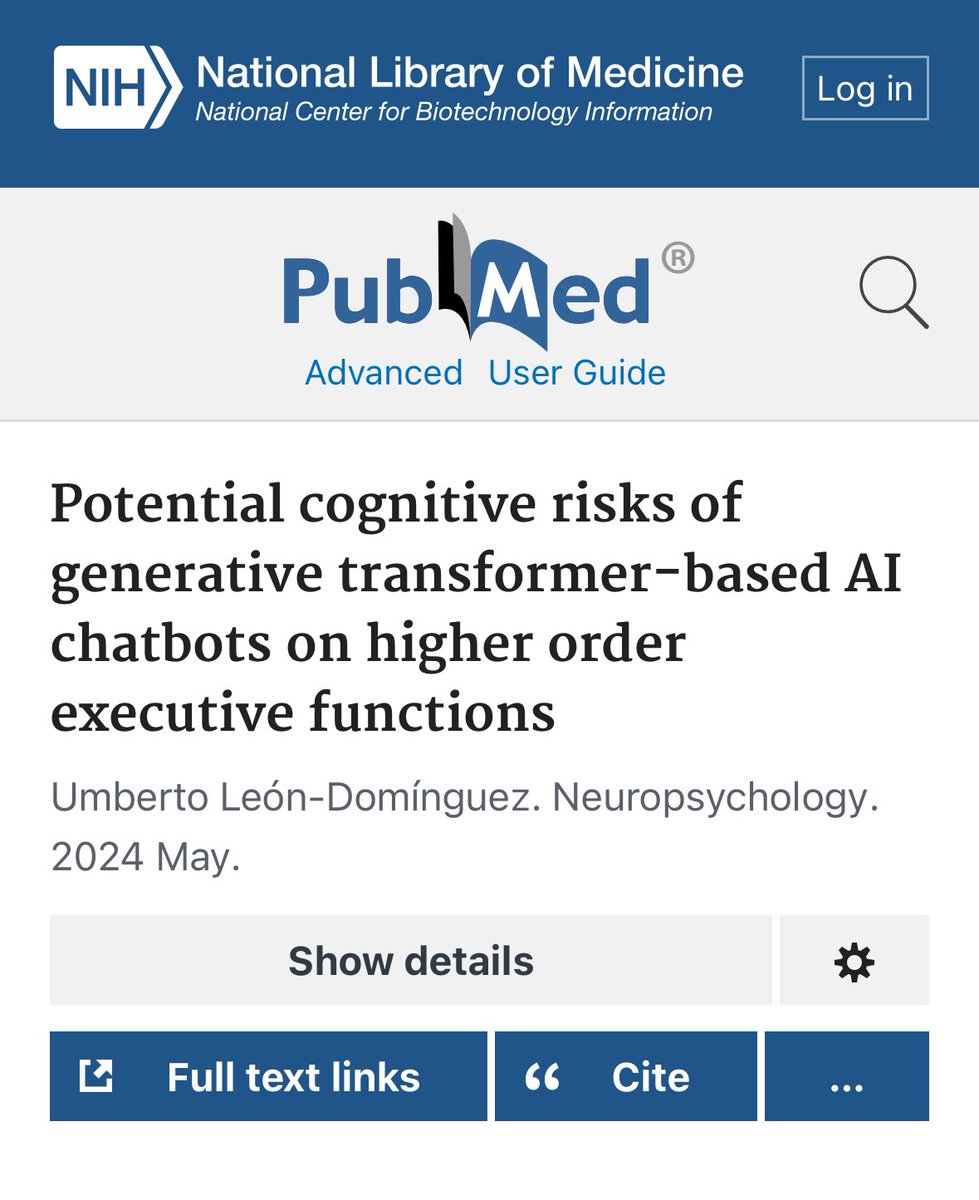
No hace mucho leía como los modelos animales fallaban estrepitosamente al intentar replicar sus éxitos en humanos, y le daba un poco de caña a Skinner y su método inductivo
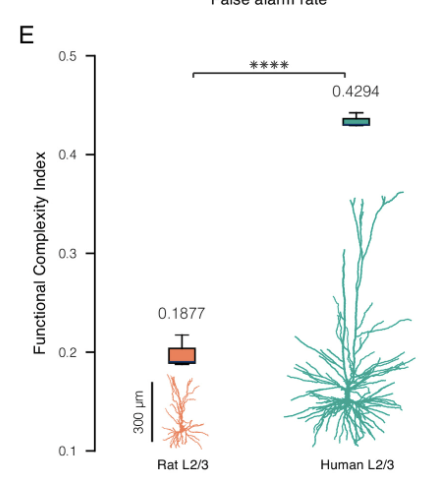
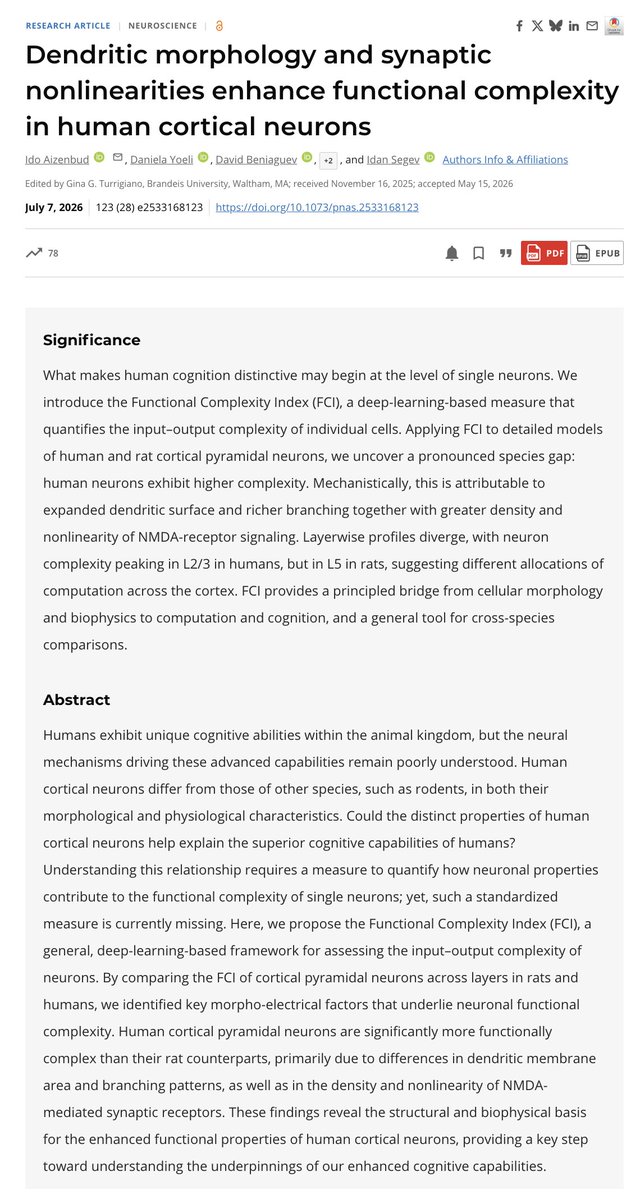
Pues este maravilloso artículo muestra experimentalmente que la potencia de computo de las neuronas humanas y de las ratas no son las mismas
En concreto, esto ocurre debido a una combinación de una morfología dendrítica más extensa en los humanos y una integración sináptica no lineal, lo que nos permite realizar un procesamiento de información más sofisticado
Resumo el paper en preguntas:
Cuál es la diferencia principal?
Las neuronas humanas tienen un árbol dendrítico más grande y ramificado, lo que incrementa su capacidad para integrar y procesar señales
Rol del NMDA? (un receptor de glutamato que permite una integración sináptica no lineal)
Los receptores NMDA en neuronas humanas presentan una respuesta más intensa y no lineal, favoreciendo cálculos más complejos a nivel dendrítico
Capas corticales?
En humanos, la mayor complejidad funcional se encuentra en las neuronas de las capas II/III, mientras que en las ratas predomina en la capa V, lo que sugiere una organización distinta de la computación cortical entre ambas especies
De dónde surge la complejidad?
Surge de la interacción entre una morfología dendrítica más elaborada (mayor superficie y ramificación) y propiedades sinápticas no lineales mediadas por los receptores NMDA
Metodología?
Esta me gusta, los autores desarrollaron el Functional Complexity Index (FCI), una métrica que cuantifica la complejidad funcional de una neurona a partir de la dificultad que tiene una red neuronal artificial para reproducir su relación entre entradas sinápticas y salida eléctrica
Y nada, una vez más... las leyes de skinner están muy bien como building blocks, pero no para explicar la conducta compleja de los humanos, ya que el tejido nervioso que las produce es muuuuy diferente...
Lashley estaría orgulloso de este experimento! jejejejeje
https://t.co/VLAdFbmgmc
Hay una máxima china recurrente que viene al caso: “Los antiguos hablaban poco por temor a que sus actos no fueran coherentes con sus palabras”.
"La gobernanza global en modo China".
Xulio Ríos para CTXT
https://t.co/8m2DerA6Ng
🔴 Francia carga contra Rajoy por afirmar que su selección tiene "un altísimo nivel, eso sí, sin franceses". El ministro del Interior califica sus palabras de "absolutamente inaceptables", mientras dos ministras piden incluso acciones legales https://t.co/b77ZmKreXk
Die ersten 30 Minuten 👇 Vorlesungsgesprächs zu Einsteins Relativitätstheorie sind didaktisch wirklich brillant und man kann sie nur jedem empfehlen, der die Allgemeine Relativitätstheorie eher intuitiv verstehen will. 1/10
Stanford computer science professor just revealed how to master Markov Decision Processes.
83-minutes. free. By Stanford.
here's what they cover:
• search problems vs. stochastic environments
• policy evaluation & q-value recurrence math
• value iteration loop engineering
• convergence limits under a cyclic graphs
Bookmark & watch today. Then read the article below.
Software runs quadrillions of simulations to uncover 300 GW on the US power grid | Georgina Jedikovska, Interesting Engineering
The software could cut years from clean energy interconnection wait times.
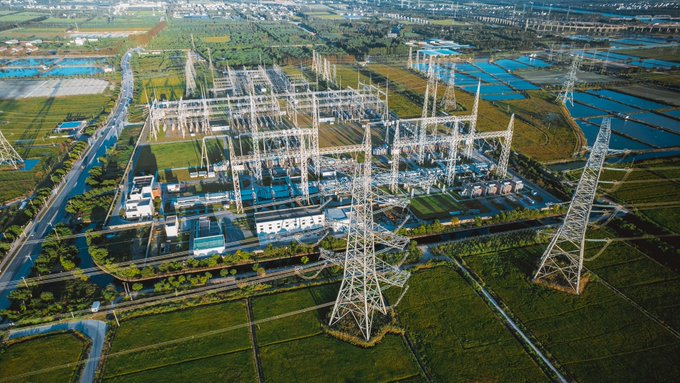
A new software could unlock about 300-gigawatts (GW) of hidden capacity on the US power grid and ease one of clean energy’s biggest obstacles, without building any new power plants.
The technology was highlighted in the latest “Energy Empire” podcast, hosted by Jigar Shah, a US entrepreneur, and former US Department of Energy (DOE) Loan Programs Office director. The show explores how abundant, affordable energy is transforming the global economy.
The platform uses advanced grid modelling to track unused transmission capacity that has remained inaccessible with traditional planning methods. Amit Narayan, GridCARE founder and CEO, stressed that it could unlock roughly 300 gigawatts of capacity across the existing US transmission network within the next three to five years.
Instead of using costly new transmission lines or even substations, the software analyzes how the grid actually operates. This allows utilities to make better use of infrastructure already in place.
Unlocking hidden capacity
The US power grid has historically been planned using conservative assumptions that prepare for multiple equipment failures occurring at the same time. This has left large portions of the network underused for most of the year.
At the same time, while electricity demand is growing again, grid upgrades may not keep pace before 2030. Bank of America data showed that the nation could face a 100 GW power shortfall by 2030. Analysts estimate at least 230 GW of new power demand between 2026 and 2030, while utilities add just 93 GW of supply.
According to the US Energy Information Administration, electricity demand has grown 2.1 percent annually over the past five years and will keep rising through 2050, driven largely by data centers.
To address the challenge, GridCARE, a California-based startup founded in 2024 has deployed its advanced physics-based AI platform called Energize, to identify hidden or latent capacity on existing power grids. This could help AI data centers to secure and activate power in months rather than years.
The software evaluates millions of potential operating conditions in order to find the limited periods when transmission constraints actually occur. Utilities can then connect new resources using flexible operating agreements or battery storage to manage those rare congestion events.
Solving grid bottlenecks
GridCARE said its software could speed up connections for solar, batteries, and large power users without years of new infrastructure work. It is already being tested by several utilities.
According to the company, National Grid found more than 650 megawatts (MW) of previously unavailable capacity using the technology. Portland General Electric reportedly unlocked over 400 MW of additional capacity in Hillsboro, Oregon. It allowed six planned data centers to connect years earlier than expected.
Meanwhile, according to PV Magazine, an AI system at the nation’s largest grid operator, PJM Interconnection, reviewed 811 generation applications totaling 220 GW in less than an hour, instead of weeks.
The system, however, is not intended to replace new transmission infrastructure. It is a way to maximize the value of the grid that already exists, while long-term expansion projects move forwards.
Moreover, the approach could also lower electricity costs by allowing more power to flow across existing transmission assets. It will spread infrastructure costs over a larger volume of electricity.
https://t.co/F6wY7UFU6Z
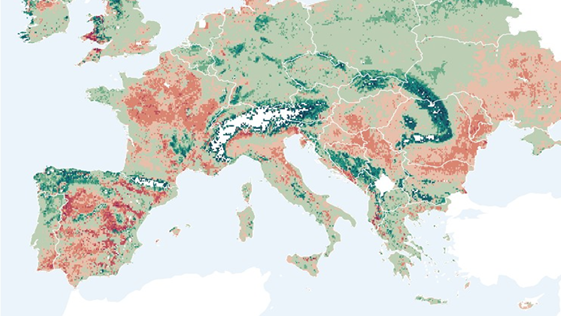
🥬 1 de cada 6 cultivos del mundo pierde productividad por el cambio climático.
🗓️ La plataforma CADI del IAE-CSIC anticipa ese cambio hasta finales de siglo
🚜 En España, gran parte del interior y del centro-este peninsular perderán productividad
👉 https://t.co/ICT845bZZY
inspired by tiny GPU @MajmudarAdam and tiny TPU @suryasure05 .
The idea was for me to learn by imitating an Nvidia GPU as closely as possible.
Created a blogpost on how AI models run on hardware with my learnings: https://t.co/GOZKp6ompv
Sí, y en mi artículo te digo exactamente el proceso neuropsicológico que substituye y que es la base de no volvernos estúpidos:
La representación del problema.
https://t.co/crV9cdFOnZ
Various layouts can illustrate how elements connect and relate.
Arc diagrams curve their links, area groupings use shading for clusters, and centralized designs radiate from a core with bursts or rings.
Globe and circular styles wrap connections in rounded forms while organic and ramified ones mimic natural branching.
Radial patterns draw lines inward or outward, flow uses sweeping curves, and spheres tangle lines in three dimensions.
Scaling and segmented versions adjust size and division for emphasis.
These layouts are used to chart relationships in social media or biological networks.
Artículo de@Nature analiza cómo la inteligencia artificial impulsa los descubrimientos en la física y las matemáticas No sustituye la intuición humana o disminuye no la creatividad, transforma las preguntas, reimaginando la exploración científica https://t.co/gPZ9XLQWJj
Want to learn Physics from first principles?
Start with these FREE online resources:
🌍 Physics Hypertextbook — https://t.co/B1tKUCcjHf
One of the best free references covering mechanics, thermodynamics, waves, optics, electricity & magnetism, modern physics, and more. Perfect for self-learners.
📘 MIT OpenCourseWare — https://t.co/eL1teze5Gf
Full university-level physics courses with lecture notes, assignments, and exams.
🎥 Khan Academy Physics — https://t.co/aSgAfpHwjw
📚 The Physics Classroom — https://t.co/Lps3kQYsrg
Interactive tutorials, concept builders, practice questions, and simulations.
🧮 HyperPhysics — https://t.co/K8k18ala9o
🎬 Lectures
• Walter Lewin (MIT) — https://t.co/54wlL4GNxM
• MIT OpenCourseWare — https://t.co/FFfCb53Xwh
🧪 Simulations
• PhET Interactive Simulations — https://t.co/kdWeRfPPQV
📖 Advanced Reading
• Feynman Lectures on Physics — https://t.co/NueTTpRTFi
Persi Diaconis, Stanford mathematician and former professional magician:
"I've spent my life on two tricks: making a rigged deck look random, and making a random one look rigged. The market is the first trick, and almost nobody catches it."
this free lecture asks one question, does anything happen at random, and the answer is: far less than you think. and the man asking isn't a trader. he's a stanford professor and former professional magician who spent his life proving how badly humans read randomness.
the market is his first trick in the wild. it looks like pure chance, yet buried inside is a faint rig, a 50.75% tilt no eye can see. your gut reads a losing week as a broken system and a hot streak as skill, and it's wrong both times. the tilt is invisible to human intuition, which is exactly why funds hand the decision to the math.
none of it is hidden. diaconis has taught it for decades, the probability goes back to 1713, and the lecture is free. same point the thread makes: the 50.75% is real, but it lives inside noise your gut will always misread.
here is the trap. you feel every win and every loss, but you cannot feel the average, and the average is the only thing that pays. it takes thousands of trades for a 51% edge to separate from luck, and almost everyone quits long before then. the math is free. the patience to trust it past your own eyes is the edge.
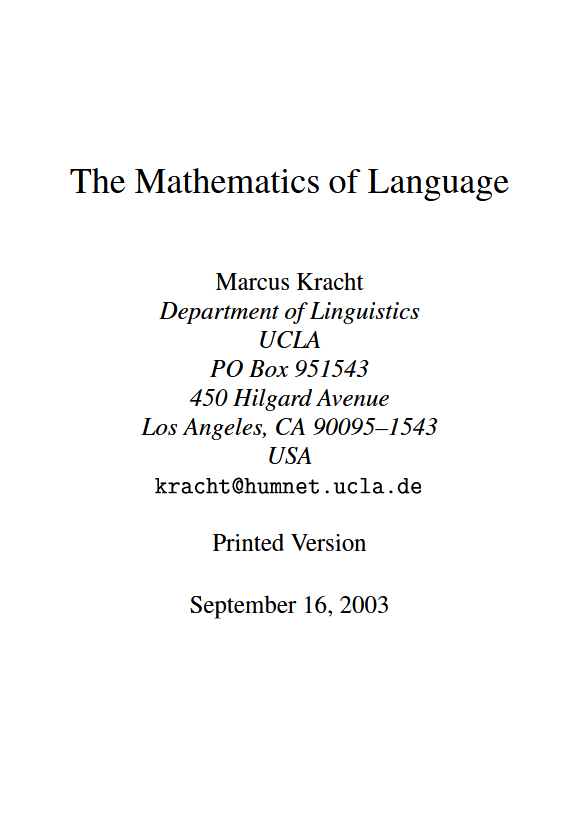
I was looking for a mathematical study of language and found this very interesting and publicly available introduction to 'The Mathematics of Language' by Marcus Kracht, on UCLA's website!
This is not a primer, but a full text book, for which the technical level surprised me! This also not an introduction to linguistics, and the author presumes a strong foundation in basic mathematics.
The book covers a lot of topics from abstract algebra, universal algebra, meta-mathematics, semigroups, trees, recursion theory and much, much more! Omitted are topics found in statistics and probability theory.
Mathematicians, computer scientists, linguists and student of computational linguistics will find value in this great text!
PS: No link provided, since it is made public by the university, but a quick search will lead you to this gem!