@sawinerywoodwrk In this situation I step out of line with the blade, in case the piece gets thrown, and turn of the saw and let in spin down on its own.
Today, we honor every American who has worn the uniform. To our veterans, thank you for answering the call and for the sacrifices you and your families have made. We will never forget. Add your hero to our Honor Roll: https://t.co/7VPMLgbF6O #VeteransDay#Veterans
Look at these two Navy fighters off Hawaii in 1942.
The man in front solved one of the Navy's biggest problems with a box of kitchen matches.
His wife used to come to the table at midnight and tell him to get some sleep.
Months later, over Midway, he found out if his idea would work.
This is the story of the Thach Weave..🧵1/5
My wife has taught high school in Tokyo for twenty years.
Every year, a few of her students spend a year living with a family in America. When they come home, she asks each of them one question.
"What do you miss?"
She expects hamburgers.
She almost never gets hamburgers.
And these aren't old stories. Most of these kids came home in the last two years.
"Every time I left the house, my host mom said, 'Text me when you get there.' In Japan, nobody needs to know where I am. In Ohio, somebody always did." (Mina, 17, Ohio)
"If you walk toward a door, an American will hold it open. Even if you are very far away. So you have to run. I ran to so many doors." (Itsuki, 16, Georgia)
"My host brother screamed on the floor of a grocery store. A stranger walked by and said to my host mom, 'You're doing great, Mama.' She almost cried. I didn't know strangers were allowed to say that." (Aoi, 17, Texas)
"We went away for the weekend and left our trash can at the curb. When we got back, it was by the garage. Nobody said who. My host dad said if it had been there one more day, the neighbor would have knocked." (Haruto, 16, Minnesota)
"A car got stuck in the snow in front of our house. Four men came out of four houses. Nobody called them. They pushed, the car drove away, and they went back inside without saying their names." (Ren, 17, Michigan)
"Every American has jumper cables. Maybe half of them know which clip goes where. The other half help anyway." (Shin, 16, Montana)
"In July, my host family put a cooler on the porch. Cold water, snacks, and a sign: 'For our delivery drivers. Thank you!' I asked if they knew the drivers. They said no." (Nanami, 16, Arizona)
"Downtown, there are banners on the lampposts. Photos of soldiers from the town. Some old, some very young. My host grandpa walked me down the street and told me every name." (Yuna, 16, Iowa)
"I got a C-plus on my first test. My host dad said, 'I'm proud of you,' and put it on the fridge. In Japan, nobody is proud of a C-plus." (Takeru, 17, Pennsylvania)
Then the quietest girl in the class raised her hand.
Sora. Seventeen. Missouri.
"Nobody asks me 'home safe?' anymore," she said.
She was wrong.
In September, there was a typhoon warning for Tokyo. At 2 a.m., Sora's phone lit up.
It was her host mom. In Missouri. Watching the weather in a country she had never been to.
"Saw the storm. You home safe?"
Sora told my wife she cried for a long time. Then she typed the answer she had typed a hundred times, from football games and friends' driveways.
"Home safe."
Her host mom wrote back one line.
"Good. That's all I needed."
My wife has asked that question for twenty years. Not one kid has ever said they missed how big America is.
They miss how America says goodbye. And how it checks that you got home.
So, America. You think you've lost something.
You haven't. It's on a porch in Arizona. It's pushing a car in Michigan. It's awake at 2 a.m. in Missouri, watching our weather.
You don't remember doing any of it.
A kid in Tokyo will never forget.
@AJamesMcCarthy City and county where I live require a "peddlers permit" to sell door to door. I just ask to see their peddlers permit and they leave quickly pretty much every
My scary classroom social experiment demonstrating how tyrannies arise from democracies:
I gave a bunch of extra credit tickets to the first few students to arrive in class, then everyone else received 1-2 tickets.
The kids that came into class last were outraged by the “injustice” of those that came first getting a greater reward.
There were no rules or directions for this day in class. I just told them I’d act as an enforcer of whatever they decided to do in the 47 minutes.
The girl circled in red- Emily- was a genius.
She used her charisma and charm to court the majority of her peers that had less coupons, and played off their resentment of the minority that had earned more tickets for arriving to class early.
In the allotted time she convinced her peers that if they voted to give her absolute power, she would confiscate the 40+ coupons held by the minority and distribute them equally.
The minority of students were frustrated, but powerless against the majority vote.
Emily was elected to a “supreme ruler” position, and as promised she confiscated all of the tickets from the minority of students that arrived to class first.
That’s when things got interesting.
She kept the vast majority of tickets for herself, and distributed a few to some of her friends.
It was a microcosm of what has happened historically time and time again, and the danger our republic faces.
I asked the students to write a reflection on how they now viewed unrestrained majority-rules democracy, and their opinions has definitely changed from the day prior.
She was 24, from Virginia, teaching English to kids in a fishing town in Japan.
March 11, 2011. The ground shook for minutes. Taylor Anderson stayed at the school until every child had been handed to a parent.
Then she got on her bicycle and headed home.
The wave took her on the way.
That could have been the end of it. An American family buries a daughter and never wants to hear the name of that town again.
Her parents did the opposite.
They started a fund in her name and sent it back to the schools where she taught. Books she loved as a kid. A shelf to hold them. Each one is called Taylor's Reading Corner.
They needed someone to build the shelves.
A local woodworker took the job. Shinichi Endo. He had lost all three of his children to the same wave. Two of them had been Taylor's students.
So a father in Japan who lost his children builds bookshelves for a father in America who lost his daughter.
There are more than twenty of them now.
Kids who were not born in 2011 sit down in front of those shelves and pull out a book an American girl once loved.
A retired NASA engineer who had worked on the Space Shuttle program for 25 years was hired by SpaceX at age 62. He described the first week as the most disorienting experience of his professional life.
At NASA, a design change required 3 meetings, 2 committees, a review board, and 6 to 18 months of documentation. At SpaceX, his new supervisor said "if it works, build it. If it doesn't, change it by Friday."
He sat at his desk after the first day and called his wife. He told her he felt like a man who had been swimming with ankle weights for 25 years and someone just cut them off. He could move. He could decide. He could build something in the morning and test it in the afternoon. The constraint that he had accepted as the nature of aerospace engineering turned out to be the nature of bureaucracy.
Within 6 months he had contributed to more design iterations than he had completed in his last 5 years at NASA. Not because he was working harder. Because the time between having an idea and testing the idea collapsed from months to hours. The same brain. The same knowledge. A different operating system.
He described a specific moment where he proposed a modification to a Raptor engine component. At NASA, the proposal would have entered a queue. At SpaceX, the modification was machined by the end of the day and tested by the following morning. He watched his idea become a physical object in 18 hours. At NASA, 18 hours would not have been enough to schedule the first meeting to discuss whether to schedule a meeting.
He told an interviewer: "I didn't get smarter when I went to SpaceX. I got faster. The intelligence was always there. The system was in the way."
The difference between SpaceX and NASA is not talent. NASA has extraordinary talent. The difference is the time between a thought and a test. SpaceX compresses it. NASA elongates it. The same engineer produces 10x more at SpaceX than at NASA because the bottleneck was never the engineer. It was the meetings about the meetings about the work.
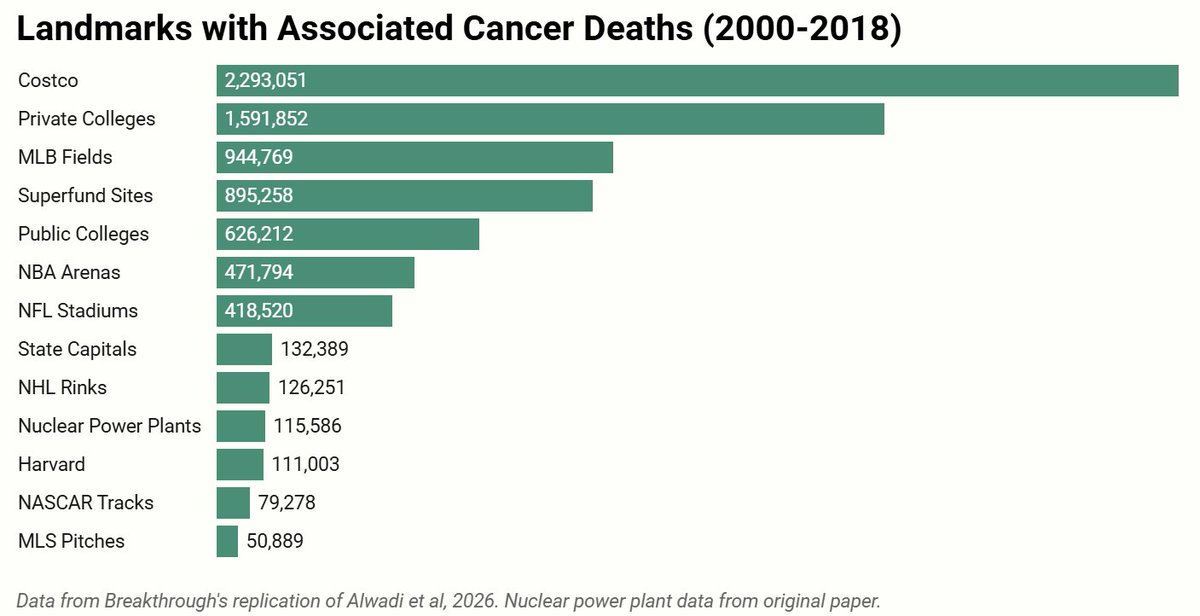
A recent series of papers suggested that nuclear power plants are responsible for more than 100 thousand cancers. Using their method, every landmark we tested causes cancer,