It's important to learn math not because you may need to do long division as an adult, but because it promotes rigorous thinking. IMO, history and causal inference are among the most important subjects a young person can study — math being central to the second.
A significant problem in public discourse right now is people's inability to critically evaluate causal claims (e.g., vaccines cause autism, deporting immigrants will solve the housing crisis, etc.). The less able people are to critically evaluate causal claims, the worse our democracy functions because people can be preyed upon for votes. You should promote anything that improves rigorous thinking, even if it doesn't have market value. In fact, we should stop thinking of education only in the context of what improves the economy.
IMO, this is distinct from knowing your own address (which Huang can avoid because he's wealthy). Memorizing facts like this may or may not be important, but it's distinct from rigorous thinking.
@kupczins@Mopsimcsgo@cwiakala Może w jakiś skrajnych przypadkach (bardzo małe miejscowości), ale generalnie jest to popyt wymuszony sytuacja materialną lub życiową. Po prostu tego typu mieszkania wypełniają niszę rynkową. Wiadomo, że każdy woli mieszkać w jak największym mieszkanie, ale nie każdego stać
@Peter8FL@plangier Dokładnie, jest bardzo duży popyt, więc cena może być wysoka. I to jest moim zdaniem ok, oglądanie meczu MŚ na żywo jest niewątpliwie luksusową zachcianką. Sztucznie zaniżanie ceny nic nie da, bo każdy wie, że można na tym zarobić.
@RozekTom Niezły populizm. Jak ktoś ma coś "krytycznie analizować" bez chociażby podstawowej wiedzy z kilku dziedzin nauki? Jak stwierdzić, czy coś jest nieprawdą/manipulacją albo zrozumieć bardziej zaawansowane koncepty bez fundamentalnej wiedzy?
Sytuacja z kontrolerką skarbową pokazuje jedną rzecz bardzo wyraźnie: Polacy lubią śmiać się z tego, że „państwo nie działa”, ale jednocześnie mamy narodowy fetysz obchodzenia prawa.
Ta sama zasada co z cwaniactwem drogowym - służby mają w dupie nielegalne parkowanie czy jeżdżenie po chodnikach, a najwyższy wymiar kary to pouczenie.
No to znajdzie się grupa ludzi, która wysra się na normy społeczne i będzie cwaniaczyć, bo im tak wygodnie.
Potem cały proceder stopniowo się normalizuje, aż dochodzimy do momentu, w którym celebrytki wzywają policję, bo ktoś zwrócił im uwagę, że zaparkowały tam, gdzie nie wolno.
I tak samo jest tutaj - afera na cały kraj, bo restaurator złamał prawo, więc dostał mandat.
I kto jest winien? Nie ten, kto złamał przepisy, tylko osoba, która mandat wystawiła. Bo przecież „nic się nie stało”, „każdemu może się zdarzyć” (co w praktyce znaczy "sam tak robię") więc nie powinno się karać, tylko co najwyżej upominać.
A potem "państwo nie działa".
@FilipLamanski@yrilibek Dokładnie, rok przejścia na emeryturę może miec gigantyczny wpływ na to, jaką pulą pieniędzy będziemy dysponowac przy indywidualnym oszczędzaniu. Polecam się zapoznac z tym postem: https://t.co/EyN26OJ8mM
I am always amazed that most people saving for retirement (or designing optimal Social Security systems) rarely take sequencing risk seriously. Simply put, sequencing risk is the risk associated with the order in which returns arrive over one’s lifetime.
Sequencing risk hits you twice: while you are working and accumulating wealth, and again while you are retired and drawing it down. Today, I will focus on the first part. The retirement phase warrants its own discussion, and I will address it in a subsequent post.
Let me walk you through an exercise I ran yesterday using actual historical U.S. stock market data from the past 80 years to illustrate how important sequencing risk is.
I took the annual total returns of the S&P 500 (including reinvested dividends) from 1945 to 2024. The source is the dataset maintained by Aswath Damodaran at NYU Stern, a standard reference for long-run U.S. equity returns. I then deflated each year’s nominal return by the CPI-U inflation rate published by the Bureau of Labor Statistics to obtain real total returns, i.e., returns in constant purchasing power.
Over this 80-year period, the S&P 500 delivered a geometric mean real total return of about 7.5% per year. That is an impressive number. But this average return masks a lot.
Imagine a worker who starts investing at age 22 and retires at age 68. That gives them 46 years of contributions. In their first year, they contribute $1. Each subsequent year, they increase their contribution by 1% (roughly keeping pace with real wage growth). Every dollar is invested in the S&P 500. They never touch the money until retirement. No panic selling, no market timing, no strategy switching (and no management fees!). Textbook investing and waiting.
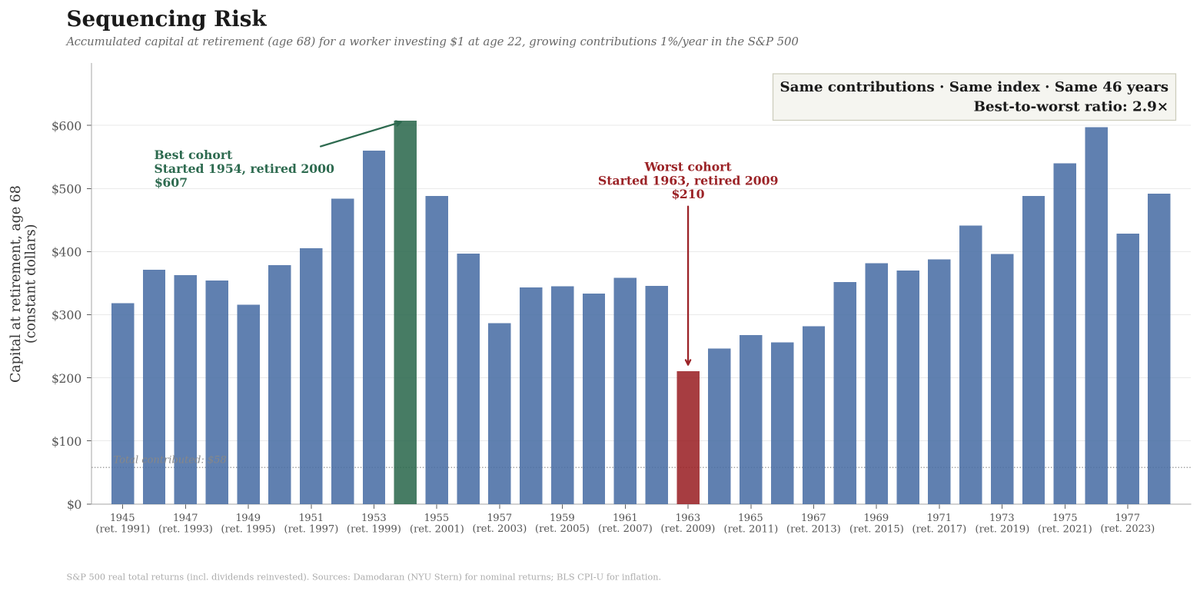
I ran this exercise for every possible cohort for which the data allow. The first cohort starts investing in 1945 and retires in 1991. The second starts in 1946 and retires in 1992. And so on, all the way to the last cohort, which starts in 1978 and retires in 2024. This yields 34 cohorts, each investing for 46 years, making the same contributions and investing in the same index. The only difference among them is which 46-year slice of historical returns they happen to live through.
The most fortunate cohort, the one that started investing in 1954 and retired in 2000, had $607 on the day of retirement (remember, all in real terms), with a real annual return of 8.82%. The unluckiest cohort, the one that started in 1963 and retired in 2009, accumulated $210, with a real annual return of 4.83%. Same contributions. Same index. Same strategy. Same investment horizon. Yet the luckiest retiree ended up with 2.9 times more wealth than the unluckiest.
Why? The 1954 cohort had a spectacular final decade. The late 1990s delivered some of the best equity returns in American history, and those returns compounded on a large portfolio built over decades. They retired at the peak, at the end of 1999, before the dot-com crash. The 1963 cohort was not so fortunate. They spent their last working years running straight into the 2008 financial crisis. The S&P 500 lost over 36% in real terms in 2008 alone. That loss hit their portfolio when it was at its largest, right before retirement, with no time left to recover.
Clearly, sequencing risk is not about the average return. Both the 1954 and 1963 cohorts experienced roughly similar average returns over their 46-year periods. The difference is when the good and bad years occurred. For the 1954 cohort, the bad years came early (when the portfolio was small) and the good years came late (when the portfolio was large). For the 1963 cohort, the opposite was true.
In fact, sequencing risk is even worse because poor returns in the stock market are correlated with weak labor markets: you have a much higher probability of losing your job (or seeing your wage income fall) precisely when the market is doing poorly, preventing you from saving when prices are low and equities are most attractive. However, let me set that point aside today to simplify the exposition.
The standard response of the financial planning industry to sequencing risk is the so-called glide path. The idea is simple: when you are young, you hold mostly equities. As you age, you gradually shift toward bonds. By the time you are near retirement, most of your portfolio is in bonds. A common implementation is a linear rule: start with 90% in stocks at age 22 and reduce the equity share steadily until you reach 20% in stocks at age 68. This is roughly what target-date retirement funds do.
The logic is sound in principle. You reduce your exposure to equities precisely when a crash would hurt you most. If 2008 happens when you are 65 and 80% of your portfolio is in bonds, the equity crash barely affects you.
I applied this glide path strategy to the same 34 cohorts, using historical real returns on the S&P 500 for the equity portion and real returns on 10-year U.S. Treasury bonds (from Damodaran) for the bond portion. Each year, the portfolio is rebalanced to the glide path weights.
The glide path does what it is intended to do: it reduces dispersion. The gap between the best and worst cohorts narrows from 2.9x under pure equities ($607 vs. $210) to 1.6x under the glide path ($292 vs. $178), but so does the upside. The best equity cohort (1954–2000) earned a geometric mean real return of 8.82% per year. The best glide path cohort (1975–2021) earned 6.59%. That is a 2.2 percentage point gap. Over 46 years of compounding, a 2.2 percentage-point annual yield yields an enormous difference in terminal wealth: the best glide-path outcome ($292) is less than half the best equity outcome ($607).
In other words, the cost of this insurance is substantial. In fact, the median cohort ends up meaningfully poorer under the glide path than under 100% equities. You are not trimming a bit of upside. You are forgoing a substantial share of your expected wealth at retirement.
This should not be surprising. Over the long run, equities have outperformed bonds by a wide margin. The equity risk premium is one of the most robust facts in finance. Every year you shift a dollar from stocks to bonds, you accept a lower expected return. Do this for 25 years of your career (roughly the back half, when the glide path has you increasingly in bonds), and the cumulative cost from foregone compounding is very large.
But the part that makes me most uncomfortable with the standard glide path advice is that bonds are not safe. People hear “bonds” and think “safe.” They are not. Bonds carry two risks that are easy to forget when inflation is low and interest rates are stable.
The first is inflation risk. A conventional bond pays you a fixed nominal coupon (yes, there are TIPS and similar instruments, but they have their own problems, so let me skip them for today). If inflation rises above the market’s expectations when the bond was issued, the real value of those payments declines. The cohorts that retired through the 1970s learned this the hard way. In the data, the real return on 10-year Treasuries was negative in multiple years during the 1970s.
The second is interest rate risk. When interest rates rise, the market value of existing bonds declines. The longer the maturity of your bond, the larger the hit. In 2022, the Bloomberg U.S. Aggregate Bond Index declined by approximately 19% in real terms. If you were 65 and had just shifted most of your portfolio into bonds following the standard glide path advice, you would have lost nearly a fifth of your “safe” allocation in a single year.
And here is the real sting of 2022: equities fell, too. The S&P 500 lost about 24.5% in real terms that year. The glide path assumes bonds will be there to cushion you when stocks fall. In 2022, both fell together. The cushion was not there. This is not some once-in-a-century event. Stocks and bonds have moved in the same direction before: the 1940s, the 1970s, and in 2022. The negative correlation between stocks and bonds that many investors take for granted is a feature of the disinflationary period from roughly 1982 to 2020. It is not a law of nature.
Let me be clear: I am not saying the glide path is wrong. For many people, it is the right choice. If a 30% equity crash near retirement would force you to sell assets at the worst possible time to cover living expenses, the insurance is worth paying for.
However, you should know what you are paying. The glide path (or variations of it that I am skipping in the interest of space) is not free. It entails substantial costs in expected returns. Worse, the insurance itself can fail. Bonds can lose money in real terms for extended periods. Bonds can fall at the same time as equities. The glide path reduces sequencing risk. It does not eliminate it. It also introduces risks of its own.
The deeper lesson from this exercise is that a substantial part of your retirement outcome depends on when you are born. You can do everything right (save diligently from your first paycheck, invest consistently, stay the course through every crash, never panic sell) and still end up with vastly different results than someone who did the same thing a decade earlier or later. The 1963 cohort did nothing wrong. They just had the misfortune of turning 68 in 2009.
No allocation strategy eliminates this. Even under the glide path, the best cohort ends up with substantially more than the worst. Sequencing risk is, to a significant extent, a matter of luck.
Next time: what happens when sequencing risk hits you in retirement, when you are drawing down instead of building up. The math there is, if anything, even more unforgiving.
@yrilibek@Krownitz Nie wiem do czego odnosi się post OP, ale ogólnie to racja, że gęsta zabudowa jest lepsza i dzięki niej miasta są miastami, w których wszyscy chcą mieszkać. Jak ktoś ma inne preferencje, to niech mieszka na wsi. Inna sprawa, że niedawno bronili RODY, więc idk 🤷♂️
Pamiętam, jak każda - nawet najdrobniejsza - wpadka językowa czy fizyczna prezydenta Bidena była przez zwolenników Donalda Trumpa traktowana jako dowód na jego demencję, słabość i niezdolność sprawowania urzędu.
Tymczasem w swej drugiej kadencji Donald Trump potrafi przeczyć sam sobie w kontekście wojny z Iranem, raz mówi, nazywa sojuszników z NATO „tchórzami”, wyśmiewa poświęcenie ich żołnierzy w poprzednich wojnach, myli Islandię z Grenlandią, twierdzi, że Chiny, największy inwestor w turbiny wiatrowe świata, nie mają farm wiatrowych i pisze, że obniży ceny leków o 1500%.
A teraz pisze, jak to cieszy się ze śmierci Roberta Muellera.
Do tego prowadzi absolutnie chaotyczną politykę celną, potrafi zwolnić szefową biura statystyk dot. zatrudnienia, bo te mu się nie podobają, a o jego wojnie w Zatoce Perskiej to szkoda nawet gadać.
I to wszystko jakoś nie budzi wątpliwości miłośników prezydenta Trumpa.
Mało tego, wielu z nich wyjaśnia, że wszystko jest w najlepszym porządku.
@mietczynski Brawo, właśnie tego oczekuję od telewizji publicznej w dzisiejszych czasach, czyli bycia stanowczą kontrą dla tępej propagandy płynącej z alternatywnych mediów. Tu nie ma przestrzeni na fasadę "bezstronności".
@AM_Zukowska@sjastrzebowski Nie chodzi o usprawiedliwianie przestępców, tylko o zapobieganie takim czynom poprzez stworzenie środowiska, które zachęca osoby z takimi zaburzeniami do sięgania po pomoc. Nie wiem, dlaczego legitymuje Pani takich trolli jak OP -- można przeczytać coś więcej niż tylko nagłówek.
@mietczynski Szczere pytanie - czemu ludzie tak bardzo nie lubią reklam AI? Przecież to nie jest tak, że ludzie w ogóle lubią reklamy, więc jak różnicę robi to, że są zrobione przy pomocy AI?
Hi. I’m Rachel.
My name is first on the website the North American far-right is using to target people they say “celebrated” Charlie Kirk’s death.
There’s just one problem: I never did that.
But the people sending me threats don’t seem to care.
Let me tell you, in my own words, what happened:
I explain how rightists justify calls for repression and violence.
1) Go to social media and find the most obscure people celebrating violence. Say that this is "the left."
2) Say "the left" wants you dead, blaming the entire Democratic Party
Literally not a single Democrat is celebrating the Kirk assassination. It's complete wishcasting on the right.
They're radicalizing their followers based on an inaccurate view of their opponents that fits with a victimization narrative. Meanwhile, the most prominent people on their side start indulging in conspiracy theories and gleefully sharing memes after Pelosi's husband is attacked in his home. The hypocrisy here is overwhelming.
They get off on the idea of "civil war" and collapse and invent the reality they want to see. They imagine Democrats are like themselves, when they're not.
Antoni Dudek: jeśli lewica chce popełnić samobójstwo, to niech siedzi w domu i nie głosuje na Trzaskowskiego. Będą mieli prezydenturę Karola Nawrockiego, a w ciągu mniej niż 2 lat rządy PiS-Konfederacja i wtedy zobaczą, czy reżim Tuska jest taki sam jak reżim PiS-Konfederacki.
NAWROCKI: wolny rynek spoko, z tą Ukrainą to teraz przesada. Braun i Mentzen nie są tacy źli
ALT-LEFT: no musi tak gadać, żeby wygrać
TRZASKOWSKI: kocham wolny rynek, lubię gejów i aborcje. Mam wspólne punkty z Mentzenem
ALT-LEFT: Perfidny libek, jak można popierać?