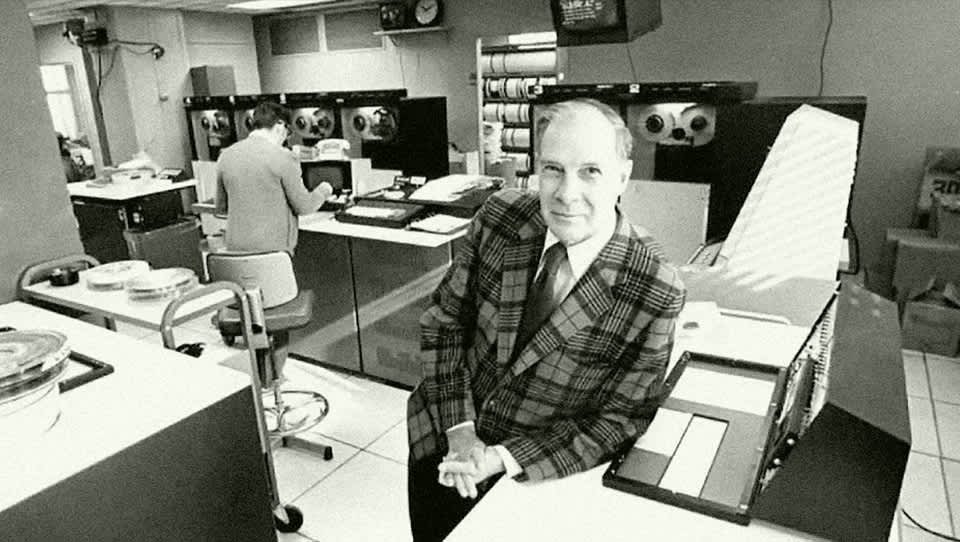
A mathematician who shared an office with Claude Shannon at Bell Labs gave one lecture in 1986 that explains why some people win Nobel Prizes and other equally smart people spend their whole lives doing forgettable work.
His name was Richard Hamming. He won the Turing Award. He invented error-correcting codes that made modern computing possible. And he spent 30 years at Bell Labs sitting in a cafeteria at lunch watching which scientists became legendary and which ones faded into nothing.
In March 1986, he walked into a Bellcore auditorium in front of 200 researchers and told them exactly what he had seen.
Here's the framework that has been quoted by every serious scientist for the last 40 years.
His opening line landed like a punch. He said most scientists he worked with at Bell Labs were just as smart as the Nobel Prize winners. Just as hardworking. Just as credentialed. And yet at the end of a 40-year career, one group had changed entire fields and the other group was forgotten by the time they retired.
He wanted to know what the difference actually was. And he said it wasn't luck. It wasn't IQ. It was a specific set of habits that almost nobody is willing to follow.
The first habit was the one that hurts the most to hear. He said most scientists deliberately avoid the most important problem in their field because the odds of failure are too high. They pick a safe adjacent problem, solve it cleanly, publish it, and move on. And because they never swing at the hard problem, they never hit it. He said if you do not work on an important problem, it is unlikely you will do important work. That is not a motivational line. That is a logical one.
The second habit was about doors. Literal doors. He noticed that the scientists at Bell Labs who kept their office doors closed got more done in the short term because they had no interruptions. But the scientists who kept their doors open got more done over a career. The open-door scientists were interrupted constantly. They also absorbed every new idea passing through the hallway. Ten years in, they were working on problems the closed-door scientists did not even know existed.
The third habit was inversion. When Bell Labs refused to give him the team of programmers he wanted, Hamming sat with the rejection for weeks. Then he flipped the question. Instead of asking for programmers to write the programs, he asked why machines could not write the programs themselves. That single inversion pushed him into the frontier of computer science. He said the pattern repeats everywhere. What looks like a defect, if you flip it correctly, becomes the exact thing that pushes you ahead of everyone else.
The fourth habit was the one that hit me the hardest. He said knowledge and productivity compound like interest. Someone who works 10 percent harder than you does not produce 10 percent more over a career. They produce twice as much. The gap doesn't add. It multiplies. And it compounds silently for years before anyone notices.
He finished the lecture with a line I have never been able to shake.
He said Pasteur's famous quote is right. Luck favors the prepared mind. But he meant it literally. You don't hope for luck. You engineer the conditions where luck can land on you. Open doors. Important problems. Inverted questions. Compounded hours. Those are not traits. Those are choices you make every single day.
The transcript has been sitting on the University of Virginia's computer science website for almost 30 years. The video is free on YouTube. Stripe Press reprinted the full lectures as a book in 2020 and Bret Victor wrote the foreword.
Hamming died in 1998. He gave his final lecture a few weeks before. He was 82.
The lecture that explains why some careers become legendary and others disappear is still free. Most people who could benefit from it will never open it.
🚨Penal Tributaria en el congreso🚨
Escribi esta nota https://t.co/yTDVAlBYuQ
Para que @DiputadosAR y @SenadoArgentina modifique el proyecto del ejecutivo para que tenga actualización automática.
El que quiera ayudar a difundir con un RT o como le parezca es bienvenido
@DanielBlancoSWE Demuestra que eres disciplinado, además, de tener ciertos conocimientos. Estoy de acuerdo que no te garantizan ningún puesto ni que seas útil en el ámbito laboral.
"Tu código es una basura y hace del mundo un lugar peor para vivir"
Imagínate que Linus te deja una review así. Yo dejo de programar 🤣
Traducción completa:
"No. Esto es basura y llegó demasiado tarde. Pedí pull requests anticipadas porque estoy viajando, y si no puedes seguir esa regla, al menos haz que las pull requests sean buenas.
Esto añade basura variada que no es específica de RISC-V a archivos de cabecera genéricos.
Y por “basura” lo digo en serio. Esto es material que nadie debería enviarme jamás, y mucho menos tarde en una ventana de merge.
Como esta función absurda e inútil make_u32_from_two_u16() “helper”.
Esa cosa hace que el mundo sea activamente un peor lugar para vivir. Es basura inútil que vuelve incomprensible a cualquier usuario, y es PEOR que no usar ese estúpido “helper”.
Si escribes el código como (a << 16) + b, sabes qué hace y cuál es la parte alta. Tal vez necesites añadir un cast para asegurarte de que ‘b’ no tenga bits altos que estropeen el resultado final, así que tal vez no sea exactamente bonito, pero no va a estar mal ni va a ser incomprensible.
En cambio, si escribes make_u32_from_two_u16(a,b) no tienes ni p*ta idea de cuál es el orden de las palabras. En otras palabras, acabas de empeorar las cosas, y además añadiste ese “helper” a un archivo genérico no RISC-V, donde aparentemente la gente debería usarlo para hacer que otro código sea peor también.
Así que no. Cosas como esta que se j*dan. No van en archivos de cabecera genéricos, y ni de coña pasan tarde en la ventana de merge."
New fastest shortest-path algorithm in 41 years!
Tsinghua researchers broke Dijkstra’s 1984 “sorting barrier,” achieving O(m log^(2/3) n) time. This means faster route planning, less traffic, cheaper deliveries, and more efficient networks - and a CS curriculum revamp =)
Cuatro organismos estatales no pueden saber dónde está el fentanilo contaminado.
Corralón Ciudadela puede decirte donde entrego ladrillos los últimos 8 años.
En Argentina, todo es una joda.
US Treasury Secretary Scott Bessent said the Trump administration would be willing to offer Argentina’s government a specific credit line if a global shock jeopardized President Javier Milei’s economic turnaround https://t.co/WZ9fQC8GDa
@pbarbieri Porque es un esquema cambiario con bandas de libre flotación cambiarias donde el BCRA compra en $1000 y vende en $1400. Lo que no se entiende es porque insisten en que cambiemos el esquema, que planificamos por casi 1 año, a 1 semana de haberlo implementado.
@horacioalonso16 La vida de una consecionaria de autos:
- hay cepo: lo suben
- no hay cepo: lo suben
- devaluan: lo suben
- dolar 1 año al mismo precio: lo suben xq los costos son en pesos
- bajan impuestos: lo suben xq el margen de ganancia es muy poco
- suben impuesto: lo suben
The IMF Executive Board has approved a $ 20 billion new 48-month program with Argentina with an upfront disbursement of about $12 billion.
https://t.co/I6yEL2dylB