**blackjackbender** One under $50 with MU-like AI infrastructure upside: **SMCI** (Super Micro Computer) ~$27.
Key AI server play (Nvidia ecosystem, liquid cooling, racks) riding the same data center buildout wave that supercharged MU's memory demand. Volatile but real earnings momentum + capex tailwinds.
Short-term analyst targets ~$38 (40%+ upside). Longer-term if AI spend accelerates: $50-70+ possible.
Not advice. High risk, do your own research. Markets move fast. What's your time horizon?
Stanford researchers did it again.
They just built the agent-native version of Git.
When an agent works on a longer task, the run builds up a lot of state.
This includes files edited/created, a dev server, a database, installed packages, KV cache, etc.
Say the agent is at step 10 and makes a mistake, maybe it misreads a traceback and rewrites a file that was actually fine.
The tests start failing, and the run goes off track, although everything through step eight was correct.
By default, the agent just tries to fix it, which creates more edits and tool calls. This burns more tokens and grows the context.
The other options are a person stepping in to redirect it or restarting the whole run from step one.
That's wasteful, because it pays for every model/tool call again and re-prefills the context. Moreover, since an agent's run is non-deterministic, it doesn't reproduce the same early steps anyway.
The reason it's hard to just jump back exactly to a previous correct step and resume from there is that the trajectory is only a message log.
It records what the agent said and which tools it called, but not the live state underneath.
That state includes things like memory, open file handles, child processes, installed packages, /tmp, and KV cache. None of that is in the log.
Git can version the files, but it doesn't snapshot the running process or the KV cache. Checking out step eight moves the files back, but the process is still sitting in step-ten memory with a cold cache.
Shepherd is a runtime layer by Stanford that records the run as a trace of typed events rather than a flat log.
Each agent-environment interaction becomes a commit, similar to Git, but it tracks the live run.
Its commit includes the agent process and the filesystem together, copy-on-write, so a branch carries the actual state and not just the files.
Going back to a previous step is then a single call that forks from that commit and continues from the exact state.
The copy-on-write fork is roughly five times faster than docker commit, and because the prompt prefix through step eight is unchanged, the KV cache is reused over 95% on replay, so early steps aren't reprocessed again.
Once the run can be forked, a meta-agent can sit on top and operate it. It watches the trace and reverts as soon as it looks wrong, before the bad write is committed.
In practice, it's just Python calling fork, replay, and revert on the trace, rather than a separate control plane wired into the harness.
Not everything is reversible though.
Files and sandbox changes undo themselves, but a database write has no automatic undo, so it needs a matching undo step set up in advance.
Something external, like a sent email or a real charge, can't be undone, so the supervisor's job there is to catch it before it fires.
They tested this on a few public benchmarks. On CooperBench, where two agents work on the same codebase, adding a live supervisor took the pair-coding pass rate from 28.8% to 54.7%.
It's still early and labeled alpha. The benefit mostly shows up when a run gets branched a lot over a heavy sandbox state, which is exactly where restarting wastes the most tokens and time.
If Git was made to make file changes reversible, Shepherd is trying to do the same thing for a live agent run.
Shepherd Repo: https://t.co/5e8W5oxY6F
(don't forget to star it ⭐ )
That said, Shepherd reverts a bad step inside a run. The harness around it, the prompts, tools, and checks the supervisor relies on, still drifts across runs as models and dependencies change.
Akshay wrote about making that harness repair itself, where a failing trace gets diagnosed, the fix is verified against the exact input that failed, and the failure is locked as a regression test so it can't recur.
Read it below.
Kea's flywheel: AI credit scoring (200+ risk metrics, 15-second on-chain score) plus tokenized lending - invoices, inventory, and trade instruments become assets LPs can fund directly. @keacredit@hedera
A guy I know was quoted $18,000 for an animated website.
He built something that looked just as premium for about $12 in AI credits.
Most people still think AI is only for writing text.
They're about to be very late.
Fable 5 + Higgsfield just changed what one person can build in a single session.
Just one prompt.
Here's what the workflow creates:
• A fully animated cinematic website
• Scroll-driven storytelling that actually keeps people watching
• AI-generated hero videos and scene transitions
• GSAP ScrollTrigger animations written automatically
• Lenis smooth scrolling
• Optimized assets, responsive layout, polished effects
Everything is connected into one pipeline.
The crazy part?
You don't need to stitch together ten different tools anymore.
Claude Code plans the experience.
Higgsfield generates the visuals.
The entire website gets assembled while you keep prompting in plain English.
This replaces work that used to cost:
• $6,000 to $35,000 for a web studio
• $800 to $2,000 for motion design
• Thousands more for frontend development
The moat was never creativity.
The moat was knowing how to connect all the pieces.
AI just removed that barrier.
Most people will read this, think "interesting," and scroll away.
A small group will learn this now.
Six months from today they'll be the ones getting paid while everyone else is still asking which AI tool to start with.
The next generation of websites won't be built by bigger teams.
They'll be built by people who learned the workflow before everyone else.
'AirPods Ultra' with built-in cameras have been leaked by Apple.
Code in iOS 27 describes how the cameras will be powered by AI and able to interpret the world around you.
Rumors suggest the upcoming headphones will launch in late 2027.
A CLIENT JUST PAID THIS CHINESE ENGINEER $12,000 TO PLAN AN ENTIRE FACTORY. HE’S USING AI TO BUILD THE WHOLE THING IN 3D BEFORE CONSTRUCTION EVEN BEGINS.
He's building out a digital twin of a real production workshop, powered by:
→ Hermes – running the intelligence layer
→ DeepSeek – for reasoning and processing
→ Vue + Three.js – rendering the entire space in real-time 3D
As he adds more equipment to the virtual room, he built an edit mode on top of it – letting him move, rotate, and reposition every machine's exact placement and angle, all inside the 3D model.
This isn't a mockup. It's a live simulation of how a real workshop would actually run – tested and adjusted digitally before anything touches the real floor.
This is what AI-assisted smart manufacturing actually looks like in practice, not theory.
The efficiency gains from testing layouts virtually before building them physically are massive.
Bookmark this, you'll want to come back to it later.
🚨SK HYNIX EYES RECORD $29 BILLION U.S. LISTING
South Korean chip giant SK Hynix is seeking to raise $29 BILLION in its U.S. stock market debut, making it the biggest-ever first-time share sale by a foreign company.
For years, SK Hynix has traded at a discount to U.S. rival Micron. Now, the AI memory boom could change that.
ADI / analog: Customer letter says semiconductor tightening is now hitting part of ADI portfolio, with lead times “extending to up to six months” and asks customers to “place orders... at least six months in advance.” If authentic: positive for ADI pricing/backlog, confirms analog cycle tightening.
China chip spot market: Huqiangbei reports >20 chipmakers starting another 2026 price hike round. Infineon/TI/ST +10-25%; Chinese power names +15%+, Nor Flash +25%. MLCC AI specs reportedly 3x-10x, one merchant: “隔两小时去拿货���涨五成” / “two hours later, goods were up 50%.”
Supply duration: Hot part lead times pushed to mid-2027 or roughly one year; 8-inch fab utilization 85-90%, no spare capacity, new lines take 2-3 years. This is tradable if it shows up in ON/TXN/ADI/IFX/STM/MLCC suppliers.
YMTC mainstreaming: Lenovo ThinkBook ships with YMTC SSD. Performance is mediocre, but the signal is not performance: Chinese NAND is entering mainstream global PC OEM supply during shortage.
**China memory threat: Korean piece says CXMT DRAM share reached 8% in Q1, HBM gap narrowed to ~3 years, CXMT shifting 20% of line to HBM, and YMTC has 119 core NAND bonding patents vs Samsung 83 / SK Hynix 11. Samsung reportedly licensed YMTC patents for next-gen V10 430-layer+ NAND. Medium-term risk to Samsung/SK/Micron/Kioxia memory scarcity narrative.**
Post-HBM / bonding DRAM: CXMT allegedly building/testing bonding DRAM pilot line. Important because it may bypass EUV constraints using DUV + multipatterning.
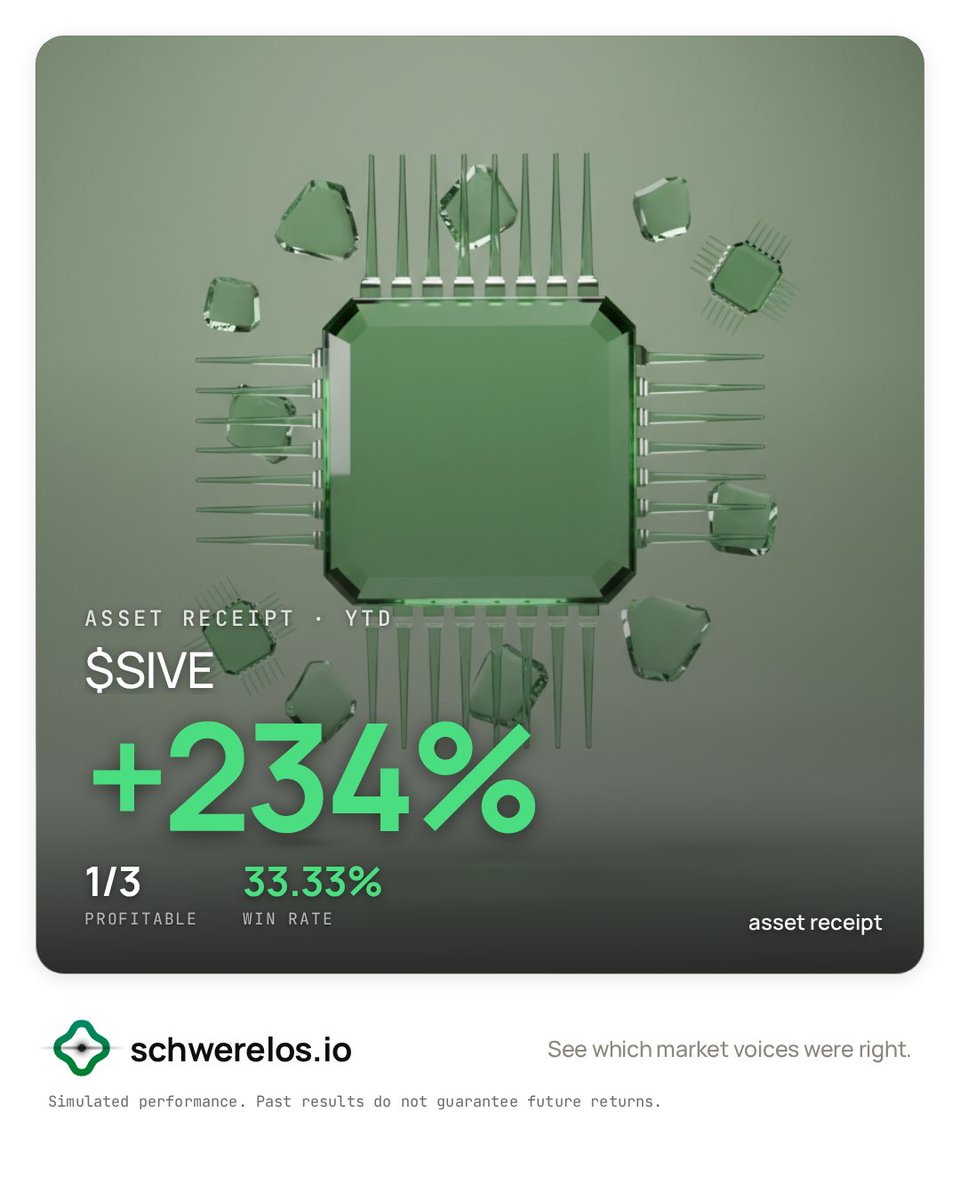
$SIVE is up ~1,700% in 2026, and following every tracked call on it returned +234% YTD on schwerelos.
Sivers makes the laser arrays for co-packaged optics, the interconnect AI data centers need to move data at 1.6 terabits. GlobalFoundries just signed them into its silicon-photonics platform, aimed at the $25B pluggable-optics market.
3 scored calls tracked, 1 closed in profit.
Head of Engineering Shopify:
"AI writes the code, AI reviews the code. Your job is just to write the loops around it."
26 minutes on how AI changed the way 3,000 engineers work inside a single company.
Ignoring it while everyone else uses AI to do more is the fastest way to fall behind.
Watch it, then read the step by step guide on loops below.
Mapping $SIVE 2030:
Current: ~52 SEK
2030 Target: 260 SEK
Cap: ~85B SEK
The catalyst is the AI Power Wall. As copper interconnects fail, Sivers photonics becomes the standard for data center light sources. A pure play on the transition from hardware to AI infrastructure.
For $SIVE, the 2030 re-rating is a bet on the "Optical Transition." Right now, the market sees them as a niche small-cap component maker. By 2030, they have the potential to be the standard-bearer for light-source technology in AI clusters.
Here is why I believe the bull case for a ~260 SEK target is realistic:
1.The Silicon Photonics (SiPh) Shift: Data centers are hitting a "Power Wall." Traditional copper wires generate too much heat and lose too much signal at AI scale. Moving data with light (photonics) is 1,000x more efficient. Sivers Photonics produces the high-power DFB lasers that act as the "engine" for these optical interconnects.
2.The LEO Satellite Explosion: Beyond AI, their beamforming chips are core to the Low Earth Orbit (LEO) satellite market. As global internet coverage shifts to space, the demand for low-cost, high-efficiency ground and satellite terminals will move from thousands to millions of units.
3.The 6G Infrastructure Bridge: As we move toward 2030, the 6G standard will rely heavily on mmWave technology. Sivers has been refining this tech for years while others were focused only on standard 5G. They own the "hard part" of the spectrum.
If they successfully navigate the liquidity hurdles of the next few years, the "massive gap" you see is the market finally pricing them as a critical infrastructure provider rather than a speculative hardware play.
SK Hynix’s upcoming $29 billion US listing could be the biggest-ever first-time share sale by a foreign company, but it’s not just about raising cash https://t.co/9hh8eAyy4M
Just some consolidated updates on memory:
- $MU leads new 1.5T Yen investment in Hiroshima ~$9.3B. (bullish read through for Disco, Advantest, Resonac, Towa) since capex is localized.
- Morgan Stanley pointed out NAND will continue to be in short supply into 2027 so $SNDK / Kioxia type players are happy alongisde $SIMO and upstream.
- MS remains especially positive on Macronix/Winbond
- UBS expects the average price of DDR contracts in the Q3 2026 to increase 32% | 18% Q4, vs. 17% and 12% est.
- UBS expects NAND flash to be raised 30% from prev quarter.
- Samsung reportedly plans 20% DRAM hike Q3. TrendForce recently forecast DRAM contract prices to rise 13 to 18 percent in the third quarter from the previous quarter, so this hike beats expectations.
Something to note:
Lot people see 20%... and don't think it's a lot compared to the 70-80% from previous quarters.
But if you hike something by 100%, then hike something by 100%, then hike something by 30%, it's a lot more than people estimate since it's compounded. Similar to tracking inflation.
I've already made projections going into 2028 from the start of the year on my memory names...
I'm just sitting back and watching things play out through all the "memory optimization" and "they can't keep price hiking like this!" noise.
ELON MUSK EMAILED HIS TEAM: "ANDREJ IS THE #2 COMPUTER VISION MIND ON EARTH, AFTER ILYA SUTSKEVER."
At 22 Andrej Karpathy could solve a Rubik Cube in 16 seconds. he spent the next 17 years cracking a harder pattern: teaching machines to see.
the arc almost nobody traces:
→ at 15 he left Slovakia for Toronto to build quantum computers
→ quit it for AI because he "couldn't get his hands dirty"
→ studied neural nets under Geoffrey Hinton, the godfather of the field
→ did his Stanford PhD under Fei-Fei Li, teaching machines to describe images
in 2012 he wrote that computer vision was "really, really far away."
in 2014 he beat Google best model by hand 5.1% error to its 6.8%.
then it compounded.
→ co-founded OpenAI in 2015
→ Musk pulled him to Tesla to run Autopilot
→ fused 8 cameras into one 3D brain that could actually drive
when Musk poached him, he wrote: "The OpenAI guys are going to want to kill me. But it had to be done."
5 years later he returned to OpenAI, coined "vibe coding," and launched his own school.
now he trains Claude at Anthropic the mind teaching the model to build its own model of the world.
Meta is dangling $100M signing bonuses to poach the people sitting beside him.
and here's the part that should scare you:
one of the sharpest programmers alive just admitted he's never felt more behind.
how do you keep up with a pace this fast?
Moore’s Law is Dead — $NVDA Just Replaced It with Extreme Co-Design.
While moors law delivered 100x more computational power over thee last decade.
NVIDIA achieved ~1,000,000x effective AI compute scaling via full-stack optimization extreme codesign.
This means optimizing ever level off the stack:
🔹 CPUs (Grace)
🔹 GPUs (Blackwell Tensor Cores)
🔹 Chip-to-chip (NVLink)
🔹 Rack-to-rack (InfiniBand)
🔹 Full racks (GB200 NVL72)
🔹 Software (CUDA ecosystem)
This is a level of engineering that no other company can match and is why their are the gold standard for AI.
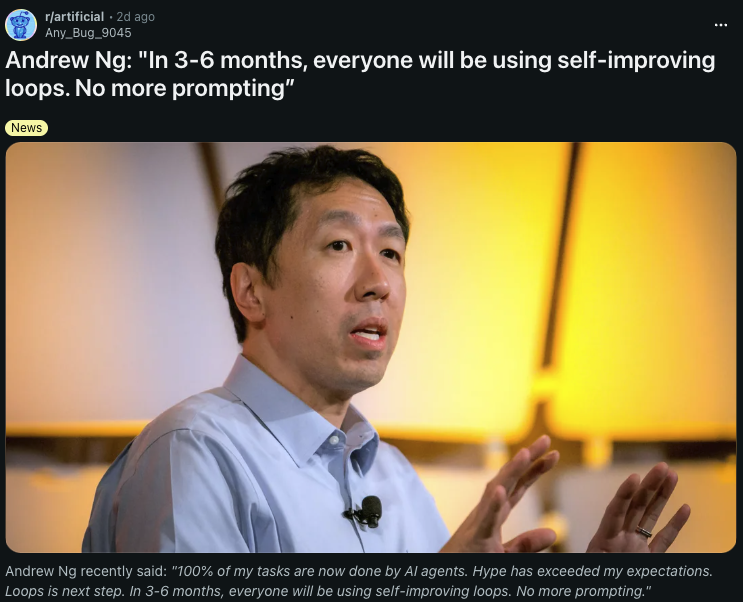
Andrew Ng just said 100% of his tasks are done by AI agents.
His prediction: in 3 to 6 months, everyone will be using self-improving loops.
Here's the thing. He's not wrong, and this isn't new.
A loop is simple. You give AI a goal, it runs, checks its own output, fixes what's wrong, and runs again. It keeps going until the output hits the bar you set. That's it. No human sitting there typing "try again." The agent just keeps improving on its own.
I already do this. I plug a free model into Ollama, put it in a loop, let it run all night, and by morning it's built something that would have taken me hours of back and forth prompting.
Then I compare it against what a paid model like Opus gives me in one shot. Sometimes the overnight loop wins.
That's the shift Ng is talking about. You stop writing better prompts. You start setting better goals and letting the loop do the work.
Now zoom out and look at who else is running loops.
→ Meta moved its best engineers off product work entirely. Their only job now is to create hard problems that AI can't solve yet and feed them back into the model. The best engineers at one of the biggest tech companies are training AI to replace themselves. That's the loop running at company scale.
→ Google uses AI to monitor its own training runs and generate its own training data. Brin called it the self-improvement game. That's the loop running at model scale.
Now here's the economics question. It's not whether loops work. It's how you run them.
Running loops on rented API credits will eat you alive. A loop runs for hours, sometimes overnight. Every iteration burns tokens. At API rates that bill adds up fast.
Running them on your own hardware changes the math entirely. Plug an open source model into your own machine, let it loop all night, and the cost will be fraction of what it use to be. Companies will slowly start to think in this directions.
Instead of renting tokens, they'll start buying hardware. DGX Sparks, Mac Studios, inference rigs. The same way they buy laptops for employees today, they'll buy compute for AI tomorrow.
The loops are already here. The question is whether you're still writing one prompt at a time while the loop is running all night for someone else.
TWO NVIDIA DGX SPARKS CONNECTED DIRECTLY OVER A 200 GIGABIT LINK POOL 256GB OF UNIFIED MEMORY FOR $7,998 TOTAL, ENOUGH FOR EVERY OPEN WEIGHT MODEL UNDER 300B PARAMETERS WITHOUT QUANTIZATION
00:22 he holds the board up to the camera, "you get NVLink for unified system, which gives you shared access to that 128 gig of memory, which is really important"
each DGX Spark ships in a 1.13 liter chassis with the GB10 Superchip, a 20-core ARM CPU, and 128GB of coherent memory. two 200 gigabit ports sit on the board next to a NIC miniaturized down to postcard size
the interesting part is the pairing. plug two units into each other over the 200 Gb link and the OS exposes 256GB of unified memory across the pair. run vLLM, shard the model, no external switch required
for local AI this is the first time frontier-class inference lives on a desk instead of a rack. one DGX Spark runs 200B parameter models. two paired run up to 405B. add a 200 Gb switch and you can scale to trays of them feeding from data center storage over NVMe over Fabrics
the one design flaw is the 2242 SSD, not rated for AI workloads. NVMe over Fabrics to external storage is the intended path
the article ranked the $4,199 Mac Studio as Device 4. two DGX Sparks at $7,998 sit above that as the first practical multi-node local AI cluster available to a single buyer
bookmark this and read the article below