A person born in China at the end of WWII saw China's power rise as its working age population tripled in their lifetime.
But now it has plateaued.
A person born today will see that growth reverse. China's working age population will drop by 1 million per month for a long time.
June 1st 1962 was the deadline for applications to NASA's 2nd group of astronauts.
Neil Armstrong's application arrived on June 4th, but an employee at NASA who knew Armstrong saw the late application and snuck it into the pile of applications anyway.
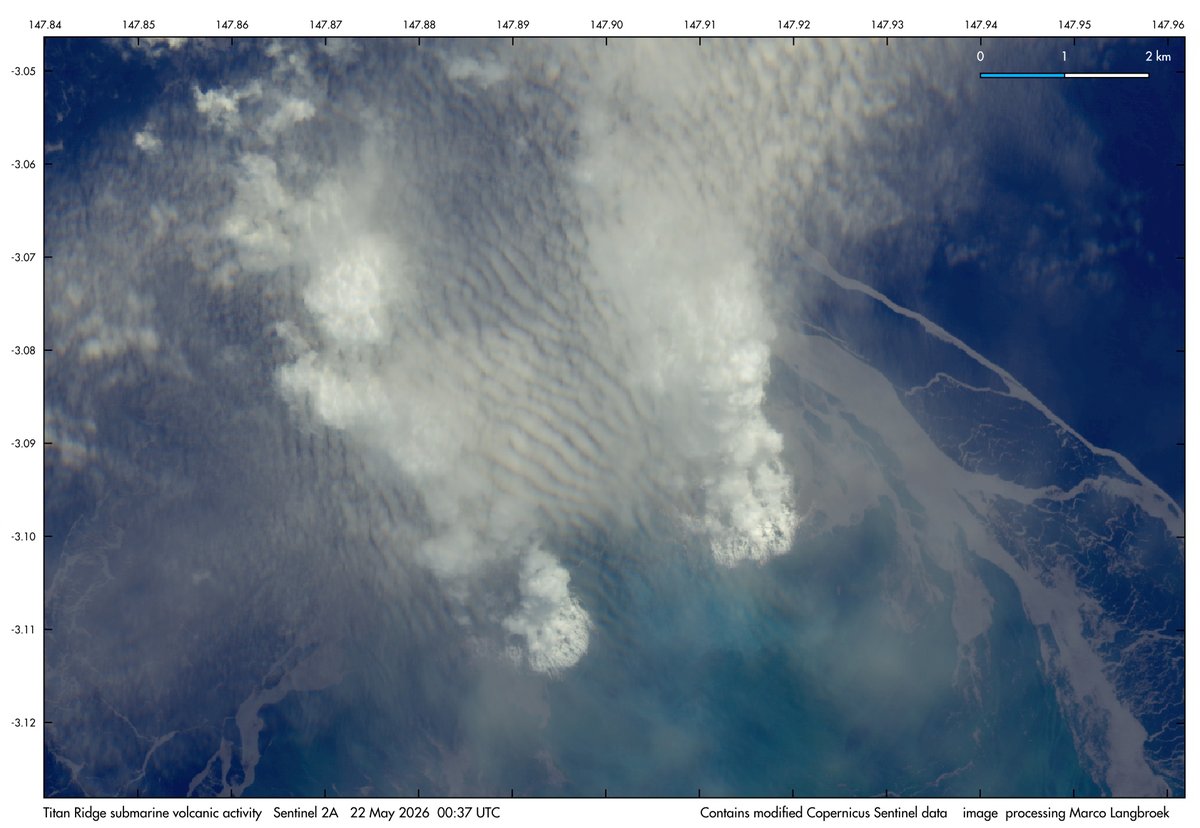
Submarine #volcanic eruptions at Titan Ridge in the Bismarck Archipelago, in a @CopernicusEU Sentinel 2A satellite image from May 22. Visible are the eruption steam plumes, volcanic ash (green and blue) and floating pumice (beige)
@A_J_Higgins Are there any particular publications you recommend for an aerospace engineer curious about the topic? (Either a survey of the theory and math or a summary of historical explosions?)
We have regained some access to Launch Complex 36 and are actively investigating the hotfire anomaly. We will start clearing the pad soon and have a good rebuild plan in place. The booster and GS2s in the integration facility appear healthy from quick looks.
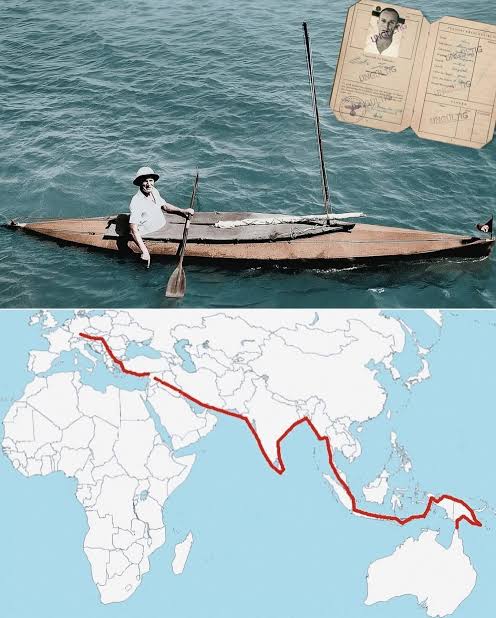
In 1932, Oskar Speck left Germany in a folding kayak, not as a famous explorer, but as an unemployed electrical contractor looking for work. His original plan was much smaller than the legend that followed. He intended to paddle from Germany to Cyprus, where he hoped to find a job in the copper mines. But once he reached the Mediterranean, the journey kept pulling him farther east.
Over the next seven years, Speck paddled through rivers, coastlines, storms, heat, hunger, and dangerous waters. He traveled through the Middle East, India, Southeast Asia, New Guinea, and finally toward Australia. By then, the world had changed around him. Germany had gone to war, and a lone German man arriving by kayak was no longer seen simply as an adventurer. He reached Australian territory in September 1939, just after World War II had begun.
After one of the most unusual kayak journeys ever recorded, Speck was greeted, congratulated, and then arrested as an enemy alien because he was traveling on a German passport. He spent the war years in internment camps in Australia and was only released after the war ended. Instead of returning to Germany, he stayed in Australia, later working in the opal trade and building a new life there. His journey began as a search for work, but it turned into a seven-year accidental epic across half the world.
#drthehistories
At the peak of their influence around 1970, illustrators charged huge fees and drove Ferraris. The right half of the chart tells a grim story, and that’s even before AI enters the room. Is the party completely over, or is there a tiny glimmer of hope? Check out my Substack.
@maenadea Hang on, the Brits have their own tornado scale that starts with T0 “may knock over wheelie bins” and goes up to T1 “minor damage to sheds”?! That is amazing. No wonder they don’t understand how tornados can damage American houses. (By throwing trucks, I mean lorries, at them.)
@tracewoodgrains I think the point the prior poster is trying to make is that whether you think property taxes are good, bad, too high or too low, it makes no sense to connect property taxes to whether the house is paid off.
They don’t become bad just because you pay off the mortgage.
This was not an isolated case. Here’s another bizarre case from Antony Beevor (The Second World War). The last line is a zinger, and is as all things must ideally end.
“In June 1944, a young soldier surrendered to American paratroopers in the Allied invasion of Normandy. At first his captors thought that he was Japanese, but he was in fact Korean. His name was Yang Kyoungjong. In 1938, at the age of eighteen, Yang had been forcibly conscripted by the Japanese into their Kwantung Army in Manchuria. A year later, he was captured by the Red Army after the Battle of Khalkhin Gol and sent to a labour camp. The Soviet military authorities, at a moment of crisis in 1942, drafted him along with thousands of other prisoners into their forces. Then, early in 1943 he was taken prisoner by the German army at the Battle of Kharkov in Ukraine. In 1944, now in German uniform, he was sent to France to serve with an Ostbataillon supposedly boosting the strength of the Atlantic Wall at the base of the Cotentin Peninsula inland from Utah Beach. After time in a prison camp in Britain, he went to the United States where he said nothing of his past. He settled there and finally died in Illinois in 1992.”
@SaysSimulation I noted that the concept art shows a narrow but navigable river between two high, rocky bluffs, which is pretty much the opposite of the wide, shallow, flat landforms I associate with the Missouri/Missisippi. Might be someplace in Montana you could do this in a pontoon boat.