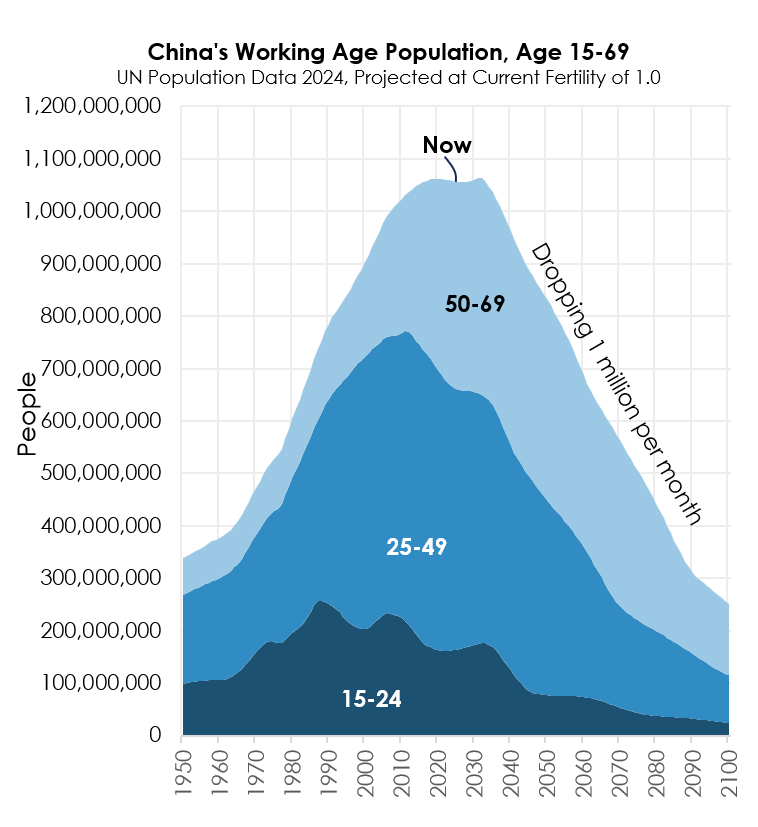
A person born in China at the end of WWII saw China's power rise as its working age population tripled in their lifetime.
But now it has plateaued.
A person born today will see that growth reverse. China's working age population will drop by 1 million per month for a long time.
Today, Foreign Affairs publishes a long essay I wrote summarizing some of my work on the global fertility collapse:
https://t.co/pdQVTk8DnH
It was a fantastic experience (with great editorial support) because the essay pushed me beyond pure economics to discuss issues such as geopolitics and polarization. Unlike some commentators, I don’t think the first-round economic consequences of fertility decline matter most; the second-round political and social ones do.
Yes, social security systems worldwide are in danger, but reality will impose itself sooner or later. The same politicians who swear over their ancestors’ tombs that retirement benefits will remain untouched will cut them (even if they are French). It will not be pretty, and most likely the cuts will come only after a major crisis and after politicians have tried everything else and failed.
Similarly, businesses will adapt to shrinking markets and valuations. Those who claim that capitalism somehow needs constantly expanding markets will be proven wrong. After all, this is the same misguided understanding of markets that has been proven wrong again and again since September 14, 1867, and that nobody really believes unless they have had the misfortune of earning a Ph.D. in a humanities department at an Ivy League school.
The real consequences will come when collapsing populations poison political systems. Look at the recent elections in eastern Germany. That is the future for all of us.
Also, the relative standing of great powers will shift drastically. Given current demographic trends, the U.S. will have a larger population than China by around 2100. The exact date depends on assumptions about net immigration into the U.S., but even with zero net immigration, the U.S. will overtake China by 2128. And Russia’s demographic future is only slightly more optimistic than China’s.
Those who dismiss these changes forget how antiquity ended in Western Europe. The western part of the Roman Empire entered acute demographic decline around 200 CE. By 476 CE, the western empire no longer existed. Despite some revisionist views that have cast a more positive light on late antiquity (and rightly corrected what was sometimes an overly negative assessment of the period), the fact is that England or France in 600 CE had lost most of their classical heritage, and material life had lost at least an order of magnitude in sophistication. The eastern part of the empire, however, weathered its demographic collapse much better and lasted another millennium.
No, I don’t believe we will go extinct (the Amish and Haredi will be enough for the survival of humankind), but the world will be very different in 2200 regardless of how you feel about it. The rational is the real and the real is the rational.
@wordsdematthew “Your poor, your huddled masses, you're in debris-free.” ?
Whoever or whatever transcribed this clearly didn’t recognize what’s written on the Statue of Liberty’s pedestal.
Fantastic work by Murtagh et al. They found serendipitous photographs of the newly-discovered planet going back to 1937. The magnitude variations are good enough to constrain the rotation rate to either 10 or 20 hrs.
On election eve I recall the story of a Colorado pol canvassing for a measure raising taxes to pay for schools.
At one door they got an affirmative.
“Thanks for supporting the kids!”
“It’s not that. My ex got the house in the divorce. I’m now in favor of property taxes.”
@OrevaZSN I recently learned that since I haven’t paid for the full version of Adobe, I can’t extract specific pages from a PDF. But I can tell it to print pages 2-6,9,14 and set the printer to Print to PDF…
@AngelicaOung Gene Roddenberry flew 89 combat missions in WWII, and lost 2 crew members in a crash on landing. He knew something about how crews work together from personal experience.
I think that is something that the current generation of screen-writers are lacking.
@george__mack I find that even understanding my grandparents’ childhood lifestyles helps banish complaints about my own problems.
Water from the well
Outhouses
Oranges only at Christmas
Heating an uninsulated house with a wood stove
No electricity
Finding a job in the Great Depression
@simongerman600 The analysis behind this data assumed that people who say they drink a lot were under reporting by 2X, but the people who say they rarely or never drink were accurate.
It’s probably bad data.
Memorization has an unfairly negative reputation. I recently spent a few hours memorizing the names of all the countries in the world and it's such a clear improvement in how well I can understand and reason about other topics. Memorization is scaffolding for more complex ideas
@allie__voss This data is really dubious. The author used surveys about how much people said the drink, noted that the amount of alcohol sold is 2X as much, and doubled the survey results.
Ignoring that maybe some goes to waste, or the discrepancy hides in the group who says they drink less.
@allie__voss This data is really dubious. The author used surveys about how much people said the drink, noted that the amount of alcohol sold is 2X as much, and doubled the survey results.
Ignoring that maybe some goes to waste, or the discrepancy hides in the group who says they drink less.
fertility rates are so abstract that people struggle to understand the scale of the catastrophe we’re experiencing.
take 1.14 children per woman (italy and japan)
if that continues, each generation is roughly half the size of the one before it
start with 100 people in a generation, the next only has about 54, then 29, then 16.
in three generations, roughly a century, you have a generation 84% smaller than the one you started with.
for taiwan that would be 97.4%!
i don't think people really understand what that means
In southwestern Idaho, there’s a county called Owyhee.
Odd-sounding name. It originates from three Hawaiian fur trappers who never returned from a remote part of the county.
Say “Owyhee” aloud. You’re already halfway to solving the mystery.
1/n
A while back I started mentally defining the “inner solar system” as everything inside the orbit of Neptune. There’s a vast realm beyond that, with a menagerie of interesting medium-sized worlds that have moons and rings and weird shapes, that we’ve never imaged.
Meet our Solar System's newest dwarf planet candidate: 2026 ED138!
Orbiting past Pluto, scientists found it in NSF–DOE Rubin Observatory data from earlier in 2026. Early analysis suggests it's 600–1500 km across, one of the largest found past Neptune!
🔗 https://t.co/wTOg898zBu