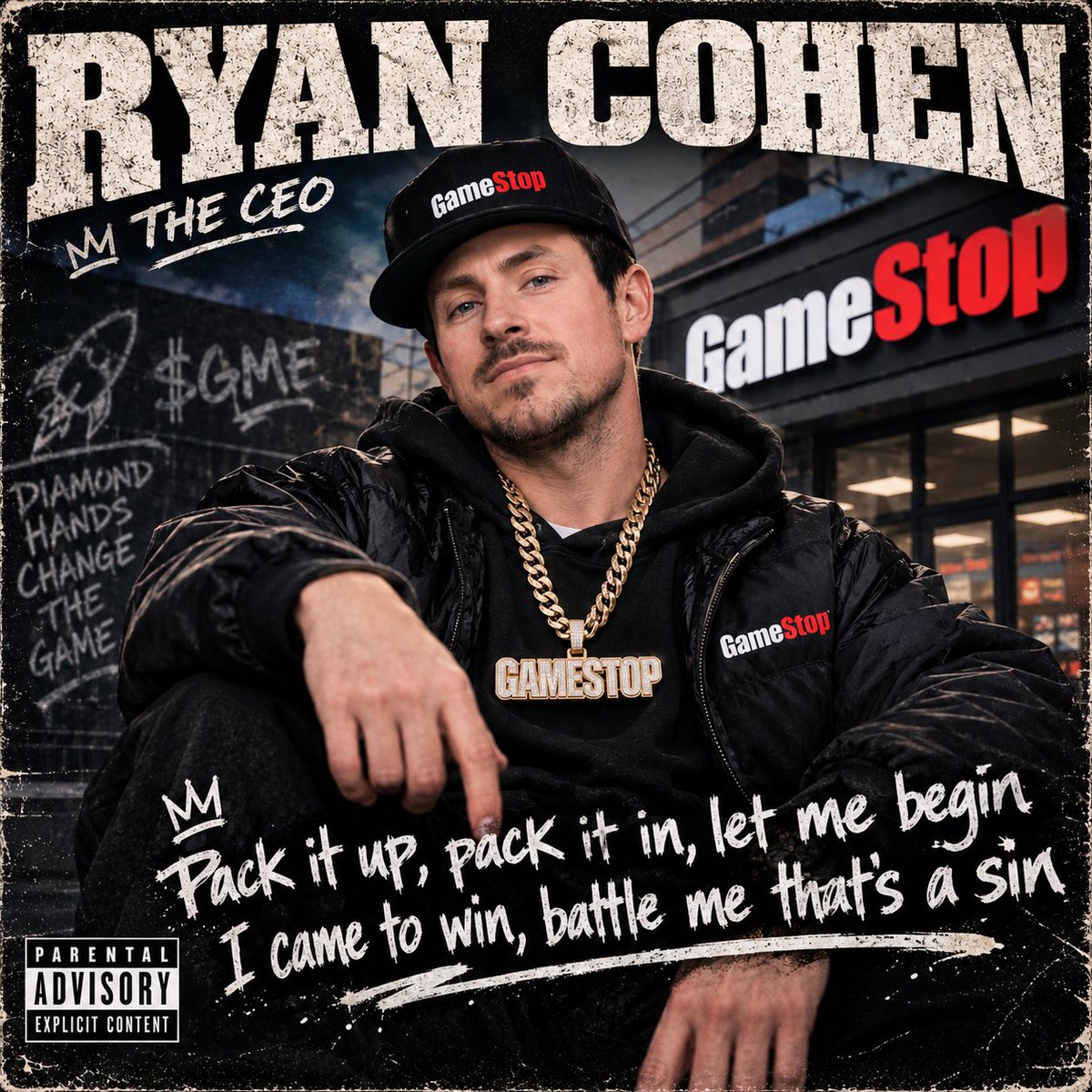
GameStop CEO @ryancohen wants to win.
I sat down with him and he explained how AI is changing work and hiring, his concerns about where humans fit in an automated future, and the rise of the retail investor.
We also discuss Neuralink, how he talks to shareholders, his biggest failure, and the legacy he wants to leave. $GME
YouTube: https://t.co/keO322D4YB
Spotify: https://t.co/0ixukBMZfz
Apple: https://t.co/pfIdbOOGh8
TIMESTAMPS:
0:00 - Intro
0:30 - AI risks & how GameStop uses AI
3:04 - How Ryan spends his time
6:05 - Hiring in the age of AI
7:45 - Why Ryan wants to learn Chinese
8:55 - Robots, UBI & human utility
13:53 - Neuralink & brain-computer interfaces
17:50 - Retail investors vs Wall Street
21:10 - Greatest strengths & weaknesses
23:05 - Shareholder communication & ignoring the noise
28:04 - Biggest failure
29:45 - Legacy & final thoughts
Ryan Cohen: “Why Does Everyone Want GameStop to Fail?”
$GME CEO @ryancohen:
“The media is an example. Why is it that you've got a ($EBAY) management team with no skin in the game, they're not builders, they haven't built anything themselves before, they've basically just been employees at major companies, they’ve been overpaid, I don't think they've ever broken out a sweat in their entire lives, why does everyone want them to succeed?
But when you have someone that, and by the way, I'm putting $500M of my own money into this transaction, I haven't pulled a penny out of GameStop, and it seems like everyone in the media basically wants us to fail, and wants them to succeed.
And you've got a board that's making hundreds of thousands of dollars a year. They don't buy stock with their own money. They end up showing up to a handful of board meetings, and they're making a fortune. You've got a management team that is grossly overpaid, taking zero risk.
There's nothing more American than basically risking your own capital. So why does everyone want us to fail?
@friedberg:
“I do think that the media, in order to give you credibility, they're gonna have to acknowledge that all of their takes on GameStop just being a meme stock were wrong, and that there is actually a business here, and that there is value being created here, and that they missed that, and they got the story completely wrong.”
--------------------------------------
Thanks to our partners!
Most advertisers have never heard of the platform with an $11B annual run rate in ad spend. AppLovin Ads — 1B+ daily active users, full-screen video ads watched for a median of 35 seconds, and businesses are profitably spending hundreds of thousands of dollars a day on it. Advertiser access is in closed beta. The window is open at https://t.co/h9SzJOL6wj
Nasdaq - Positioned at the nexus of technology and the capital markets, Nasdaq provides premier platforms and services for global capital markets and beyond with unmatched technology, insights and markets expertise. https://t.co/M4axvGYyrT
The Hollow Men
American capitalism is rotting from the head down. We have replaced the "Owner-Operator"—the risk-taker-with a new, parasitic class of corporate bureaucrat: The Risk-Free Insider.
By "Insider," I am not referring to a specific title. I am referring to the entire administrative state that has captured the modern corporation. This includes the Directors who exist solely to collect fees, the Executives who exist solely to collect bonuses, and the Managers who exist solely to hire consultants.
These are the hollow men of the boardroom. They are masters of PowerPoint. They wear the right suits. They say the right buzzwords about "governance" and "ESG." But they are mercenaries fighting a war with someone else’s ammunition.
In a functioning economy, authority is tied to liability. If you make a bad decision, you lose your own money. That fear of loss is the only thing that keeps a business honest. It forces you to cut waste, obsess over the customer, and stay late to fix what is broken.
Today, we have severed that link.
We have rigged the game so that heads, the Insider wins; tails, the shareholder loses.
If the stock goes up, the Insider collects a massive performance bonus. If the stock crashes due to their own incompetence, they are fired with a "Golden Parachute" worth tens of millions. They are gambling with the house’s money, and they never leave the table poorer than they arrived.
This looting starts in the boardroom.
We have normalized a "Country Club" culture where directors are selected based on social profiling rather than their ability to build a business. The modern board member is often a professional tourist—paid an average of $350,000 a year.
Let’s be brutally honest about what that number represents. The average director is paid nearly five times the GDP per capita of the United States. They earn more for attending four quarterly lunches than the vast majority of Americans earn in five years of hard labor.
And for what?
Most of these directors are "over-boarded," sitting on three or four boards simultaneously. They treat directorships as a gig economy for the elite. They fly in, rubber-stamp a compensation package they didn't read, and fly out. They collect checks from companies they do not understand, do not use, and certainly do not love.
They are not there to ask hard questions. They are there to be collegial. They are there to protect the other Insiders.
And what happens when these boards hire executives who also have no personal capital at risk?
We get the Delegation Economy.
When a Risk-Free Insider faces a crisis—bloated expenses, a broken supply chain, or a stale product—they do not roll up their sleeves. They hire a consultant. They pay a strategy firm millions of shareholder dollars to produce a 100-page deck telling them what they already know.
This is not management. It is intellectual money laundering.
They use shareholder capital to buy an insurance policy for their own careers. If the plan fails, they can blame the consultants. They delegate the work because they are terrified of the responsibility. They would rather preside over a slow, comfortable decline than risk a bold mistake.
While American Insiders are busy optimizing their severance packages, our global competitors are optimizing their products. They are not slowed down by bureaucracy. They are not waiting for a slide deck. They are outworking us.
If we continue to fill our C-suites with administrators instead of operators, we will lose our edge. We will see iconic American franchises hollowed out by fees, managed for the benefit of the Insiders, while the true owners—the shareholders—are left holding the bag.
The time for polite governance is over.
If we want to save the American economy from mediocrity, we must demand a return to the "Owner’s Mentality." We need leaders who treat shareholder capital with the same reverence they treat their own savings. The era of the Risk-Free Insider must end.