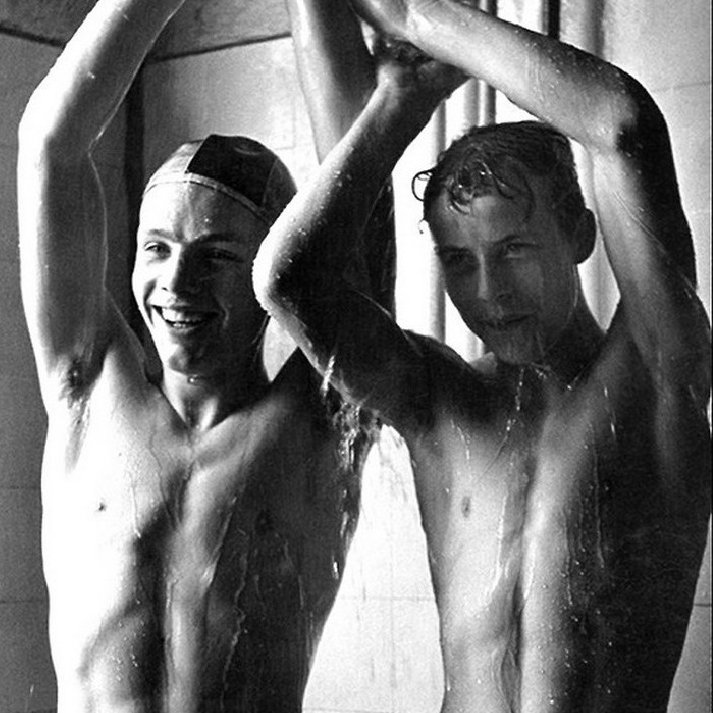
The absence of bright illumination forces the viewer to look closer, tracing the subtle contours defined entirely by light. These rare archival studies remind us that photography is fundamentally about painting with light and shadow.
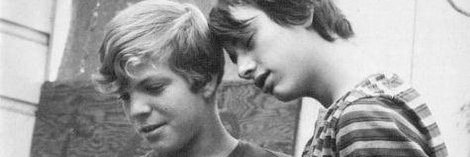
An unspoken understanding that bridges the age gap. These vintage prints do more than record a family outing; they preserve the tender, foundational moments of growing up side by side.
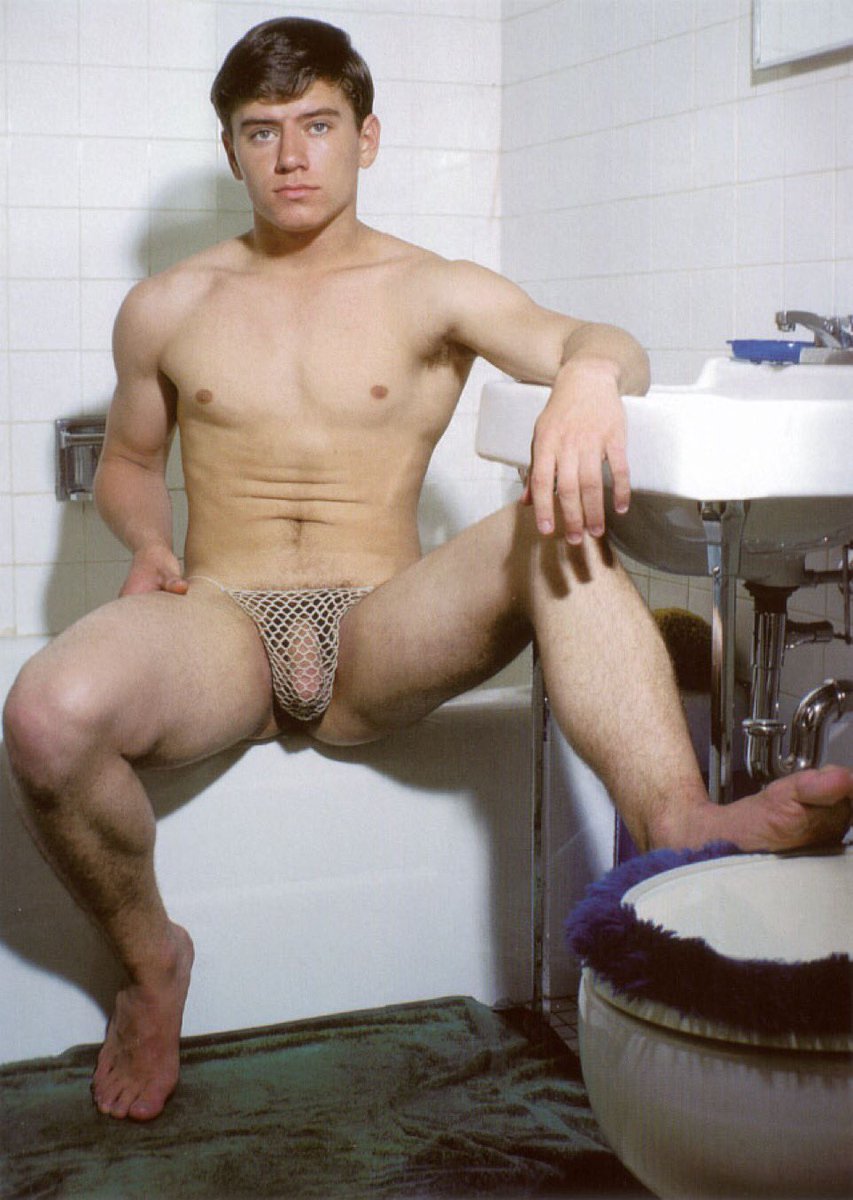
This 1960s photograph is interesting not simply as a nude study, but as an image caught at a remarkable cultural crossroads. Three details in particular give it a significance beyond the immediately apparent subject: colour photography, the changing conventions of the posing pouch, and the very conventional appearance of the young man himself.
The use of colour is important. Earlier physique and nude photography was so often encountered in black and white that colour gives this image an entirely different immediacy. The model no longer seems quite so distant or idealised; his skin, hair, eyes and surroundings are rendered with an almost startling naturalism. The clinical white tiles and bathroom fittings reinforce that impression. There is something almost documentary about it—as though the viewer has been admitted into an ordinary contemporary space rather than presented with an artificially constructed studio fantasy.
Equally revealing is the open, mesh posing pouch. The posing pouch had traditionally provided a compromise: the male body could be displayed with considerable freedom while the most explicitly sexual areas remained concealed. Here, however, the garment has been reduced almost to a transparent convention. Its deliberately open, netted construction makes the fact of nudity unmistakable. This belongs to a period when the boundaries governing the presentation of the male nude were beginning to loosen in certain photographic and physique contexts. What had previously required concealment could increasingly be suggested—or, as here, made conspicuously visible—while still being presented under the respectable guise of physique photography.
And then there is the model himself. He looks remarkably conventional for a photograph that, in retrospect, feels anything but conventional. His carefully combed short hair, clean-cut appearance and composed expression belong unmistakably to the respectable young American male of the early 1960s. There is no beard, long hair, flamboyant clothing or rebellious styling to announce the coming revolution. Yet the photograph is already quietly pushing against some of the conventions that appearance represents.
This is what makes the image particularly evocative when viewed against the social upheavals that were gathering momentum in America. The Vietnam War was becoming an increasingly divisive presence, provoking protest and profound resentment among sections of the younger generation. At the same time, the emerging counterculture was beginning to reject precisely the kind of neat conformity embodied by this clean-cut young man. Long hair, beards, unconventional clothing, communal living, sexual liberation and the developing hippie movement would soon transform the visual language of youth.
Seen from that later perspective, the photograph possesses an intriguing before-and-after quality. The young man seems to belong to the old order—tidy, masculine, disciplined and conventionally presented—while the photograph itself hints at the new one. His body is being displayed with an openness that would have been considerably more daring only a few years earlier.
In that sense, this is almost a photographic moment of transition: the polished, clean-cut America of the early 1960s standing on the threshold of the turbulent, sexually and socially liberated culture that would emerge later in the decade. The model has not yet adopted the outward appearance of the counterculture, but the conventions surrounding the representation of his body are already beginning to change. The photograph therefore captures something particularly fascinating about the 1960s: the revolution was beginning before everyone looked revolutionary.
Herbert List’s photograph is a wonderfully ambiguous study of youthful intimacy, physicality and latent drama. Two young men occupy an almost sculptural composition, their bodies overlapping so closely that the distinction between wrestling, play and affection becomes deliberately difficult to establish.
The boy on the left is particularly intriguing. His attention is directed downward towards the hands, where the small knife introduces an unexpected element of danger. Yet List does not photograph it as an overt threat: the blade is almost incidental, emerging from the lower edge of the composition while the boy’s expression remains contemplative rather than aggressive. The knife therefore becomes a psychological detail—something capable of transforming an apparently innocent encounter into something more uncertain.
The second boy looks down towards his companion, his arm resting around his shoulder. Their gestures create a remarkably intimate physical vocabulary: hands meet, arms cross, shoulders touch, and the two bodies form an almost closed geometric structure. List's cropped framing makes the figures feel larger than life, while the stark sunlight picks out the planes of their chests, shoulders and faces like fragments of classical sculpture.
This is characteristic of List's approach to photographing young men. His work was deeply influenced by Greek antiquity, classical sculpture and modernist composition, and he frequently transformed ordinary physical encounters into images possessing the stillness and idealised beauty of ancient statuary.
What makes this photograph especially compelling is the tension between tenderness and menace. The hand on the shoulder suggests trust; the intertwined arms suggest play or wrestling; the knife quietly contradicts that atmosphere. We are left wondering whether we are witnessing a moment of friendship, a game, a struggle—or simply a carefully constructed photographic fantasy.
List famously believed that the photographic lens was not truly objective: photography, for him, was a means of constructing a vision rather than merely recording reality. Here, that principle is particularly evident. The photograph doesn't tell us exactly what is happening; instead, it creates an atmosphere in which male beauty, intimacy, physical contact and the possibility of violence coexist within the same frame.
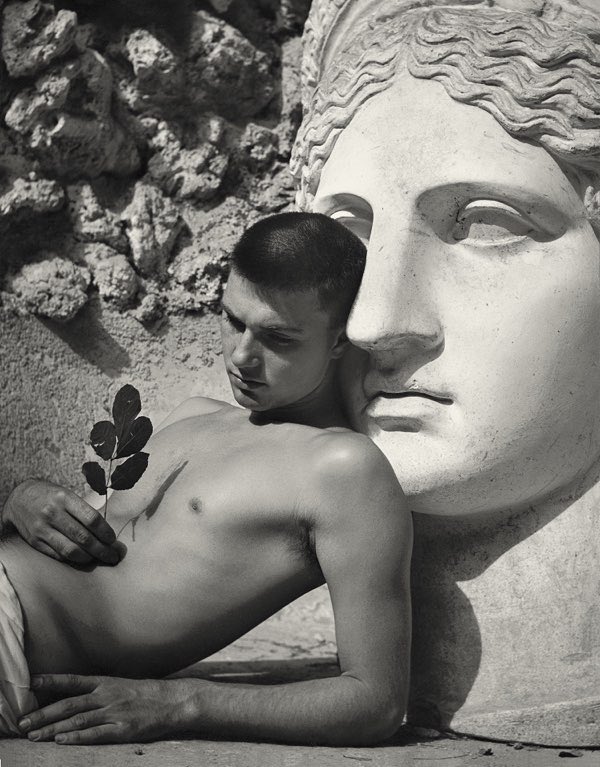
@alainf55 Herbert List’s photograph has the deceptive calm of a classical portrait, yet behind its serene beauty lies a story of considerable secrecy. The young man sits almost like a figure from an ancient Greek relief, his slender body illuminated against an intensely geometric arrangement of light and shadow. List was fascinated by precisely this meeting of modern masculinity and classical ideals, transforming the male body into something simultaneously intimate, sculptural and dreamlike.
What makes the photograph particularly poignant is that List’s male nudes occupied a largely private world. During the 1930s he produced numerous images of young men in Germany, Italy and Greece, but these photographs were not simply another branch of his professional work for magazines such as Vogue, Harper’s Bazaar and Life. Many were intensely personal, homoerotic images that he never published during his lifetime. He kept this body of work hidden—famously storing the negatives and prints in a sack he referred to as his “poison bag.”
The secrecy becomes even more understandable when placed against List’s circumstances. He was gay, and in 1936 left Germany partly because of the increasingly dangerous political climate and persecution under the Nazis. Later, because of his Jewish ancestry, he was prevented from working professionally for the German press. The male nude therefore existed in a precarious territory: aesthetically it could be defended as classical beauty, but its personal and erotic implications could make it dangerous.
There is something almost conspiratorial about the lighting here. The sharply defined triangle of sunlight seems to create a private stage on which the young man is temporarily revealed, while the enormous shadow behind him doubles his presence. His expression is withdrawn rather than performatively seductive; the photograph feels less like an advertisement of the body than a stolen moment of contemplation.
And that is perhaps the key to List's secret photographs. They were not merely exercises in depicting the nude. They formed a kind of private visual diary of male beauty, friendship, desire and intimacy—a world that could not safely be made public. The irony is that the very photographs List concealed became, decades later, among the most important evidence of his personal and artistic vision. His Junge Männer was not published until 1988, thirteen years after his death.
Seen today, the photograph consequently carries two histories at once: the classical ideal that List deliberately constructed before his camera, and the hidden personal life that he could only cautiously encode within it. The beautiful young man is therefore not simply a nude model; he becomes a symbol of something that List could see, photograph and preserve—but, for much of his lifetime, could not openly declare.
This striking contemporary nude is photographed from a deliberately low vantage point, a choice that immediately gives the figure an imposing, almost monumental presence. Seen from below, the body seems to rise above the viewer, while the broad shoulders, strongly modelled back and powerful legs are emphasised against the remarkably simple horizon.
The pose itself intensifies that effect. With his hands resting at his hips and his legs planted apart, the model adopts a stance that feels assured and almost statuesque. His head turns downward and away, introducing a subtle contrast between the confidence of the body and the introspective gesture of the face. The slight shift of weight through the legs also creates a pleasing asymmetry, preventing the pose from becoming merely frontal or rigid.
The absence of distracting scenery makes the body the entire subject. Light traces the musculature of the shoulders, spine, buttocks and thighs, while the low camera position exaggerates his physical scale. There is something distinctly sculptural here: the photographer has transformed a living figure into an imposing study of masculine form, using viewpoint and pose as much as anatomy to create its powerful visual impact.
@alainf55. Alan MacWeeney’s photograph of Neil, from his celebrated series Irish Travellers, 1965–1971, is a remarkably intimate portrait. MacWeeney’s approach to the Traveller community was observational yet deeply sympathetic, and this image has a quietness that distinguishes it from a conventional documentary portrait.
Neil’s face dominates the frame, turned slightly away from the camera, his eyes closed and his head gently inclined. The expression is difficult to read: there is something peaceful and inward-looking about it, almost as though he has momentarily withdrawn from the photographer’s presence. The soft natural light emphasises the planes of his face while the shallow tonal range of the black-and-white image gives the photograph an almost sculptural quality.
The close cropping is particularly effective. We see little of the surrounding environment; instead, attention is concentrated on Neil’s face, neck and shoulders. Droplets of water remain visible on his skin, suggesting that the portrait may have been made immediately after bathing or washing. Rather than becoming merely descriptive, these small details make the photograph feel spontaneous and personal.
There is also an interesting tension between vulnerability and strength. The closely cropped head, powerful neck and broad shoulders give Neil a physical presence, yet his closed eyes and relaxed expression create a sense of introspection. MacWeeney avoids turning his subject into a stereotype of Irish Traveller life; instead, he presents an individual personality, allowing the viewer to contemplate the young man himself.
The attribution shown alongside the photograph identifies the subject as Neil, though with some uncertainty, and notes that he may be the point at which the image moves from documentary record into something more recognisably portraiture. That distinction is important: MacWeeney is not simply recording a community here. He has created an intensely human study of one individual—quiet, direct and unexpectedly tender.
@alainf55 Brett Lloyd — Napoli, Napoli, Napoli, Naples, 2022
Three young men stand together in the rough, shadowed embrace of a Neapolitan grotto, barefoot and apparently fresh from the water. Their relaxed poses, smiles and easy proximity give the photograph an almost spontaneous quality: a fleeting moment of friendship and summer life set against the ancient, heavily textured stone.
The accompanying text places the image in a more literary context, invoking the poetry of Sandro Penna, whose work repeatedly returned to love, longing, youth and the elusive happiness of fleeting encounters. The quotation begins, “Love, love / gay dishonour,” and describes Penna's poetry as combining an “unquenchable thirst for love” with both euphoria and the melancholy of the outsider. It concludes with the striking idea of Penna as “the messenger of the good news”—someone whose poetry suggests that the world might still be saved through the simple recognition of beauty and love.
That seems an especially evocative accompaniment to Lloyd's photograph. The three figures are not presented as mythological heroes or carefully constructed studio models, but simply as young Neapolitans caught in a moment of warmth, companionship and carefree presence. The ancient rock surrounding them provides a wonderful counterpoint: the fleetingness of youth against the extraordinary permanence of Naples itself.
The original post credits the quotation to Dominique Fernandez, The Amorous Walker (1980), Éditions Plon, and the photograph to Brett Lloyd, Napoli, Napoli, Napoli, 2022.
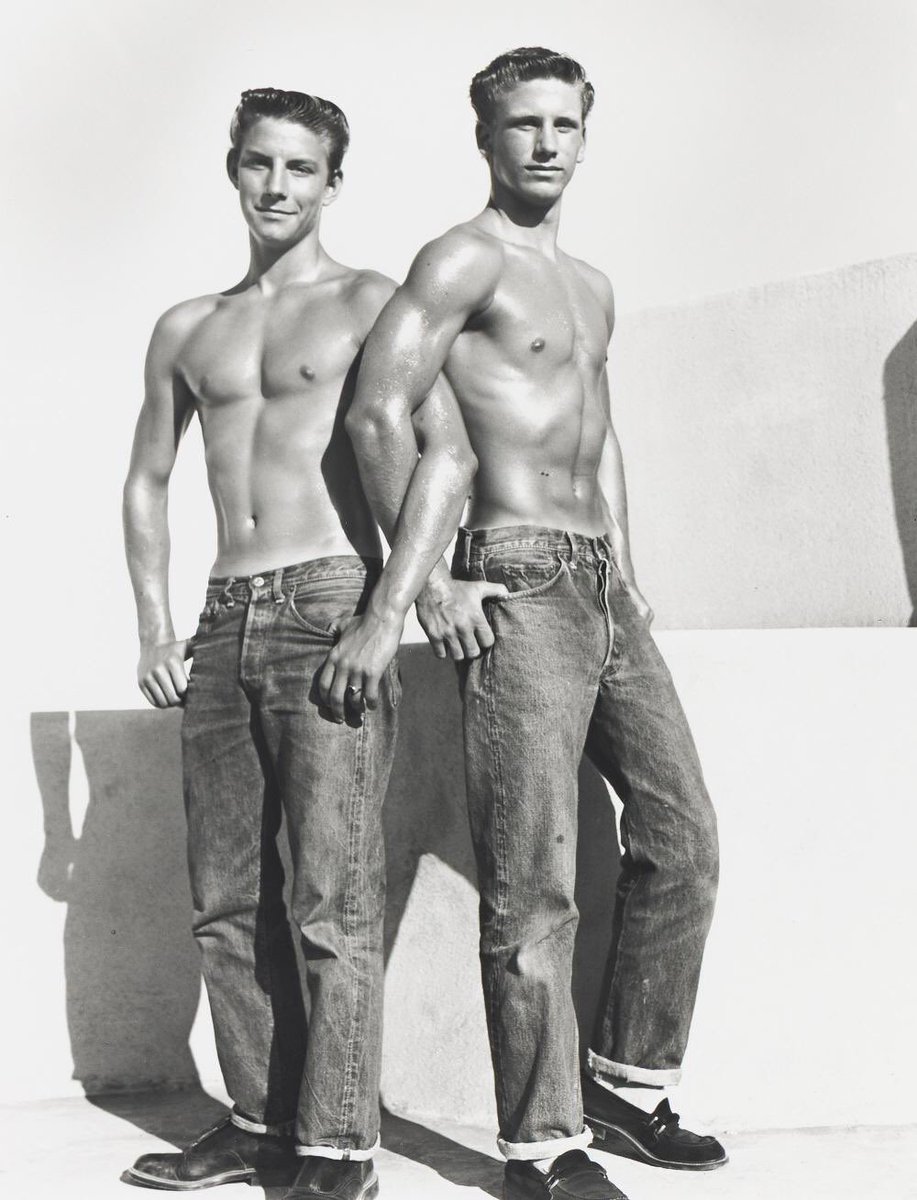
This photograph has the unmistakable aesthetic of Bob Mizer and the Athletic Model Guild (AMG) in the 1950s: an idealised vision of youthful American masculinity in which physical fitness, informality, camaraderie and a certain carefully controlled sensuality are brought together.
The two models are posed outdoors against a stark, sunlit architectural setting. Their bare torsos and rolled-up denim jeans create a deliberately uncomplicated, working-class image of masculinity—more young men at leisure than classical studio models. Yet the pose is anything but accidental. Both figures stand upright and confidently, their bodies carefully presented to show the broad shoulders, narrow waists, developed chests and arms that were central to Mizer's physique aesthetic.
The composition is particularly effective because of the overlapping figures. The nearer model dominates the picture while his companion stands immediately beside him, producing a compact arrangement of two bodies rather than two isolated portraits. Their similar clothing, hairstyles and physiques reinforce the suggestion of youthful male companionship, while the slight differences in expression and stance prevent the image from becoming mechanically symmetrical.
The hard California sunlight is important aesthetically. It throws crisp shadows across the white wall and gives the bodies a sculptural quality, almost recalling the strong modelling of light found in classical sculpture. The models' smooth, oiled skin contrasts with the rough texture of the denim, creating one of Mizer's characteristic visual oppositions: the perfected male body against ordinary American clothing and surroundings.
There is also an intentional tension between the photograph's ostensibly wholesome subject and its sensual presentation of the male body. AMG photographs were frequently framed as studies of athleticism, health and physical culture, but Mizer understood very well how posture, proximity, exposed torsos and the emphasis on musculature could create an image with considerable homoerotic appeal. Here the aesthetic remains restrained: there is no overt sexual action, but the physical attractiveness of the two men is plainly the principal visual subject.
In that sense, the photograph presents a quintessential Mizer fantasy of the 1950s: the handsome, healthy, self-assured young American male—casual, athletic, sun-drenched and seemingly unconcerned with being looked at—while the photograph itself makes that body the object of admiration.
@alainf55 Gaetano d’Agata’s— Caino— is a fascinating example of artistic appropriation, reinterpretation and, ultimately, emancipation. The photograph belongs to a visual lineage that can be traced back to Hippolyte Flandrin’s celebrated Young Man Seated Beside the Sea of 1836–37. Flandrin’s anonymous youth, curled tightly into himself with his head resting upon his knees, became one of the most recognisable images of the male nude in nineteenth-century art. What began as an academic study gradually acquired meanings far beyond its original context.
The pose was subsequently appropriated by Wilhelm von Gloeden, who transformed Flandrin’s anonymous young man into Cain, the biblical outcast condemned to wander after the murder of Abel. The introspective posture suddenly acquired a narrative and psychological dimension: solitude, guilt, exile and melancholy became embodied in the same carefully contained figure.
It is this already established visual language that d’Agata inherited. Having been associated with von Gloeden and his photographic circle, d’Agata understood the power of the classical male nude placed within the Mediterranean landscape. In Caino, the figure sits isolated upon a rocky promontory, surrounded by the vast stillness of sea and mountains. The expansive landscape makes the contracted body appear even more solitary, turning the photograph into an image of psychological as well as physical isolation.
By the beginning of the twentieth century, such imagery had become part of a broader homoerotic visual culture, circulating among collectors and connoisseurs across Europe. Yet d’Agata’s Caino is more than a derivative exercise. The repeated transformation of the same pose—from Flandrin, through von Gloeden, to d’Agata—demonstrates how an image can gradually detach itself from its original author and acquire an independent cultural life.
The continuing interest in vintage prints of d’Agata’s version is therefore significant. It suggests an artistic emancipation from the masters whose vocabulary he inherited. The question becomes an intriguing one: is this the victory of the image over aesthetics? Perhaps not quite. Rather, it is the victory of the icon. Flandrin supplied the pose; von Gloeden supplied the myth; d’Agata helped transform it into an autonomous photographic image.
What survives most powerfully is not necessarily originality in the conventional sense, but the extraordinary persistence of a visual idea. Across painting and photography, the same curled figure continues to signify beauty, solitude, vulnerability and forbidden or unconventional desire. Caino demonstrates how an image can be borrowed, transformed and reinterpreted until the original source almost disappears—and the image itself becomes the work of art.
In a culture often obsessed with curated perfection, these rare archival frames remind us of a time when the simple, joyful bond between friends was captured just as it was—natural, vibrant, and completely unfiltered.
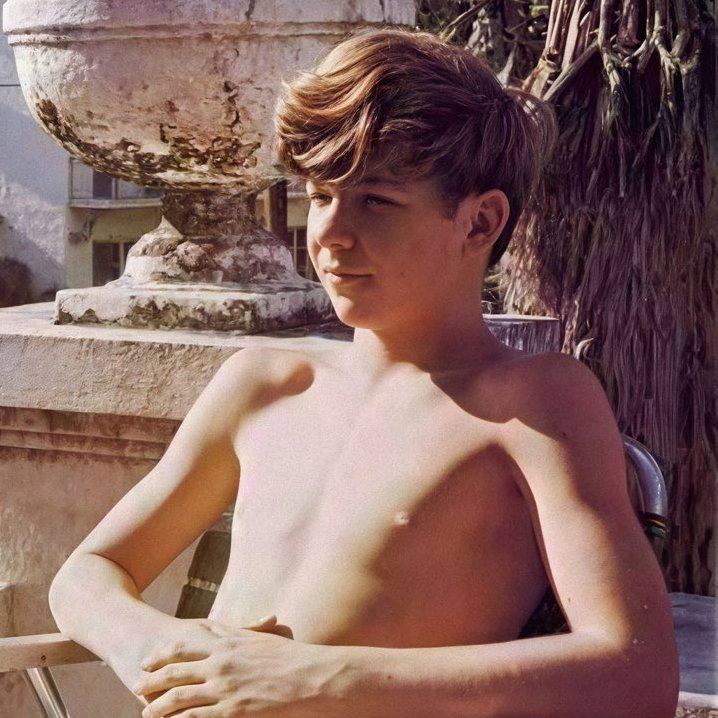
Notice how the sunlight bridges the gap between centuries, highlighting the texture of the modern subject against the time-worn grain of the classical urn. It is a brilliant reminder that every vintage snapshot carries echoes of the art history that came before it.
Notice how the sheer fabric of the curtain diffuses the harsh world outside, creating a private sanctuary where time seems to slow down. It is a stunning reminder that the most compelling archives are often found in the quietest, most private moments of daily life.
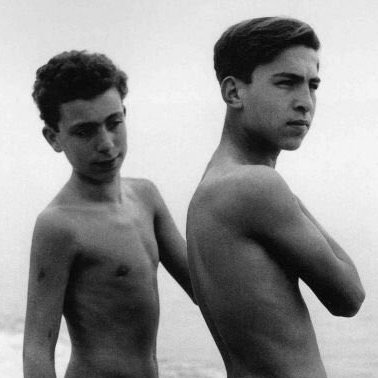
Notice the quiet intensity that builds in the space between them. The ocean provides an endless backdrop, but the true story is happening entirely in the micro-expression of a turned head and a fixed, admiring gaze.
Notice how the neutral backdrop forces your eyes directly to the textures of the fabric, the fall of the light across the shoulders, and the unforced poise of the subject. It is a masterclass in how simple studio staging can turn everyday attire into an enduring work of art.
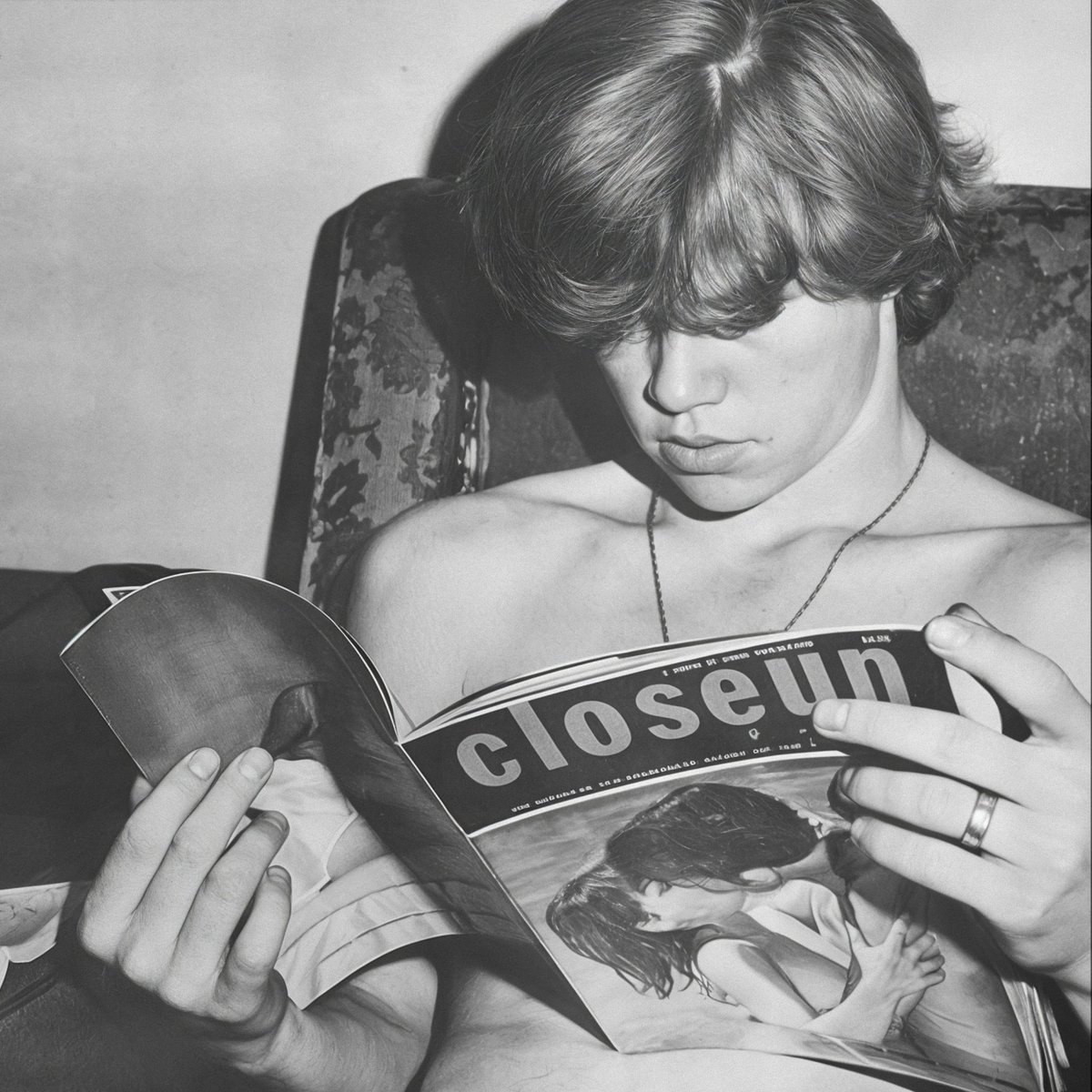
The lowered gaze, the absorbed posture, and the hurried reflex to turn a page when a floorboard creaks—these are the timeless markers of male youth testing the boundaries of desire.
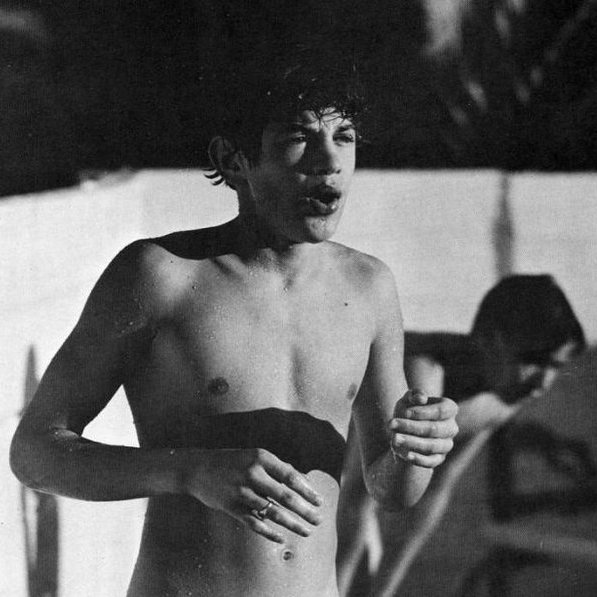
Caught mid-stride by the water's edge. A brilliant dynamic capture of youth, summer energy, and movement frozen on film. There is an unmatched vitality in vintage sports and poolside photography.