from incentives to infrastructure: how @twinexyz fixes crypto’s attention problem
there is currently one major dependency in crypto: projects don't know how to attract users other than by paying them for their attention.
every new release involves quests, airdrops, points, farming and whitelists.
this is not because everyone wants to blow their budgets but because the industry simply lacks a built-in distribution layer.
when you make an app in web2, people are already looking for you and downloading you through the app store or google play, but in crypto, you have to create user traffic manually.
in essence, attention in crypto has to be “plowed from scratch” every time: a new product means new marketing, new points and a new airdrop.
it doesn't work for long: tge → everyone left.
and this mechanism of “bought attention → handed out money → burned out” is what is called the old incentive model.
now there is an approach like @twinexyz.
@twinexyz essentially says: instead of incentives, let's build a system where the user is already there.
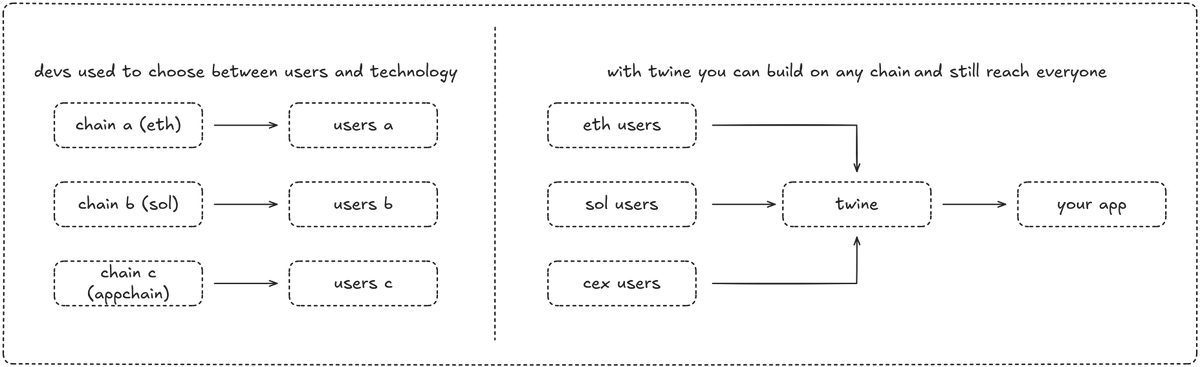
as a developer, you simply connect to @twinexyz and automatically get access to all active users from different blockchains and even centralized platforms.
the user doesn't have to go through the pain of “create a wallet, bridge, find assets” - they already have it, and @twinexyz combines everything into one stream.
this turns the economy upside down:
- previously, a project would spend tens of millions on one-time airdrops to gather users and retain them for at least a couple of weeks;
- now, it simply pays to connect to a network where users already exist by default.
this transforms distribution from marketing to infrastructure.
therefore, the idea of “from incentives to infrastructure” is about a paradigm shift.
the current crypto solves the lack of audience with money, while @twinexyz makes the audience part of the network architecture itself.
it's like when the app store appeared: developers stopped buying clicks and traffic - people were simply brought in by the system itself.
crypto doesn’t need more campaigns - it needs infrastructure. and that’s exactly what @twinexyz builds.
the rise of trusted execution - how @0xfairblock brought TEEs onchain
1/
for a “trustless” industry, crypto still had one small problem - it trusted too much of the wrong stuff.
trusted oracles. trusted sequencers. even “trustless” contracts were leaking data before they ran.
the idea of fairness was there, but execution wasn’t.
2/
then came trusted execution environments - TEEs.
a small, hardware‑isolated vault inside a processor, originally made for cloud security.
someone looked at it and thought:
what if blockchains could borrow that vault?
run the logic inside, keep every input hidden, output verifiable.
3/ @0xfairblock took that thought seriously.
they embedded TEEs into block production, turning each block into an encrypted compute zone.
transactions go in opaque, results come out fair - no frontrunning, no leaks, no favorites.
crypto didn’t need another privacy coin.
it needed private execution.
4/
trusted execution isn’t about blind faith.
it’s about verifiable isolation - trust measured, not assumed.
@0xfairblock made it real:
a network where computation stays secret, outcome stays public, and rules stay equal.
the hardware was there.
it just needed a purpose.
the end of chain choice
1/ once upon a time, “which chain to build on” was the existential question.
a trivial example: you want to build something on a new blockchain with interesting technology, but you're afraid you won't have enough users.
solana gave you speed, ethereum gave you users, appchains gave you freedom
and builders kept losing sleep over a choice that shouldn’t exist.
chains became silos. apps became hostages.
2/ with @twinexyz, the question dies.
build once. users come from everywhere.
ethereum wallets, solana wallets, even cex balances - they all connect through the same distribution layer.
your appchain taps all networks at once, without bridges, wrappers or UX spaghetti.
3/ @twinexyz abstracts chains the way browsers abstracted the internet.
you don’t “build for solana,” just like you don’t “build for chrome.”
you build apps.
twine handles where the users come from.
4/
the next wave of crypto won’t be chain‑maxi.
it’ll be app‑maxi.
chains compete on consensus.
apps compete on experience.
and @twinexyz connects them all.
the end of chain choice is the beginning of the application era.
crypto doesn’t need anonymity, it needs fairness
1/
privacy was never the goal.
fairness was.
anonymity hides who you are.
fairness hides what shouldn’t be seen until it’s time.
crypto doesn’t need to go dark - it needs to go just opaque enough to stay fair.
2/
public‑by‑default chains turned every action into alpha.
traders snipe mempools, mev bots front‑run swaps, whales shape markets by being visible.
too much light blinds the room.
@0xfairblock dims it - encrypts execution, reveals only when settled.
everyone sees the same block at the same time.
3/
this isn’t secrecy.
it’s synchronization.
transactions still end up public, just not predictable before they’re final.
no leaks, no races, no unfair previews.
4/
anonymity keeps you invisible.
fairness keeps you equal.
@0xfairblock builds the structure where transparency and privacy work together - open ledgers, private execution, verifiable fairness.
because crypto doesn’t need to hide - it needs to play fair.
the internet had https. crypto needs @0xfairblock.
1/ before https, browsing the web was like shouting your password in a crowded room.
data moved in plain text - snoopers everywhere.
early crypto does the same thing today:
every order, bid and balance sits wide open in the mempool.
it’s time crypto got its encryption upgrade.
2/ https didn’t make the web private by hiding everything
it made it secure enough for banks, shops and normal people to trust it.
@0xfairblock does the same for crypto:
transactions are encrypted until execution, transparent once finalized.
math guarantees fairness, not secrecy theatre.
3/ no one sees what’s inside your tx before it lands.
mev bots can’t front‑run.
validators can’t peek at pending orders.
dexs, lending markets, auctions - all operate on equal footing.
@0xfairblock is https for state machines.
4/ web2’s explosion started when https turned trust into protocol.
defi’s next explosion starts when encrypted execution becomes default.
open ledgers stay auditable,
private data stays safe
and fairness becomes programmable.
the internet had https.
crypto needs @0xfairblock.
wallet maximalism is dead. how @twinexyz lets all wallets speak the same language.
1/ today each wallet lives in its own bubble.
phantom = solana.
rabby = ethereum.
unisat = bitcoin.
users are trapped in chain silos.
apps lose users before they even start.
with @twinexyz, chains stop being walls - they become doors.
2/ one click. any wallet. any chain.
a user with phantom, rabby, unisat or funds sitting on a cex - all can enter your app immediately.
- no bridge UX.
- no new wallet setup.
- no fragmented liquidity.
@twinexyz speaks to all wallets like they’re one.
3/ what this means for builders
- users from every wallet, chain and cex from day one
- no separate integrations for each chain
- one unified onboarding → massive reach
focus on product, not plumbing
4/ @twinexyz is the distribution layer crypto was missing.
wallet maximalism made the industry smaller.
twine makes it borderless.
build with @twinexyz. onboard everyone.
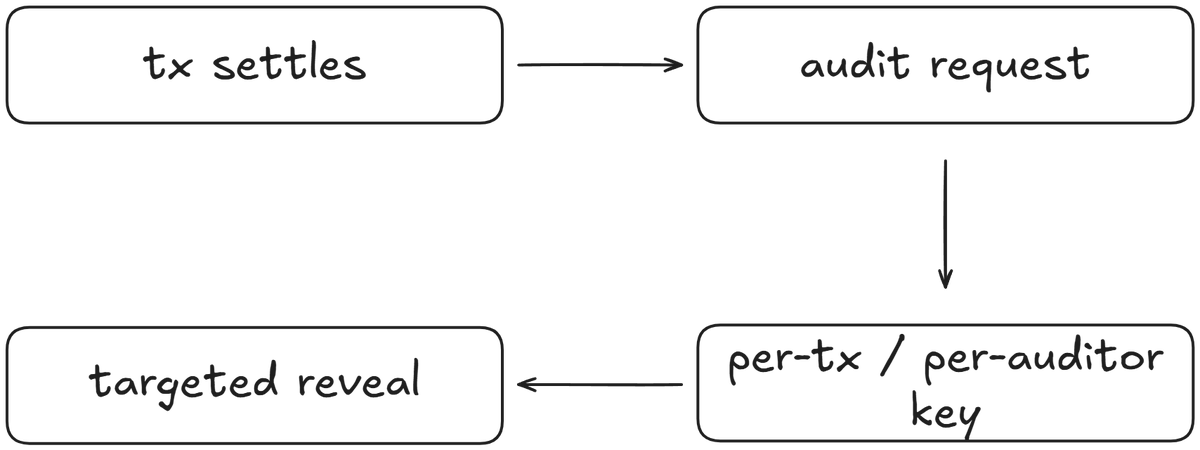
selective disclosure 101: how to show the regulator one line and keep the rest of your book in the dark
1/ public chains are glass boxes.
an audit request = your entire tx history on a platter.
mixers flip the switch the other way: zero visibility, instant compliance pain.
we need a dimmer, not an on/off switch.
2/ @0xfairblock's dimmer works like this:
no global “view-all” key can exist - math forbids it.
3/ example: payroll tx 0xabc, receiver 0x123
1. contract logs the request on-chain
2. validators publish their key shares
3. auditor assembles the key locally
4. only the amount field pops open; every other salary, memo, pnl line stays redacted
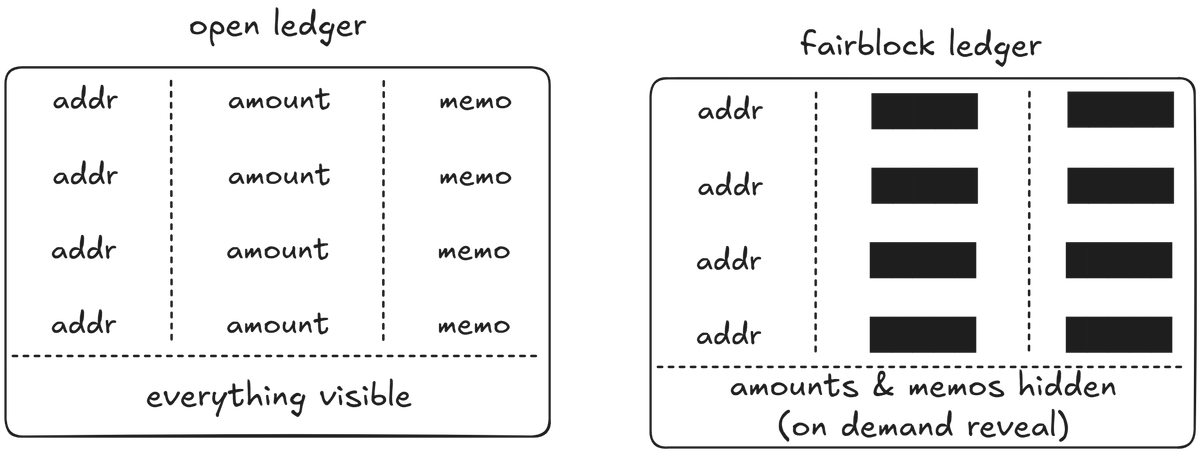
4/ open ledger: every line is public - address, amount, memo, timing.
bots, competitors, regulators all scrape the same raw feed.
transparency is absolute but so is data leakage.
@0xfairblock ledger: address & contract calls stay clear for composability, while value-bearing fields (amounts, memos, strategy params) arrive as ciphertext.
those blacked-out cells can be opened later only with a one-time key minted for a specific viewer + specific purpose (audit, oracle trigger, block height).
validators hold key-shares, 2/3 must cooperate, so no single party can peek.
result: the chain remains usable and searchable like any l1, yet sensitive numbers surface only when policy says “reveal”.
5/ why it matters
• regulators get the line item they need, not your whole playbook
• proof-of-reserve: auditor sees balances, market sees a signature
• companies pay suppliers without leaking vendor terms
• dao treasuries reveal a grant, hide the rest
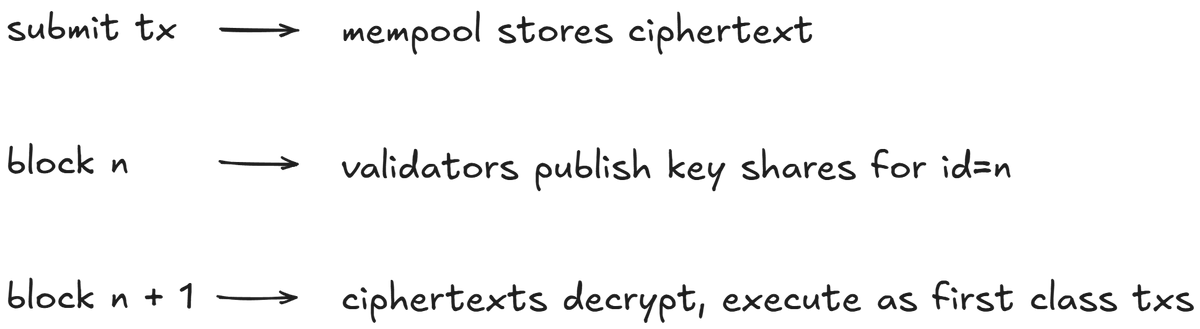
the mempool re-imagined: from open pool to delayed black box
how threshold IBE (tIBE) flips the script
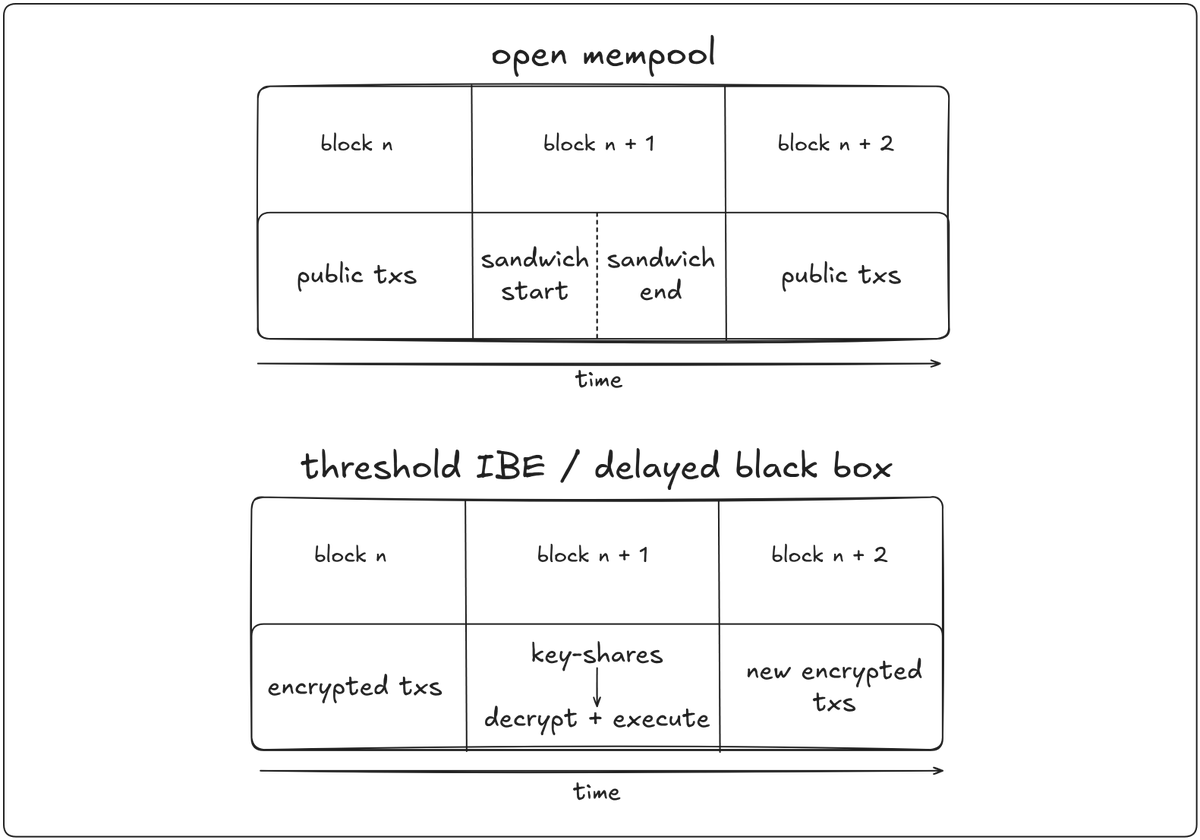
1/ today’s mempool is an open buffet
anyone can scan pending txs → copy trade, sandwich, censor.
the “waiting room” leaks more alpha than the block itself.
tIBE turns that room into a time-locked capsule:
txs stay encrypted, keys appear only when the chosen condition fires.
2/ what actually changes?
• no early visibility → bots lose the jump window
• ordering games vanish (no hint, no bribe, no back-run)
• users pick the reveal trigger: block N, price target, oracle update …
• validators just aggregate key shares; none can peek alone.
3/ concrete flow
result: the same throughput, but zero pre-trade leakage.
4/ why that matters beyond MEV
• sealed-bid auctions: bids stay dark until hammer time
• intent systems: solvers work blind, then prove best execution
• confidential payroll: amounts decrypt only for auditor after payday
• liquidation triggers: bots can’t hunt your leverage before you act
5/ compliance is built-in, not bolted-on
selective disclosure lets regulators see exactly what policy allows - no more, no less.
with tIBE, the mempool stops being public market data and starts being a programmable black box.
the future mempool isn’t private by default, it’s private on your terms. build accordingly.
why your app gets users from day one with @twinexyz
1/ launching a new app?
the hardest part isn’t building - it’s getting users to actually show up.
with @twinexyz, you don’t start from zero.
twine connects your app to users and liquidity from every major chain and even cexs, right from day one.
2/ no more cold start.
solana users, ethereum users, cex users - all can use your app instantly, with their existing wallets and assets.
no new wallets, no bridges, no friction.
3/ what does this mean for you?
- instant access to a massive userbase
- no more begging for liquidity or users
- focus on building, not on distribution
4/ twine is the distribution layer crypto was missing.
your app starts with real users.
just build with @twinexyz and your users are already there.
the future of onchain privacy: why programmable > just private
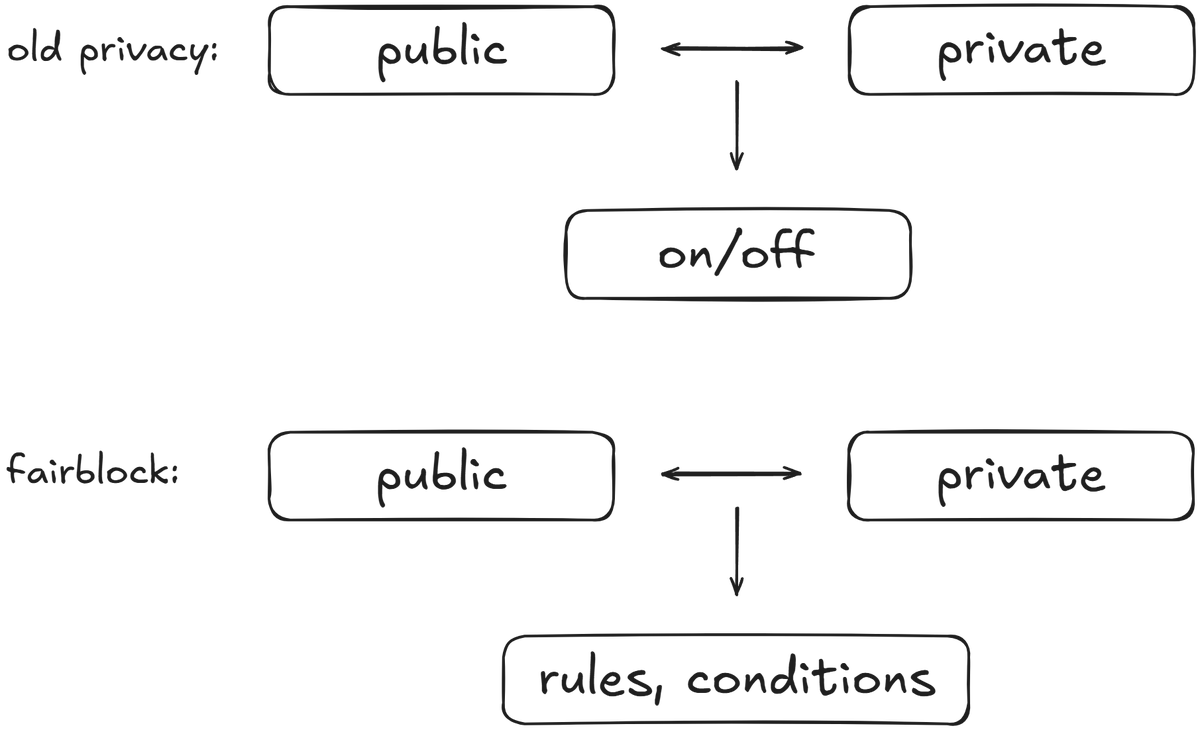
1/ most privacy tools just give you an on/off switch:
either everything is hidden or everything is public.
but real-world use cases need more than that.
with @0xfairblock, privacy is programmable.
you decide who sees what, when and under what conditions.
2/ imagine this:
- payroll that’s private for everyone but auditable for your accountant
- sealed-bid auctions where bids are hidden until the deadline, then revealed to all
- trading strategies that stay secret until execution, then become provable
- private club memberships, where only nft holders can see the content
3/ programmable privacy means you can:
- set conditions for when data is revealed (block number, price, event, etc)
- choose who can decrypt (auditor, partner, community or just you)
- combine privacy with compliance, composability and automation
4/ with @0xfairblock, privacy isn’t a wall - it’s a smart contract primitive.
build dapps where privacy is as flexible as your business logic.
the future isn’t just “private by default” - it’s private by design.
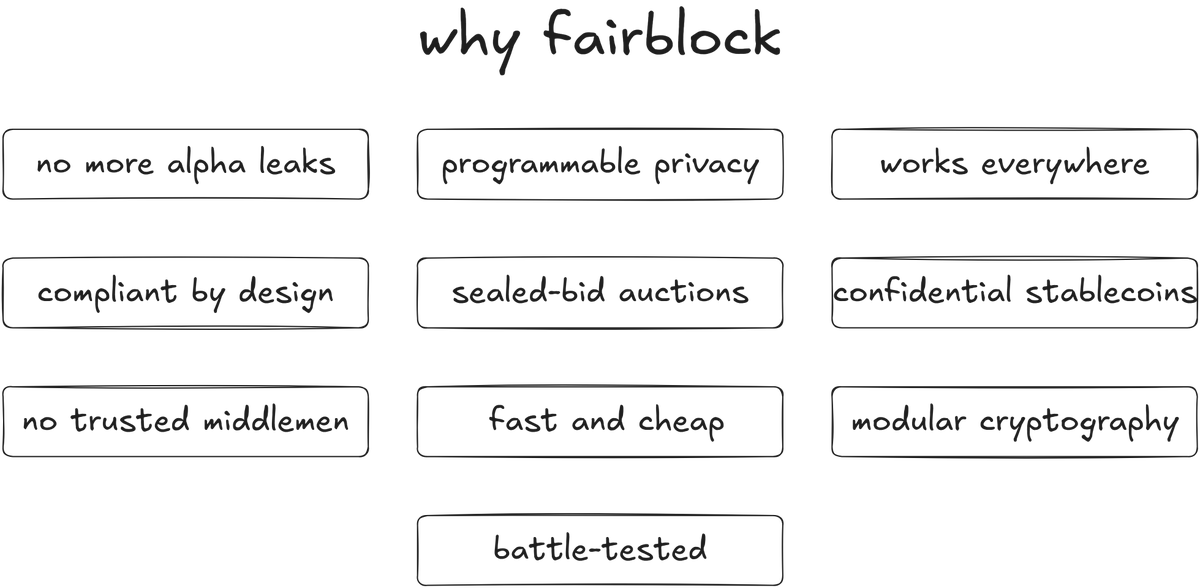
top 10 reasons why do you need @0xfairblock
1/ no more alpha leaks.
your trades, bids and strategies stay private until you decide to reveal them. no more copy-trading, no more frontrunning.
2/ programmable privacy.
set your own rules: reveal data at a certain block, price or only to specific people. privacy isn’t just on/off - it’s programmable.
3/ works everywhere.
@0xfairblock plugs into arbitrum, solana, cosmos, base, hyperliquid and more. no need to migrate your app or users.
4/ compliant by design.
selective disclosure means you can share just what’s needed with auditors or partners. no more, no less. ofac, fincen, mica? covered.
5/ sealed-bid auctions, finally done right.
run real, leaderless, sealed-bid auctions onchain. no privileged decryptor, no last-minute peeking, no shilling.
6/ confidential stablecoins.
payroll, vendor payments and treasury moves stay private while addresses remain transparent for composability.
7/ no trusted middlemen.
no centralized relayers, no single point of failure. threshold cryptography and mpc keep your secrets safe.
8/ fast and cheap.
client-side encryption, minimal overhead, no extra installs or bridges. just privacy that works at defi speed.
9/ modular cryptography.
mpc, threshold ibe, he, zk, tee - with @0xfairblock you can pick the right tool for each job. no unnecessary bloat, no tradeoffs.
10/ battle-tested.
already live with 20+ partners (arbitrum, uniswap, cowswap, axelar and more). 63m+ transactions on public testnet.
atomicity: the secret sauce behind twine’s seamless experience
ever tried to use a new app and got lost in a maze of wallets, bridges and failed transactions?
most people give up before they even get to app.
1/ @twinexyz fixes this with atomicity
with twine, all the messy steps like bridging, account creation, sending funds, executing the action happen as one single, atomic operation (check infograpgic).
it’s all or nothing: either everything works or nothing happens and your money stays safe.
2/ what does this mean?
- no more half-finished transactions or lost funds
- users can jump into any appchain from anywhere, in one click
- devs can focus on features
3/ atomicity is what makes @twinexyz stand out.
instead of worrying about every little step, you just decide what you want to do and twine handles the rest, all at once.
no more getting stuck halfway, no more lost funds, no more onboarding nightmares.
it’s a smoother, safer way to use crypto and it means anyone can try new apps or move assets across chains without stress.
with @twinexyz, cross-chain actions finally feel as easy as they should.
your data your rules
1/ with @0xfairblock, you always see your own data but once you send a transaction, it’s locked up tight
you fill out your payment, trade or bid as usual.
the moment you hit send, @0xfairblock encrypts all the sensitive info using advanced cryptography.
2/4 after that, your transaction goes onchain fully encrypted
nobody else - not validators, not relayers, not bots can see your amount, your strategy or your message.
all they see is encrypted data, until the exact condition you set is met.
3/4 why does this matter?
- your trades and payments stay private from the start
- your salary, spending and strategies aren’t exposed to the world
- even if someone intercepts your transaction, it’s just unreadable code
4/4 with @0xfairblock, privacy isn’t just an afterthought - it’s built in from the moment you send
your data stays yours, from your screen to the blockchain