My new book Blitzscaling Security is now available.
Dive into the mind of Alex, the first security engineer at a scale-up, & experience the brutal truth behind designing a security that protects and boosts the business
The gloves are off with this one :)
https://t.co/35AxFmPAhE
The most fundamental equation in Cybersecurity still holds. One of its variables just exploded.
Every security decision is a tradeoff. Every tradeoff is an arbitrage. Strip any of them down and you hit this equation:
Risk = Likelihood x Impact.
That's it.
Marketing wants to vibecode an app and push it to Vercel by Friday. You ask a few questions. Does it touch proprietary data? Is it a branded far-reaching public page? Does it take user input? Will you use the company's standard CI/CD stack? Is it behind a WAF? Do we have SSO on Vercel? and so on.
Each answer moves one of the two variables and plays on the risk the company is taking. High impact means likelihood has to be crushed to match the risk tolerance. Low enough impact? Well, you let it ship with a knife in the teeth. That's the mental gymnastics that go on in every CISO's head when arbitrating what to veto, what to adjust and what to let slide.
Now AI agents walk in and multiply likelihood by 10. Maybe 100. Across almost every threat scenario.
Look at ARTEX. An open-source agent framework that showed up in July. You plug in a model, hand it a target, and go grab a coffee. Researchers looking at attacker consoles found operators barely touching the keyboard. They set a goal and checked in now and then to see how it was going.
That's the real shift.
The attacker used to be the bottleneck. Their time, their skill, their patience.
Now the attacker is a manager. The agents do the work, around the clock, on a thousand targets at once.
The easy read is: "Fine, let's revisit the risks we accepted because nobody would bother."
Wrong. It's much bigger than that.
Every control you put in place to lower likelihood was calibrated against a human attacker and their odds of stringing three weird vulns together before giving up or tripping a SIEM alert.
Think about the controls you're proudest of.
You IP-whitelisted the provider's webhook on top of HMAC signatures. That needs another look.
You segmented the network so only admins on a jumpbox could reach prod. That needs another look.
You stacked 12-hour key rotation on top of VPC restrictions and tight IAM permissions. That needs another look too.
None of these controls stopped working. Each one was a speed bump sized for a human, and the thing now hitting them doesn't slow down.
So it's not only the risks you accepted. It's the ones you thought you'd already mitigated.
Every earlier tradeoff you've made, consciously or not, is now obsolete. Your instincts are miscalibrated. Impact didn't move. Likelihood did, and you need to rerun the math.
What was possible is now probable.
What was probable is now certain.
Remember the old line? You don't need to outrun the bear. Just the guy next to you.
The bear just got a semi-automatic. It doesn't chase anyone. It shoots the whole camp.
We at @MacHomebrew been warning @Google about this for years. Sadly, they are too addicted to making money selling malware ads.
If someone senior enough at @Google wants to talk about this or, ideally, just fix the fucking problem: I'm easily contactable online.
RTs welcome.
@sc_cath what you’re expressing is nog lack of regulation, but lack of law enforcement. There are rules and laws cover cyber, dangerous products, etc. They simply seem to be suspended so much so that Labs now brag about Cyber incidents with impunity.
Restore law enforcement, and risk will be priced in as a proper constraint in model/harness development and evals.
regarding cve-2026-98432: it is a uaf in tcp, mptcp is needed to make the race win and to get the leak and write.
the impact of the bug is bad, its essentially go2shell, caddy2shell etc. go 1.24+ servers are all vulnerable, because mptcp is enabled by default.
BUT:
1. It is extremely hard to win the race reliably, anthropic said it took 40 mins for them to get leak and defeat kaslr
2. It is probably hard to exploit in practice. most routers, lbs and isps drop ip options, without that header you can't race at all, so realistically only a same network attacker can try, which is pretty common in sandbox infra
my mythos worked on this for last 3 days burned ~$2k and couldn't build a reliable poc that can be sprayable. gpt-5.6 sol als exhausted my subscription and couldn't even get a leak.
either anthropic has a unreleased model which is better than their public one or they have a pro exploit dev internally.
A reminder that this seminal blog post from MDSec (RIP) was dated 2023.... 20... 23! How much louder does infosec need to shout. (up until recently there was no way to even prevent this via config). https://t.co/QqJWMM1p41
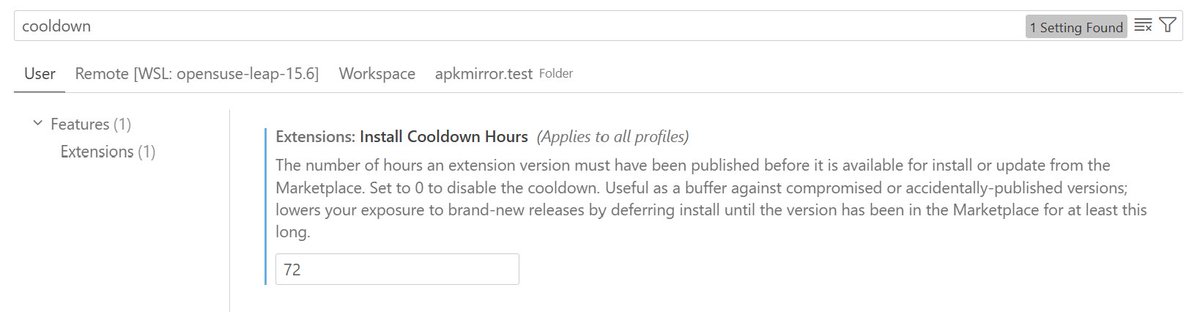
Today's Claude extension compromise is a good reminder to do this. If you're using VSCode @code, Cursor @cursor_ai, or any other IDE built on VSCode, I would immediately enable extensions.installCooldownHours.
I've set this setting to 72 (hours), which is a much safer delay to install new updates to extensions than the default setting of 0 (immediate updates).
This prevents extension updates from getting installed for 3 days, which would hopefully eliminate most of the risk from compromised updates. It's not foolproof, but it's better than no delay.
Heck, set it to something even higher to be safer, like 336 (2 weeks).
Someone has created a vulnerable PHP website, loaded it with a Bitcoin wallet, and challenged the Internet to hack into it and they can keep the Bitcoin. It has a running timer to show if the PHP exploitability was over-hyped. https://t.co/5Pk2aLtFR3
@Jason I saw the latest pod talking about @abliteration_ai. Everyone was freaking out about the novelty of it. Allow me to weigh in as a customer of this very service:
* Remember how, in the HuggingFace incident, the team couldn't protect itself against an unrestricted OpenAI model? That's a serious problem. Not everyone can whip out GPUs and fine-tune models that spit out 500 tks/s. It's unrealistic. But advanced threat actors WILL find a way to use unrestricted models. Period. Any corporation or defender that only tests its defenses against restricted commercial models is arguably irresponsible. It's like bringing a bow & arrow to a gunfight.
* What about the cyber programs of the big labs? They're so rate-limited they're barely usable. And they're not even fully unrestricted, so the models will still refuse certain advanced instructions. How exactly are defenders supposed to prepare for threats they're not even allowed to simulate?
* My bet is that product liability will probably lie primarily in the harness and upper layers, not the model itself. A model is a capability. What you allow it to access, execute, and interact with is what turns that capability into an actual risk. We don't drag Microsoft & Apple into every computer crime lawsuit simply because they provided the computer. Why should models be fundamentally different?
* The debate around restricted/unrestricted access is as old as the security industry itself. Should we disclose vulnerabilities in full so defenders can upgrade? Or should we only disclose the patch? Well, guess what: attackers can reverse-engineer the patch, find the vulnerability, and exploit it, while defenders are left wondering which and how systems are actually vulnerable. Yes, full disclosure can help less sophisticated attackers too. That's the tradeoff. But in an adversarial system, restricting information doesn't make the threat disappear. It just determines who gets to act on it.
I'm not saying there are no risks in providing unrestricted models. Of course there are. Do your own diligence.
But here's what I find absurd: we're building defenses against adversaries who don't play by our rules, using models that are required to play by those very rules.
The world needs your services. Keep up the good work.
My hot take on this PHP mess is that its incredibly overhyped and we'll see very little ITW exploitation. Overall it seems less impactful than its named bug predecessors; heartbleed, shellshock, log4shell etc
@JasonDClinton come on mate, the php vulns are the most overhyped vulns i have seen lately. Bad, yes, but not stop the world bad. They don’t scale to mass exploitation yet they made the local news. Let’s leave some of that attention to actually dangerous vulns we’ll find in the future.
Agree. These vulns are overhyped. These are not the type of vulns that lead to reliable mass exploitation. Patch yes, but far from the doomer scenario narrative pushed yesterday.
Current information I have on php2Shell:
- The RCEs requires the attacker to obtain memory addresses which are typically protected by ASLR.
- I suspect the original author (lcfr_hax) likely has a reliable exploit which leads to stable code execution.
- Most of the PoCs being posted are completely non-functional AI slop.
- There is at least 1 working non-slop exploit being passed around, but it's reliant on bruteforcing for ASLR bypass, so not particularly impactful.
- Rumor of ITW exploitation are patchy. There are attempts being seen using the non-functional leaked RCE, or variants that are config / system specific.
- Some rumors point towards a known-working exploit being used by threat actors (I've personally confirmed this specific exploit works, but the ASLR bypass technique is unreliable at best and massively limits the potential impact).
- I'd expect heavy ITW exploitation in the next few weeks based on how many people are looking at this. Though, success rates will vary heavily based on the specific exploit chain.
You've gotta patch your dependencies super fast because they're full of vulns (PHP, Node, eMudhra, etc), but not _too_ fast because they're full of backdoors (LiteLLM). Good luck!
Les chiffres:
- 68 millions de Français
- 38M d'inactifs
- 30M d'actifs
Et parmi les actifs:
- 3M de chômeurs cat. A
- 6M d'employés du public dont 5M de fonctionnaires
- 21M d'employés du privé dont 2M d'employés d'associations
Soit 19M d'emplois privés réels sur 68M.
Last year the same labs, politicians, NGOs, and media outlets now pushing the extinction hoax were running a full-scale campaign that AI would cause a jobs apocalypse.
We were told it would be a “white-collar bloodbath,” 10–20% unemployment, half of entry-level jobs gone. Obama amplified it.
Over a year later: unemployment at 4.1%. No economy-wide displacement. A million new jobs created by AI, says The Economist. Anthropic’s own chief economist says the data looks like skill augmentation, not job destruction.
So, any admission by the doomer labs, politicians, and NGOs that they were wrong? Any humility about scaring the public with wild extrapolations dressed up as forecasts? Nope.
They just move on to the next hoax, with the same false certitude and fake precision.
@sherrod_im@byt3bl33d3r I gave many talks on this. Even wrote a book about it. Yet laws and regulations look for these awareness campaigns as the bare minimum. You could have airgap’d machines with m out N fingerprints and they’d still look at you weirdly if you don’t do the damn’d phishing test