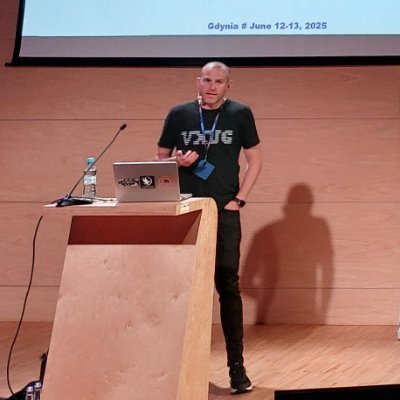
@MDSecLabs will be running our Red Team Capability Training out in #BlackHatUSA26 again this year. This year the course features a big refresh, with a bunch of new additions on the latest evolving techniques!
Early bird discounts end this month! @BlackHatEvents
https://t.co/l3uAga4TS5
With the AI companies hiring all these amazing VR folks and giving them capabilities that 10xs their talent, it’s really no surprise we’re starting to see a vulnpocalypse.
I’d personally like to see them hire more of the world’s best cancer or Alzheimer’s researchers.
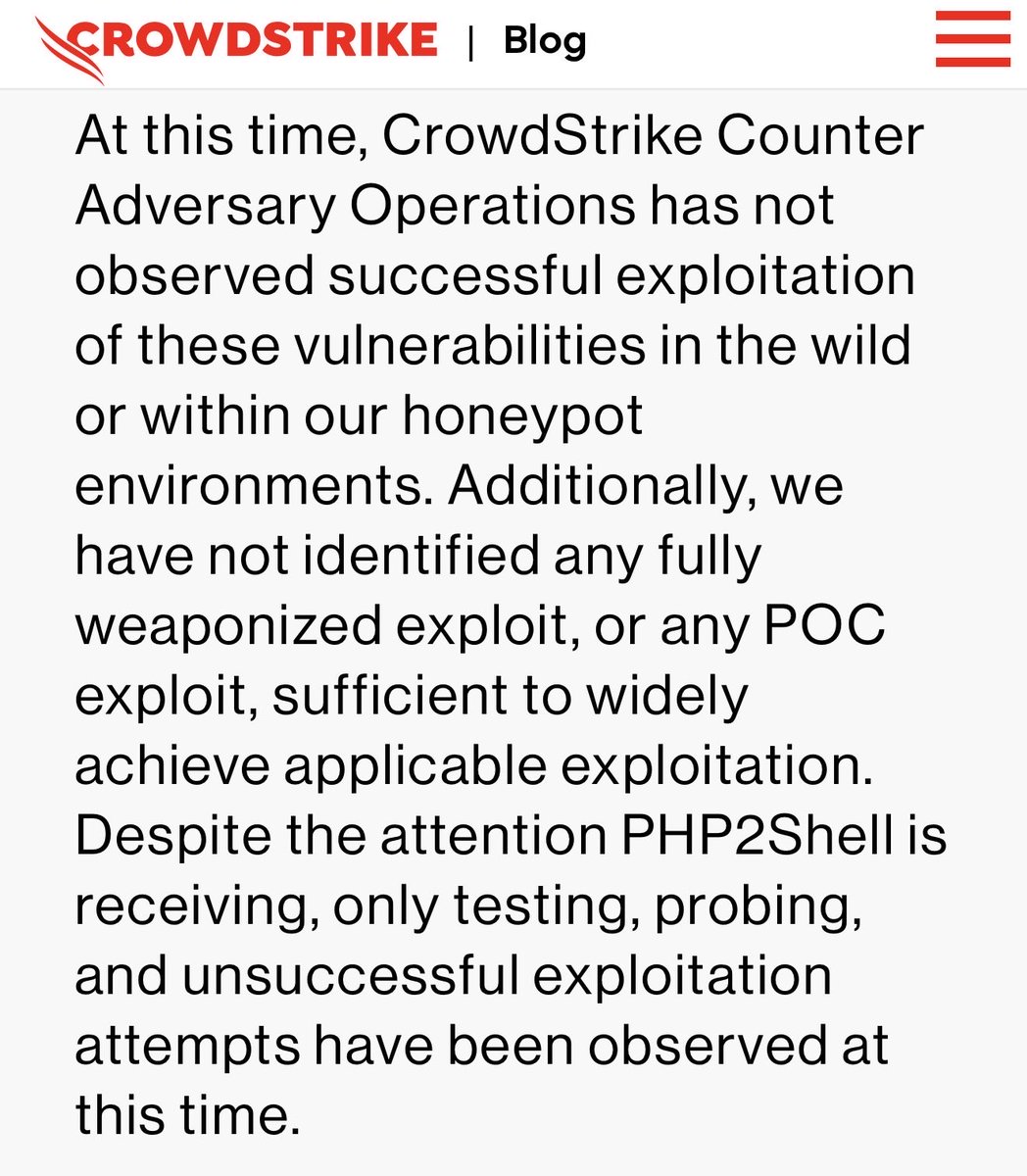
My hot take on this PHP mess is that its incredibly overhyped and we'll see very little ITW exploitation. Overall it seems less impactful than its named bug predecessors; heartbleed, shellshock, log4shell etc
@dcolascione Indeed - though we have seen vulns capable of true mass and wormable exploitation before; ssh crc32, sadmind, slammer, wannacry etc. People forget easily, and we're all still here.
"The previous update (October 22 16:18 UTC) reported that Sophos observed successful exploitation of PHP2Shell in customer environments. Upon further analysis, we are correcting that assessment as Sophos customer telemetry shows scanning and a small number of failed exploitation attempts. As of this update, there is no evidence of a successful compromise due to these vulnerabilities." https://t.co/BC5caSSSiR
Two critical PHP RCEs are patched: CVE-2026-109618 and CVE-2026-109619, both CVSS 9.2.
• Fixed in 8.5.12, 8.4.27, 8.3.36, and 8.2.35.
You can still focus on detection coverage today.
Security Labs writeup (coverage + guidance): https://t.co/aBB6g7gCZ5
Most PHP RCEs converge on the same outcome, whatever the bug: a web server process (php-fpm, php-cgi, apache2, httpd) doing something a request-serving daemon almost never does legitimately.
• a shell to confirm access: id, whoami, uname -a
• a second stage pulled in: curl http://... | bash
• a reverse shell: bash -i >& /dev/tcp//
• a webshell written into the web root
The bug class is public now: out-of-memory corruption, and stale state reused by the same worker. The behavior is what you detect.
We recently ran a different PHP RCE end-to-end (wp2shell): apache2 spawning dash to run id; whoami; hostname fired the exact rules that we suspect to catch php2shell. Payload Execution by Web Server kills the shell on the endpoint.
The Suspicious/Unusual Command, Child, and File Creation via Web Server rules stack on top.
(PHP did confirm partial php.ini mitigations. session.upload_progress.enabled=0 blocks the confirmed session paths only. Patch is still the fix.)
Patch to 8.5.12, 8.4.27, 8.3.36, or 8.2.35. Verify that the stack is enabled now.
Guidance + every rule link below.
While everyone’s patching PHP today, don't sleep on Node.js CVE-2026-111497 OOB write in the bundled Brotli decoder. Reachable via fetch(): a malicious server just replies
Content-Encoding: br.
Fixed in 26.12.1 / 24.22.1 / 22.23.4.
Update.
At the @NCSC we are asking all UK organisations and their supply chains across product and services to understand their use of PHP and prepare to patch...
https://t.co/UPT31kqBL6
Your EDR Has Boundary Issues.
@harmj0y and @tifkin_ of @SpecterOps explore how adversarial machine learning can evade EDR detection- and how LLMs are accelerating the reverse engineering behind it.
Watch their Offensive AI Con talk below. 👇
https://t.co/cwnirhS595
#OAIC #OffensiveAI #Cybersecurity #EDR
Google's GTIG and Mandiant reported UNC7017 conducted ephemeral, five-to-ten minute software update tampering against AOMEI, delivering CROSSROAD and SHINYROAD via evolving infrastructure to stage backdoors and C2 operations. https://t.co/zDza9TlNzV